HOMESENSE887 · Published 6 November 2026 · About 4 Minutes For The Main Article · About 9 Minutes For The Expanded Notes
Published Editorial Edition Manuscript revised 28 October 2026 · Publication preparation completed 6 November 2026 · Visuals and expanded research notes updated 6 November 2026. Research qualifications and practical proposals are retained.
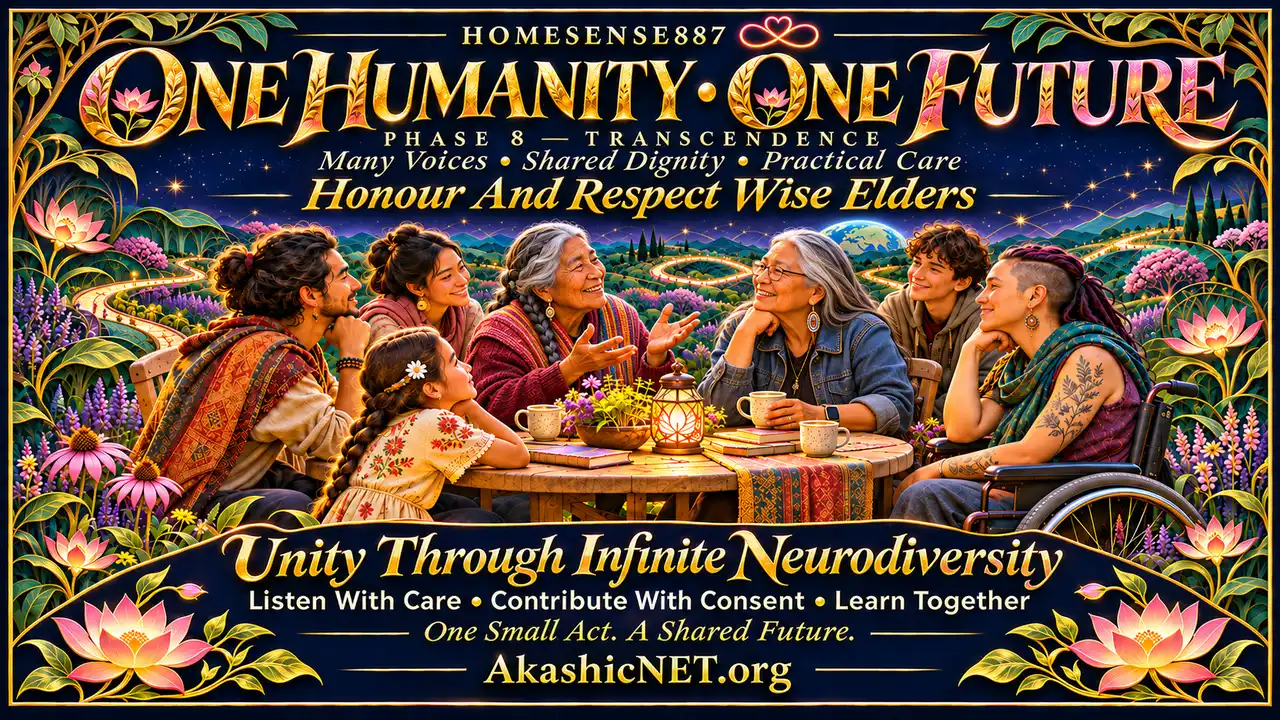
Many lives. Many ways of knowing. A shared responsibility for what comes next. AI-generated conceptual artwork illustrating shared dignity and practical care. The people are imagined, and the image does not portray the speakers linked below. The lettering invites us to listen with care, contribute with consent and learn together.
Many Voices · Shared Dignity · Practical CareA shared commitment for the bridge from 878 to 888.
Reading order: 878 → 887 → 888 → 899. HOMESENSE887 is published. HOMESENSE888 remains an editorial preview until its own release. The full title and date of 899 remain open. Numbers are editorial markers.
What would change if every person’s dignity had a place in our decisions?
HOMESENSE878 explored balance and harmonic civilisation: the arrangements through which different people might live well together. Before 888 draws the wider strands together, 887 pauses at the commitment beneath them. How do we widen our care without asking people to become the same?
One Humanity, Many Voices
We can cherish a language, a faith, a family or a place while extending concern beyond familiar circles. Research on identification with all humanity finds associations with humanitarian concern. It does not show that a unity slogan creates lasting generosity. [1]
Here, shared humanity means equal dignity across unequal circumstances. It asks who can participate, whose labour supports the welcome and whether people can challenge a decision without losing their place.
Unity through infinite neurodiversity. Let that aspiration shape accessible spaces, patient listening and several ways to contribute. Ask people what helps them participate. No one needs to represent an entire identity or agree with a spiritual worldview to belong.
Honour And Respect Wise Elders
Make space to listen across generations, especially to Indigenous women whose knowledge communities choose to share. Respect begins with their voice, authority and priorities. Ask permission, credit the people and place, and offer something useful in return. Let gratitude become a relationship sustained through care.
Compassion begins with another person’s needs, including their freedom to decline help. In a laboratory study, compassion training increased redistribution to a victim. Reviews qualify broader claims about meditation and prosocial behaviour. A helpful act in one task leaves its durability and wider consequences open. [2][3]
Our invitation is practical: ask what would help, make a manageable offer and return to hear how it was received. Good intentions can coexist with unwanted effects. Repair includes changing our approach.
Traditions and communities retain their own meanings and authority. A shared conversation does not make their teachings interchangeable or their knowledge freely available. Seek permission, attribute contributions and respect a decision to withhold them.
One Future, With Many Possible Paths
“One Future” expresses our interdependence and a responsibility to consider consequences. The future remains open. People have different capacities, histories and opportunities to shape it.
Before beginning a shared project, ask: who benefits, who carries the cost and who has a say? Make room for future generations and the living systems on which human life depends. Wider care needs fair resources and accountable decisions alongside personal goodwill. The institutional questions remain in 878.
One Small Commitment
Choose one act of care this week with the people it affects.
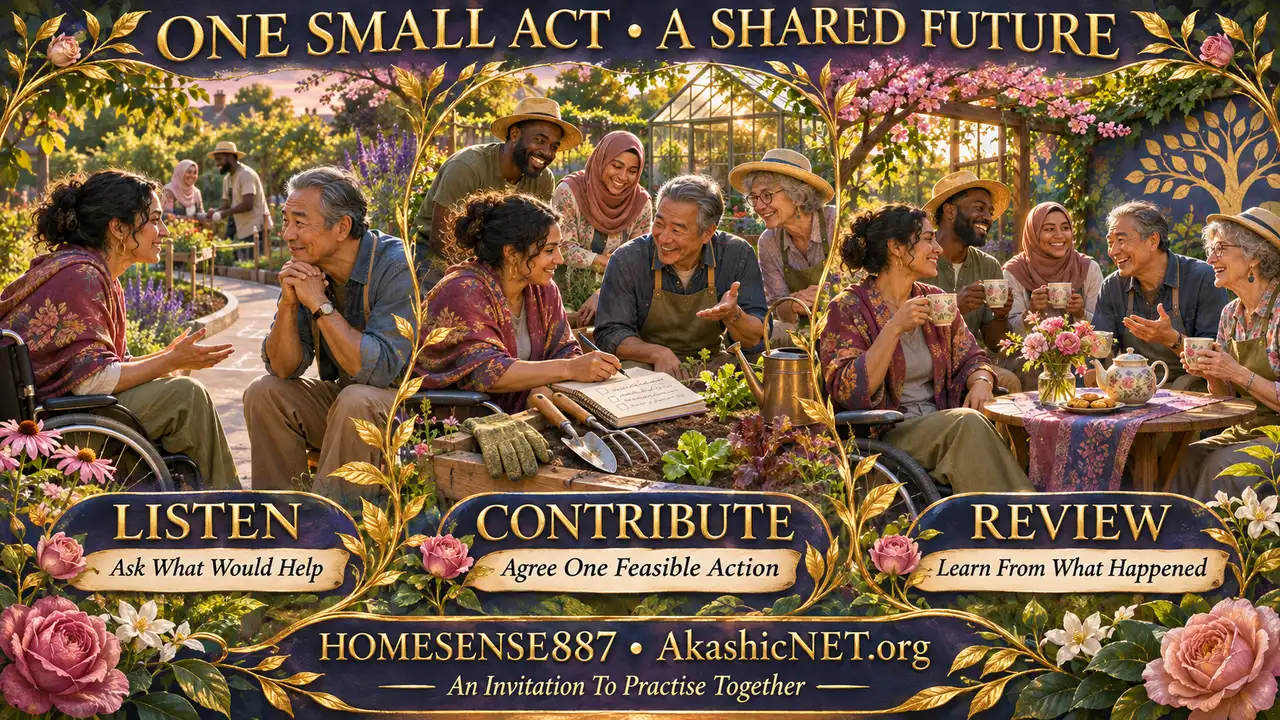
Listen: ask what is wanted and what would make participation easier.
Contribute: agree one feasible action, a responsible person and clear boundaries.
Review: arrange a check-in. Did it help? Who did extra work? What should change?
This is an editorial proposal for learning together, not a validated HOMESENSE intervention. Participation is voluntary. Keep the action small enough to complete without exhausting those doing it.
One small act, a shared future. Listen to what is wanted, agree a feasible action and review what happened. AI-generated editorial illustration of an invitation to practise together.
An Everyday Example Ask a neighbour whether help with shopping would be welcome. Agree what they want, what you can manage and when to check in. Afterwards, ask whether it helped and what they would prefer next time.
The Bridge To Integration
A powerful experience of connection may inspire care while its explanation remains uncertain. We can distinguish what someone experienced, how they interpret it and what research establishes, then work together on a practical responsibility.
HOMESENSE888 — The Great Integration asks how that responsibility can connect inner awareness, relationships, communities and the living world. The forthcoming 899 closing edition will provide the next place to reflect; its title and date remain open.
One humanity. Many voices. A future to care for together.
What is one act of care your community could begin — and whose voice should shape it?
Sources & Evidence Notes
Three research publications support the narrow claims above. The ethical resources are labelled separately. None validates the combined HOMESENSE proposal.
[1] McFarland, Webb And Brown (2012). All humanity is my ingroup: A measure and studies of identification with all humanity.
Measurement-development and association studies. Identification with humanity predicted humanitarian concern and related outcomes. This does not establish a causal effect of the title’s slogan.
Review Depth: Primary indexed abstract rechecked 28 October; full methodological appraisal not performed.
Compassion training versus reappraisal training, with altruistic redistribution measured in a specific task. Neural associations and task behaviour do not establish lasting everyday altruism or a consciousness field.
Review Depth: PubMed abstract and indexed figure/results description rechecked 28 October; no participant-data reanalysis.
Findings varied by outcome and methodology. The compassion subgroup was not statistically significant against active controls; uncertainty was wide and non-significance does not prove no effect. This review concerns its included trials.
Review Depth: Primary indexed abstract and publisher-indexed subgroup passages rechecked 28 October; earlier full-text assessment retained in the research companion.
From Shared Values To Measurable Outcomes · Expanded Research Notes
Five additional publications from the existing 887 research curation help examine communication, action, ecological behaviour and fairness. These notes distinguish published findings from practical suggestions. They extend the three source cards above. Numerical results are reported from the papers and have not been independently reanalysed.
[4] Communication Across Neurotypes
Crompton and colleagues’ 2025 Registered Report included 311 participants. It found no difference in information transfer between single-neurotype and mixed-neurotype chains, contrasting with the earlier mixed-chain disadvantage. Rapport and information accuracy were separate outcomes. A null difference in this task does not establish equivalence in every setting or represent everyone’s support needs.
Practical implication Ask which format helps each person contribute. Keep communication accuracy, comfort and participation as separate questions.
Primary abstract and accessible publication text checked 6 November 2026. No new analysis of participant data.
Wang, Wang and Gai’s 2021 meta-analysis combined 21 studies with 24 independent effect sizes and 15,907 participants. Mental contrasting with implementation intentions produced a pooled standardised effect of g = 0.336, with a 95% confidence interval of 0.229–0.443. A trim-and-fill sensitivity analysis reduced the estimate to 0.242. Publication bias and variation between studies qualify the average.
The authors excluded two large studies from moderator analyses because their participants dominated several categories and the study characteristics overlapped. Subgroup comparisons therefore use a different evidence set from the overall estimate. The sensitivity adjustment is model-dependent.
Practical implication Name a realistic obstacle and agree an if–then plan. For example, if someone needs more time to respond, offer a written contribution afterwards. Goal completion and benefit to others need separate checks.
Primary full-text abstract, results and bias/moderator sections checked 6 November 2026.
Whitburn, Linklater and Abrahamse’s meta-analysis, published online in 2019 and in the 2020 volume, combined 37 samples with 13,237 participants. The pooled association was r = 0.42, with a 95% confidence interval of 0.36–0.47. Samples varied substantially, and measurement scales explained much of that variation. Causal direction remains unresolved.
Practical implication Pair a feeling of connection with a specific stewardship outcome chosen locally, such as reduced waste. Record the outcome separately from people’s reported connection to nature.
Primary abstract and indexed methods summary checked 6 November 2026. No fresh extraction of sample-level data.
In Mousa’s 2020 randomised field experiment in post-ISIS Iraq, Christian players assigned Muslim teammates showed improved behaviour towards Muslim peers in football-related activities, including follow-up six months later. Effects did not consistently extend to wider attitudes or other social settings.
Practical implication A shared activity can be a starting point. Check whether any improvement continues outside the activity and whether people who did not participate benefit.
Original paper’s abstract and intervention/generalisation passages checked 6 November 2026. Supplementary analyses and replication data were not reanalysed.
Saguy and colleagues’ 2009 paper combined an experiment with an observational study. Commonality-focused contact increased disadvantaged participants’ expectations of fair treatment beyond what advantaged participants delivered in the experiment. The observational study linked positive contact with perceived fairness and lower support for social change. These designs support different causal conclusions.
Practical implication Ask who gets a say and who carries the work, alongside whether the interaction felt friendly. Preserve a clear way to disagree and seek change.
Publisher abstract checked 6 November 2026. Full text was restricted.
The following is an editorial proposal. Participants can choose which questions are helpful and record only information they wish to share.
Question
Possible Record
What To Check
Could people participate?
Invited and participating totals, plus access changes requested
Who was missing and why, where people choose to explain
Did the action help?
The recipient’s chosen outcome and feedback
Completion, satisfaction and benefit can differ
Who carried the work?
Time contributed and burdens participants identify
Whether effort was shared fairly
Did any benefit persist?
An agreed follow-up and any changes reported
Immediate impressions and later outcomes separately
A before-and-after comparison can help a group learn, while selection, other events and missing responses limit causal conclusions. Report the response denominator and unavailable follow-up. Avoid collecting diagnostic labels or identifying details unless participants have a clear purpose and freely choose to provide them. These suggestions have not been validated together as a HOMESENSE intervention.
Targeted curation from the existing 13-publication companion, with selected primary-source checks on 6 November 2026. This is a narrower review than an audit of the full AkashicNET Atlas. No raw datasets were downloaded or reanalysed.
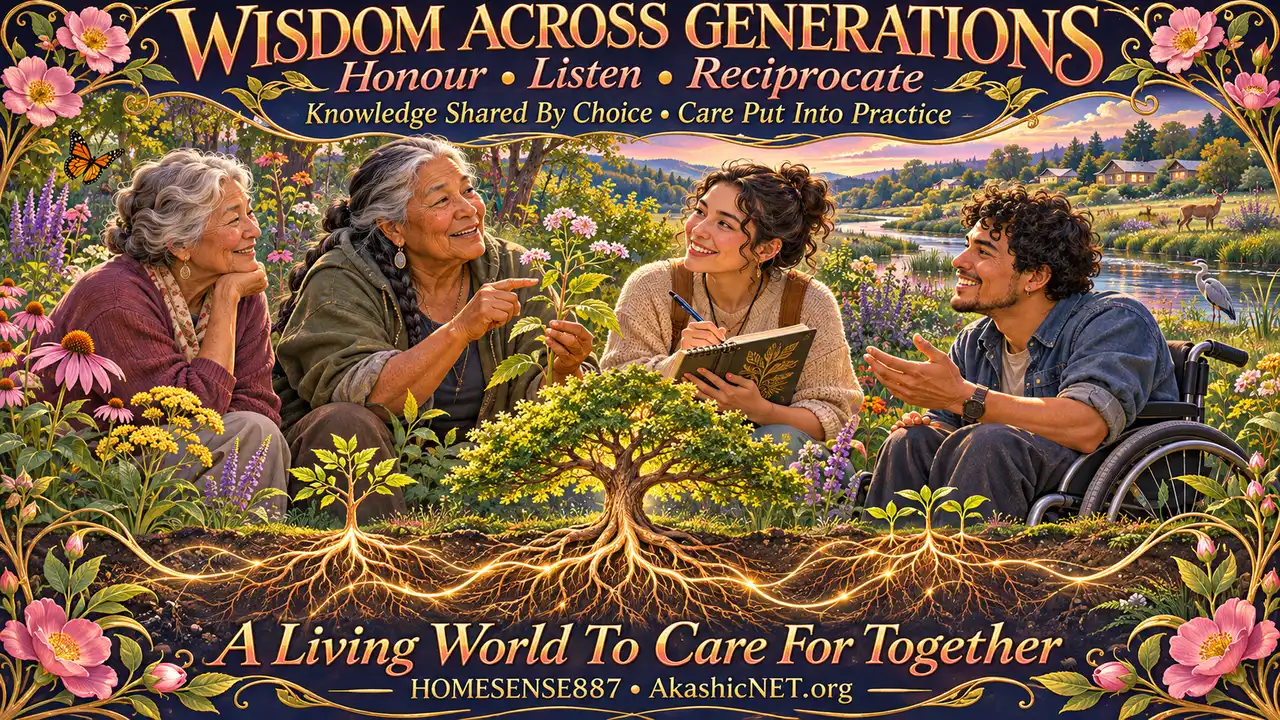
Learning Across Generations · Community Voices & Living PracticeHonour, listen and reciprocate. AI-generated conceptual artwork with imagined people. The glowing roots are an artistic metaphor for relationship. This image does not portray Apela Colorado, Susana Bustos or Elizângela Baré.
These community posts and original resources connect 887 with living voices, teaching traditions and practical opportunities. Their source roles are identified individually. The cultural and institutional resources below provide context for the invitation.
Community-Led Knowledge Sharing
UNESCO’s LINKS programme supports knowledge transmission between generations and research led by knowledge-holding communities. Its account describes younger people documenting knowledge under elders’ guidance. A useful question for our own projects is who decides what can be recorded, how it is described and whether it should circulate at all.
Institutional programme account, selected passages checked 6 November 2026. Atlas route S077. This is an account of an approach, without a causal evaluation of our proposed practice.
The 2022 report A/HRC/51/28 by the UN Special Rapporteur examines Indigenous women’s roles in developing, preserving and transmitting scientific and technical knowledge. It also examines threats to that knowledge and community-led responses. This supports giving women’s voices, authority and priorities a substantive place in the conversation.
Thematic report, selected reproduced text checked 6 November 2026. The linked page identifies itself as a reproduction and provides the original PDF. This is an additional source lead beyond the named Atlas routes.
Our r/TribalGathering discussion introduces Anishinaabe teachings on love, respect, courage, honesty, wisdom, humility and truth. Its wording is an editorial interpretation. Seven Generations Education Institute offers a community-rooted teaching resource for further learning. These teachings retain their Anishinaabe context and living custodians.
Community discussion and educator resource checked 6 November 2026. Cultural teaching and interpretation are identified separately.
The r/TribalGathering archive points to a CIIS conversation about Indigenous spirituality and wisdom. The original CIIS page provides the programme context and transcript. Readers can engage with the speaker’s own account and the setting in which it was shared.
Archive title and source link recovered. Original programme description and selected transcript text checked 6 November 2026. The complete recording was not watched in this pass.
An archived post titled Elizângela Baré: The Strength Of Indigenous Women In Healing The Earth points towards an ISA account. Its original post body and linked article were not recovered in this pass, so it remains a discovery lead. A separate, readable community post discusses Indigenous stewardship and links to a 2024 Nature commentary about the limits of a widely repeated biodiversity statistic.
Baré entry is archive-title metadata. The stewardship discussion was read. Its underlying commentary has not received a fresh full appraisal here.
Invite a willing elder and younger participant to choose a topic together, such as gardening, local history or a shared place.
Let the knowledge holder decide what may be shared. Agree whether notes or recordings are wanted.
Ask what practical help would be welcome. It might be time, transport, an accessible meeting place or technical help, depending on what is requested.
Choose one small act of care together and check afterwards whether both people found the exchange worthwhile.
This is an editorial invitation. Community-led guidance takes priority when engaging with Indigenous knowledge.
Observe The Living World Together
iNaturalist supports sharing observations of living organisms and seeking community help with identification. A local nature walk can combine careful observation with conversation and a chosen stewardship action. Record observations separately from claims about ecological improvement. Uneven observation effort and identification uncertainty limit what the records can establish.
Official platform description checked 6 November 2026. Atlas route S087. This is a participation resource, without an evaluation of the proposed nature walk.
Hauser and colleagues’ 2014 intergenerational resource game found that shared resources were maintained more effectively when democratic decisions bound all participants. The experiment used successive groups making decisions with monetary consequences. Applying its results to communities separated by decades requires further evidence.
Practical connection Ask how today’s decisions affect those who inherit their consequences. Give agreed responsibilities a clear way to be reviewed.
Primary indexed abstract checked 6 November 2026, alongside the existing 887 curation. No raw-data analysis.
The new resources extend selected Atlas routes and the existing curation. They do not represent a review of all 155 source families. Links preserve attribution, and none implies an endorsement of AkashicNET by the people or institutions named.
Ethical Resources & Fuller Research
The Universal Declaration of Human Rights is a normative reference for dignity and non-discrimination. The CARE Principles are community-led guidance on Indigenous data governance. Neither is experimental evidence of metaphysical unity. Apply relevant community authority and permission in context.
The internal editorial research companion for 887 retains the broader 13-publication curation and its review-depth limits. The main article selects three research publications, and the expandable notes add six from that curation alongside separately labelled cultural, community and participation resources. Omission is not rejection of the other leads. The sources relied on by this public edition are listed above.
Reading order: 878 → 887 → 888 → 899. HOMESENSE887 is published. HOMESENSE888 remains an editorial preview until its own release. The full title and date of 899 remain open. Numbers are editorial markers.