
HOMESENSE♾️💗 · Phase 8 · Transcendence
Balance &
Harmonic Civilisation
Thinking Together, Living Well & Sharing A Finite Planet
[Working Draft — Feedback Welcome]
Public working edition combining the research curation, additional findings, practical resources and editorial insights developed for 878.
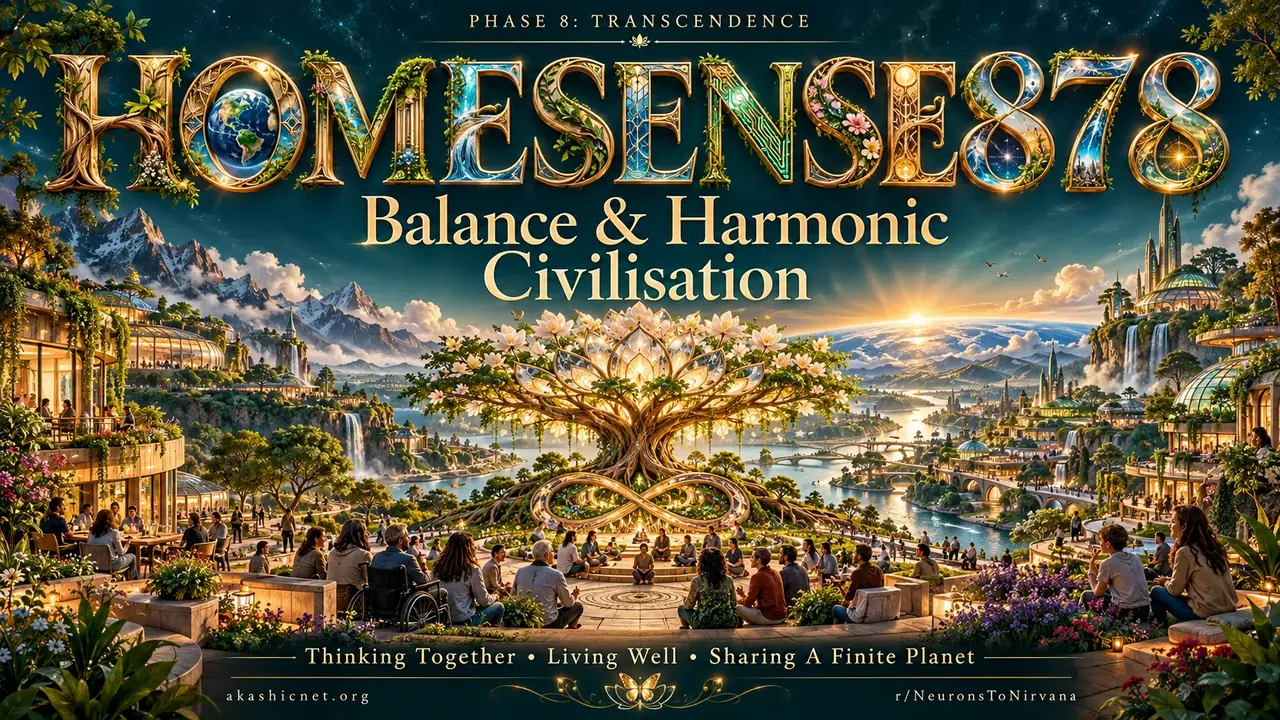
How might people with different experiences, needs and beliefs build a civilisation in which they can live well together?
That question connects everyday life to the systems around it: how we work and rest, how communities share resources, how institutions handle disagreement and how technology affects the decisions we make. HOMESENSE868 approached our shared future through planetary health. HOMESENSE878 turns towards the social arrangements that might help us act on that understanding, preparing the way towards The Great Integration.
Here, harmonic civilisation is a guiding aspiration. It means a society capable of sustaining difference, responding to evidence and repairing harm while respecting the living systems on which everyone depends. The research below investigates particular parts of that aspiration. It does not establish one universal harmony factor or a finished model of civilisation.
1. Balance Is Something To Investigate
Balance can describe the relationship between commitments: earning a living, caring for others, protecting health, finding meaning and contributing to a community. It need not mean allocating identical amounts of time to everything. Different lives call for different arrangements.
A particularly relevant 2026 study followed life-balance responses in the Global Flourishing Study. Its more conservative analysis found small associations between earlier balance and later flourishing, with considerable variation between countries. This provides a reason to investigate balance carefully, while the observational design leaves causal questions open. [11]
For HOMESENSE, the useful move is to make the idea concrete. Which responsibilities are crowding out sleep, relationships or creativity? Which demands are chosen, and which reflect insecure work, caring duties or unavailable support? A realistic account of balance considers both personal agency and the conditions in which people exercise it.
2. A Flourishing Society Needs More Than One Measure
The Global Flourishing Study broadens the discussion beyond a single economic or happiness score. Its framework includes health, meaning, relationships, character, life satisfaction and material stability. Its original profile provides the background for several studies used in this edition. [18]
A 2026 comparison of subjective and objective indicators found that they were only modestly related. At the country-mean level, the correlation between its two summary indices was 0.15. A single ranking can therefore hide important differences between how people experience their lives and the conditions in which they live. [12]
Our editorial implication is to use a small, transparent dashboard. Ask about belonging and meaning alongside access to resources, health, environmental conditions and the distribution of opportunity. Preserve disagreements about what matters. Neither a high average nor a favourable personal impression tells us how everybody is doing.
The flourishing papers share a research programme and overlapping participants. They should be read as related analyses, rather than independent replications. The 2026 cohort update also documents substantial attrition and methodological variation between settings. [19]
3. People Need Time To Participate
Participation requires time and energy. Invitations to deliberate mean little to someone who cannot afford the journey, cannot leave a caring role or is exhausted after work. Accessibility belongs in the design of collective life from the beginning.
A 2025 reduced-working-time study followed 2,896 employees across 141 organisations. Trials with unchanged pay were associated with improved wellbeing, with a different pattern in the control companies. Its design and participating workplaces limit the conclusions we can draw about other occupations. [9]
This suggests a practical line of enquiry: consider working conditions, recovery and care alongside productivity. In a community project, that might mean shorter meetings, several ways to contribute, advance information, accessible venues and recognition of unpaid work. These are editorial proposals to assess locally, rather than outcomes established by the working-time study.
4. Thinking Together Requires Room For Difference
Groups can bring together knowledge that no individual possesses. Whether they use it well depends on their task, membership and ways of working. The science of collective intelligence remains contested: a substantial 2021 synthesis supported a general factor, while a small 2024 study favoured a multidimensional account and did not reproduce several reported predictors. [8, 17]
The appropriate lesson is curiosity about performance. Invite independent views before discussion, make uncertainty visible and check whether a decision improves when different perspectives are heard. A popular explanation of group intelligence should remain open to revision.
A Finnish climate-deliberation experiment, published in 2026, compared three packages of discussion norms. Most predicted differences were unsupported, and polarisation did not decline as expected. The authors identify participant self-selection and limited opinion diversity as important issues. [3]
For 878, this makes recruitment as important a question as facilitation. A comfortable conversation among similar participants can miss the people who bear a decision’s costs. Record who is absent, what objections remain and how someone can challenge the result.
5. Repair Requires Accountability And Follow-Up
Disagreement becomes more manageable when people can identify a harm, explain its effects and seek a fair response. Repair also requires attention to power: who sets the terms, whose account is believed and whether participation is safe and voluntary.
School research provides a bounded example. A trial in 33 US schools found that a combined restorative-practices and school-reform programme reduced major exclusions overall. The results were uneven for students with disabilities, and the study cannot isolate the restorative component from the wider programme. [15]
This supports examining both overall outcomes and subgroup experiences. It does not justify transplanting a school programme directly into every community. For an online group or neighbourhood initiative, any repair process needs clear expectations, routes to appeal and a way to assess unintended effects.
The same care applies to political reconciliation. A large 2024 megastudy showed that hostility, undemocratic attitudes and support for violence respond differently to interventions. A friendlier exchange does not tell us everything about commitment to fair procedures. [5]
Durability also remains unsettled. One 2025 synthesis found rapid decay in many depolarisation effects; another study reported improvements lasting up to four weeks after the last treatment. Its authors defended that finding in a 2026 exchange. The studies should remain together in our evidence map. [4, 6, 7]
6. Everyday Reciprocity Has A Place
A civilisation is experienced through ordinary encounters as well as formal institutions: sharing a skill, checking on a neighbour, offering practical help or making room for someone to contribute. These actions provide a human connection to the gift-economy questions explored in HOMESENSE858.
The KIND Challenge tested weekly acts of kindness over four weeks in three countries. It found small reductions in loneliness in the USA and UK, with different outcomes in Australia. Substantial dropout and the pandemic setting limit what this tells us about sustained community change. [16]
The invitation is modest: try reciprocal practices that people welcome, then ask what they changed. Keep help responsive to the recipient’s preferences. Material provision, fair institutions and reliable services remain important parts of the larger picture.
7. Sharing A Finite Planet Means Sharing Authority
The Earth Commission’s safe-and-just framework connects ecological limits with minimum access to essential resources. It makes a useful bridge between planetary health and the institutions that distribute benefits and burdens. Its thresholds and pathways include normative choices alongside empirical analysis. [10]
A 2026 public-goods paper adds a caution: under its allocation models, policies that facilitate cooperation can also generate inequality. Its findings concern specified mechanisms and networks. They encourage a distributional assessment rather than a universal conclusion about fairness. The associated figure correction is included in the references. [1, 2]
Indigenous governance brings another essential dimension: authority over land, knowledge and decisions. A 2026 review of 111 studies found broadly positive conservation relationships on Indigenous lands, but also geographical concentration, reliance on spatial metrics and low Indigenous authorship in the reviewed literature. [13]
Our implication is to ask who defines success and controls the work. Respecting a community’s knowledge includes respecting its right to determine how knowledge is used. Community authority has significance beyond any particular conservation metric.
8. Technology Needs A Defined Role
AI can help organise information and reveal possible common ground. The Habermas Machine studies found that participants preferred AI-generated group statements in the tested settings. A separate meta-analysis found that human–AI combinations did not, on average, outperform the better standalone system. Both findings matter when assigning a role to AI. [20, 21]
Consider a bounded task: draft a summary, retain the original submissions, expose disagreements and ask participants whether they recognise their views. Compare the result with a human-produced version. Agreement with a summary is one outcome; accuracy, minority representation and the consequences of the decision require their own checks.
A 2026 Warddeken paper offers a concrete case of Indigenous-led participatory action research around AI-assisted wildlife monitoring. It examines technology within the community’s governance, cultural relationships and monitoring goals. It is a contextual case and framework, rather than a general performance trial. [14]
The CARE Principles and GIDA’s 2026 AI communiqué provide relevant resources on collective benefit, authority, responsibility and ethics. Polis offers another practical example: it can map patterns of agreement and disagreement among participants. Whether a particular exercise represents a wider population depends on recruitment and access, rather than the software alone. [22–24]
9. A Small Practice Of Harmonic Civilisation
The following is an editorial proposal for local learning, not a validated intervention. Choose one bounded shared decision: a community resource, an event, a meeting format or a project priority. Establish what participants can actually influence before asking for their time.
- Invite a range of perspectives. Identify affected people, participation costs, accessibility needs and missing voices.
- Collect views independently. Ask what matters, what evidence is relevant and what risks people see.
- Discuss and document. Record the decision, its reasons, unresolved objections and who will carry out the work.
- Check the distribution. Ask who gains, who contributes, who carries risk and how someone can appeal.
- Return to the result. At two and six weeks, ask whether the action happened and whether its effects match the intention.
The OECD resources below offer more developed guidance on process design and evaluation. They can help distinguish a good experience in the room from a decision that has a meaningful route to action. [25, 26]
| Dimension | Questions To Revisit |
|---|---|
| Representation | Who participated, who was absent and what barriers remained? |
| Understanding | Were evidence, uncertainty and disagreements recorded accurately? |
| Fairness | How were benefits, burdens and opportunities to challenge distributed? |
| Wellbeing | What happened to workload, belonging and the people most affected? |
| Ecology | What resources did the action use and what environmental effects followed? |
| Durability | Did the action persist, and what should be changed? |
Within HOMESENSE, transcendence can include learning to act with a wider field of concern: for ourselves, people whose lives differ from ours and the living world. That is a philosophical framing. The scientific contribution is to help us ask clearer questions, recognise trade-offs and discover whether our actions improve what we hoped to improve.