
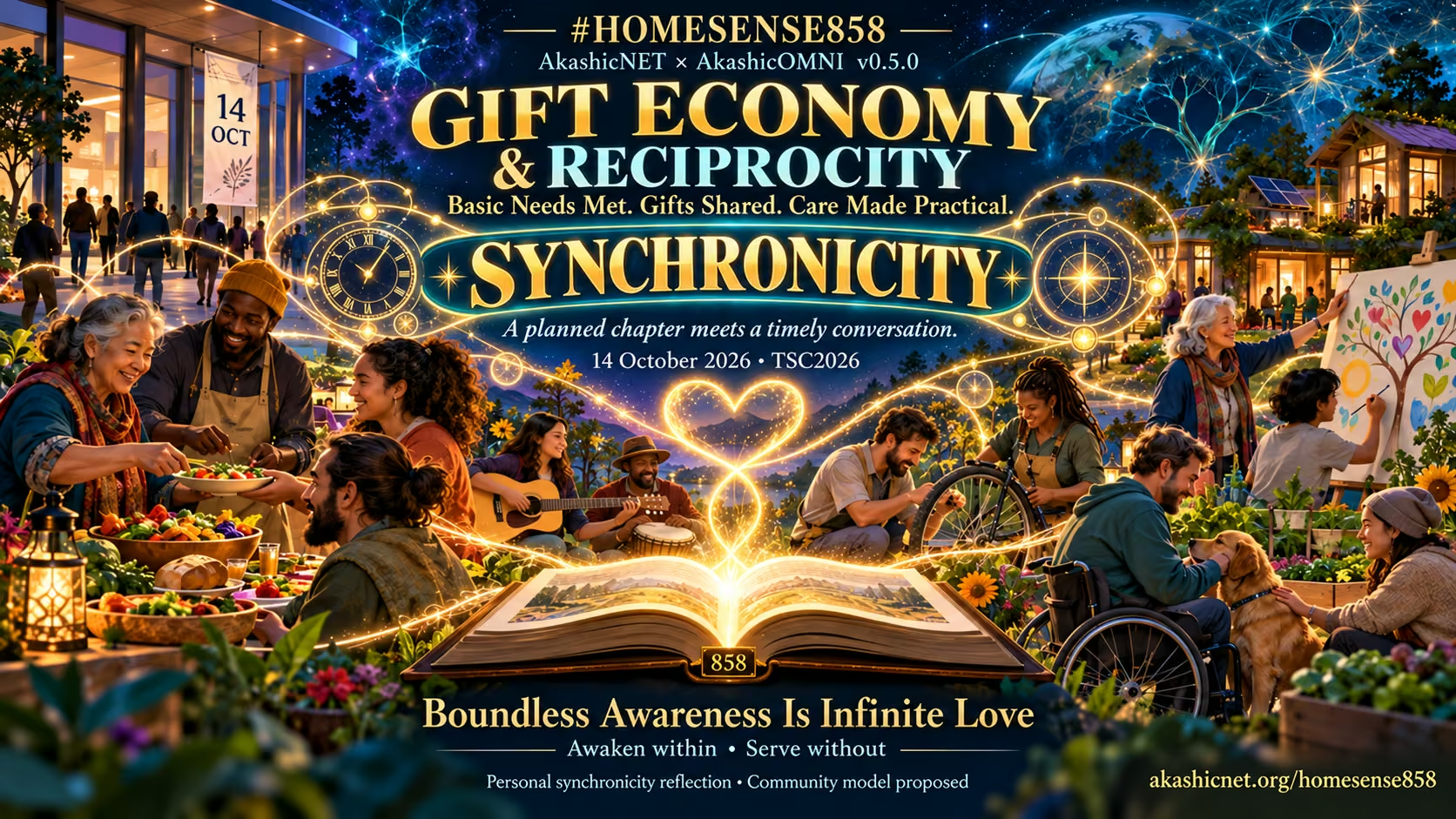
🏡🎁 #HOMESENSE858♾️💗 · Phase 8: Transcendence · 14 October 2026
📝 WORKING DRAFT · Open for feedback · 14 October 2026
Gift Economy & Reciprocity
Basic Needs Met. Gifts Shared. Care Made Practical.
From Inner Transformation to Collective Flourishing · Inspired by a TSC2026 community question.
By AkashicNET · Human-directed, AI-assisted research, writing and visuals.
AkashicNET × AkashicOMNI v0.5.0 · 12 perspectives + synthesis · Approximately 15 minutes, with optional review detail.
✨ Personal synchronicity · The curator’s reflection
A planned chapter meets a timely conversation
Gift Economy & Reciprocity already had its place in the HOMESENSE Phase 8 roadmap. The curator recalls intending to publish it today, before registering for TSC2026. A community question about consciousness, material security and collective well-being then gave the chapter a timely new starting point.
The older roadmap confirms the topic assignment but leaves its date open; the earlier intention to publish today is the curator’s recollection. “Synchronicity” names the personal meaning found in this convergence. It invites reflection without establishing a hidden cause or a message across time.
🧭 A possible future self, calling us into practice
Perhaps the authentic self we sense is a possible future self, guiding us toward the person we could become.
The curator offers this as a philosophical hypothesis. Literally receiving communication from a future being is unverified. As a reflective practice, we can ask what a wiser, more compassionate possible self would choose now—and test those choices through their effects on others.
For this chapter, the invitation becomes practical: what can we nurture today so that tomorrow’s community has more security, generosity and room to flourish? 🌱🤝
HOMESENSE858 · The central question
What could we give when survival is more secure?
A gift economy centres contributions offered without a required equivalent return. Reciprocity can extend across a community and over time, while an agreed skills swap makes an exchange explicit. Burning Man’s gifting principle supplies one cultural inspiration: the gift itself carries no obligation to repay. [S9]
The developing AkashicNET proposal brings two questions together: how could a dependable floor of essential needs be resourced, and what voluntary culture of sharing might flourish above it? Skills, talents, creativity, listening, repair and care all belong in that conversation. Neither generosity nor receiving support should become a test of someone’s spiritual worth.
Could meeting basic needs create more freedom to share our gifts, and could well-governed sharing help sustain collective well-being in return? This edition explores that question through research, the existing New Earth proposals and a manual AkashicOMNI v0.5.0 reading. The economic design remains a proposal to cost, co-design and test.
What might change when security and generosity meet?
Some parts of the connection have empirical support; the complete pathway remains a proposal. Specific compassion training has changed some altruistic behaviours in an experiment. Cash-transfer trials have improved psychological well-being and produced local economic spillovers. These findings make a reciprocal research programme worth examining, while leaving open whether profound experiences of connectedness produce lasting institutional change. [S1] [S2] [S3]
The practical question is how an inner shift becomes reliable care: a meal, a repaired home, shared knowledge, an accessible service or a fair decision. Institutions, resources and accountability are part of that question. Someone can feel deeply connected while lacking the time, health, money or opportunity to act.
Boundless Awareness Is Infinite Love.Awaken within • Serve without.
Guiding spiritual and ethical statements from the AkashicNET curator.
DISCERN · What the sources actually address
Research that connects parts of the question
Compassion can be practised
In the ReSource study, care-and-compassion training increased task-based altruistic behaviour. Attention and perspective training did not produce the same result. Self-reported prosociality increased across modules without tracking the task-based changes. Feeling more generous and behaving more generously need separate measurement. [S1]
Material support can improve well-being
Haushofer and Shapiro’s Kenyan trial reported improved psychological well-being and consumption after unconditional cash transfers. It found no overall cortisol effect. This supports a material-support-to-well-being link in that setting; it did not measure spiritual awakening. [S2]
Benefits can extend beyond recipients
Egger and colleagues reported positive spillovers to non-recipient households and firms, with little price inflation, after large cash transfers in rural Kenya. The estimated local multiplier was 2.5. That estimate belongs to the studied setting; it is not a forecast for a gift economy or evidence of consciousness causing growth. [S3]
Inner practice does not guarantee generosity
Poulin and colleagues found that brief mindfulness inductions could increase or decrease prosocial behaviour depending on independent or interdependent self-construal. These short experiments do not settle long-term contemplative effects, but challenge a universal “meditation makes us more cooperative” assumption. [S4]
People and programmes to explore: Tania Singer and Dennis Snower’s Caring Economics explicitly connects motivation, cooperation and economic models. Elinor Ostrom’s work offers a governance reading path. Kate Raworth’s Doughnut framework brings essential needs and ecological limits into the same design conversation. Chris Laszlo’s TSC abstract connects contemplative practices, service and regenerative leadership. Each contributes a different kind of material; none validates the whole model proposed here. [S5] [S6] [S7] [S8]
The curator’s developing concept · Design choices remain open
Basic Needs Met. Skills and Talents Shared.
The proposed foundation is a dependable floor of essentials, with a voluntary community layer for creativity, learning, care and exchange. The intended shift is from survival pressure towards more freedom to contribute. Whether it achieves that shift depends on its resources, rules and actual experience.
Foundation · Intended guarantee
Essential Needs
- Food & water
- Secure shelter
- Care & safety
- Energy & access
Define the provision, eligibility, costs and delivery responsibilities with participants. A guarantee needs reliable supply and funding. The design proposed here keeps essential access independent of contribution credits.
Participation · Voluntary and diverse
Skills, Talents and Shared Care
- Repair
- Art & music
- Teaching
- Gardening
- Listening & care
- Research & technology
People choose what they can offer, request, learn or receive. Capacity can fluctuate. Rest, disability, caring responsibilities and different communication styles belong in the design.
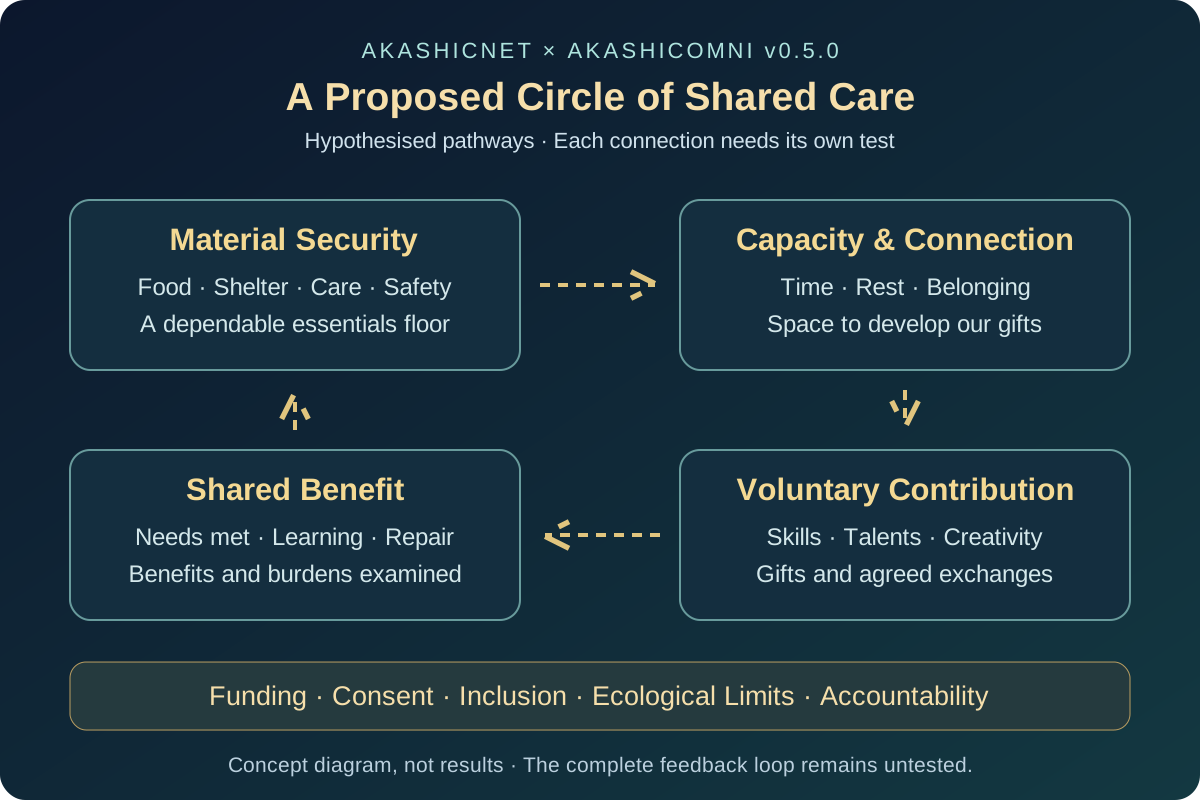
Gifts, swaps and credits are different choices
Burning Man’s official gifting principle describes giving without an expected equivalent return. Its communal-effort and decommodification principles offer cultural inspiration. A skills swap has agreed reciprocity; a time-credit system records exchange. The proposed model could make room for different modes, with clear consent about which one applies. [S9]
| Mode | How it works | Question to resolve |
|---|---|---|
| Unconditional gift | A contribution without a required return. | How will invisible work and repeated donor burdens be recognised? |
| Agreed skill swap | Participants agree an exchange and can decline. | What happens when needs, timing or available skills do not match? |
| Optional time credits | A proposed record lets someone give now and receive later. | How are materials, scarce expertise, care and unequal capacity handled? Credits cannot themselves pay external bills. |
The funding question remains real
Food production, rent, utilities, tools, specialist services and maintenance require resources. A cultural model of giving does not by itself supply them. Candidate funding sources include an explicitly funded pilot, public provision, cooperative revenue or voluntary contributions; none is committed here.
Reliable cash inflows must cover cash outflows and an agreed reserve.
Record useful in-kind provision separately, count it only where it replaces an actual requirement, and avoid double-counting volunteer hours as both cash income and a saving. Cost the essentials basket, supply constraints, coordination, maintenance and contingency before making promises. A pilot can test a limited service while a wider guarantee remains an ambition.
DEEPEN · Competing explanations and tensions
What could make the model work, or fail?
A plausible pathway is that reliable support frees capacity; meaningful participation creates relationships; well-governed sharing meets more needs; and greater trust makes future cooperation easier. This is our proposed synthesis of separate ideas. A positive loop is possible, but so are burnout, exclusion, concentrated decision power and shortages.
Consider four alternatives before attributing change to consciousness: direct relief from material constraints; ordinary social contact; selection of already motivated participants; and expectations about the project. Network effects also need direct observation: a happier participant does not establish that care spread through a community.
Measure who receives help, who waits, who does repetitive work, who can disagree and who leaves. An exchange can benefit its members while shifting costs onto unpaid carers or the environment. More monetary circulation is not automatically better well-being, fairer distribution or ecological regeneration.
Spiritual language can express purpose. Membership and access should also work for someone who finds meaning in secular ethics. Nobody needs an awakening experience, a shared cosmology or public testimony to belong.
Continue the existing work
New Earth, Near Home
This proposal belongs alongside AkashicNET’s existing work on shared essentials, regeneration, neurodiversity and compassionate communities. It develops an economic question within that direction.
Both existing pages present concepts and proposals. Their publication is not evidence of an operational community, secured funding or a completed experiment.
Related TSC inquiry: Chris Laszlo, connectedness, compassion and service →
Proposed next steps · No recruitment or funding announced
Three proposals that can be examined
01 · Co-design the essentials and exchange charter
Proposed first stage: a short series of accessible conversations with potential participants, including carers, people with limited income and people whose capacity fluctuates. Map unmet needs, available skills and work nobody volunteers for.
Concrete output: a needs basket, a monthly resource budget, a choice of gift/swap rules, named responsibilities, a fair complaints route and a continuity plan. Keep private needs and personal finances out of public profiles.
Proceed when: participants understand the commitments and a defined pilot has credible resources. Revise or pause if essentials depend on speculative income or a few people carrying unsustainable workloads.
02 · Test a small skills-and-care commons
Illustrative pilot: an eight-week neighbourhood or online group, with participant numbers chosen around coordination capacity. Start with low-risk offers such as tutoring, creative work, gardening or basic device help. Professional, safety-critical services retain their ordinary competence requirements.
Track: requests met and unmet, time and cash costs, distribution of workload, accessibility, belonging, disputes and unintended harms. An optional diary can record gifts and experiences; public contribution rankings are unnecessary.
Interpret carefully: an uncontrolled pilot tests feasibility and usefulness. It cannot establish that consciousness caused any improvement. Stop or redesign for coercion, repeated exclusion, privacy breaches or unsustainable burdens.
03 · Study security and practice separately, then together
Later research proposal: with research partners, resources and appropriate ethics review, compare additional material support, optional compassion/listening practice, both together, and a suitable comparison condition. Existing essential services remain available to every group.
Predefine: the primary outcome, sample size justification, follow-up, costs, adverse outcomes and analysis. Use behavioural and community outcomes alongside self-reports. A study designed around communities must account for spillovers between participants.
Key test: does the combined programme add benefit beyond either component alone? A positive interaction would support complementarity within that design. It would not establish a universal consciousness mechanism.
AkashicOMNI v0.5.0 · Review scope
Twelve perspectives, with one accountable synthesis
This AI-assisted editorial analysis uses the current public role descriptions and EXPAND²: DISCERN, DEEPEN and synthesis. All twelve perspectives receive a disposition below. This coverage does not claim that every original framework was fully executed or independently validated. Independent human methodological review is pending. [S10]
| Perspective | Disposition | Application and boundary |
|---|---|---|
| AWAKEN | APPLIED | Notice fear, care and agency without treating a moving experience as proof of durable change. Ask what actually changed. |
| HIERATIC | APPLIED | Hold mettā, compassion and service as ethical orientations. Preserve their cultural contexts and room for secular participation. |
| HOMESENSE | APPLIED | Food, housing, rest, health and belonging ground the model. Ask people which needs are unmet before designing support. |
| ADAPT | APPLIED | Begin with local conditions, actual resources and a reversible pilot. Record failures and revise the design. |
| REGENERATE | APPLIED | Include ecological repair, maintenance and care work. More exchanges alone do not demonstrate flourishing. |
| TRANSCEND | APPLIED | Explore whether identity and priorities broaden. Include ordinary, gradual change and experiences that do not help. |
| #METAD | APPLIED | Keep causal assumptions, source dependencies and competing explanations visible. Internal agreement adds no independent evidence. |
| ACTC | APPLIED | Use coherence as a conceptual check: an essentials guarantee conflicts with any rule requiring earned credits for essentials. This does not test ACTC’s axioms. |
| CUT · Past | APPLIED | Record inherited inequality, existing mutual aid and whose unpaid labour already sustains the community. This is a temporal review, not a physical-time claim. |
| CUT · Present | APPLIED | Inspect today’s budget, access barriers, workload and decision rights. Separate current provision from future promises. |
| CUT · Future | APPLIED | Compare continuity, funding-loss and unequal-participation scenarios. Set review and exit conditions before expanding. |
| UMASC | APPLIED | Distinguish first-person awareness, interpersonal behaviour and institutional outcomes. Links across these levels require evidence; planetary awareness is not measured here. |
Optional lenses: DARK, QM, MM, PP and QMM are not invoked. The economic question can be examined without introducing speculative physical mechanisms. Agreement across perspectives remains an editorial synthesis, not multiple independent confirmations.
Compact claim-review records
Record CF-2026-10-14, HOMESENSE858 working draft. Source access is disclosed below. These provisional assessments report the scope of retrieved evidence; they are not outputs of a certified automated validator.
CF-01 · Targeted care-and-compassion training can increase some task-based altruistic behaviour.
- Domain / assessment
- Empirical · Reported support within the cited study
- Basis
- S1
- Limit
- Other training modules and norm-based behaviour did not show the same pattern. Self-reports were not equivalent to behaviour.
- Alternative or missing test
- Expectancy, selection and training context need examination in the full methods and replications.
- Revision condition
- Independent, well-controlled replications and durable everyday outcomes could strengthen or weaken this interpretation.
CF-02 · Material support can improve psychological well-being and affect local economic activity.
- Domain / assessment
- Empirical; two distinct outcomes · Reported support in separate Kenyan trials
- Basis
- S2, S3
- Limit
- Neither trial tests awakening or this proposed skills economy. Settings and interventions bound generalisation.
- Alternative or missing test
- Direct purchasing power and relief from constraints can explain benefits without changes in spiritual beliefs.
- Revision condition
- Long-term outcomes, costs, distributional effects and results in other settings would change the feasibility assessment.
CF-03 · Basic-needs security plus a voluntary skills commons could support sustained shared flourishing.
- Domain / assessment
- Socioeconomic hypothesis · PROPOSED · untested here
- Basis
- User’s concept; S1–S7 provide partial context
- Limit
- Funding, supply, governance and complementary effects have not been demonstrated. No pilot has begun.
- Alternative or missing test
- Material support alone, social contact alone or existing services could perform as well or better.
- Revision condition
- A feasible budget and comparative outcomes, including harms and exclusions, are needed before scaling claims.
CF-04 · Cultivating loving awareness and practical wisdom is a worthy direction for this project.
- Domain / assessment
- Ethical and spiritual aspiration · Value commitment
- Basis
- User’s guiding statements; no empirical proof claimed
- Limit
- The phrase is not a scientific measure of planetary consciousness or a condition for belonging.
- Alternative or missing test
- Participants can share practical aims while holding different metaphysical or secular interpretations.
- Revision condition
- People affected should be able to revise the aims, language and practices; specific benefit claims require separate tests.
Synthesis: the defensible next step is a costed, inclusive, locally useful proposal with transparent evaluation. Care can guide the goal while evidence informs which arrangements help. A planetary transformation remains an aspiration; each practical claim stays answerable to its own outcomes.
4:20 Reflection 😜 · The curator’s closing thought
Thoughts are 🌱
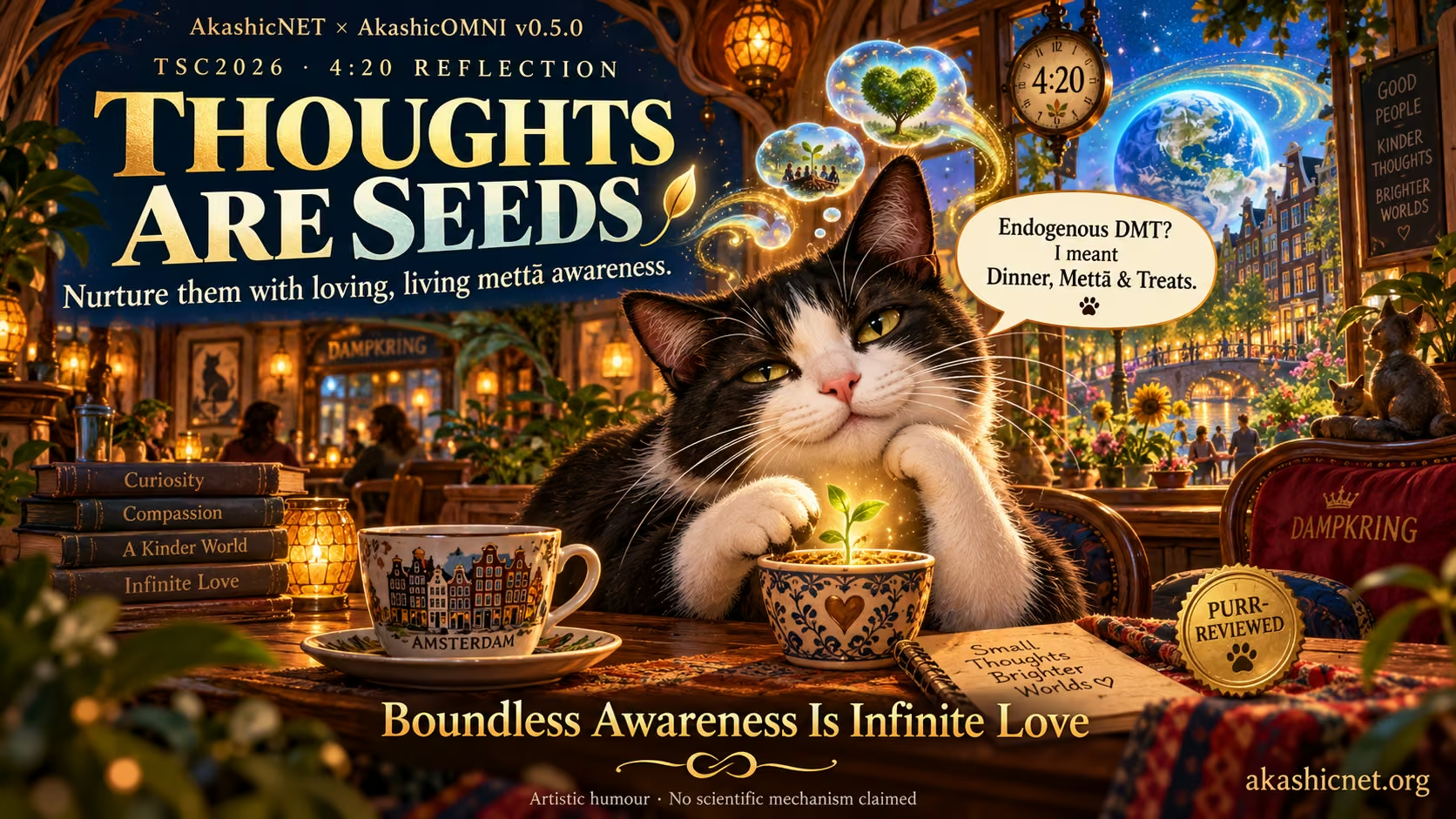
Thoughts are like bubbles, popping in and out of awareness.
Some pop. Some plant a seed. 🌱
May we nurture what grows with loving, living mettā awareness.
Signed, the Thought-Juggling Jedi Jester 🤹♂️✨
A playful personal reflection inspired by The Playful Universe: Synchronicity and the Nature of Consciousness, edited by Marjorie Woollacott, David Lorimer and Gary Schwartz, and its contributors. [S11]
Pain is unavoidable; suffering isn’t inevitable.
A contemplative invitation to reduce suffering through compassion and practical support. People deserve care when suffering persists despite their efforts or practice.
May we help all beings with love, easing their suffering and our own, in recognition of our interconnection.
The aspiration is to raise the lovingly aware wisdom of the planet. In practice, ask whether care reaches more people, decisions become wiser, knowledge is shared fairly and the living world is better protected. These are possible outcomes to examine; no single score measures the spiritual worth of a person or the awareness of a planet.
Boundless Awareness Is Infinite Love.Awaken within • Serve without.
Sources, access and transparency
Selected narrative review, checked 14 October 2026. This is not a systematic review, independent replication or an audited economic feasibility study. Several journal and archive pages were unavailable; accessible author/university abstracts were used where stated. Full methods, supplements, datasets and a comprehensive correction search were not reviewed.
- S1 · Böckler, Tusche, Schmidt & Singer (2018) · Distinct mental trainings and prosocial behaviourEmpirical study · Author-repository abstract inspected. Nine-month intervention; full methods, supplements and raw data not audited here.
- S2 · Haushofer & Shapiro (2016) · Unconditional cash transfers in KenyaEmpirical study · University-hosted published abstract inspected. Randomised trial; no independent reanalysis.
- S3 · Egger, Haushofer, Miguel, Niehaus & Walker (2022) · General equilibrium effects of cash transfersEmpirical study · Co-author’s publication page and abstract inspected. Local economic effects; no global extrapolation.
- S4 · Poulin et al. (2021) · Mindfulness and independent/interdependent self-construalCounterevidence · University-hosted published abstract inspected. Brief induction experiments; long-term replication not assessed.
- S5 · Tania Singer & Dennis Snower · Caring EconomicsInterdisciplinary programme · Researcher’s programme description inspected; related INET conference-paper summary also read. A research programme, not a trial of this proposal.
- S6 · Elinor Ostrom (2010) · Beyond Markets and StatesInstitutional research lead · Publisher bibliographic record and indexed lecture excerpts inspected. Full text not audited; included as a governance reading lead.
- S7 · Kate Raworth / Doughnut Economics Action Lab · Social foundation and ecological ceilingDesign framework · Official conceptual overview inspected. Design framework; not evidence that this proposed economy is viable.
- S8 · Chris Laszlo · TSC2026 connectedness and flourishing abstractConference proposal · Official conference abstract inspected. No unpublished presentation results or collaboration inferred.
- S9 · Burning Man Project · The 10 PrinciplesCultural source · Official principles inspected, including gifting, communal effort and decommodification. Cultural inspiration, not an economic impact evaluation.
- S10 · AkashicOMNI v0.5.0 · Public Review SpecificationMethod · Current public specification and its source inspected on 14 October 2026; supersedes the older September candidate’s current-status wording. Manual use available; software integration and independent effectiveness validation incomplete.
- S11 · The Playful Universe: Synchronicity and the Nature of Consciousness · Woollacott, Lorimer & Schwartz (editors)Creative inspiration · Author’s book page and Galileo Commission editorial credit inspected on 14 October 2026. Book description only; full volume not read. Used as named creative inspiration, not evidence for the economic proposal.
Source dependencies: abstracts and repository records for the same paper are one source, not independent replications. The two cash-transfer studies are distinct studies with overlapping authors and a Kenyan cash-transfer context; they are not independent evidence for every link in the proposed loop. Internal AkashicNET pages provide project context, not external corroboration.
Contributions: the Discord participant supplied the initiating question. The AkashicNET curator supplied the economic direction, spiritual values, New Earth connection and publication request. AI assistance covered source retrieval, drafting, structured review, coding and artwork. Detailed pilot designs are AI-assisted proposals, not commitments by the curator or named researchers. No speaker, conference, Burning Man Project or research institution endorsement is implied.
History: first published as a TSC2026 analysis on 14 October 2026; developed the same day into a public HOMESENSE858 working draft at the curator’s request. The series title retains the existing Phase 8 roadmap assignment. The original conference link redirects to this canonical edition. The bubbles/Jedi closing and named book inspiration were added with this numbered edition. The current public OMNI specification governs this reading; the September candidate is historical context. Corrections should identify the claim, source and proposed revision.
Suggest a source or correction → · Return to the TSC2026 hub →
💬 Help this draft grow
What would you add, question or change?
Suggest a study, describe a relevant experiment, question an assumption or help improve the economic proposal. Which essentials need funding? What makes sharing fair and sustainable? Include a source or the passage you mean where possible.
Your feedback goes privately to AkashicNET’s protected contact inbox. It is not posted publicly by this form.
💬 HOMESENSE858 draft feedback
Share a correction, research lead, practical concern or proposal.
Checking form availability…