TSC2026 · 13 October 2026 · Companion reflection & proposal
Akashic Field, Trance & Lived Connectedness
Chris Laszlo · Ervin Laszlo · Edgar Cayce
A response to Chris Laszlo’s official TSC2026 abstract on Science and the Akashic Field, with its emphasis on connectedness, compassion, nature and service.
Can we meaningfully connect the experience of oneness, its effects on everyday conduct, and claims of accessing information beyond ordinary awareness?
Independent AkashicNET proposal · Collaboration unconfirmed
THE STARTING POINT · MEANING, COMPASSION & SERVICE
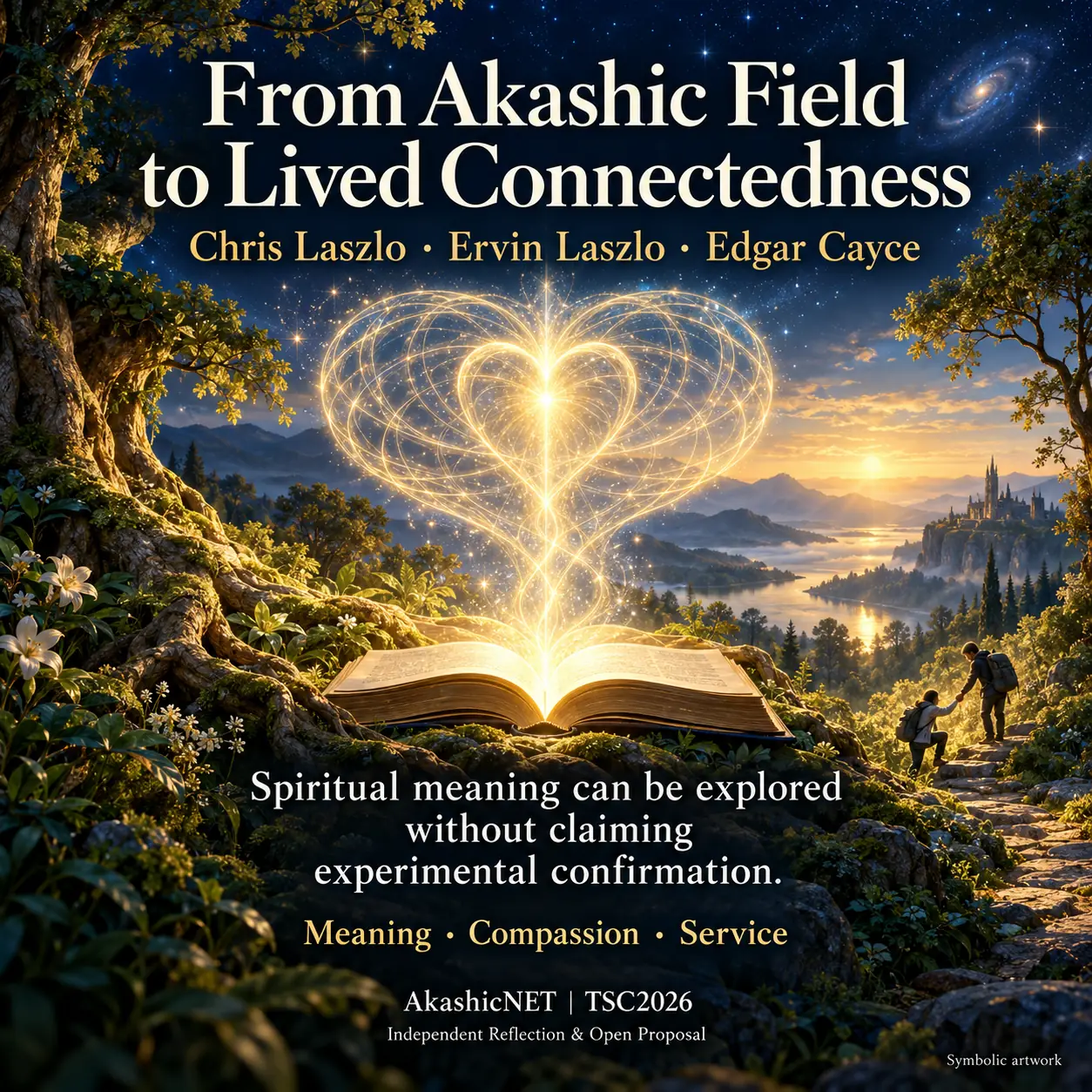
Spiritual meaning can be explored without claiming experimental confirmation.
An experience may matter through the connection, purpose or compassion someone finds in it. Exploring that meaning does not require the person to prove a universal field, demonstrate extraordinary information access or adopt a single explanation.
Conversation, contemplation, art and reflection can ask what an experience means and how a person wishes to live with it. Scientific methods address additional questions when we make claims about causes, general benefits or factual accuracy. These forms of inquiry can inform one another while retaining their distinct purposes.
Chris’s abstract invites reflection on deep listening, gratitude, nature, compassion and service. Our first response is to take that invitation seriously: how might connectedness become care in ordinary life? The Cayce comparison and proposed tests below are further possibilities for discussion.
Explore the meaning. Practise the compassion. Test the claims.
OUR ANSWER · A PROPOSED RESEARCH APPROACH
Yes: connect the questions while testing each separately.
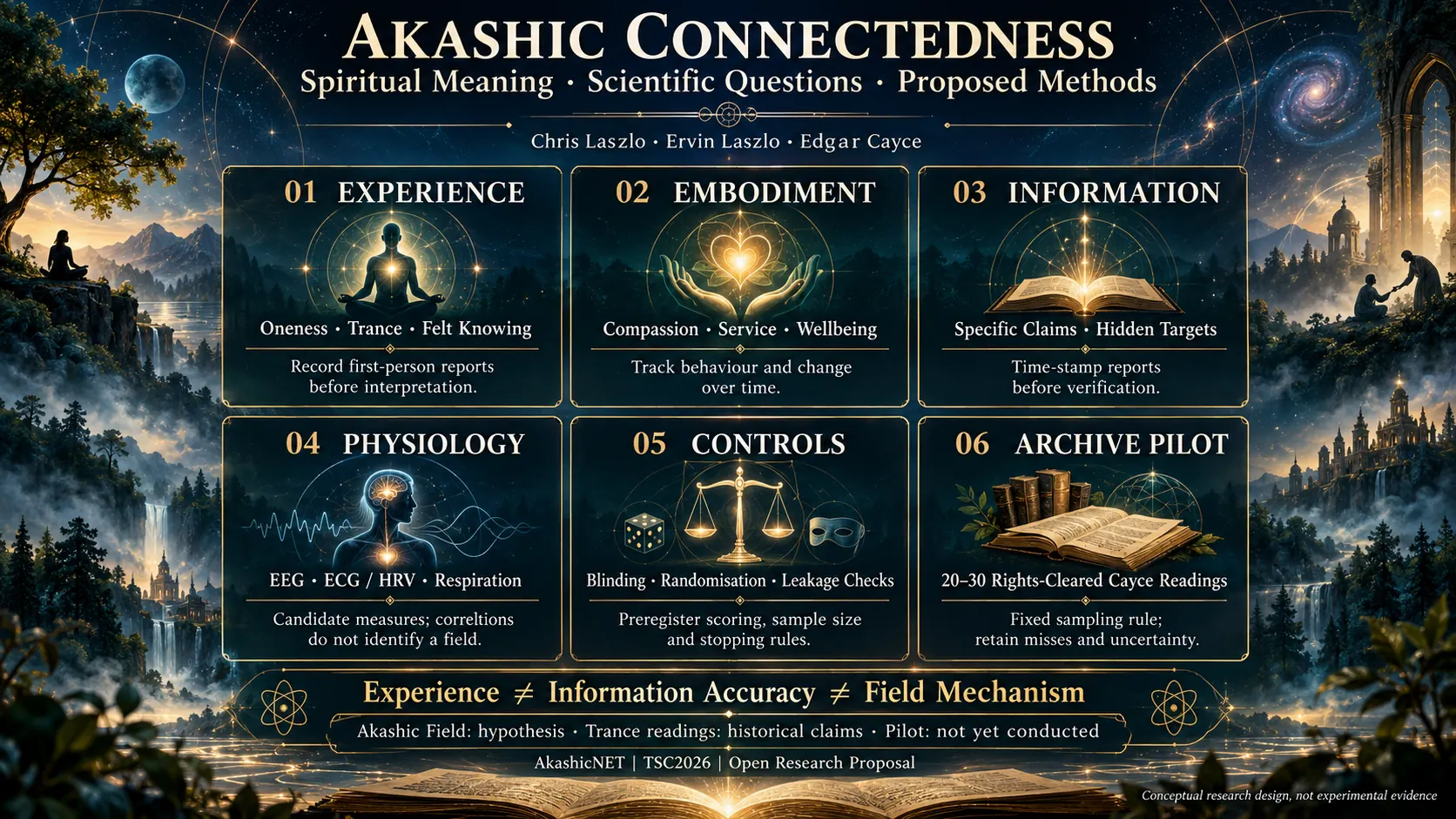
Oneness is an experience to describe. Compassion and service are outcomes to follow. Access to otherwise unavailable information is a claim to test. A person could show any combination of these; evidence for one does not establish the others.
They can be studied together by recording the same person’s experience, subsequent conduct and performance on a separate information task. This could reveal associations. Stronger designs would be needed to establish causation or a specific mechanism.
The bridge is a research programme, with room for both meaning and measurement.
Three questions. Three kinds of evidence.
What was experienced?
Document oneness, imagery, trance, insight and felt connection in the participant’s own words. Record context and uncertainty before imposing an explanation.
First-person interviews and structured descriptions
An experience can be profound while its interpretation remains open.
What changed in everyday life?
Follow compassion, wellbeing, relationships and service over time. Use suitable comparison groups and measures agreed in advance; include unwanted effects and people who do not benefit.
Longitudinal outcomes and behavioural measures
A beneficial change would not identify an Akashic mechanism.
Was new information obtained?
Specify facts unavailable through ordinary access. Time-stamp statements before verification, conceal targets, blind judging and compare performance with a defined chance model.
A preregistered information task and independent replication
A reproducible anomaly would prompt further explanation, not automatically prove a universal field.
These are proposed methods, not results from a completed AkashicNET study.
WHY THESE THREE STRANDS?
A shared vocabulary, with distinct questions
Ervin Laszlo
The explanatory hypothesis. Chris’s abstract describes his father’s Akashic Field as a proposed informational basis of reality. For testing, the proposal needs an operational definition and predictions that differ from competing accounts.
Source: Chris’s official abstract ↗Chris Laszlo
Connectedness in practice. His lecture considers contemplation, deep listening, gratitude, compassion, nature and service. This supplies a practical strand: what changes in how people live?
Read the lecture abstract ↗Edgar Cayce
A historical archive. A.R.E. attributes Cayce’s trance readings to claimed sources including the subconscious and Akashic Records. Those accounts offer material for historical study; their stated origin is itself a claim.
A.R.E.’s account of Cayce’s claims ↗Our comparison is an editorial synthesis. Similar terminology does not establish a shared mechanism, a historical collaboration or independent confirmation.
How would we distinguish connectedness from information access?
A feeling of knowing can be recorded as part of an experience. To test informational accuracy, the content must also be specific enough to score against facts established independently.
- Define the claim first. Agree the target, scoring rule, main outcome, exclusions, sample size and stopping rule before gathering results.
- Prevent ordinary access. Conceal targets and personal details, control communication and document what the participant and experimenters could know.
- Commit before checking. Preserve the complete, time-stamped report before any feedback. Count misses, ambiguous statements and unscorable material alongside apparent successes.
- Judge without knowing the target. Use blinded assessors, suitable comparison targets and a prespecified statistical model. Separate exploration from a fresh confirmatory test.
- Replicate independently. A new team should reproduce the result. Then compare explanations, including overlooked cues, procedural errors and any explicitly specified anomalous model.
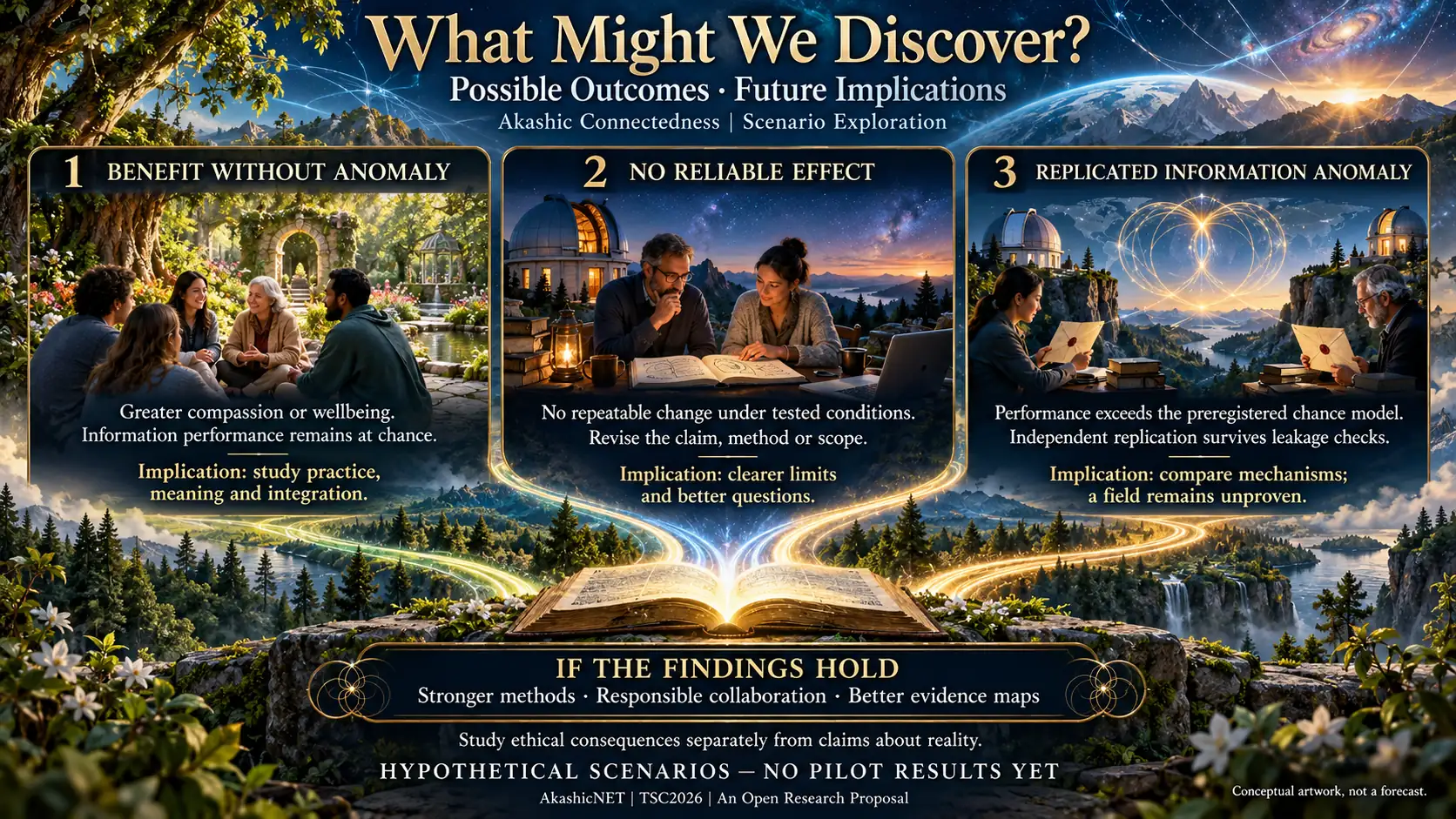
What would a positive result mean? Under sufficiently strong controls, it could support an information anomaly within that task. Identifying an Akashic Field would require additional predictions distinguishing that explanation from alternatives.
What would a negative result mean? It would constrain the tested claim under those conditions. It would not erase someone’s experience or settle every possible account of consciousness.
PROPOSED FIRST STEP · FOR DISCUSSION WITH CHRIS
From Akashic Field to Lived Connectedness
We propose a small comparative pilot linking selected writings by Chris and Ervin Laszlo with a rights-cleared sample of Cayce’s historical trance readings.
Start with 20–30 readings
Agree a fixed date window or reproducible sampling rule before inspecting the sample. This would be a scoping exercise to establish what can be studied, not a powered test of psychic accuracy.
- Record the reading identifier, original question, date, transcript source and available contextual records.
- Distinguish subjective descriptions, ethical guidance and specific checkable assertions.
- Assess what was known before the reading, when corroboration was recorded and whether verification is independent.
- Preserve contrary evidence, missing documentation and claims that cannot be scored.
Historical records may lack the controls required for a decisive test. Their strongest initial contribution may be to identify precise questions for a prospective study.
What AkashicNET could contribute
A source-linked comparison, an auditable claim map and a draft protocol for one testable question. AI could help retrieve and organise authorised material; human reviewers would check every substantive finding. Unpublished or sensitive personal records would require appropriate access and publication decisions.
The invitation
Chris, would you be open to a brief conversation about a comparative pilot connecting your father’s field hypothesis, your practices of connectedness, and Cayce’s trance archive? Which texts, questions or collaborators would make the first step useful?
This is a public discussion draft. No acceptance, partnership, archive access or endorsement by Chris Laszlo, the Laszlo family, A.R.E., the Cayce Foundation or TSC organisers is claimed.
Where could shamanic traditions contribute?
Our proposed connection concerns relationships with nature, ceremonial context, altered states, meaning and service. It is an interpretive bridge, not an assertion that all traditions teach one theory or that Cayce’s practice was equivalent to Indigenous healing.
A later comparison should involve practitioners and communities as collaborators, with their own terms, consent, credit and decisions about what may be shared. Their knowledge could help researchers formulate better questions about preparation, context and integration.
Joe Tafur’s conference abstract offers a relevant conversation through South American curanderismo, sacred ceremony and spiritual healing. His involvement in this proposal is unconfirmed.
Multi, Meta & Mettā
Multi: compare experiential, psychological, cultural and informational accounts. Meta: ask what observation would distinguish them and what would change our minds. Mettā: judge the project’s conduct by care, compassion and service to the people involved.
Within our frameworks, HIERATIC can organise experience and reflection; AkashicOMNI can compare interpretations and predictions; AkashicNET can preserve sources and uncertainty. These are proposed roles for this project, not validation of a field-access mechanism.
Sources & transparency
- Chris Laszlo: official TSC2026 lecture abstract — source for his proposed themes and the description of his father’s hypothesis.
- Official concurrent programme — lists Chris on Wednesday 14 October, 5:25–5:50 pm PDT, Sunset Ballroom Zone B; subject to organiser changes.
- A.R.E.: Edgar Cayce on the Akashic Records — a source for Cayce tradition’s own account, not independent verification of the claims.
- Edgar Cayce Foundation — archival and research-access information.
- Joseph Tafur: official TSC2026 abstract — context for curanderismo and spiritual healing.
Prepared 13 October 2026 from public source material and a user-directed proposal. Human-directed, AI-assisted editorial synthesis and research design. We have not audited the proposed Cayce sample, reviewed a completed Chris Laszlo lecture, conducted a field-access experiment or established a shared mechanism. The methods and interpretation above are AkashicNET’s proposal.