
TSC2026 · LIVE FIELD REPORT · 13 October 2026
Mitochondria, Microtubules & Consciousness: Many Mechanisms, One Experience
A live conference field report comparing energy supply, cellular structures, receptors, membranes and brain networks. The evidence does not yet establish a quantum generator of experience.
By AkashicNET / u/NeuronsToNirvana · Human-directed, AI-assisted analysis · Approximately 5-minute read
← Conference JournalWhat Neven’s Talk Adds
Hartmut Neven’s TSC2026 presentation proposes that conscious experience accompanies the formation of quantum superpositions. His closing slide reports indications of anesthetic isotope effects and says more studies remain to be done. Conference observations below are attributed to the presentation; they are not independently reproduced findings.
His slides introduce NMR studies and ask whether nuclear spins could become physical “control knobs” for cellular function. This is a question about experimental manipulation, not a demonstration of mental intention controlling spins.
MULTI-PERSPECTIVE · COMPARE THE MECHANISMS
Mitochondria vs Microtubules? Widen the Question.
Mitochondria and microtubules need not be mutually exclusive. Energy supply, cellular organisation, signalling and network communication could contribute at different stages. This is a synthesis to test, not a demonstrated unified mechanism. Explaining an anesthetic effect is also different from explaining why any physical activity feels like something.
Mitochondria and energy supply
Could anesthetics reduce the energy available for nerve signalling?
Published work links isoflurane inhibition of mitochondrial complex I to impaired synaptic vesicle recycling. Neven’s slide proposes a spin-related energy mechanism for xenon; that specific explanation remains a proposal.
Research source ↗Microtubules
Could structures inside neurons contribute to anesthetic sensitivity or experience?
A 2024 rat experiment found that epothilone B delayed loss of righting reflex under isoflurane. Quantum optical effects have also been measured in microtubule structures. Neither finding by itself demonstrates that microtubules generate subjective experience.
Research source ↗Receptors and ion channels
Could altered signalling explain the anesthetic effect?
Xenon inhibits excitatory NMDA receptor channels. This is a relevant established pharmacological action to compare with proposed spin-based mechanisms, not a complete explanation of experience.
Research source ↗Membrane organisation
Could changes in membrane domains alter ion-channel activity?
A 2020 experiment linked chloroform and isoflurane to lipid-domain disruption, PLD2 signalling and TREK-1 activation. Its scope should not be assumed to include every anesthetic.
Research source ↗Electron transfer and spin chemistry
Could spin-dependent chemistry contribute to anesthetic action?
A radical-pair model reproduces reported xenon isotope differences. Modelling compatibility is not experimental confirmation of the mechanism or proof of quantum consciousness.
Research source ↗Brain-network coordination
Could disrupted communication across brain regions explain altered awareness?
Human propofol studies associate loss of consciousness with altered corticocortical and thalamocortical connectivity. These findings concern network function; they do not identify a unique microscopic generator of experience.
Research source ↗ONTOLOGY · AN OPEN QUESTION
What If Consciousness Is a Field?
A field-based view starts from a different premise: consciousness may be fundamental, with the brain modulating access to or expression of it. Under that premise, looking only for a brain process that creates consciousness may ask the wrong question. This is a philosophical hypothesis here, not an established finding. Physical measurements could still investigate a specified interface. A physical field requires defined properties, coupling and predictions; a metaphysical use of “field” may not supply those. Anesthesia findings can fit more than one interpretation, so altered responsiveness alone does not decide between production and access.
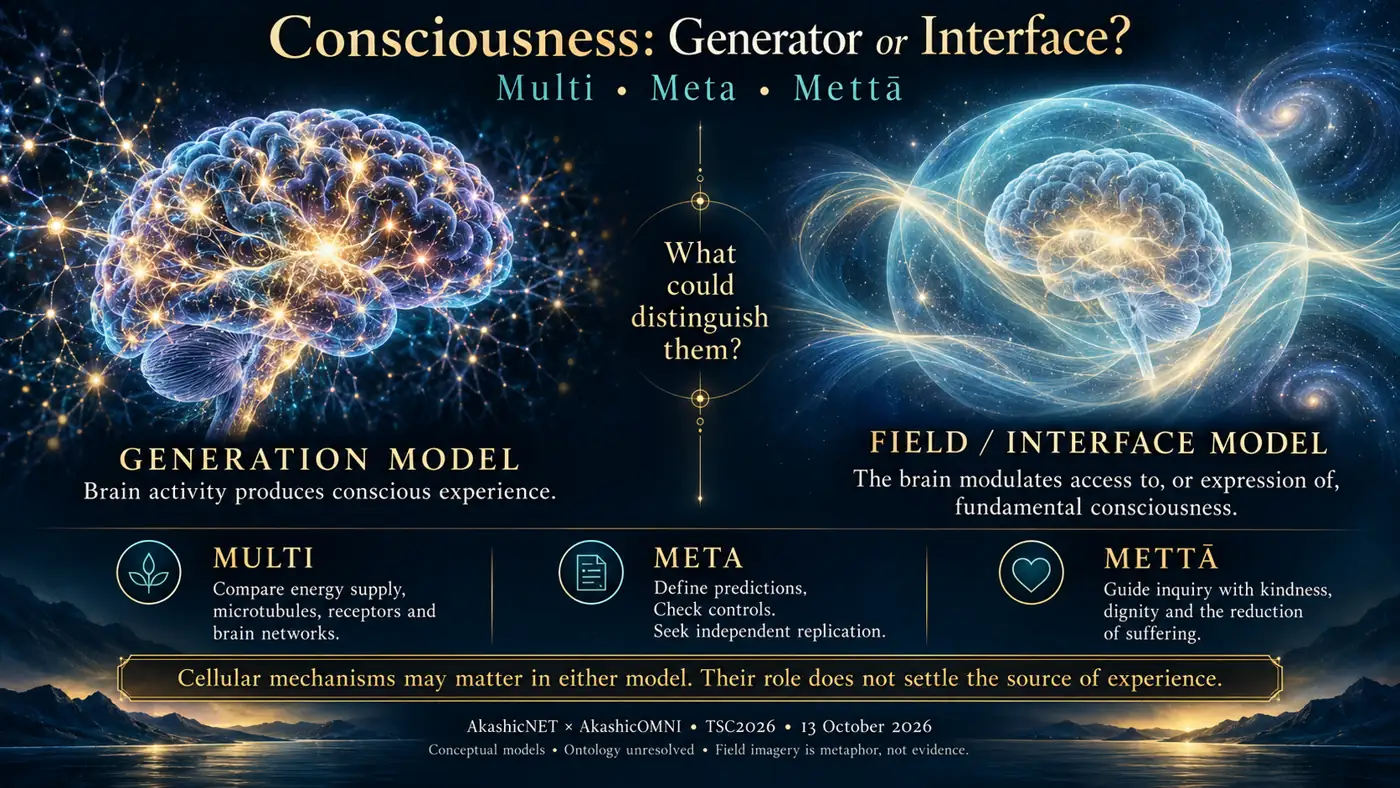
Researcher-proposed question: what outcome would a specified field-access model predict differently from a brain-generated model? An undefined model cannot yet be compared experimentally. Reports of awareness, memory and responsiveness must also be distinguished.
Multi, Meta & Mettā
Multi-perspective
Compare several mechanisms and levels of explanation without assuming one must explain every finding.
Meta-perspective
Check prediction, measurement, controls, uncertainty and replication. Ask which outcome would distinguish explanations and which would count against them.
Mettā perspective
Orient the research toward kindness, participant dignity and reducing suffering. Mettā guides the purpose of inquiry; it is not evidence for a physical mechanism.
These are three complementary lenses for this field report, not a replacement for AkashicOMNI’s twelve-perspective method.
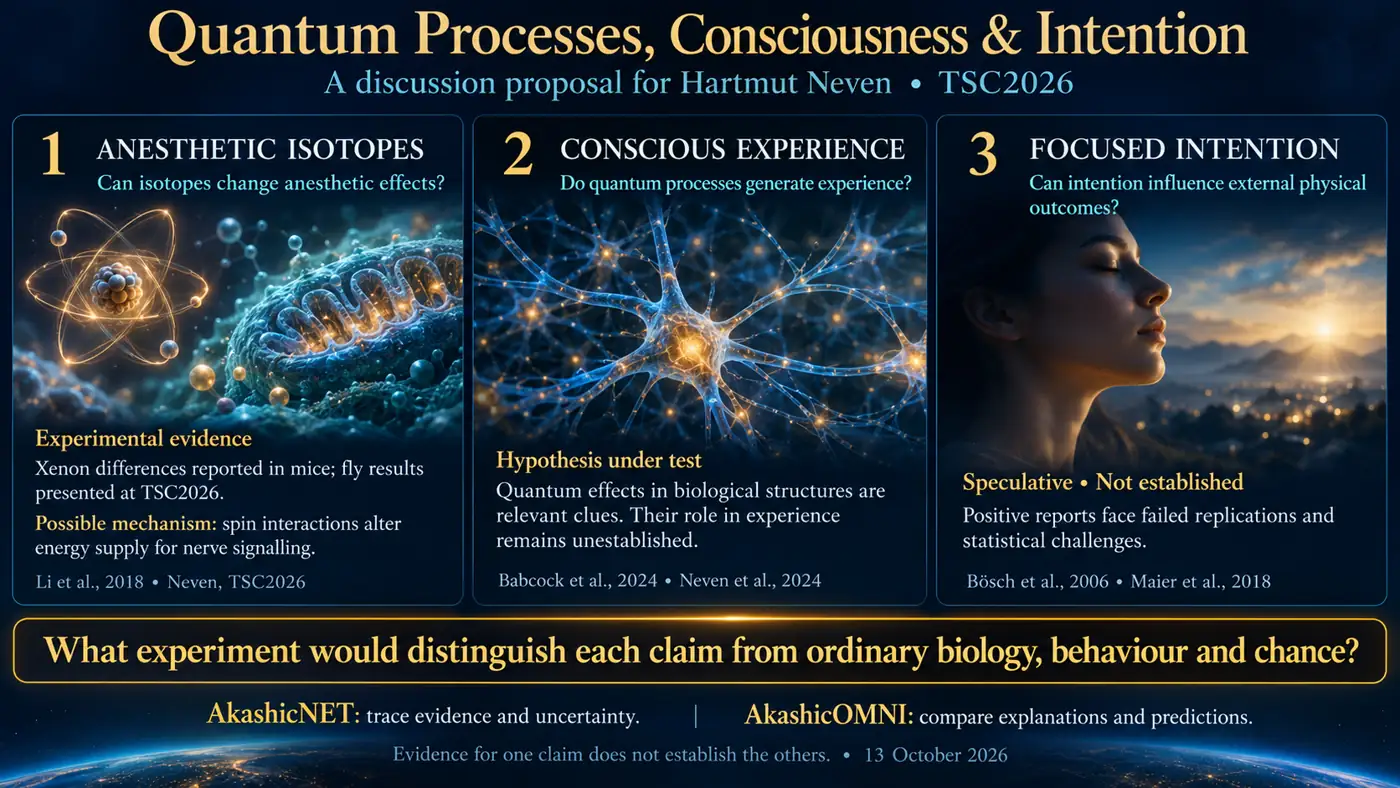
Three Claims, Three Separate Tests
| Claim | Current distinction | What remains to test? |
|---|---|---|
| Isotopes alter anesthetic effects | Published animal results and new conference reports. | Independent replication, relevant controls and a specified mechanism. |
| Quantum processes generate experience | A theoretical proposal with relevant biological clues. | A measured quantum property causally connected to a defined experiential endpoint. |
| Intention changes external events | Disputed anomalous reports; a separate hypothesis. | A preregistered outcome reproduced independently with ordinary influences excluded. |
Focused intention is a separate research question. IONS studies report attention-related optical anomalies, but planned predictions, exploratory findings and independent analyses give a mixed picture. The 2025 report did not support its three preregistered hypotheses overall, while reporting a subgroup difference and exploratory trend. No evidence reviewed here establishes intention selecting or co-creating quantum realities.
IONS intention findings and limits →
Susan Schneider: Which AIs Might Be Conscious?
Schneider’s TSC2026 abstract proposes a Superpsychist framework combining resonance theory, spacetime emergence and Quantum Darwinism. She highlights biological AI, neuromorphic systems and quantum computation as candidates to examine. This is a theoretical framework, not a demonstration of artificial consciousness.
Our comparison question: which measurable condition would distinguish a system that behaves intelligently from one that has subjective experience?
META-PERSPECTIVE · WHAT WOULD CHANGE OUR MINDS?
Questions for the Current Discussion
- Which isotope effects remain after exposure, purity, pressure, mass and ordinary biological effects are controlled?
- Can mitochondrial, microtubule and receptor explanations make different predictions in the same preparation?
- How would verified spin manipulation change reported experience, beyond changing cellular activity or responsiveness?
- Can an attention-related optical finding reproduce with preregistered analysis and independent equipment?
AkashicNET can trace sources, uncertainty and replication status. AkashicOMNI can compare explanations, mechanisms and predictions. These are proposed contributions, not an established collaboration or endorsement.
Sources & Transparency
- Neven: TSC2026 abstract ↗
- Neven et al.: consciousness conjecture, 2024 ↗
- Babcock et al.: microtubule superradiance, 2024 ↗
- Li et al.: xenon isotope study, 2018 ↗
- IONS: 2025 primary report abstract ↗
- Independent double-slit reanalysis, corrected ↗
Conference field notes and source-based commentary prepared with AI assistance. No raw-data reanalysis performed. Images are artistic metaphors, not scientific evidence. Current status: open research questions.
The mechanism cards link to additional primary research. Endpoints, anesthetics and biological preparations differ between studies; a shared theme does not make their results interchangeable.