A Reading Companion · L/L Research

The Law of One,
Book I.

Unity, Love & Service [1984]

A book encountered through a dancing synchronicity. An invitation to explore connection—and carry it into the way we live.

[1984] identifies the copyright year of the linked edition. The opening session is dated 15 Jan 1981.

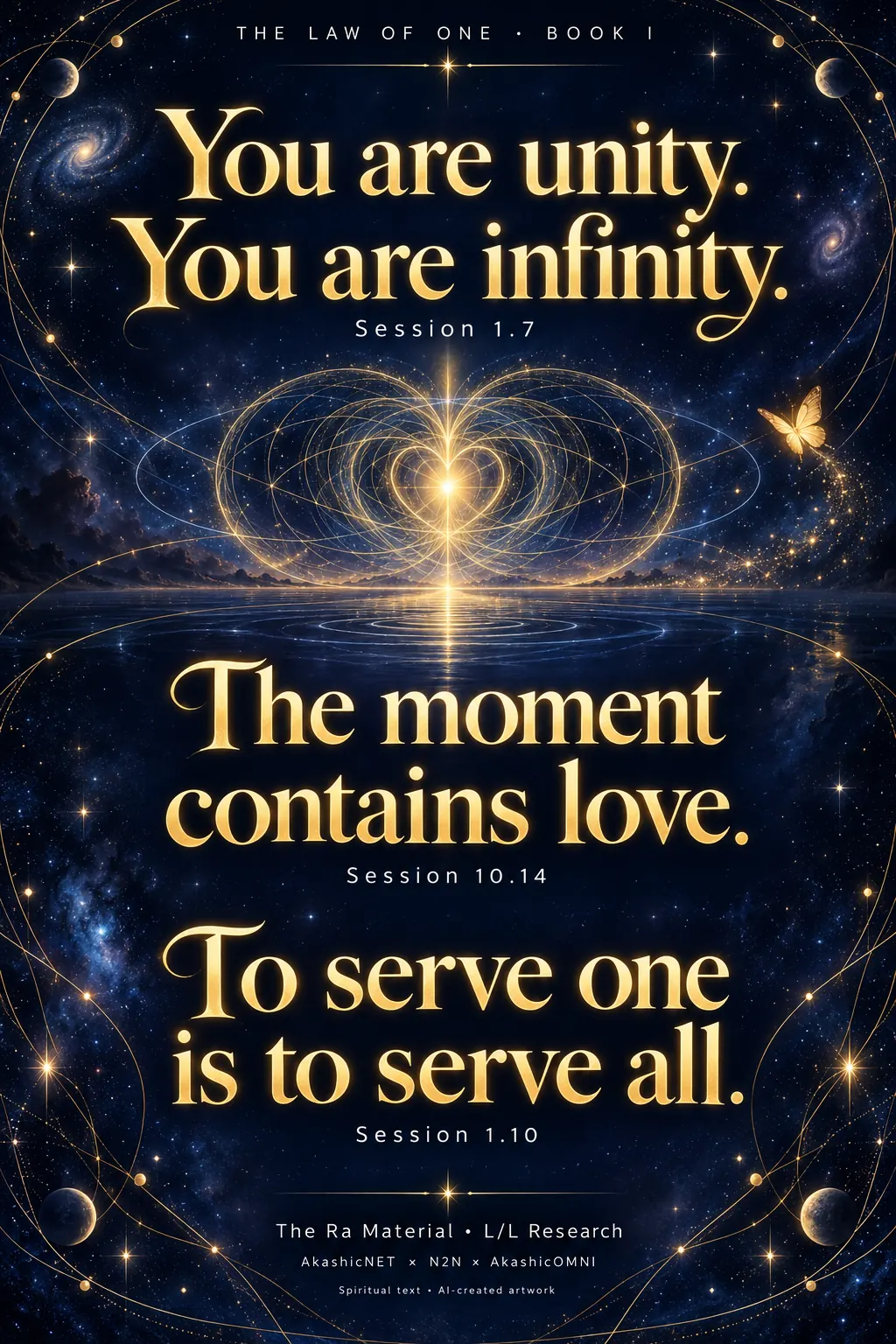
The Ra Material poster with a golden butterfly and luminous heart. Three excerpts concern unity and infinity, love in the moment, and service to all. References: 1.7, 10.14 and 1.10.
Three brief excerpts, with session references.
Spiritual text · AI-created artwork

01 · Context

What Is
The Ra Material?

The Law of One, Book I is the first volume of dialogues published by L/L Research and attributed to a source calling itself Ra. Don Elkins, Carla Rueckert and Jim McCarty are the human collaborators associated with the work. It is a channelled spiritual text, presented through questions and answers.

Its central concern is the relationship between a unified creation and the experience of individual life. The dialogue explores spiritual development, service, free will and an elaborate cosmology. This companion concentrates on selected passages that connect its larger vision to everyday conduct.

The questions matter as much as the answers: read what prompted a passage, notice the specialised vocabulary, and follow the session reference before deciding what an excerpt means to you.

Read L/L Research’s account of the work ↗

02 · Selected Passages

Four Ways Into the Book

Each entry separates a brief account of the passage from an AkashicNET reflection. Open the source to read the complete exchange.

Unity

Ra presents existence as one creation, with apparent separation understood within that unity. Learning, teaching and service become expressions of relationship.

Integration Prompt

If another person belongs to the same whole, how might that change the quality of our attention?

Love in the Present

Four contemplative exercises direct attention toward love in the moment and the Creator in other people, oneself and the surrounding world. Meditation, contemplation or prayer provides their foundation.

Integration Prompt

Pause before responding. Look for one caring action available in this particular moment.

Free Will & Compassion

The dialogue favours understanding and accepting experience over suppressing desire. It also makes service sensitive to another person’s needs, autonomy and environment.

Integration Prompt

Ask what would help. A generous intention becomes more useful when the other person can freely say yes or no.

A Spiritual Cosmology

The narrative moves from infinity and awareness to a creative principle described as love, then to the diversity of creation. These are metaphysical propositions within the text.

Integration Prompt

Read the cosmology as a framework to examine. Personal resonance and scientific verification answer different questions.

03 · A Closer Reading

Meaning, With
Room to Question.

Unity and Difference

Our reading asks how a language of oneness can deepen care while leaving room for different experiences, beliefs and boundaries. An experience of connection need not erase disagreement. The practical test is how we treat the person in front of us.

Service and Agency

Helping can become controlling when we assume that our interpretation is what someone else needs. Read alongside the attention to free will in session 18, service invites listening, consent and sensitivity. These are editorial applications of the passage.

Cosmology and Evidence

The book’s nonhuman source attribution, cosmic history and spiritual development scheme belong to its claimed revelation. This page does not establish those claims as empirical findings. Readers can consider ethical insights while independently questioning the proposed explanation of reality.

A Useful Reading Practice

Keep three brief notes: what the text says; what it brings up in you; what you could responsibly do with it. That small separation helps a moving passage become an honest inquiry, rather than a conclusion reached too quickly.
04 · Personal Reflection

Trikāya.
Gratitude, Then Integration.

With gratitude for the dancing synchronicity at the Trikāya dance event that brought The Ra Material into my awareness. A shared moment, an unexpected connection, and a book to explore.

Now comes integration: carrying that feeling beyond the dance floor through listening, kindness, compassion and service to others. Let inspiration become care in everyday life.

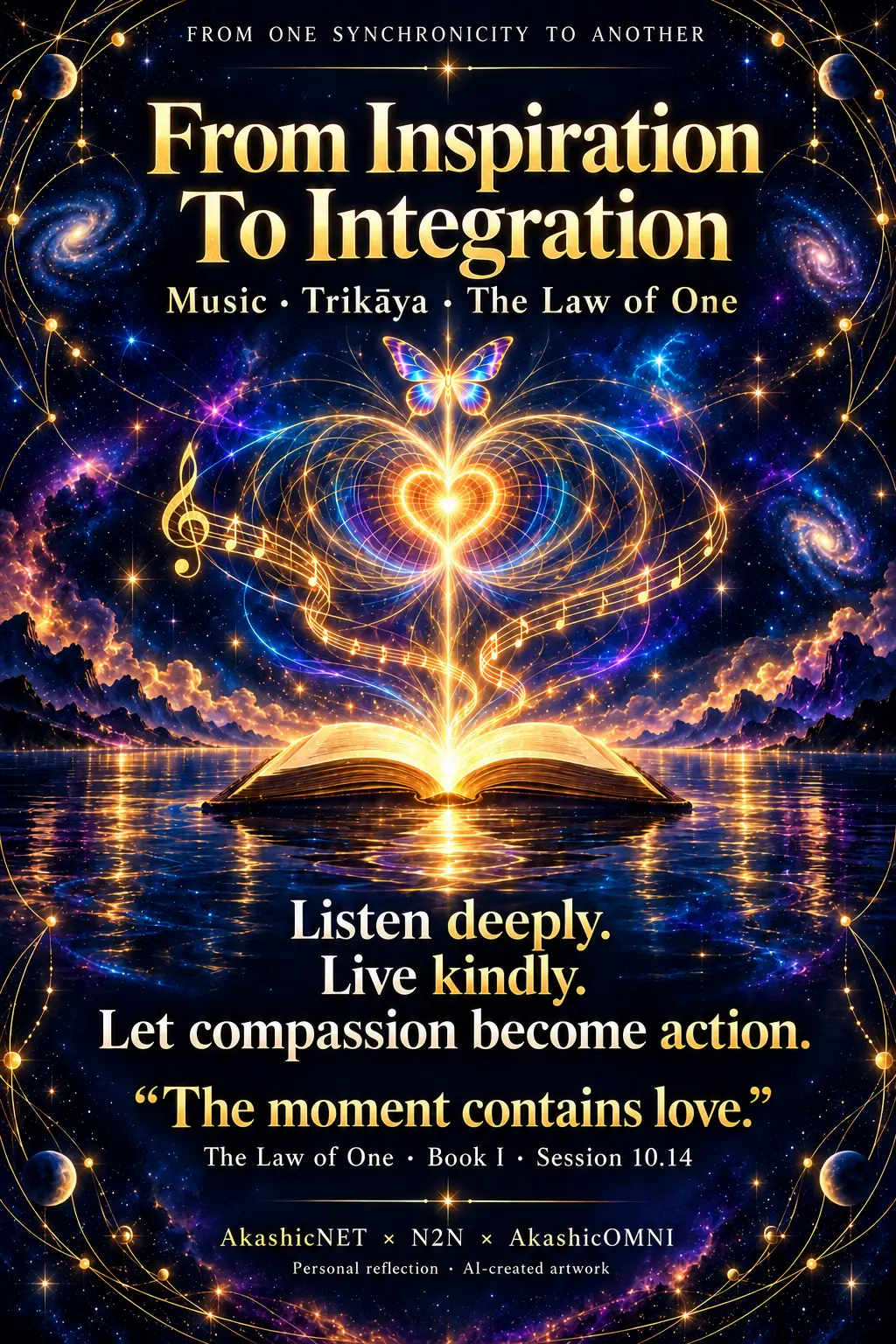
An open book, musical light, a golden toroidal heart and a butterfly connect music, Trikāya and The Law of One as personal reflection.
From inspiration to integration: gratitude for the dancing synchronicity at Trikāya, and an invitation to carry love into everyday kindness.
Personal reflection · AI-created symbolic artwork.

What Does Trikāya Mean?

Trikāya means “three bodies” in Sanskrit. In Mahāyāna Buddhism, it refers to three aspects of Buddhahood:

Dharmakāya
Truth or dharma body
Saṃbhogakāya
Enjoyment body
Nirmāṇakāya
Manifestation or emanation body

This Buddhist teaching and the Ra material have distinct contexts. Their connection here is personal and symbolic, arising from the encounter at Trikāya.

Trikāya terminology · Tsadra Commons ↗

From the Music to the Book · Bridge of Eternity →

Continue the N2N Conversation ↗

05 · Read Further

Return to the Source.

The original PDF is the edition for this page. Searchable transcripts make individual exchanges easier to find; later transcript editing can produce wording differences.

How This Page Was Made

The AkashicNET editor supplied the book, the Trikāya encounter and the intention to connect gratitude with integration. AkashicNET provides the editorial setting; N2N is the community conversation; AkashicOMNI names the interpretive perspective. AI assisted with writing, source checks, layout, the quote poster and the integration companion artwork.

This is a selective reading companion, not a complete scholarly review. It does not report an executed EXPAND² analysis, measured contribution percentages, or peer-reviewed validation of the book’s metaphysical claims. Session summaries, personal testimony and editorial reflection are identified separately.