What changes when a powerful experience becomes part of ordinary life?
The moment and the morning after
An experience can rearrange what feels important. A familiar place appears new; a longstanding assumption loosens; a sense of connection becomes difficult to describe. We can acknowledge the force of that moment without deciding immediately what it proves.
Book I distinguishes the report of an experience, investigation of its correlates and interpretation of its meaning. Book II carries that distinction through time. The experience happened, a story formed around it, and a life continued. These are related stages, but they are not interchangeable evidence.
State, story and conduct
A temporary state is not the same as a lasting capacity. A person may feel unusually clear and later struggle with a familiar disagreement. That does not make the experience worthless. It asks us to investigate how learning, context and repeated practice affect what follows.
Nor should transformation become a hierarchy in which certain sensations, brainwave labels or dramatic narratives certify a superior person. Book I's landscape of awareness makes room for ordinary attention, rest, uncertainty and changing needs. There is no requirement to produce an extraordinary story in order to belong.
A witness who can revise
The Cosmic Theatre offers actor, director and witness as reflective positions. Stepping back can help us notice a role or inherited script. It does not establish a separate immortal observer. That further proposition belongs to the continuity inquiry and needs its own argument.
Humility becomes especially useful when an interpretation has become central to identity. We can ask what would change our view while preserving respect for what we experienced. We can also allow a story to become less certain without treating the whole period of life as a failure.
What Do We Owe the River?

On a riverbank an answer can feel obvious. You want to help look after this place. By the next morning you have a free Saturday, a pair of boots and a question you overlooked yesterday. Has anyone asked for the help you have in mind?
Ngā Tāngata Tiaki o Whanganui describes the relationship between Whanganui Iwi and the river in Aotearoa New Zealand as inseparable. That relationship reaches back generations. In 2014 Whanganui Iwi and the Crown signed Ruruku Whakatupua, the deed of settlement. The 2017 Act recognises Te Awa Tupua as a living whole extending from the mountains to the sea. It gives Te Awa Tupua legal personhood and establishes Te Pou Tupua to act and speak on its behalf. Ngā Tāngata Tiaki o Whanganui · Our Story · Te Awa Tupua Act 2017 · ss 12–14 and 18–19
A reader elsewhere can begin closer to home. Imagine offering to count litter along a stream. The residents who already care for it want to know why a path floods after rain. Before picking up a clipboard, ask who chose the question. Would a record of when the path becomes impassable help? Who should keep that record and who would use it? The residents might also tell you they have what they need.
If someone does ask for help, agree on one job you can finish and a date to bring the result back. When you return, let the people who asked tell you what you missed. A powerful experience belongs to the person who felt it. The people who live with the consequences have a say in what happens next.
The World Philosophy Day plan for 19 November 2026 paired this river question with SAMĀDHI000 and AkashicINQUIRY013, A Tenuous Connection to Time. The proposed handoff follows a thread from stillness through enquiry to care.
Integration with a return date
HOMESENSE848 asks what remains after a gathering: who was welcomed, who needed quiet, and whether care survives inconvenience. These questions provide a grounded companion to accounts of awakening. Recent N2N research notes on context and experience supply research leads; they are not proof of a spiritual mechanism.
Choose a small change you believe followed an insight. Describe it without superlatives, revisit it later and include occasions when it did not occur. Ask whether another person experienced it as helpful. This is reflective practice, not a validated measure of awakening.
Friday in the Playground
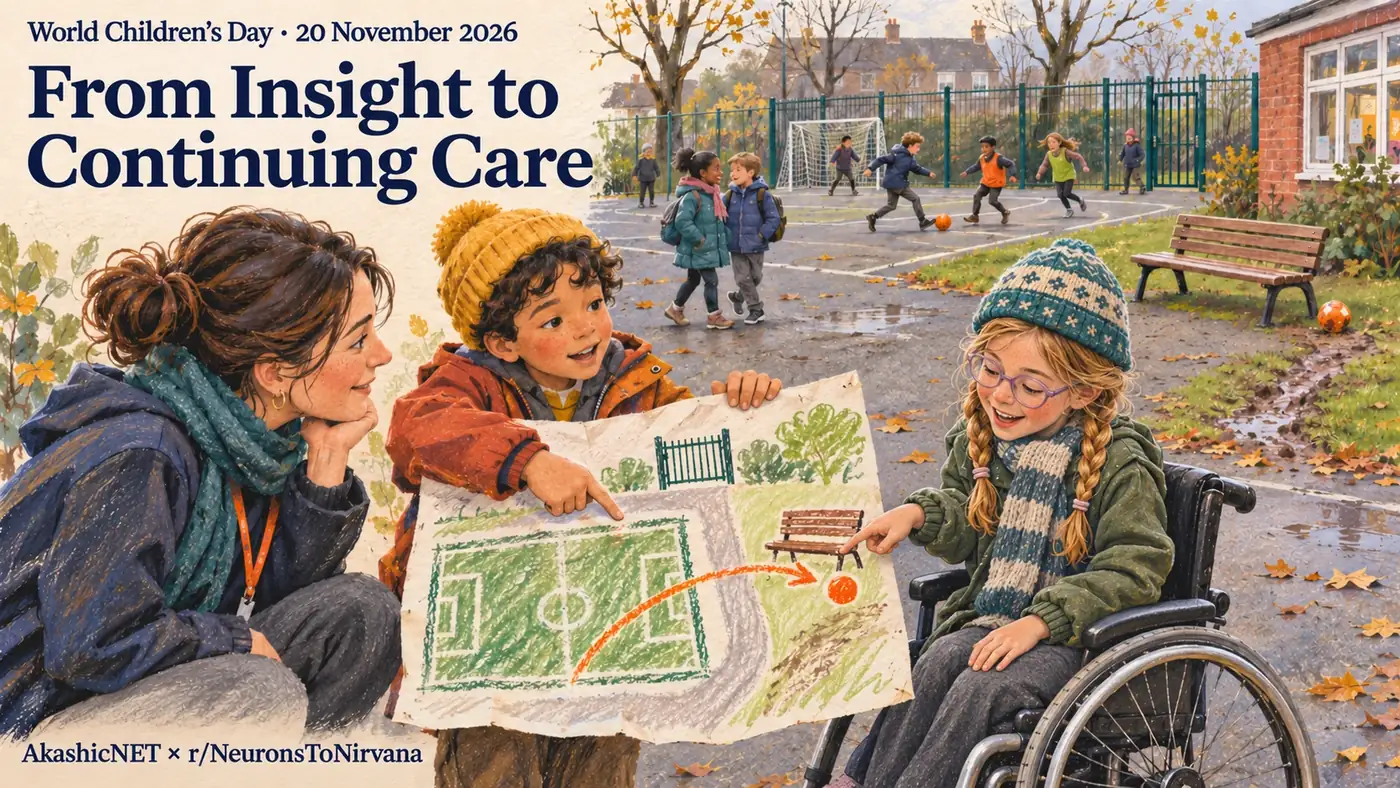
Two friends can finally hear each other after the school moves a bench. On Friday a third pupil points to the mud between the bench and the paving. In the full chapter, the children help decide where to try next. What would the teacher have missed by asking only the first two pupils?
HOMESENSE848 asks how care continues after a gathering. Book I references use the condensed editorial edition 1.1, 22 September 2026.