

World Children’s Day ·
From Insight to Continuing Care
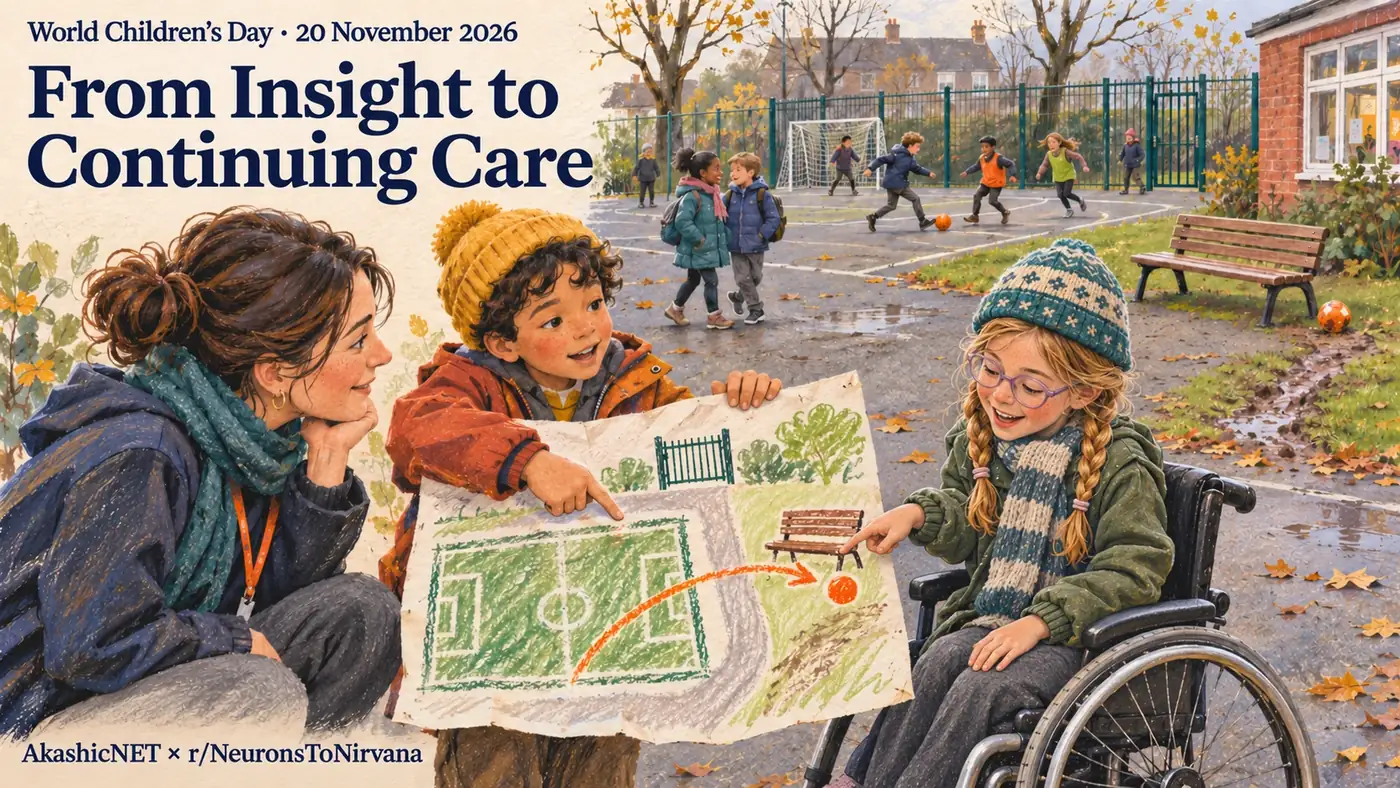
Imagine asking a child to draw a map of the school playground. An adult might mark the gate, the benches and the football pitch. A child might draw a thick line through the middle to show where the ball keeps flying. A bench that looks like a good place to sit on the adult’s map might be the last place the child would choose. Both have drawn the same playground. Only one of them spends breaktime there as a child.
UNICEF’s theme for World Children’s Day 2026 is “my day, my rights, my future”. In Germany, UNICEF reports that more than 200,000 pupils at over 2,000 schools are taking part in its YES-Day campaign. Pupils have spent weeks putting forward ideas and voting on which ones to carry out. Choosing a school trip or starting a club gives a child a chance to recognise something in their day and say, we decided that. UNICEF’s 2026 toolkit · UNICEF Germany on YES-Day
Who Gets To Shape Breaktime?
Two rights meet in that playground. Article 12 of the UN Convention on the Rights of the Child says children can express their views on matters affecting them and that those views should carry weight according to their age and maturity. Article 31 recognises their right to rest and play. A child who wants a football match and a child who wants to sit with a friend both have a stake in how those twenty minutes feel. UNICEF’s children’s version of the Convention
Suppose a school is deciding where to put a new bench. Before anyone fixes it to the ground, a teacher could take a plan of the yard outside at lunchtime and invite pupils to mark where they like to be. Some might draw. Others might prefer to walk the route with someone, point out a spot or pass. The footballers might be the first to explain where a stray shot usually lands. Someone who uses a wheelchair might spot that the proposed route crosses grass that turns to mud.
This is where the three AkashicNET strands meet. AWARE asks the adult to notice the moment they start supplying the answer. RELATE gives them a question to ask while they stand beside the child. Have I understood what you mean? REGENERATE gives the adult a job afterwards. Find a bench that can be moved, agree a spot to try and take responsibility for getting it there. AWARE and attention · RELATE000 · REGENERATE001
Come Back Next Friday
If the school tried the idea on Monday, the most important appointment might be the one it kept on Friday 27 November. Take the map back to the yard and let the pupils lead the walk. Can the friends hear each other? Can everyone reach the seat after rain? What else did the children mark on Monday?
Decide together whether to keep the bench there or try another spot. If pupils favour different places, let them show each other why. If a spot is unsafe or someone can’t reach it, the teacher can explain the problem and ask where else they could try. Mark the choice on the map together. Before the next break, tell the class which suggestions changed the plan. The adults can do the lifting.
A child who starts at that school next term will inherit whatever today’s pupils and adults decide. That gives my future a place and a timescale a child can picture. It also leaves room for the next child to draw a different map.
A Question for Today
Think back to a decision adults made about your day when you were young. What would you have shown them if they had come and stood beside you?
If this were your playground, where would you try the bench first? When you come back on Friday, what would make you want to keep it there or move it?
More from AkashicNET Insights