Skip to readingAKASHICNETSandbox Reading Room · #HOMESENSE♾️💗
Working Draft · For Feedback
HIERATIC Book II: The Mystery of Continuity
HIERATIC016–024 · Death, Rebirth & the Art of Living Wisely · Whole-book preview Draft dated 5 October 2026 · By AkashicNET
Open by direct link. No login required. This is an unlisted whole-book preview, not a final edition. Anyone with the link can read or share it.
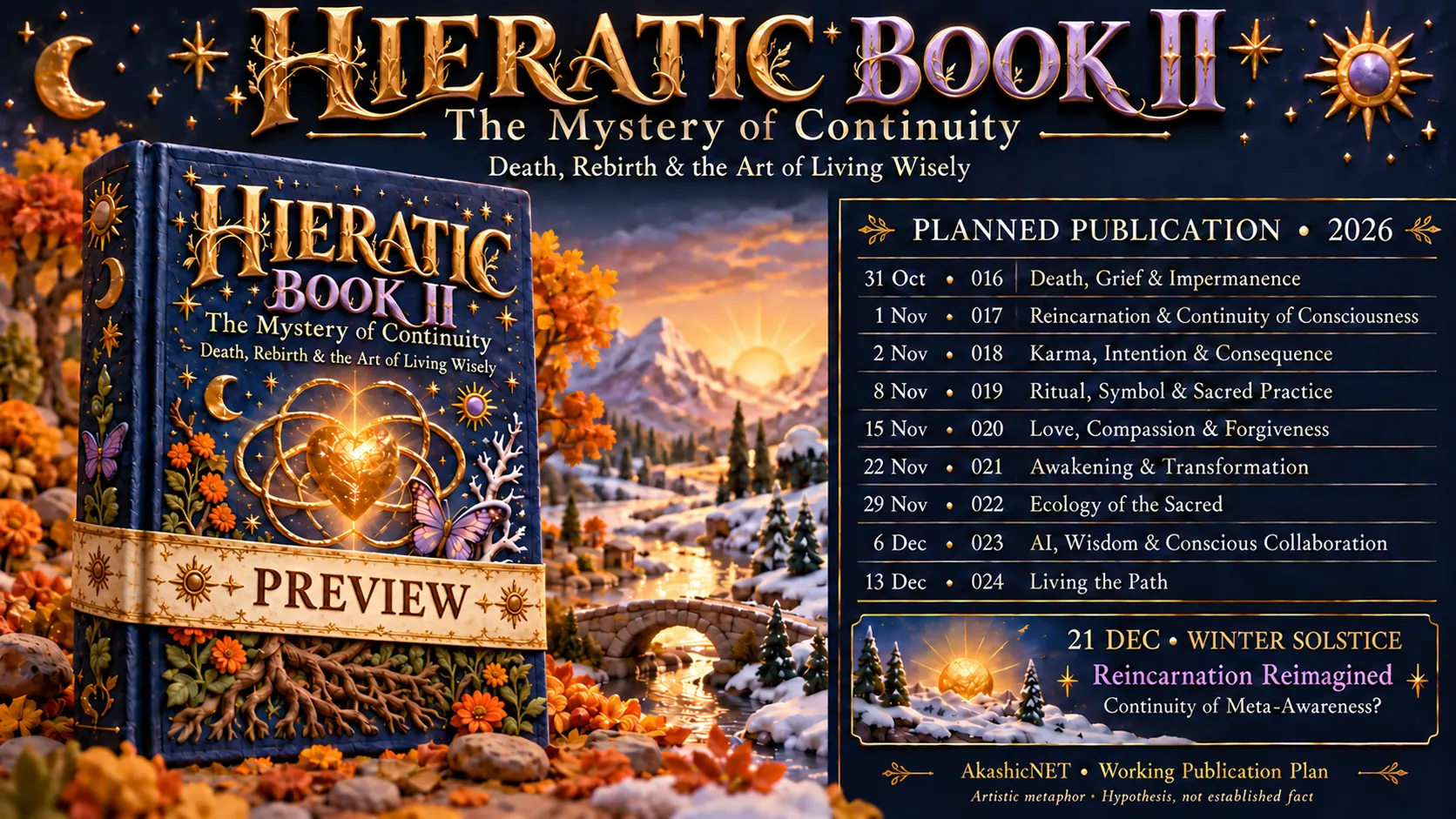
Working publication plan · 31 Oct–21 Dec 2026 · AI-generated artistic metaphor. The continuity of meta-awareness proposal remains a hypothesis.
HIERATIC · BOOK II
The Mystery of Continuity
Death, Rebirth & the Art of Living Wisely
AKASHICNET × N2N Working preview · 2026
THE QUESTION THAT OUTLIVES US
What continues when a life changes?
A memory. A relationship. A consequence. Perhaps something we do not yet understand.
The Mystery of Continuity begins with mortality and grief, then follows humanity’s questions about rebirth, identity and karma into the ways we live now.
Across nine chapters, HIERATIC brings research questions into conversation with distinct wisdom traditions, personal meaning and the responsibilities of care. Ritual, compassion, ecology and human–AI collaboration become different ways of asking what we inherit, what we transform and what we pass on.
Building on Foundations of Wisdom, this second book invites curiosity without premature certainty, and compassion without requiring a shared belief about an afterlife.
What might survive us remains an open question. What we give to one another begins here.
Awaken within · Serve without. AkashicNET × r/NeuronsToNirvana Preview edition · AI-assisted editorial collaboration Cover artwork is symbolic. Research review continues.
Foundations of Wisdom follows character, relationship, awareness and service. Book II asks what these ways of living carry forward, while keeping possible experiential survival an open question. Its strongest foundations are Interbeing (004), Impermanence (005), Humility (006), The Cosmic Theatre (014) and Unity of Wisdom (015). The cross-references throughout use editorial edition 1.1, dated 22 September 2026.
Three threads: continuity through consequences and relationships; continuity of memory and identity; and possible continuity of subjective experience. These threads inform one another without becoming equivalent evidence.
Mettā-awareness names the book’s ethical orientation of noticing with loving-kindness. Meta-awareness remains a separate term in the proposed solstice hypothesis. A commitment to care does not establish survival.
How does contemplating death and possible continuity change the care we bring to life now?
This working preview opens the whole nine-chapter HIERATIC Book II in #HOMESENSE♾️💗 Phase 8: Transcendence. The revised sequence begins with death and grief, moves into the question of continuity, and returns to intention and consequence. The opening sequence leads into ritual, compassion, transformation, ecology, AI collaboration and living the path. Each chapter has a reading page and Book I connections. This is a complete preview sequence, not a finished manuscript.
Toward the winter solstice: Reincarnation Reimagined
The purpose of this book is to prepare a clearly framed hypothesis essay for 21 December 2026, the Northern Hemisphere winter solstice. The working direction is “Reincarnation Reimagined: Continuity of Meta-Awareness?” The question mark is deliberate. This is a proposal to develop and challenge, not a conclusion the trilogy is designed to prove.
HIERATIC016 establishes the human and ethical context. HIERATIC017 examines what might be meant by continuity and which observations could distinguish explanations. HIERATIC018 asks what responsibilities follow from our beliefs without making compassion conditional on those beliefs being true.
In consciousness research, meta-awareness concerns explicitly noticing the contents of one’s own experience, for example noticing that the mind has wandered. It is distinct from experience itself, autobiographical memory and personal identity. Using this term for a process that might continue beyond an individual life would be an additional speculative proposal, not an established implication of that research.
Candidate question: Could any aspect of the capacity to recognise experience as experience recur or continue beyond one individual life? If so, what would make that continuity rather than a new instance of a similar capacity?
The solstice essay will need to define what is proposed to persist, whether it carries information or identity, and what would count against the proposal. Recurrence, causal inheritance and the survival of the same subject are different claims. If no observation can distinguish the idea from alternatives, it should be presented as a philosophical model rather than a testable scientific hypothesis.
Readers do not need to share a belief about an afterlife. The invitation is to examine experience, evidence, tradition and interpretation with curiosity and compassion.
Reincarnation Reimagined: Continuity of Meta-Awareness?
Intended winter-solstice hypothesis essay; working title and hypothesis to refine
The 31 October–2 November sequence is an editorial arrangement around a period of remembrance. It does not assign universal meanings to those dates or equate distinct cultural observances.
Related reading and companion topics
These connections help locate Book II. A topic listed below is not a promise of an additional scheduled post.
BQ001 · Continuity of consciousness: existing inquiry into consciousness beyond the individual; unresolved, with sources and competing explanations.
AWAKEN001 · Akasha: existing film commentary. The planned Spiral entry continues that sequence.
Research Notes [4 Oct 2026]: published research roundup. Its consciousness and embodiment topics are background, not direct evidence of survival.
ADAPT001 · Water Resilience: already published; practical companion to ecology and stewardship. The AWAKEN, HIERATIC, HOMESENSE and ADAPT strands can exchange questions while retaining their different purposes.
Death Cafés and conversations about dying: a focus within HIERATIC016; no separate publication date set.
Near-death experiences and reported past-life memories: research strands within HIERATIC017; detailed appraisal pending.
Living memory, remembrance and legacy: threads across Book II; no additional stand-alone post scheduled here.
Source desk
A small starting set checked for this preview. Links identify where a statement comes from; inclusion is not endorsement or a completed systematic review.
Death Café: What is Death Café? Organiser’s description of the discussion format and its distinction from grief counselling.
Parnia and colleagues, AWARE II (2023). Primary-study record concerning cardiac arrest and resuscitation; not proof of consciousness after irreversible death.
Research identifies an empirical question and its sources. Tradition requires attribution to a particular community or text. Testimony records experience without automatically verifying its explanation. Interpretation makes a proposed connection. These categories can inform one another without becoming interchangeable.
Feedback invited
Which passages help people speak openly? Which sound too certain, too abstract or insensitive to grief? What sources, counterarguments or cultural perspectives are missing? Use the reviewer-note sections in the death and reincarnation chapters to leave comments privately for the editor. Notes are saved when you press Save and remain separate from the manuscript. Editor’s private notes page (sign-in required).
Facilitator feedback is welcome, especially on the opening entry. Reading or reviewing this preview does not imply endorsement by Death Café, researchers or any religious community.
The complete chapter preview
Read from mortality through inquiry into care. Opening entries retain their detailed research plans; later entries are newly drafted editorial previews. All remain open to revision.
HIERATIC016 · 31 October 2026
Death, Grief & Impermanence
How can we meet mortality with honesty, tenderness and practical care?
Death can enter a conversation as an abstract question, a recent loss, a memory, or a fear we have not yet found words for. This opening chapter begins with the person in front of us. Before asking what might survive death, it asks how we accompany one another while we are alive.
A place for the conversation
The chapter will explore what makes a conversation about death feel possible: listening without correction, permission to remain silent, and room for both belief and uncertainty. A person may want to speak about a loved one, practical wishes, unfinished relationships, or an experience that changed their understanding of life. None of those starting points requires the group to reach a shared metaphysical conclusion.
Death Café’s own description presents a participant-led discussion about death. It distinguishes this from grief counselling or a bereavement support group. That distinction matters here: a reading preview can offer questions and language, but it is not a replacement for care or a prescribed agenda for a Death Café.
Grief, memory and an unfinished relationship
We will consider the ways a relationship can remain present through stories, photographs, recipes, music, gestures and values. Calling these “continuing bonds” can open an exploration of remembrance. It does not, by itself, establish communication with the deceased or settle whether consciousness survives bodily death.
The full chapter will avoid a universal timetable for grief. Its emphasis will be on making room for different responses and on asking what a particular person finds helpful. The editorial question is simple: does this passage make space for the reader, or does it tell them what they should feel?
Impermanence without emotional bypassing
Contemplative traditions offer ways of reflecting on change. We will examine selected teachings in their own contexts, with attribution, rather than present every tradition as saying the same thing. A reflection on impermanence should not be used to hurry someone past pain, explain away an injustice, or demand that they “let go.”
The practical thread concerns care: conversations we want to have, gratitude we want to express, and ordinary acts of presence. These are invitations for reflection, not promises that thinking about death will produce a particular psychological outcome.
Living memory and Día de Muertos
The late-October and early-November publication window offers a connection to remembrance. UNESCO’s account describes the Indigenous festivity dedicated to the dead in Mexico, including the commemorated temporary return of deceased relatives. We will give this its own cultural context. The series is not an authoritative guide to participating in those traditions, and the three editorial dates are not a universal ritual calendar.
Questions for the reader
What do you wish people could ask about death more openly?
When has listening helped more than an explanation?
What would you like remembered through an ordinary act of care?
Which words in this draft might feel comforting to one reader and alienating to another?
Before the full chapter
Further work will add carefully attributed cultural and contemplative sources, a bounded review of grief and continuing-bonds literature, and feedback on the language used around bereavement. No interviews or personal accounts are included without permission. This draft does not imply endorsement by Death Café or any facilitator.
The next chapter asks what “continuity” might mean. We begin here so that the question remains connected to human lives.
Add a Reviewer Note
Comments, questions and suggested sources for HIERATIC016. No login is needed. Your note is saved privately for the editor, not displayed to other readers or added to the chapter automatically.
HIERATIC017 · 1 November 2026
Reincarnation & Continuity of Consciousness
What might continue, and what would count as evidence?
“Does something continue after death?” contains several different questions. A person’s influence may continue through others. A religious tradition may describe rebirth. A witness may report an unusual memory or near-death experience. A researcher may investigate a specific claim. This chapter will keep those meanings visible instead of allowing one to stand in for all the others.
What exactly is being proposed?
The full entry will distinguish personal survival, reincarnation, rebirth, cultural inheritance and the continuing effects of our actions. It will ask whether a claim concerns memory, identity, awareness or a soul, and how the relevant tradition or author defines those terms. Similar language can conceal substantial philosophical differences.
This is an open inquiry. The preview does not conclude that individual consciousness survives death. It also does not treat a person’s experience as unworthy of attention merely because its explanation is uncertain.
Children’s reported past-life memories
The University of Virginia Division of Perceptual Studies describes investigations of children who report apparent memories of previous lives. Its account is an introduction to the research programme and its researchers’ interpretation; it is not a substitute for independent assessment of each underlying case.
The chapter will ask when statements were first recorded, what information was available beforehand, whether the families had contact, how a proposed match was found, and how incorrect statements were handled. We will distinguish prospective documentation from recollection gathered after a match, and independent cases from repeated publications about the same people.
Possible explanations to assess include ordinary information transfer, suggestion, selective reporting, coincidence and memory reconstruction, alongside the survival interpretations offered by researchers. The aim is a fair comparison with explicit criteria, rather than a competition between emotionally attractive stories.
Near-death experiences and resuscitation research
AWARE II (2023) is a prospective study of consciousness and awareness in cardiac arrest and resuscitation. It belongs in a discussion of what survivors report and how researchers attempt to investigate awareness in those circumstances.
Cardiac arrest, the period of resuscitation, recovery, and irreversible death must not be conflated. Reports from survivors do not directly demonstrate awareness after irreversible death. The full chapter will examine timing, measurement, the people available for interview, verification procedures and what the design can actually distinguish.
Experience, meaning and explanation
A report can be deeply meaningful while its mechanism remains unsettled. Likewise, an experience that changes someone’s priorities does not automatically verify every interpretation attached to it. We will distinguish what was experienced, what was independently documented, and what is inferred.
Spiritual readings will be identified as spiritual readings. Scientific claims will need sources whose methods support the particular claim. “Unexplained” will not be used as a synonym for “proof of survival,” and a proposed conventional explanation will not be presented as demonstrated unless it has actually been tested in the relevant case.
Questions for the reader
What do you mean by “the same person” continuing?
What observation would change your current view?
Can you respect an experience while remaining uncertain about its explanation?
Which cases need stronger documentation or independent criticism?
Before the full chapter
The research review remains incomplete. Planned work includes primary-paper reading, bibliographic checks, deduplication of shared cases and datasets, and examination of methodological criticism. Sources listed here are starting points, not a completed evidence grading. No numerical confidence score or percentage probability of survival is assigned.
Whatever answer one finds plausible, the third chapter returns to a question we can act on: how shall we live?
Add a Reviewer Note
Comments, questions and suggested sources for HIERATIC017. No login is needed. Your note is saved privately for the editor, not displayed to other readers or added to the chapter automatically.
HIERATIC018 · 2 November 2026
Karma, Intention & Consequence
How do our intentions and actions shape the lives we touch?
The opening sequence reaches responsibility. After contemplating mortality and possible continuity, we return to choices made in this life: what we say, what we practise, what we repair, and what we leave for others. The central question is how to translate reflection into care without pretending that the universe supplies a simple explanation for every outcome.
Give the word “karma” its context
The full chapter will compare selected religious and philosophical uses of karma with explicit sources and attribution. It will not present a single definition as representative of all Hindu, Buddhist, Jain or Sikh perspectives. Detailed tradition-specific accounts remain to be researched and reviewed.
Everyday discussions often use “karma” to mean habits, consequences or poetic justice. We will identify when the word is being used metaphorically. Psychological learning and social feedback can be investigated on their own terms; they do not, by themselves, establish a trans-lifetime moral mechanism.
Intention matters; impact matters too
As an ethical reflection, the chapter proposes attending to both intention and consequence. A caring intention can accompany a harmful result. Acknowledging the result need not erase the intention, but intention alone cannot do the work of repair.
Consider a familiar example: someone offers a spiritual explanation to a grieving friend. The intention may be reassurance. The friend may hear dismissal. A useful next step might be to ask what support is wanted, listen to the answer, and apologise if needed. This is an illustrative scenario, not a clinical case or a claim that one response suits everyone.
No deservingness story for suffering
This series will not tell readers that bereavement, illness, disability, poverty or abuse proves moral failure or a debt from a previous life. Such claims would go beyond evidence available here and could compound harm. The editorial commitment is to support dignity and practical responsibility while allowing philosophical disagreement.
We will also examine the limits of individual choice. Circumstances, institutions, resources and other people’s actions affect what is possible. An ethics of consequence needs to notice those conditions, rather than turn every difficulty into a personal spiritual lesson.
Legacy as an everyday practice
Legacy can be explored through small actions: sharing useful knowledge, keeping a promise, acknowledging harm, supporting a community, or caring for a place. This is a proposed ethical lens, not evidence that a cosmic system records rewards and punishments.
The link to #HOMESENSE♾️💗 is practical compassion. “Awaken within • Serve without” becomes a question about conduct: does an insight make us more attentive to the beings affected by our choices? We can ask that without first resolving the survival of consciousness.
A reflection to carry forward
Intention: what am I trying to bring into this situation?
Attention: whose experience have I not yet heard?
Consequence: what happened, including effects I did not intend?
Repair: what can I acknowledge, change or make good?
Continuation: what practice do I want to carry into tomorrow?
Questions for the reader
Where does the draft blur a religious teaching with an everyday metaphor? Does it make enough room for structural causes and limits on agency? What would an account of responsibility look like that supports accountability without cruelty?
Before the full chapter
Tradition-specific sources and qualified commentary still need to be selected and checked. Claims about habits or psychological outcomes will require appropriate research sources before being presented as empirical findings. This preview offers the chapter’s ethical direction and questions, not a finished comparative account of karma.
The opening sequence closes with an invitation: hold the unanswered questions honestly, and give today’s actions the care they deserve.
HIERATIC019 · 8 November 2026
Ritual, Symbol & Sacred Practice
What does a practice carry forward, and to whom are we responsible?
A gesture becomes a relationship
A candle is lit. A name is spoken. A familiar song changes the atmosphere of a room. Ritual gathers attention through repeated forms, making a moment recognisable within a larger story. For one participant it expresses religious commitment; for another, remembrance; for another, belonging. These meanings need not become identical before people can listen to one another.
The question of continuity enters here through transmission. Someone taught the words, maintained the place or remembered the sequence. A practice can connect generations through action and interpretation. That cultural continuity deserves attention in its own right. It does not require us to settle whether a spiritual presence also participates.
Receive without claiming ownership
Book I asks us to encounter traditions in their particular homes. A practice has a language, history and community, and may contain knowledge that is not offered for general circulation. Access to a recording or object is not the same as permission to reproduce, teach or commercialise a ceremony.
A responsible account therefore names what is known and what has been adapted. If a personal practice combines influences, describe it as a personal synthesis. Do not lend it the authority of a community that has not endorsed it. Respect can include leaving something undescribed. Reciprocity requires asking what the people represented consider beneficial, rather than deciding that publicity is a gift.
Intensity and interpretation
An experience may feel unusually vivid, sacred or embodied. Begin with description: what happened, in what setting, and what was understood at the time? Keep that separate from a later explanation of its source. A feeling of connection can remain meaningful while a proposed mechanism remains unverified.
The AkashicNET essay Beyond the Jar offers an existing example of distinguishing personal vows, cultural context and responsibilities. It is an editorial companion, not authorisation to reproduce a rite. This chapter offers no substance or ceremony instructions. Its concern is how intention becomes accountable relationship.
After the ceremony
A ritual can close while its obligations continue. Was participation voluntary? Could someone decline without losing belonging? Did anyone need quiet, practical help or privacy? What happened to the place and the people who made the gathering possible?
The reflective invitation is modest: choose one practice already meaningful to you and trace its lineage as far as you can responsibly establish. Name an uncertainty. Ask what care the practice calls for afterwards. Continuity becomes visible in how we return.
Reading companion and remaining work
Read the existing AkashicNET companion. This preview develops an editorial argument. Tradition-specific and empirical claims need individual source appraisal before the final chapter. Book I references use the condensed editorial edition 1.1, 22 September 2026.
HIERATIC020 · 15 November 2026
Love, Compassion & Forgiveness
Can the wish for boundless care remain attentive to particular needs?
A heart that makes room
Love can feel expansive, as though the boundary around a private life has softened. Yet its ethical meaning emerges in particular encounters: hearing a difficult answer, respecting a refusal, noticing an overlooked need. A declaration of universal love cannot tell us, by itself, what another person requires.
The Golden Rule in Book I begins this work and then complicates it. Others may not want what we would want. Care becomes more attentive when imagination is followed by a question and a willingness to accept the answer.
From noticing to mettā-awareness
Within AkashicNET, mettā-awareness is a creative contemplative expression for bringing loving-kindness into how we notice and interpret experience. Meta-awareness concerns noticing our mental activity. The two terms can work together, but they should not be treated as synonyms or as names for a demonstrated field outside the body.
The existing Mettā-Awareness essay places goodwill alongside compassion, appreciative joy and equanimity. Together these invite more than an intense loving feeling. We can respond to suffering, welcome another person's flourishing and acknowledge the limits of our control. Kindness can also include the person doing the caring.
Forgiveness without compulsion
Forgiveness raises questions that should not be answered on someone else's behalf. A person may release a grievance, seek accountability, maintain distance or remain undecided. Reconciliation requires conditions beyond one person's inner intention. Trust may need evidence of changed behaviour, and a boundary can remain appropriate even when anger softens.
No grief, injury or abuse should be turned into an obligation to demonstrate spiritual maturity by forgiving quickly. In this book, compassion includes the freedom to name harm and seek repair. It does not make suffering a necessary lesson or require renewed contact.
What love carries forward
A patient response can alter the next conversation. Reliable care can become part of what someone expects from relationships. These are useful ways to explore continuity through action without turning them into evidence for consciousness after death.
Ask one person what would actually help, or choose one commitment whose effects you can revisit. Notice whether your response made room for their preferences. The invitation is not to measure the purity of your heart. It is to let care remain answerable to the life before you.
Reading companion and remaining work
Read the existing AkashicNET companion. This preview develops an editorial argument. Tradition-specific and empirical claims need individual source appraisal before the final chapter. Book I references use the condensed editorial edition 1.1, 22 September 2026.
HIERATIC021 · 22 November 2026
Awakening & Transformation
What changes when a powerful experience becomes part of ordinary life?
The moment and the morning after
An experience can rearrange what feels important. A familiar place appears new; a longstanding assumption loosens; a sense of connection becomes difficult to describe. We can acknowledge the force of that moment without deciding immediately what it proves.
Book I distinguishes the report of an experience, investigation of its correlates and interpretation of its meaning. Book II carries that distinction through time. The experience happened, a story formed around it, and a life continued. These are related stages, but they are not interchangeable evidence.
State, story and conduct
A temporary state is not the same as a lasting capacity. A person may feel unusually clear and later struggle with a familiar disagreement. That does not make the experience worthless. It asks us to investigate how learning, context and repeated practice affect what follows.
Nor should transformation become a hierarchy in which certain sensations, brainwave labels or dramatic narratives certify a superior person. Book I's landscape of awareness makes room for ordinary attention, rest, uncertainty and changing needs. There is no requirement to produce an extraordinary story in order to belong.
A witness who can revise
The Cosmic Theatre offers actor, director and witness as reflective positions. Stepping back can help us notice a role or inherited script. It does not establish a separate immortal observer. That further proposition belongs to the continuity inquiry and needs its own argument.
Humility becomes especially useful when an interpretation has become central to identity. We can ask what would change our view while preserving respect for what we experienced. We can also allow a story to become less certain without treating the whole period of life as a failure.
Integration with a return date
HOMESENSE848 asks what remains after a gathering: who was welcomed, who needed quiet, and whether care survives inconvenience. These questions provide a grounded companion to accounts of awakening. Recent N2N research notes on context and experience supply research leads; they are not proof of a spiritual mechanism.
Choose a small change you believe followed an insight. Describe it without superlatives, revisit it later and include occasions when it did not occur. Ask whether another person experienced it as helpful. This is reflective practice, not a validated measure of awakening.
Reading companion and remaining work
Read the existing AkashicNET companion. This preview develops an editorial argument. Tradition-specific and empirical claims need individual source appraisal before the final chapter. Book I references use the condensed editorial edition 1.1, 22 September 2026.
HIERATIC022 · 29 November 2026
Ecology of the Sacred
What conditions allow attention, belonging and care to continue?
The world that holds attention
A mind arrives somewhere. A room offers quiet or interruption; a garden offers shade or inaccessible paths; a digital community offers support or pressure. An ecology of the sacred begins by noticing those conditions and the different people who encounter them.
Sacred can express a religious relationship or a depth of regard. Book I preserves that difference. The word does not certify a place as beneficial for everyone, and it does not turn ecological interdependence into evidence of a shared cosmic subject.
Connected for whom?
HOMESENSE848 asks us to separate feeling connected, changing behaviour and explaining the experience. A place that inspires one visitor may overwhelm another. A gathering can offer belonging while imposing work or costs on people whose voices are less visible.
Care therefore includes access, consent and maintenance. Who can rest? Who can leave? Who decides how a place is used? Who carries the consequences after visitors depart? An account of sacred ecology becomes stronger when these practical questions remain inside the picture.
The continuity of a living place
Soil, water, organisms and human institutions have histories. We inherit both resources and damage. Stewardship asks what our use leaves possible for others. It also recognises limits: a small act can matter without being presented as a complete solution to systemic harm.
ADAPT001, already published on water resilience, provides a practical cross-publication connection. HIERATIC can explore why a catchment deserves care; ADAPT can examine situated actions and preparations. Each should keep the sources and scope appropriate to its task. Soil-regeneration research highlighted in the recent notes remains a lead for separate appraisal.
Digital places are places of responsibility
A knowledge commons also needs tending. A correction, a source link, a respectful boundary or a less demanding interface changes the conditions in which people participate. Repeated claims can become familiar without becoming independently confirmed.
Choose one setting you can reach and one improvement others welcome. Return to see whether it helped. Include burdens you had not anticipated. The sacred, in this ethical reading, is expressed through sustained regard for a shared world.
Reading companion and remaining work
Read the existing AkashicNET companion. This preview develops an editorial argument. Tradition-specific and empirical claims need individual source appraisal before the final chapter. Book I references use the condensed editorial edition 1.1, 22 September 2026.
HIERATIC023 · 6 December 2026
AI, Wisdom & Conscious Collaboration
What does a knowledge system preserve, and what must remain an open question?
Many minds, shared responsibility
An assistant can place a testimony, a research abstract and a contemplative teaching beside one another almost instantly. That can reveal a useful question. It can also make a connection seem firmer than the sources allow. Fluent synthesis is a beginning for scrutiny, not a substitute for it.
HOMESENSE838 frames this as a responsibility shared by the people who curate, interpret and publish. A source may support a narrow finding while the surrounding prose suggests a wider worldview. Careful collaboration keeps that gap visible and gives readers a way to correct it.
The archive and the person
A collection of writing can preserve expressions, relationships and decisions. A model may reproduce aspects of a style or respond using remembered material. Neither achievement, by itself, establishes that the original person's subjective experience continues.
This makes AI a useful comparison for the identity problem in chapter 017. Resemblance, accurate information, causal connection and first-person continuity are different proposed criteria. A system could satisfy one description while leaving another unanswered. We should say exactly which claim is being made.
Consent outlives convenience
Records concern people as well as information. Preserving a conversation may preserve another person's private words. A convincing reconstruction may attribute statements its subject never made. Questions of consent, provenance and the right to correct or remove material are therefore part of the inquiry from the beginning.
This chapter proposes a discussion of digital legacy, not a service that recreates deceased people. Grief should not be treated as permission to blur a generated response with an authentic message. Readers need to know when a voice is quoted, paraphrased or newly generated.
Wisdom includes disagreement
Book I describes unity as a conversation among methods rather than their collapse into one explanation. A useful AI-assisted commons should therefore retain disagreements, null results and the limitations of retrieval. Several frameworks repeating one source do not create several independent confirmations.
Recent N2N notes identify research on how people attribute consciousness and a preprint comparing theories. Those are candidates for appraisal. Human judgements about AI and the question of whether AI has experience remain distinct. The practical commitment is already available: preserve sources, name uncertainty, listen to correction and keep humans accountable for public claims.
Reading companion and remaining work
Read the existing AkashicNET companion. This preview develops an editorial argument. Tradition-specific and empirical claims need individual source appraisal before the final chapter. Book I references use the condensed editorial edition 1.1, 22 September 2026.
HIERATIC024 · 13 December 2026
Living the Path
How shall we live while the largest questions remain open?
A book returns to a life
We began with death because it makes the question of continuity immediate. We encountered reports, traditions, identity puzzles, ethical consequences and practices of remembrance. We then followed continuity through culture, care, environments and knowledge. These routes do not all answer the same question, but each changes what we should ask next.
A responsible conclusion need not resolve the metaphysics. It can identify what is established in a particular inquiry, what remains contested and what deserves better methods. It can also ask what we owe to others while our explanations are incomplete.
A practice that can be corrected
Begin by noticing a situation before interpreting it. Choose one achievable response, with consent where it affects someone else. Return to its effects. Revise what did not help. These steps adapt the reflective practice already developed in HOMESENSE848; they are not a clinical protocol or a guaranteed causal pathway.
The return matters. Good intentions can miss a need. A helpful action can become unsuitable when circumstances change. A practice that cannot acknowledge disappointment risks becoming a story about the practitioner instead of a relationship with the world.
Service has a human scale
The Bodhisattva chapter in Book I offers a vast aspiration alongside realistic limits. Concern for all beings does not mean that one person can meet every need. Shared responsibility, rest and boundaries help care continue. A small contribution can be sincere without becoming a claim to attainment.
Mettā-awareness supplies an ethical orientation: notice with goodwill, question without contempt, and include oneself within the circle of care. That orientation can be practised by people who disagree about reincarnation. Cooperation does not require a shared answer to every metaphysical question.
Leave the question better than you found it
For the proposed solstice synthesis, the task is to sharpen the continuity hypothesis, not to make the calendar produce a conclusion. Define what is claimed to continue. Identify the observations it predicts, the alternatives and the conditions that would weaken it. If no discriminating test is available, say so.
The closing invitation is both practical and unfinished. Preserve something worth passing on: an honest record, a repaired relationship, an accessible place, a method that lets another person check your work. Whatever remains unknown about another life, our participation in this one is already consequential.
Reading companion and remaining work
Read the existing AkashicNET companion. This preview develops an editorial argument. Tradition-specific and empirical claims need individual source appraisal before the final chapter. Book I references use the condensed editorial edition 1.1, 22 September 2026.