
HOMESENSE ♾️💗 · Spiritual science inquiry
AWAKEN002The Spiral
Inner Worlds, Outer Worlds · Part 2
What changes when we meet movement with stillness?
The source film
Inner Worlds, Outer Worlds
Part 2: The Spiral · Daniel Schmidt · AwakenTheWorldFilm · October 2012 · 32m:44s
Watch on YouTube ↗ · Official English transcript ↗ · More films & meditations ↗
From Akasha to the unfolding spiral
Movement around a quiet centre
AWAKEN001 · Akasha opened with interconnectedness. The Spiral gives that inquiry a moving form: growth, repetition, expansion and the possibility of remaining present within change.
The film travels through ancient spiral symbols, shells, plants, galaxies and branching structures before turning towards hara, prana or qi, kundalini and witnessing consciousness. Its “golden key” is a spiritual interpretation of recurring pattern. It brings mathematics, cultural symbolism and inward experience into one meditative narrative.
For HOMESENSE, the invitation becomes practical: can we participate more attentively in a changing world? A returning difficulty, an old conversation or a familiar habit may offer another chance to respond with greater care.
Notice → Wonder → Investigate → Practise → Care → Return.
01 · Pattern, growth & meaning
Let a beautiful form open a question
The transcript places Neolithic carvings, including Newgrange, alongside living forms. It draws on the Chinese idea of Li to describe dynamic order: branching, cellular arrangements and patterns that emerge through change.
A useful distinction follows. We can observe a shape, investigate its formation and explore what it means to us. These are connected activities with different questions. A spiral carved in stone has a cultural context; a growing plant has a developmental history. Similarity invites us to look more closely at both.
When discussing traditions, this companion treats the film’s cultural comparisons as its interpretive narrative. The meanings of particular carvings and the knowledge of distinct communities need their own historical sources. A recurring symbol alone cannot establish a single ancient teaching shared by everyone.
What is repeating? What is changing? What would I need to measure before calling the resemblance exact?
02 · Science & inquiry
Different patterns deserve their own explanations
Scientific explanations add detail to wonder. Expand each note to see where a mathematical description, an observed mechanism or an imaginative connection enters the inquiry.
Spiral, golden spiral, helix & fractal
A logarithmic spiral has the polar form r = a exp(bθ). A golden spiral is a particular logarithmic spiral whose radius grows by the golden ratio over each quarter-turn. The Fibonacci sequence adds the preceding two terms; its successive ratios approach the golden ratio. These are precise mathematical relationships.
A helix winds through three dimensions, while a planar spiral winds around a centre in a plane. Self-similarity describes a scaling relationship; claims about physical holography require further evidence. An illustration or an approximate curve fitted to a photograph cannot by itself establish an exact golden ratio.
Mathematical definitions are stated here as definitions. A claim that a particular shell, galaxy or molecule follows one needs measurements and a suitable model. The film’s pitch-angle wording also needs care: under the usual convention, a larger pitch angle means more open, loosely wound arms.
Plants: a mechanism beneath the pattern
Reinhardt and colleagues found that auxin transport regulates the arrangement of leaves and flowers. Existing primordia redistribute auxin, helping determine where new organs form. This supplies an experimentally investigated mechanism for plant patterning.
It does not establish that every natural structure follows Fibonacci numbers or that a single efficiency rule explains plants, DNA, honeycomb and galaxies. Each system needs its own account. Primary study abstract ↗
Galaxies & the cosmic web
NASA’s Hubble explanation describes spiral arms as regions of enhanced density through which material moves, using a traffic-jam analogy. The Millennium Simulation models the evolution of cosmic matter and galaxy formation. Its branching images are outputs of a cosmological simulation.
Calling the cosmic web brain-like can be evocative. Those images do not measure thought or establish a universe-wide nervous system. Dark matter and dark energy also have distinct roles: NASA distinguishes gravitationally inferred matter from whatever causes accelerated expansion. NASA: spiral arms ↗ · Original simulation project ↗ · NASA: dark matter ↗
The gut brain & subtle-body maps
The enteric nervous system comprises nerves in the walls of the gastrointestinal tract. NIDDK describes their role in digestive movement and secretions, alongside communication with the central nervous system.
The film places this beside hara and subtle-energy traditions. That juxtaposition can support reflection on embodied experience, but the cited physiology does not identify nadis, chakras or kundalini as anatomical structures. The film’s ida/pingala mapping to brain hemispheres is presented as a traditional interpretation rather than an established neuroscientific result. NIDDK: nerves and digestion ↗
Research addition · 24 October 2026 · earlier publications
Similar forms, different mechanisms
A spiral can be a measured arrangement, a model output or a meaningful symbol. The following studies add explanations to investigate; neither tests the film’s spiritual interpretation.
A living spiral built through cell division
Cammarata and colleagues studied the moss Physcomitrium patens using time-lapse imaging, quantification and computer modelling. Their 2026 Current Biology paper links the spiral arrangement of leaf-like structures to asymmetric divisions of the single apical stem cell. A model combining a displaced new wall with a shortest-wall rule reproduced spiralling division planes. Read the study ↗
This supplies a species-specific developmental explanation. It does not establish that all plants, shells and galaxies share that mechanism. Review scope: John Innes Centre abstract and bibliographic record; full methods, sample sizes, uncertainty, data/code and independent replication unreviewed.
Fibonacci spirals as one possible model outcome
Michael F. Staddon’s Phyllotaxis in a Keller–Segel model, published 27 March 2026, models a growing disc with a central signal source. Depending on growth and signal balance, it produces Fibonacci spirals or alternating patterns; linear stability analysis examines their emergence. Read the publisher abstract ↗
This is a mathematical, phenomenological model, not a new plant experiment or a demonstration that one chemical mechanism governs every spiral. The publisher links model code; execution, version and licence of that repository were not checked. Scope: abstract and publisher metadata; full equations and numerical robustness not independently reviewed.
| Lens | What would strengthen it? |
|---|---|
| Biological mechanism | Predictions tested against measured growth, including perturbations and independent replication. |
| Mathematical description | Parameter sensitivity, comparison with alternatives and predictions beyond the fitted pattern. |
| Cultural or spiritual interpretation | Attributed context and careful interpretation; visual resemblance alone cannot establish shared origin or metaphysical truth. |
03 · The inner invitation
Notice the movement. Notice the noticing.
The film’s central contemplative proposal pairs the spiral’s movement with the stillness of witnessing awareness. In its language, hara offers a grounded centre, while kundalini represents unfolding potential. Its closing image is that of a flower: cultivate conditions and allow growth.
Within this companion, witnessing can be explored as noticing a thought, feeling or sensation while also recognising that it is being experienced. This is a prompt for first-person observation. Whether awareness exists independently of the body remains a separate research question.
Try an ordinary moment: feel the support beneath your feet, hear a nearby sound, and notice a thought arriving. There is no special state to achieve. You can keep your eyes open, move or return your attention to the room whenever you choose.
Can I make room for this moment, then choose what deserves my attention?
Stillness can accompany dancing, walking, conversation or rest. The relevant question is how attention changes participation: more listening, a gentler pace, a clearer boundary, or a small act completed with care.
04 · PRISM
Four lenses for an unfolding experience
- Experience: Describe what happened before explaining it. Warmth, a bodily sensation, visual beauty and a feeling of unity are different observations.
- Memory: Ask which symbols, expectations and earlier experiences shaped what stood out.
- Physiology: Consider the possible contribution of movement, music, breathing, sleep and bodily state.
- Research quality: Identify what was measured, which alternatives remain and what evidence could change the explanation.
These lenses give an experience room to be meaningful and revisable. A strong sense of recognition can begin an inquiry; its intensity alone cannot decide which explanation is correct.
05 · HOMESENSE
The spiral through the jigsaw of life
HOMESENSE brings the inquiry into bodies, homes, relationships and shared environments. These connections are editorial proposals for exploration through AkashicOMNI.
| Piece | Connection | Question to carry |
|---|---|---|
| AWARE | Attend to movement, sensation and the space around them. | What is present before I name it? |
| PRISM | Explore experience, memory, physiology and research quality. | What would change my explanation? |
| RHYTHM | Notice the habits that return through each day. | Which rhythm gives me room to flourish? |
| RELATE | Let attention include the people affected by our choices. | Am I listening as well as expressing? |
| REGENERATE | Ask what our participation replenishes. | What can I help restore? |
| BECOMING | Return to an old question with new understanding. | What can I revise with kindness? |
06 · Integration
Which patterns do we help grow?
The film uses bees and locusts to ask how we participate in a shared world. Here, we carry that forward as an ethical reflection on human choices. Communities need specific attention to consequences and circumstances.
Choose one recurring pattern this week: interrupting, delaying a meal, checking a screen, withdrawing from a friend, or making space for someone. Notice its conditions. Try one manageable change. Observe what follows and ask the people affected how it landed.
- Notice the recurring situation.
- Pause long enough to recognise a choice.
- Investigate what sustains the pattern.
- Act in one caring, proportionate way.
- Return to the consequences and revise.
A spiral is a useful metaphor for revisiting a question with changed understanding. Growth may include asking for help, resting or repairing harm. Housing, food, health and supportive relationships are part of the conditions in which people can flourish.
07 · AkashicFUTURES Lab · #VisionaryART
Greetings from a flourishing 2100
An original imagined scenario, not a forecast.
Greetings from 2100. We still return to difficult questions. Our progress grew from learning how to return with more care.
Schools make room for quiet observation and lively disagreement. Neighbourhood gardens bring different generations together. Research is easier to inspect, and people can question an explanation without losing their place in the conversation.
Our institutions learned a patient rhythm: listen, investigate, act, review. When a promising idea failed, we kept the record and changed course. When a practice helped, we asked whom it helped, under which conditions, and who still lacked access.
Tonight, someone watches a fern unfurl beside a shared courtyard. A child asks why it curls. Several people offer ways to find out.
What could we begin today that would make tomorrow easier to inhabit together?
Sources, credits & transparency
Film credit: Inner Worlds, Outer Worlds – Part 2: The Spiral, Daniel Schmidt / AwakenTheWorldFilm, 2012. The film and official transcript remain with their creators. This page links to them and provides original commentary rather than reproducing the complete transcript.
- Film & official transcript ↗
Daniel Schmidt / AwakenTheWorldFilm · Inner Worlds, Outer Worlds, Part 2: The Spiral (2012). Source for the film’s ideas and imagery. - Plant pattern formation ↗
Reinhardt et al. · Regulation of phyllotaxis by polar auxin transport. Nature (2003). DOI: 10.1038/nature02081. Primary experimental research; abstract consulted. - Spiral galaxy dynamics ↗
NASA / ESA Hubble · Hubble Spies Galactic Traffic Jam (2020). Institutional explanation of density waves in spiral arms. - The cosmic web ↗
Virgo Consortium / Max Planck Institute for Astrophysics · Millennium Simulation Project, with Springel et al. (2005). Original project documentation. - Dark matter & dark energy ↗
NASA · Dark Matter. Institutional reference distinguishing gravitationally inferred matter from the cause of accelerated cosmic expansion. - The enteric nervous system ↗
NIDDK / US National Institutes of Health · Your Digestive System & How It Works. Institutional reference on nerves in the gut and brain–gut communication. - Spiral growth in moss ↗
Cammarata et al. · Spiral phyllotaxis in the moss Physcomitrium patens emerges from simple division rules of the apical cell. Current Biology (2026). DOI: 10.1016/j.cub.2026.01.059. Institutional abstract and metadata reviewed; full methods, sample sizes, data and code unreviewed. - Mathematical pattern formation ↗
Michael F. Staddon · Phyllotaxis in a Keller–Segel model. Physical Review E (27 March 2026). DOI: 10.1103/9yk5-b4q2. Publisher abstract and metadata reviewed; model code and full analysis not independently checked.
Contribution report: the user selected the film, supplied its summary and full transcript, and requested AWAKEN002. AI assisted with the synthesis, source checks, page implementation and original artwork. HOMESENSE, PRISM and AkashicOMNI supply the editorial framework. Contribution percentages have not been measured.
Scope: this is an independent spiritual-philosophical companion, not a systematic review or an endorsement by the filmmakers. Scientific notes use the sources listed above; historical attributions and cross-cultural comparisons in the film have not received a comprehensive audit. The distinction between experience, interpretation and tested explanation remains open throughout.
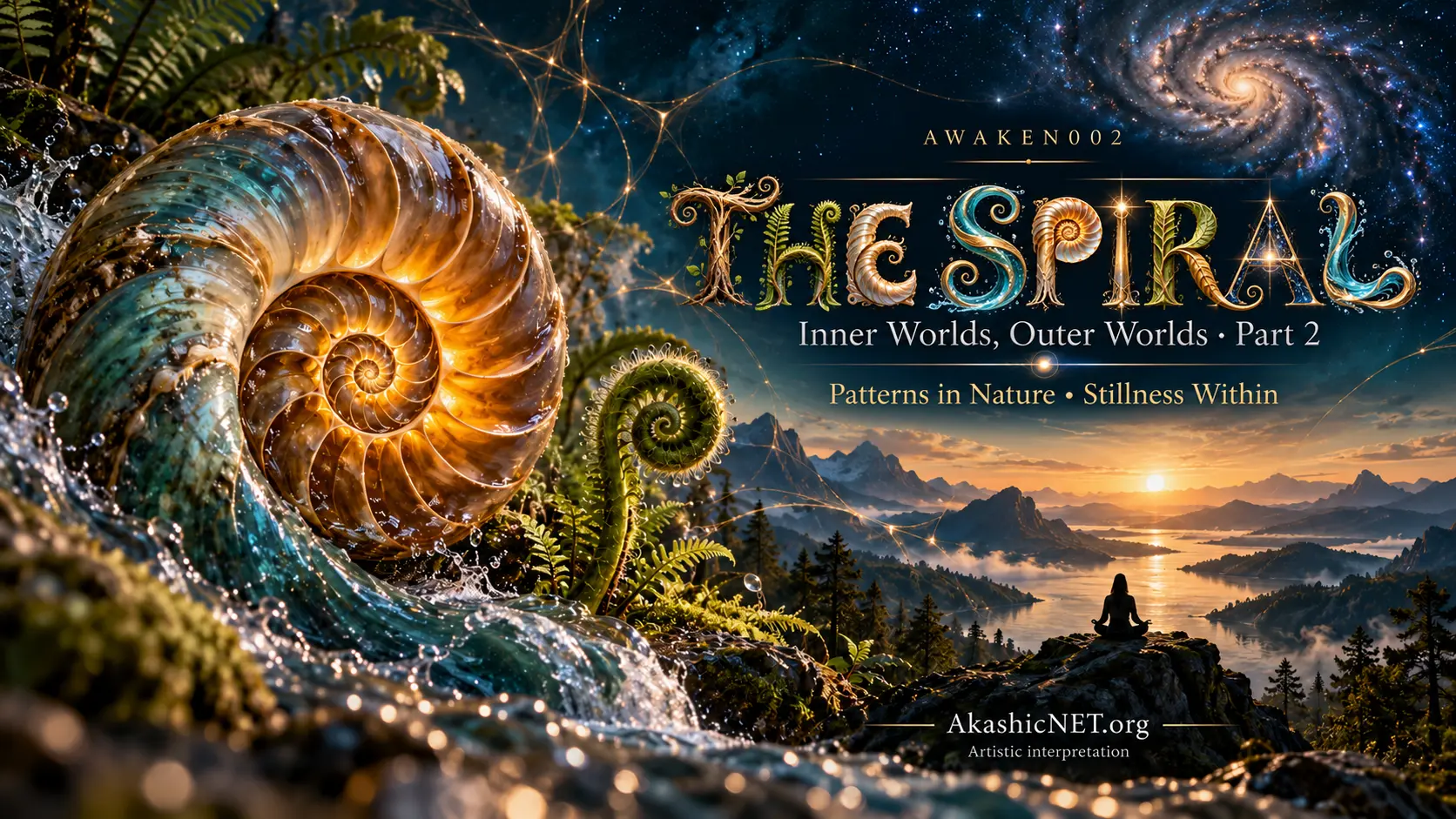
Artwork: the hero image was generated with ChatGPT for AWAKEN002. The fern, galaxy and contemplative scene form a symbolic composition, not experimental documentation. The animated background uses decorative logarithmic curves drawn in SVG. Pause them using the control above; reduced-motion preferences display a still background. The 2100 passage is original imaginative writing.
Synthesis and linked-source check: 23 October 2026. Reading time estimates article text at approximately 200–250 words per minute and excludes film playback and linked material. Article length: approximately 1,850 words including expandable notes, excluding navigation. Video: October 2012. Runtime verified in the embedded YouTube player: 32m:44s. Chapter timestamps were not independently verified.