
Consciousness2.0 Explorer · AkashicNET × N2N
Before The WordsIntention Awareness (Telepathy?)
Could telepathy be awareness of another being’s intention?
A sense of care. A readiness to act. A feeling that someone is about to say something. Could some experiences described as telepathy concern the direction of another being’s attention or purpose?
Research status: Untested hypothesis · Proposed protocol · No experimental results

Meaning, perception and explanation
Listening with the heart. Asking a precise question.
From a spiritual perspective, intention awareness might feel like becoming receptive to another being’s presence, care or purpose. A nondual interpretation could understand this through shared awareness. That is a philosophical lens through which to explore an experience.
Science asks what information the impression contains, how accurately it matches the other person’s intention, and which explanations remain after ordinary cues are considered.
Information in behaviour
In particular experimental tasks, observers can identify some intentions from movement cues. Cavallo and colleagues’ 2016 experiments studied this visible information. They were not tests of cue-free telepathy.
Information beyond those cues?
The additional hypothesis concerns accurate matching when ordinary communication is blocked. A compelling feeling or an occasional correct guess cannot identify the mechanism.
The feeling of knowing is an experience. Its accuracy can be tested. Its explanation is a further question.
One operational hypothesis
Can intention leave a measurable correspondence?
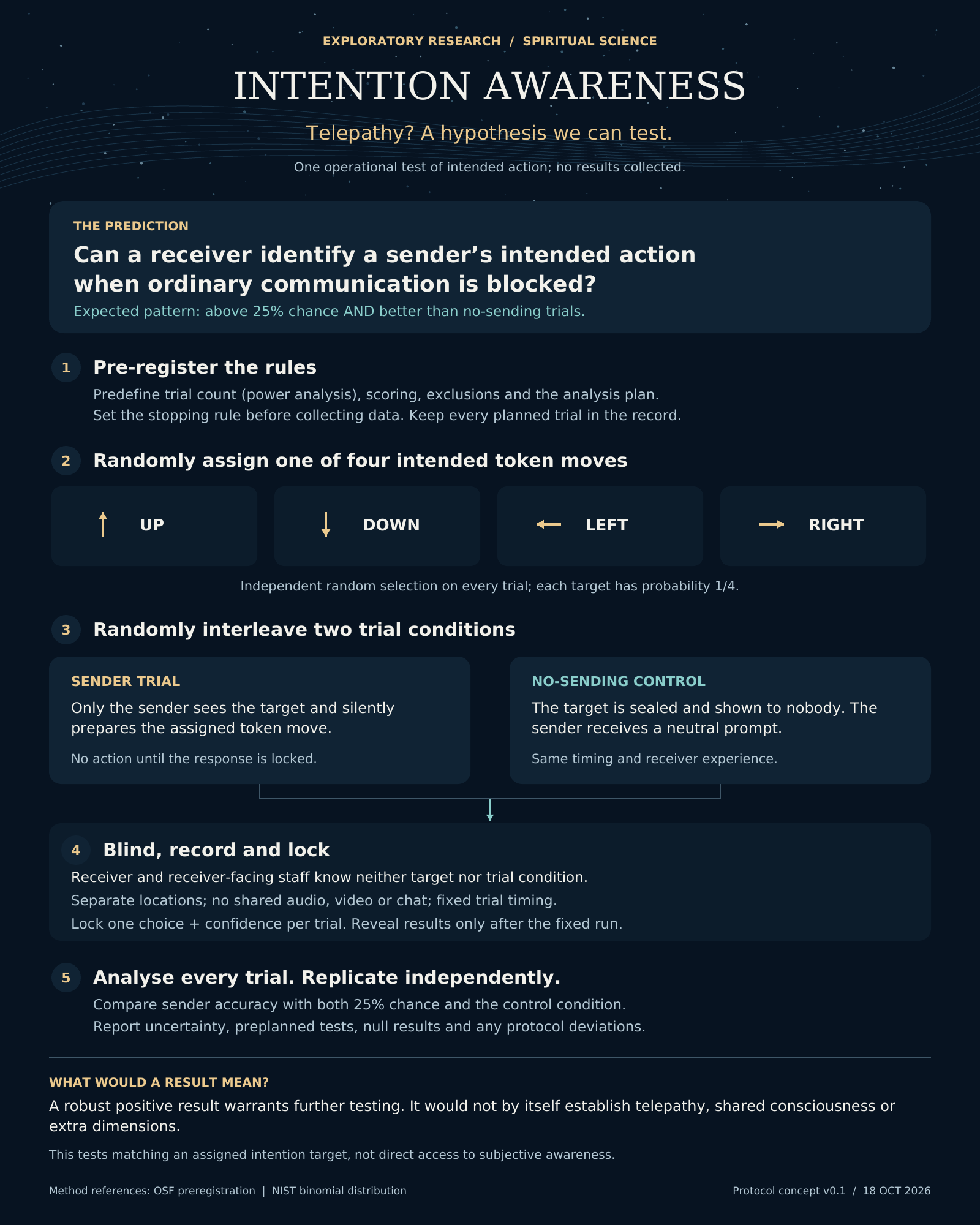
When ordinary communication is blocked, receivers will identify a sender’s randomly assigned intended action above chance and more often than in no-sending control trials.
For four equally likely targets, the chance expectation is 25%. A score merely above 25% is not sufficient: the planned analysis must assess uncertainty and the control comparison.
This is a deliberately narrow test of an assigned action target. It does not directly measure another person’s subjective awareness, and it cannot by itself establish a shared consciousness or an extra-dimensional mechanism.
A proposed blinded experiment
Make the question answerable.
The first test could use clear intended actions: moving a token up, down, left or right. Exact choices allow scoring without interpreting ambiguous impressions after the event.
Agree the rules before collecting data
Pre-register the prediction, sample size, session length, exclusions, stopping rule and analysis. Choose the trial count through a power analysis. Decide in advance how missing responses and any additional comparisons will be handled.
Randomly choose one of four intended actions
A computer independently selects a token move: up, down, left or right. Each has an equal probability on every trial. In sending trials, the sender silently prepares that action and waits until the receiver’s response is locked before moving.
Interleave sending and no-sending trials
Randomly alternate the conditions. In the control condition, the target is generated and sealed but displayed to nobody; the sender sees a neutral prompt. Keep timing and the receiver’s experience the same in both conditions.
Block cues and preserve blinding
Use separate locations with no shared audio, video or chat. The receiver and anyone interacting with them know neither the target nor the trial condition. The receiver’s device must never receive target values. Independently audit the software, timing and access controls.
Lock a response before revealing anything
Record exactly one choice and a confidence rating per trial. Timestamp and lock responses, with no correctness feedback until the fixed run ends. Keep all scheduled trials, misses and deviations in the record. Confidence and free-text impressions do not replace exact-match scoring.
Analyse the complete record and replicate
Compare sending accuracy with both chance and the control condition using the registered tests. Report effect sizes and uncertainty; account for repeated trials within pairs and sessions. Publish null findings and deviations, then seek an independently run, preregistered replication.
The sender’s compliance should also be recorded. Rules for noncompliance must be set in advance and must not depend on whether a guess was correct.
What different outcomes would mean
A result opens the next question.
No clear effect
No support under these test conditions. The uncertainty interval helps show which effect sizes remain plausible.
Both conditions unusually accurate
Investigate leakage, randomisation, software and analysis before attributing anything to the sender.
Sending exceeds chance and control
A robust result under audited controls warrants independent replication and further tests of alternative explanations. It would not, by itself, establish telepathy.
Closeness, meditative preparation or focused intention could become later research questions. Each would need its own planned comparison. This proposal does not assume that a stronger feeling produces stronger information transfer.
Public research record · Protocol concept v0.1
Read the method. Inspect the limits.
The record documents the prediction, targets, control condition, blinding, scoring, analysis requirements and source references. No study has been conducted. Sample size, timing and the full analysis must be settled before preregistration or recruitment.
The ZIP includes the protocol, source list and PDF/PNG diagram. These are public website downloads, accessible without this chat.
Research Footnote
From human connection to the living world.
This post extends the exploration of intention awareness across human–human and human–animal relationships. See the research record and proposed methodology and the related Animal–Human Connection exploration, including its human intention-awareness discussion.
Animal findings cannot automatically be extrapolated to humans or treated as evidence of a shared mechanism across species. Experiences of connection can motivate the question without establishing telepathy.
Sources and Transparency
- Cavallo et al. (2016), Decoding intentions from movement kinematics. Scientific Reports 6, 37036. Research on visible movement cues, not cue-free telepathy.
- Open Science Framework: Registrations & Preregistrations. Guidance for recording a study plan before collecting or analysing data.
- NIST/SEMATECH: Binomial Distribution. A reference chance model for independent forced-choice trials; the final analysis must reflect the actual study design.
Human-directed, AI-assisted synthesis, protocol design and artwork. Spiritual interpretation, ordinary intention perception and the proposed information-transfer hypothesis remain distinct. This page is not a validated test of personal ability, a recruitment invitation or a report of an experiment.