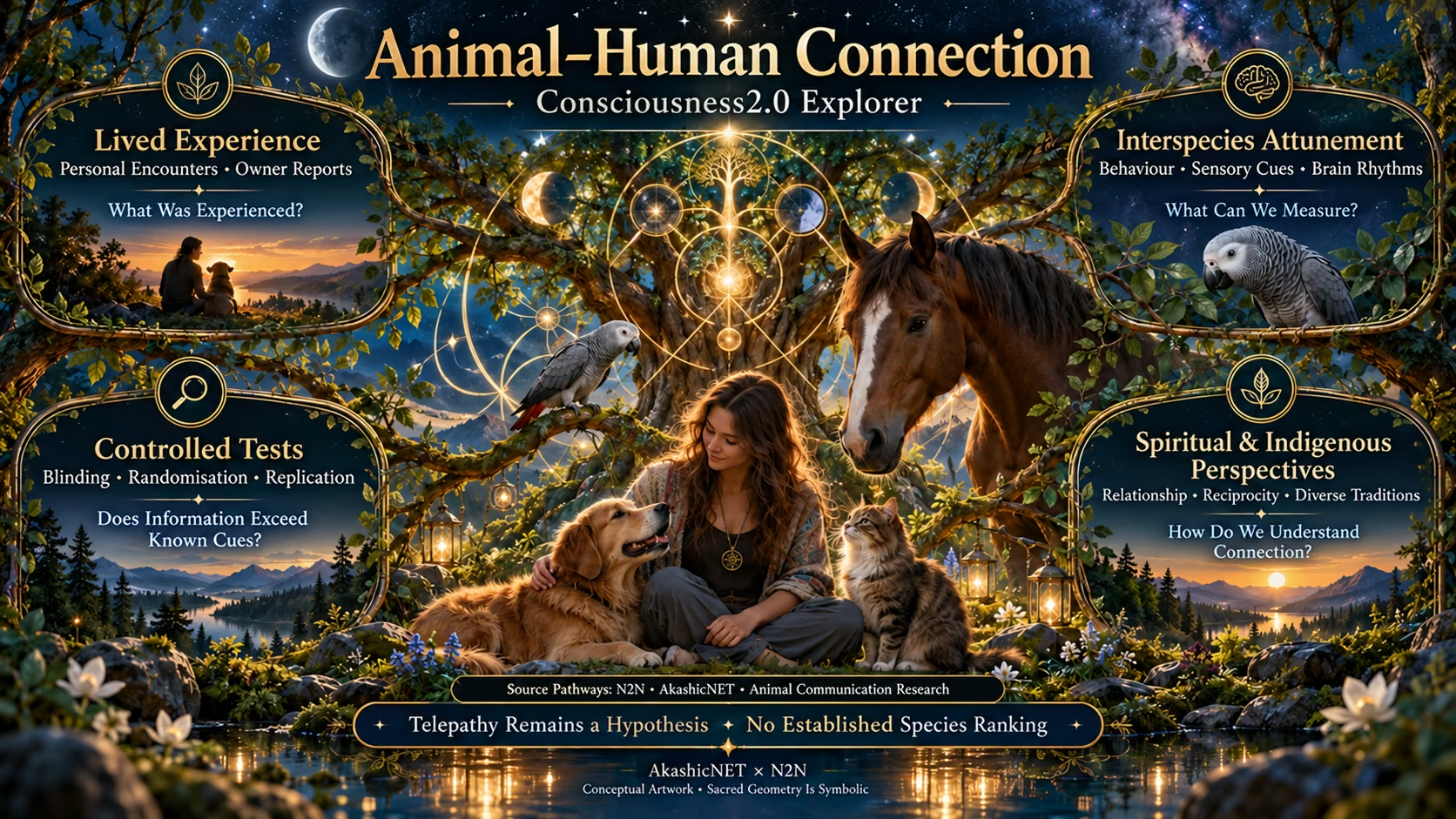
What was experienced?
Personal encounters and owner reports help us identify questions. Record what happened before interpreting why.

Consciousness2.0 Explorer · AkashicNET × N2N
Experience, attunement and the telepathy hypothesis.
Have you ever felt that an animal knew you were coming home, sensed your emotions before you spoke, or responded to an unspoken intention?
These encounters can be deeply meaningful. This exploration brings personal reports into conversation with animal cognition, experiments and diverse spiritual perspectives.
Four complementary questions
Personal encounters and owner reports help us identify questions. Record what happened before interpreting why.
Behaviour, familiar routines, scent, sound, gaze and brain rhythms reveal subtle forms of connection.
Concealed targets, randomisation, independent scoring and replication help distinguish competing explanations.
Reciprocity, responsibility and belonging can guide inquiry. Traditions differ and deserve attention in their own contexts.
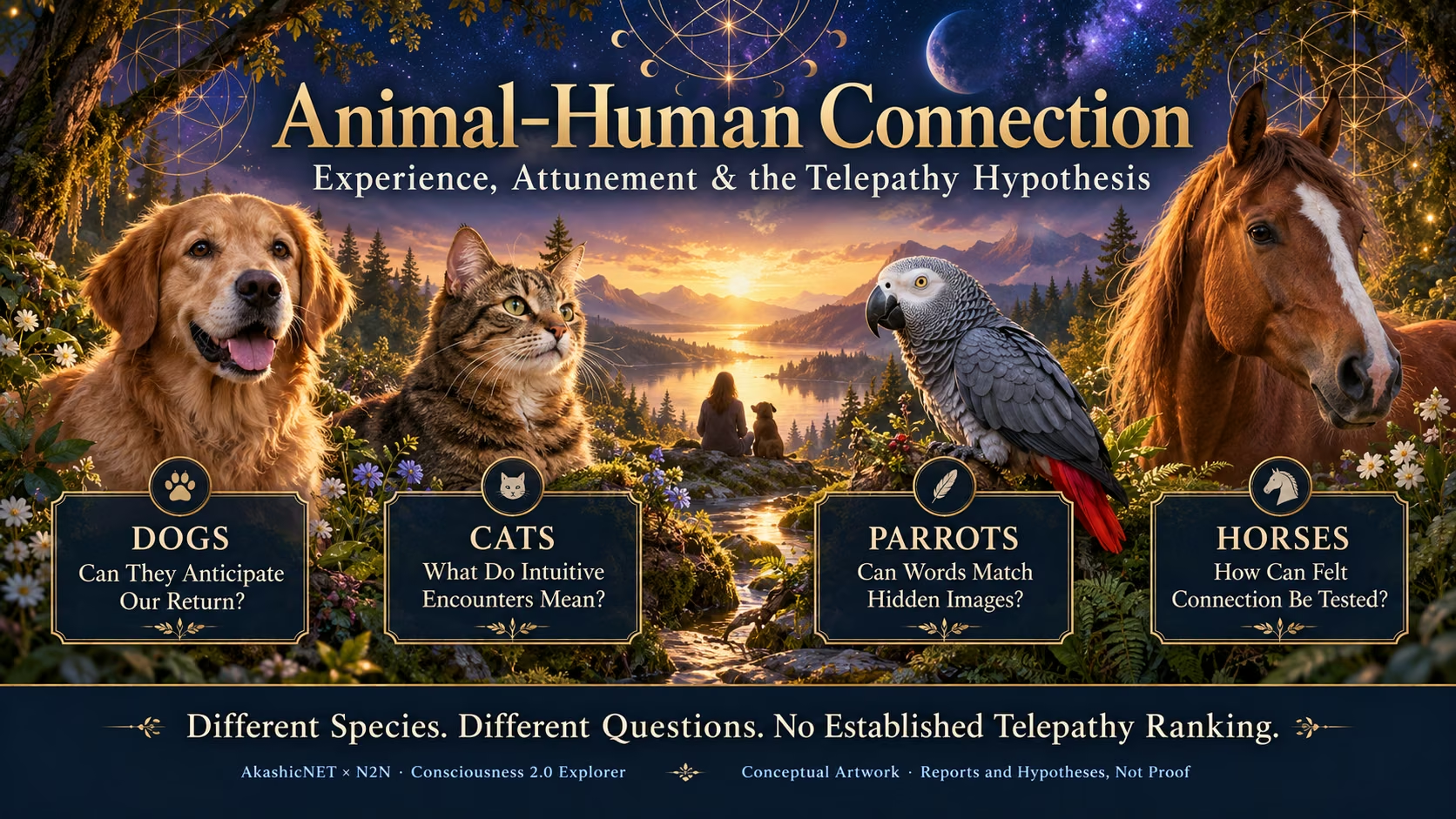
Different species · Different measures
Dogs
Sheldrake and Smart reported return anticipation in Jaytee. Independent investigators testing the same dog did not find support under their criteria. Interpretation and scoring remain disputed.
Selected animals and conflicting analyses do not establish a population-wide ability.
Cats
A California survey recorded return anticipation reports for 31% of cats versus 45% of dogs. These are owner reports, not verified telepathy rates. Separate experiments suggest cats track an unseen owner’s location using their voice.
Sensory abilities, opportunity to observe and owner expectations must be considered before inferring an unusual mechanism.
Parrots
The 2003 N’kisi experiment reported above-chance matches between one African grey parrot’s words and images viewed by his human companion, with blind transcription and statistical comparisons.
One selected bird cannot establish a species-wide ability. Independent replication was not verified in this bounded curation.
Horses
A 2016 exploratory study involving therapeutic riding horses and veterans collected favourable assessments of purported communication.
Meaning and usefulness ratings are different outcomes from accurate identification of concealed information.
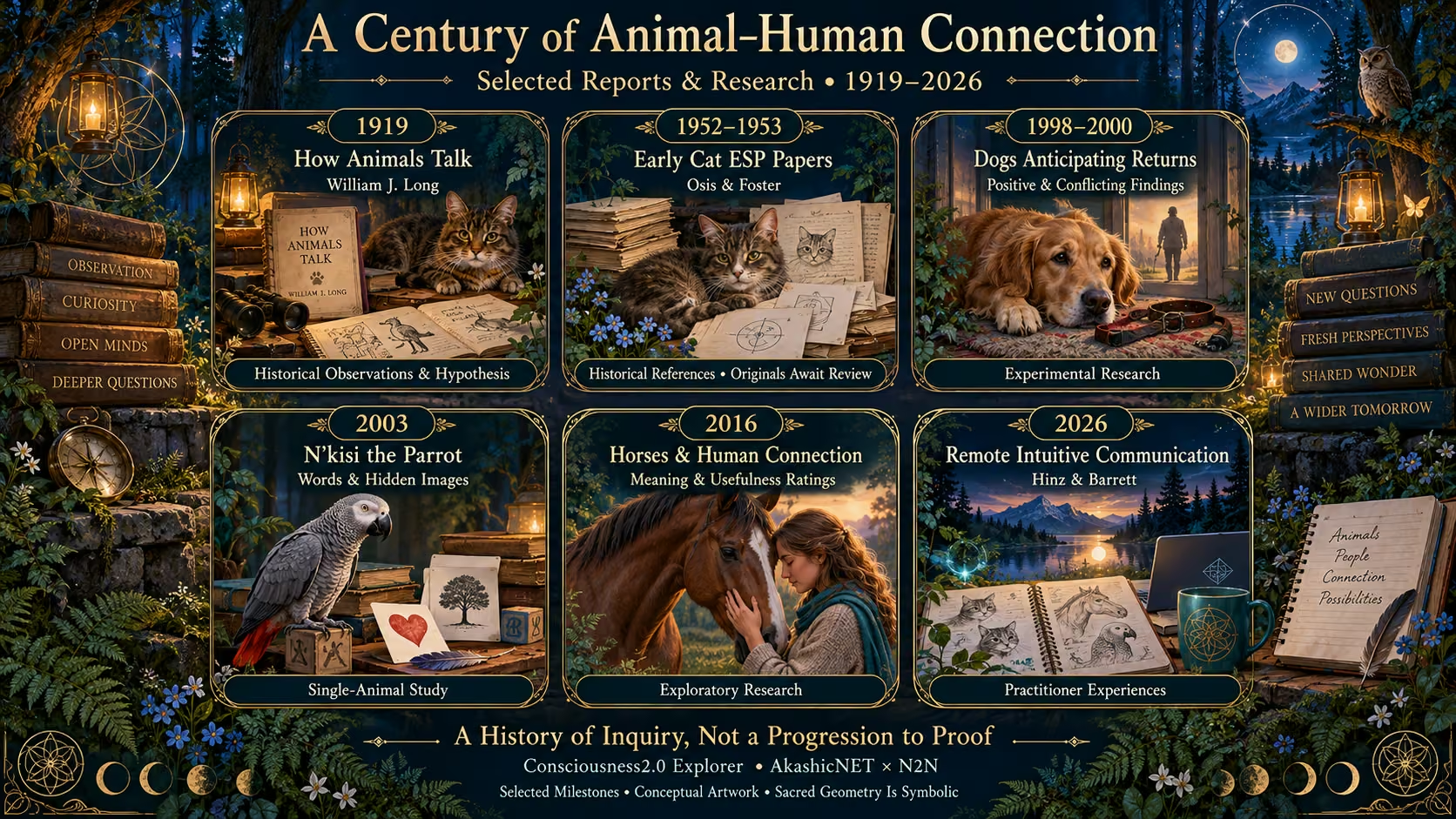
Selected milestones
The starting date marks an accessible historical publication, not the beginning of human relationships with animals or the first account ever recorded.
William J. Long’s observations and natural-telepathy hypothesis. The original text acknowledges that the proposed faculty was unproved.
Osis (1952) and Osis & Foster (1953) appear in later bibliographies. Original papers remain to be reviewed; no outcome is promoted here.
Owner surveys and experiments, including positive findings and conflicting analyses of Jaytee.
A single-parrot study of spoken words and hidden images.
Exploratory research into perceived meaning and usefulness.
Hinz & Barrett describe practitioner experiences and identify further questions about correspondence with animals’ circumstances.
Read Long’s original 1919 book. The Psi Encyclopedia overview also points to Durov’s early-1920s work, Max the dog near Munich in the 1930s and Henry Blake’s horse reports. Those remain pathways to original records, rather than newly verified results here.
Follow the source
Hinz & Barrett describe practitioners’ experiences using phenomenological and arts-based methods. Their abstract calls for further investigation of correspondence with animals’ actual circumstances. Abstract reviewed; this is not a concealed-target accuracy trial.
The Animal Communicator International Scan covers 400 websites, 191 books and 80 directory issues. These are discovery resources, not hundreds of independent experimental confirmations.
Vanessa Wijngaarden’s 2024 paper brings Indigenous and relational approaches into dialogue with intuitive interspecies communication. This is an anthropological perspective, not an animal telepathy effect-size estimate.
Communicating with Non-Human Intelligence is a 2024 gathering resource. The 2026 Mind2Mind presentation concerns related human research. Event descriptions are not animal trial results; recordings were not reviewed for this page.
The Society for Psychical Research’s Psi Encyclopedia supplies a secondary overview and bibliography. Trace individual claims to their original studies and critiques before interpreting them.
Dogs, Brainwaves & Interspecies Consciousness and Morphic Resonance & Cosmic Memory offer community discussion and hypotheses, with specific claims still requiring source checking. Explore Conscious Beings, Living Worlds and AkashicNOETIC for the wider context.
Compassionate citizen science
This is a starting point for study design, not a validated protocol or a recruitment invitation. No experiment has been run for this page.
What did you experience, with which animal, and what would help distinguish familiar cues from something still unexplained?
Continue the conversation on N2N ↗Footnote · Added 18 October 2026 · Proposed inquiry
Could one being accurately perceive another’s unspoken intentions, and could that accuracy be objectively tested under conditions that exclude familiar sensory cues?
Emotional closeness and intention strength are possible factors to investigate. Animal findings cannot automatically be extrapolated to humans. Finishing a partner’s sentences or sensing their mood may reflect familiarity, shared context and subtle cues. Spiritual interpretations can motivate inquiry; they do not establish the mechanism.
A proposed pilot could randomly assign a sender one of four equally likely intended messages, such as offering comfort, expressing gratitude, asking for help or inviting play. An isolated receiver would record a choice and confidence before disclosure. This tests identification of an assigned message, not direct access to another person’s entire subjective experience.
Compare close partners with unfamiliar pairs, include separately analysed no-message trials, prevent ordinary communication and blind the receiver and their supervisor to the condition. Fix the sample size, stopping rule and scoring before collecting data; retain every trial. Chance accuracy on the four-choice message trials is 25%. Analyse repeated trials within pairs appropriately and seek independent replication.
To investigate “stronger intentions,” randomly compare ordinary and focused expression while keeping duration fixed; ask senders to rate intensity before feedback. This tests a focusing instruction, without assuming a measurable intention energy. A positive result would initially establish an unexplained correspondence, not its cause or proof of telepathy.
This is a study-design sketch, not a validated protocol, recruitment invitation or reported experiment.
Selected historical reports and research published between 1919 and 2026. Original sources were checked where accessible; some records were assessed from abstracts, bibliographies or event descriptions. The 1952–1953 cat papers remain original-source review leads. This is a developing curation, not an exhaustive or systematic review.
Human-directed, AI-assisted research synthesis and artwork. Community reposts are not counted as independent replications. Sacred geometry is symbolic. Telepathy remains a hypothesis; these sources do not establish a higher-dimensional information store or a shared mechanism.
The horse and parrot illustrations depict representative animals, not documentary photographs of study participants. Research depth and personal meaning are distinct from certainty about an explanation.