The Faster the Map, the Greater the Responsibility
An AI system can connect a personal account of an unusual experience, a neuroscience paper and a contemplative teaching in seconds. It can compare language, surface patterns and produce a compelling map of apparent relationships.
That speed is useful. It is also dangerous.
A compelling map is not necessarily a trustworthy one. The experience may be real as a report of experience. The paper may support a narrower scientific claim. The teaching may carry a distinct history, context and authority. Similar words do not prove that these sources describe the same phenomenon.
This is the central thesis of human–AI knowledge work: AI can accelerate connection, but humans remain responsible for meaning, evidence, boundaries and consequences.
The task is not to reject synthesis. It is to make synthesis accountable before a plausible pattern hardens into a public claim.
A Living Library Needs More Than One Gardener
Imagine an old post asking whether consciousness might extend beyond the individual. One person remembers a powerful experience. Another brings research. A third points to a contemplative tradition. AI helps locate related material and organise the discussion.
Within moments, a shared library begins to take shape. But every new connection also creates a duty of care:
- What did each source actually claim?
- Which parts are evidence, interpretation or testimony?
- Whose context or consent might matter?
- What has the system overlooked?
- Who is responsible if the connection misleads someone?
If we connect everything too quickly, the library may look profound while quietly erasing the distinctions that make it useful. If we refuse every connection, we lose the possibility of discovering relationships across fields and forms of experience.
Human–AI stewardship is the practice of holding both needs together: use AI to extend attention, while preserving human judgment, source integrity and shared accountability. It begins where automated pattern-making ends: with the human work of checking, contextualising, limiting and, when necessary, saying no.
A Curated Spine, Not an Oracle
AkashicNET did not begin with an AI prompt. Its roots include years of human-curated posts and conversations in r/NeuronsToNirvana, followed by an expanding collection of sources, questions, notes and proposed relationships. Metadata and AI-assisted analysis can help make that history navigable.
But the size of a collection is not a measure of its truth. Thousands of links are not thousands of independent confirmations. A topic appearing often may reflect the curator’s interests, a community’s conversations or the way material was collected.
This matters when we ask AI for a “comprehensive” answer. The wording of a question can change which sources and frameworks come into view. A consciousness question framed through neuroscience may yield a different map from one framed through contemplative practice, philosophy or lived experience. Neither map should quietly pretend to be the whole territory.
A responsible answer should say which lenses it selected, why, what it actually examined and what remains outside its view. It should welcome a request to try another lens.

What the Research Adds
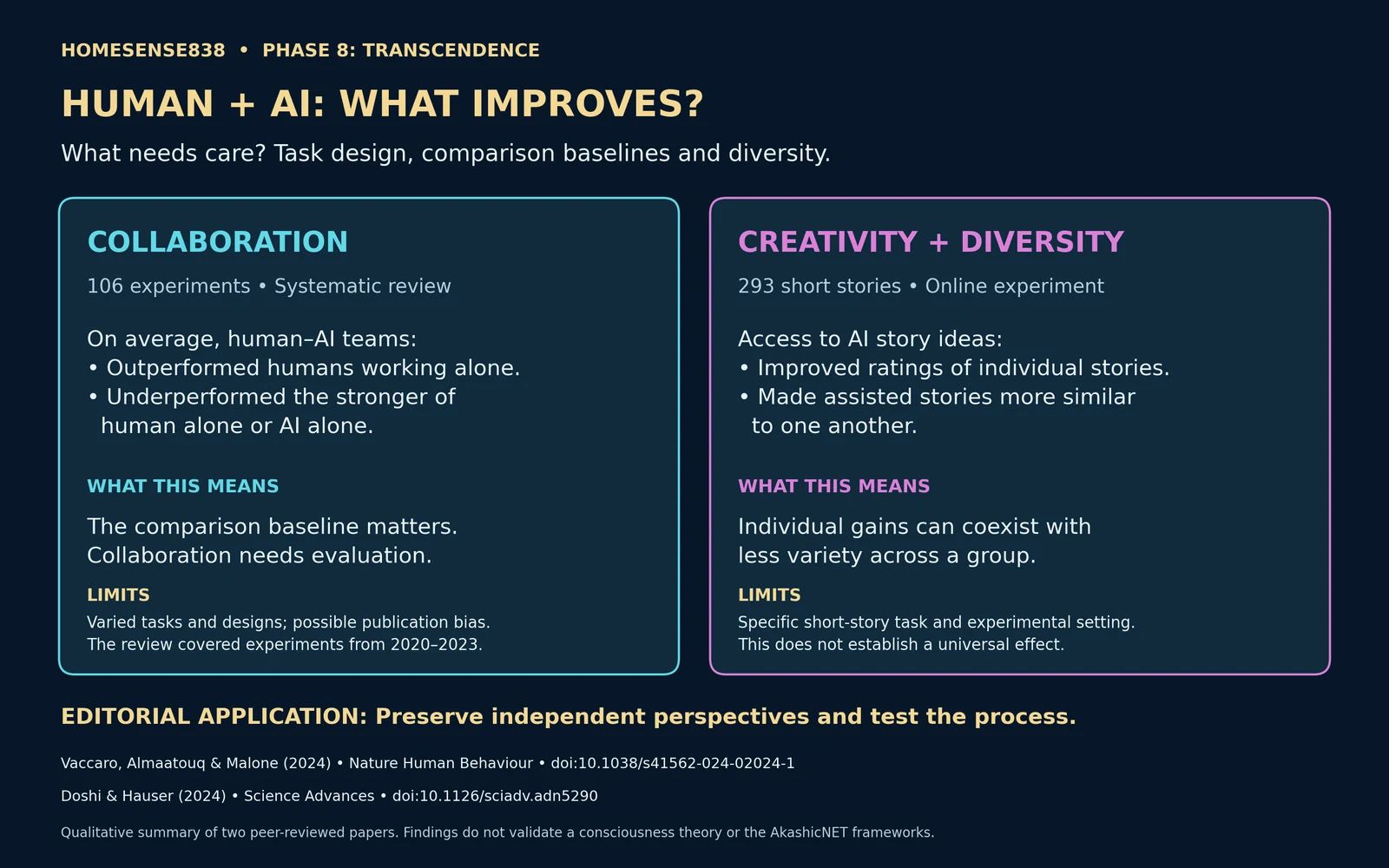
The promise of collaboration deserves a test. A preregistered systematic review and meta-analysis of 106 experiments found that human–AI combinations performed better than humans alone on average, yet worse than the better of human or AI alone. Outcomes varied substantially by task. Creation tasks looked more promising than decision tasks, although the estimated gain for creation tasks alone was not statistically conclusive. [1]
This asks us to identify which work assistance actually improves. Searching, grouping and drafting may benefit, but the review does not establish that a human reviewer always improves accuracy. Human accountability also concerns consent, context and consequences, which a task score cannot settle. The review covered selected experiments from 2020–2023, with varied designs and possible publication bias. It is not a benchmark of every current AI system.
In a separate online experiment involving 293 short stories, access to AI ideas improved evaluators’ ratings of individual stories, while AI assisted stories were more similar to one another. This was a specific writing task, not proof that AI always reduces diversity. [2]
Our practical proposal is to invite independent perspectives before circulating an AI summary, preserve disagreement and check whether the process improves the result. These are editorial safeguards to evaluate, not interventions proven by these two papers.
Five Commitments for Human–AI Stewardship
1. Trace: show the trail. Link to original sources. Distinguish quotation, summary and interpretation. Identify an AI suggestion that still needs checking.
2. Distinguish: keep evidence in its lane. Testimony describes what someone reports. Research tests specified questions under specified conditions. Philosophy and contemplative traditions offer interpretations with their own histories.
3. Respect: protect people and context. Public accessibility does not settle consent, privacy or cultural authority. Consider how recirculation may affect the person or community represented.
4. Revise: preserve uncertainty and correction. Give unresolved questions a visible status. Update an error and record what changed.
5. Consider consequences. Ask who benefits, who checks the work, who could be harmed and what resources the tools consume. The responsibilities should have named human owners.

Three Sources, Three Kinds of Claim
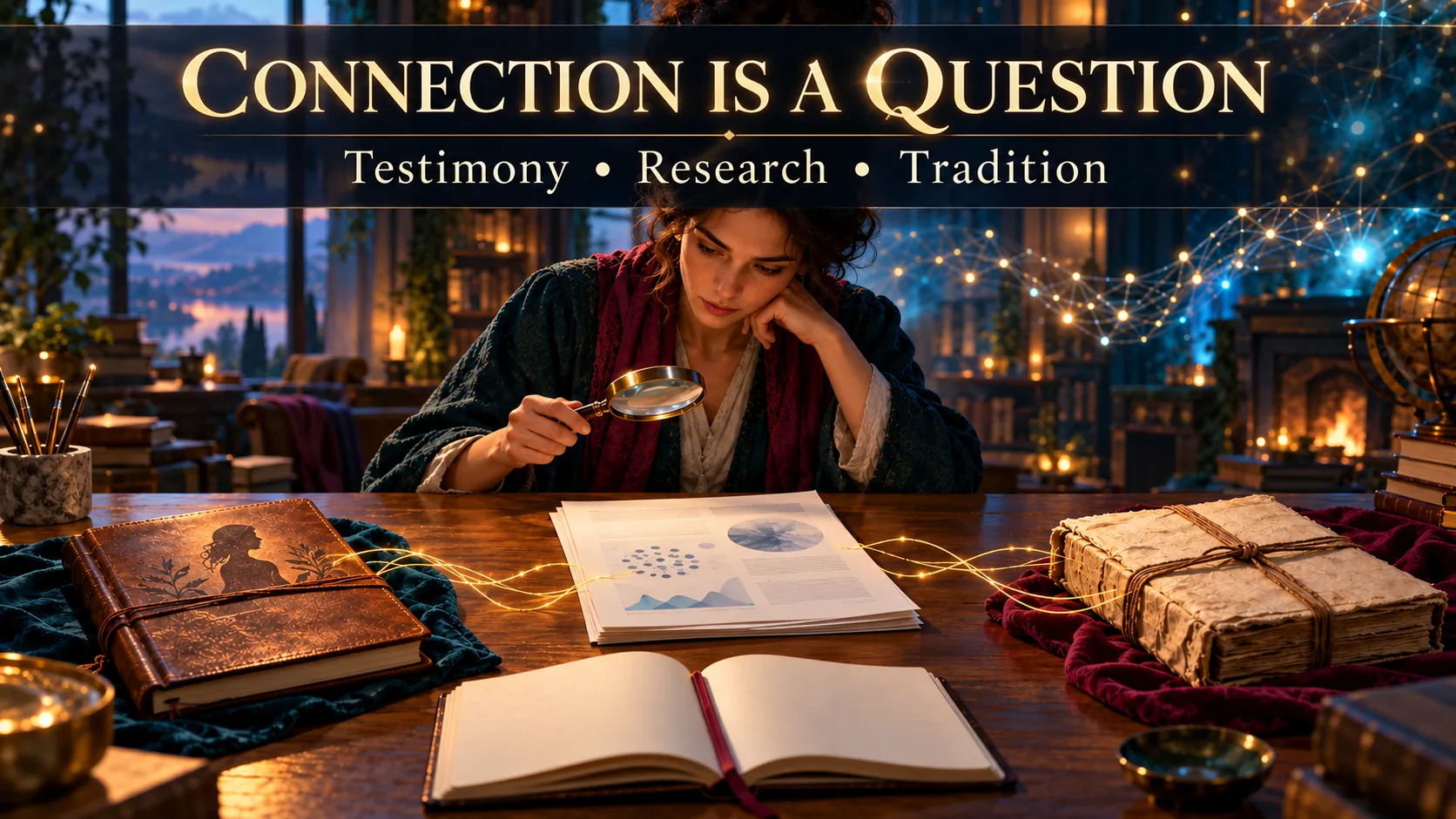
Suppose a contributor describes a vivid sense of connection during meditation. A neuroscience paper examines a measurable change in attention. A contemplative text describes interdependence. This is an illustrative scenario, not a report from a particular participant.
An AI summary might announce that all three confirm one theory of consciousness. A steward would slow the claim down:
- Testimony: a contributor reports an experience. Respect for that account does not establish a general mechanism.
- Research: a paper measured an outcome in a defined population and setting. Keep the claim within those limits.
- Tradition: a teaching has a particular context. Do not rewrite it as a laboratory finding.
- Possible connection: the sources may illuminate one another. That relationship remains an interpretation to examine.
Readers should be able to follow each thread and decide where the proposed connection holds.
Questions Worth Asking the AI
Ask: What are the strongest and weakest links? Which claims are directly supported? What would a knowledgeable critic challenge? What perspectives are missing? Which material requires consent or cultural context?
Then inspect the cited material. If the source is absent or says something narrower, revise the answer. A citation offers a route to verification; it does not complete the verification.
Transcendence as Responsibility
Phase 8: Transcendence is an editorial and reflective theme. Here it means looking beyond the isolated self or system and asking how wider connection can deepen care. It is not a scientific stage or a finding established by the studies above.
Care includes the contributor whose words could be taken out of context, the reader who needs visible uncertainty, communities with their own knowledge custodians, and the environment supporting our digital tools. This essay has not measured its computing footprint; acknowledging resource use should lead to measurement and proportionate choices.
Hope, love, harmony and peace become more credible when they shape how we handle evidence and people.

A Practice We Can Improve Together
A shared library can hold a supported finding beside a disputed interpretation, an attributed lived account and an open question. Readers should be able to tell which is which.
AI can widen a search and suggest connections. People remain responsible for how those suggestions are checked, shared and used. The strongest collaboration is one whose process can be examined and corrected.
If you spot a missing source, mistaken reading or excluded perspective, bring it forward through r/NeuronsToNirvana or the contact page. The next connection should make the library more accountable as well as more expansive.
Sources and Scope
- Vaccaro, Almaatouq & Malone (2024). When combinations of humans and AI are useful: A systematic review and meta-analysis. Nature Human Behaviour, 8, 2293–2303. DOI: 10.1038/s41562-024-02024-1.
- Doshi & Hauser (2024). Generative AI enhances individual creativity but reduces the collective diversity of novel content. Science Advances, 10, eadn5290. PubMed abstract and figure descriptions.
This was a targeted source check, not a systematic review for this essay. The first paper’s main text and the second paper’s abstract and figure descriptions were examined. Underlying datasets and supplements were not independently audited. The findings inform specific claims about collaboration and creative output; they do not validate a consciousness theory or the AkashicNET frameworks.
Transparency: Who Shaped This Post?
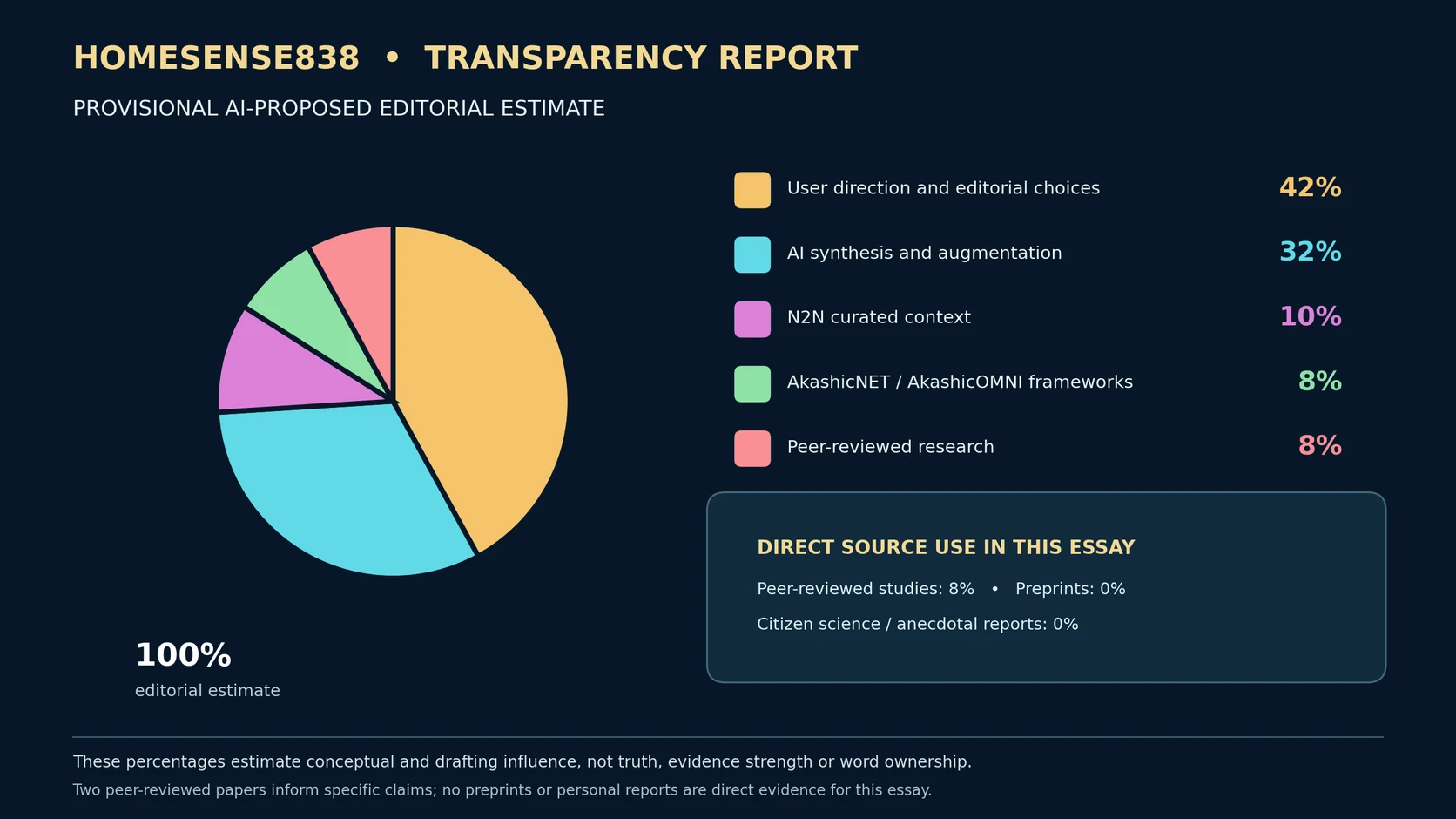
The following is a provisional AI-proposed editorial estimate. It describes perceived influence on this essay, not measured authorship, evidence strength, word ownership or a validated attribution method. Categories overlap in practice; the pie allocates them once for illustration.
| Contribution | Estimate |
|---|---|
| User direction and editorial choices | 42% |
| AI synthesis and augmentation | 32% |
| N2N curated context | 10% |
| AkashicNET / AkashicOMNI frameworks | 8% |
| Peer-reviewed research | 8% |
| Preprints | 0% |
| Citizen science / anecdotal reports as direct evidence | 0% |
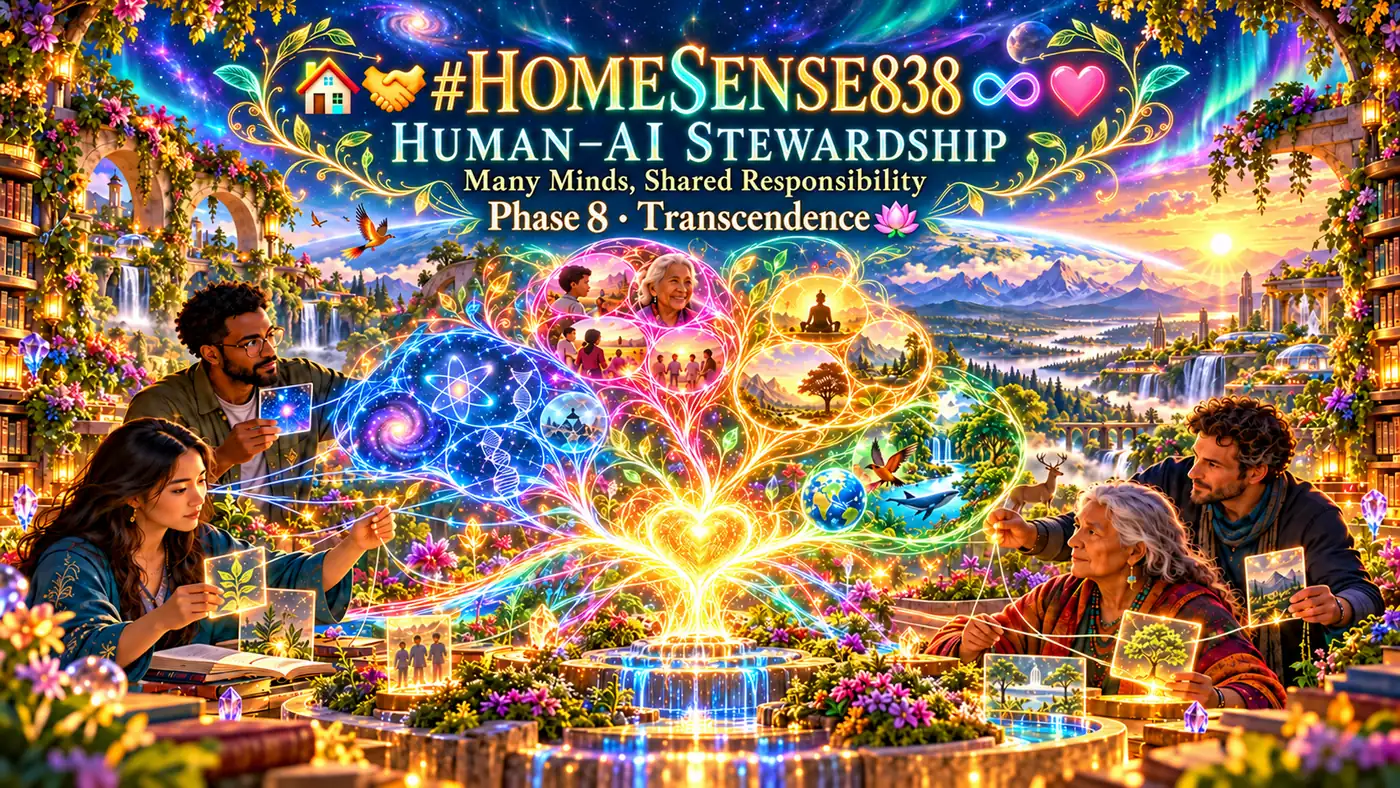
Two peer-reviewed papers directly inform the research section. N2N and framework shares reflect the supplied project context, not an audit of the entire archive. No individual lived account is used as direct evidence. Six illustrations are AI-generated artistic metaphors; the research summary and pie chart were composed programmatically for exact text and values. Human editorial responsibility remains with the publisher.