Two 5 g jars · 10 g total
- Label: “Nukini Onça Rapé”
- Purchased from Happy 420
- Onça means jaguar in Portuguese
- Maker, batch, full formula, nicotine analysis, community authorisation and benefit-sharing are not identified on the visible label


AKASHICOMNI v0.3.0 ADDENDUM · 18 SEPTEMBER 2026 · 9 MIN READ
A personal rapé ceremony, Bodhisattva vows and the responsibility behind the Nukini name.
Personal testimony · exact quantities
I recently bought two 5 g jars labelled “Nukini Onça Rapé”—10 g in total. They joined three earlier 15 g jars labelled “Chacruna”—45 g in total—acquired in Hungary.
The names carried imagery, cultural associations and implied origins, but the labels did not identify who made each preparation, what each batch contains, who authorised the names or whether value returns to the people represented.
This is not a product ranking. It is a movement from consumption towards context, accountability and reciprocity.
Personal ceremony · Bodhisattva orientation
Rapé has become part of a personal contemplative ceremony in which I renew a Bodhisattva-oriented vow:
I vow to know the Dharma.
For me, that means listening, learning and translating inner experience into service—not collecting spiritual identities.
These are personal words and embodied metaphors. They are not medical claims about the heart, microbiome or nervous system, and they do not make my ceremony an Indigenous rite.
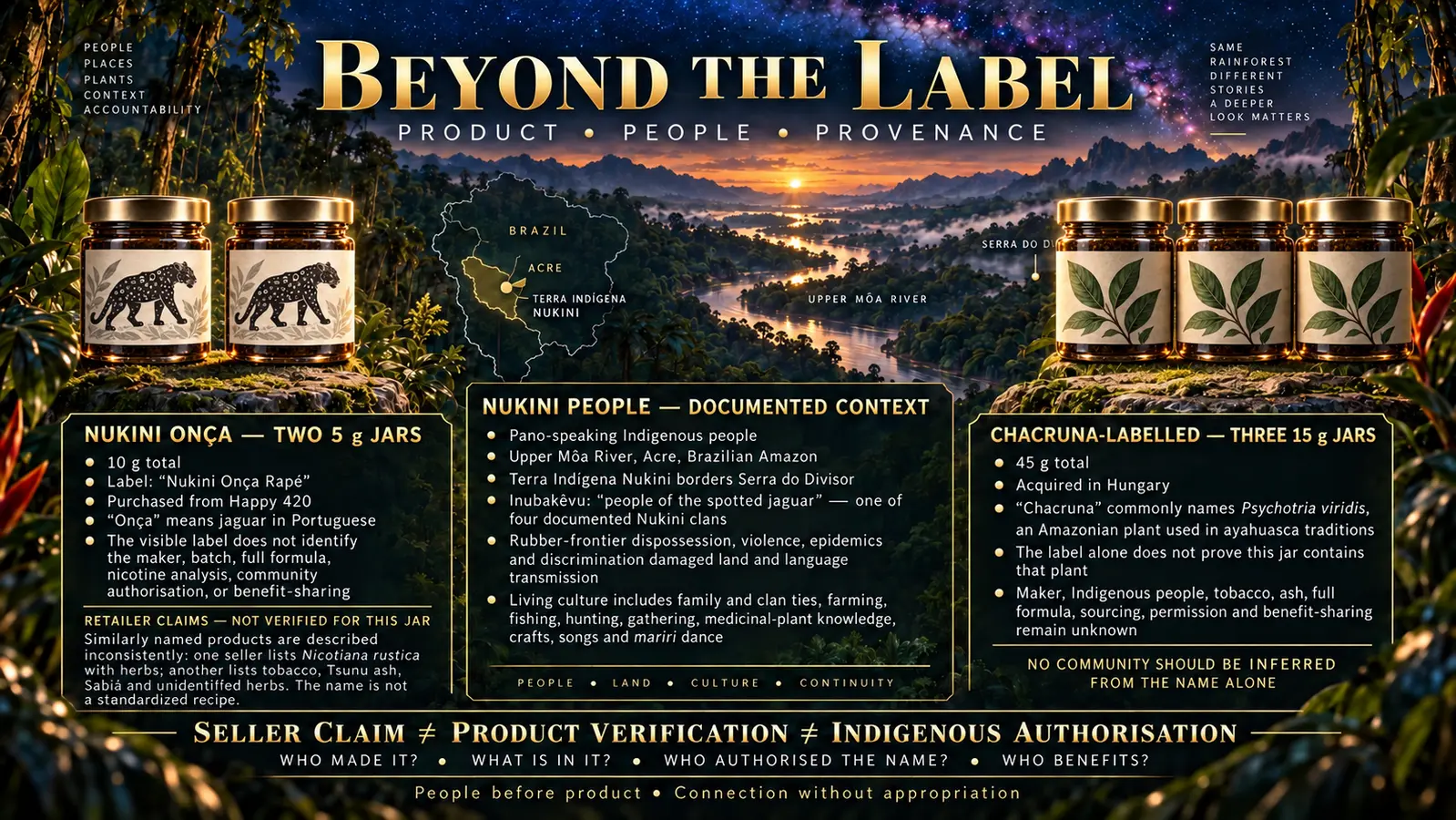
Product · people · provenance
Documented Indigenous context
The Nukini are a Pano-speaking Indigenous people whose territory lies on the upper Môa River in Acre, in the western Brazilian Amazon near Peru. Terra Indígena Nukini borders Serra do Divisor National Park.
The jaguar association has documented Nukini context, but it does not authenticate every commercial jar carrying an Onça image.
Nukini profile · Povos Indígenas no Brasil / Instituto Socioambiental ↗
Seven directions · personal synthesis
I encountered a seven-direction tobacco ceremony in a Mexican context and adapted its spatial structure into my own practice. These meanings are personal contemplative prompts—not a reconstruction of one authenticated Mexica ceremony.
CARE · ethical lens, not product certification
The CARE Principles concern Indigenous data governance. They are applied here as questions for respectful knowledge use—not as approval of a seller, product or ceremony.
Indigenous peoples should benefit, not merely be referenced.
Communities retain authority over their identities, knowledge and cultural material.
Outsiders must be transparent and accountable in how names and knowledge are used.
Indigenous rights and wellbeing come before novelty, access or convenience.
Is the maker named because they chose to be named?
Is a community name used with permission?
Does material benefit return to the people represented?
Are protected knowledge and the right not to disclose respected?
I feel connection—not ownership. I receive with gratitude—not entitlement.CARE Principles · Global Indigenous Data Alliance ↗
Evidence boundaries
Cardiac biomagnetic activity can be detected with sufficiently sensitive instruments. That does not establish a health benefit from rapé or scientifically verify a personally perceived energy field.
People may report energetic, spiritual or embodied sensations. Testimony can be meaningful without becoming laboratory proof.
Shamans, aghoris and other practitioners may describe forms of sensing beyond ordinary instrumentation. Accurate attribution matters; testimony alone does not establish a measurable mechanism.
Extended sensing can remain a question for careful research. “Unresolved” is a valid evidence status.
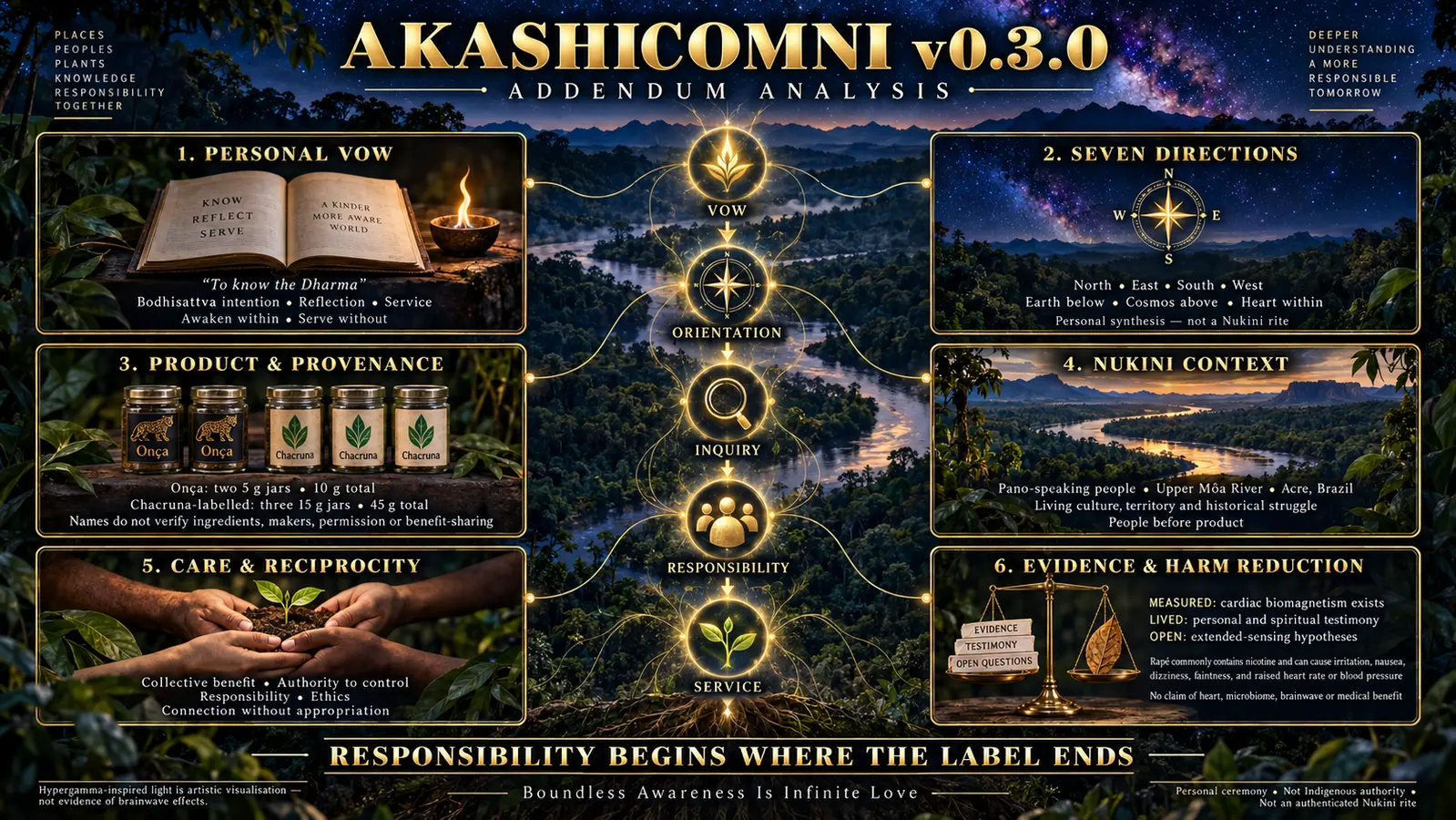
AkashicOMNI v0.3.0 addendum
This addendum maps a five-stage movement:
Practice becomes more ethical when it carries humility about what is unknown; clear separation of evidence, interpretation, testimony and hypothesis; respect for Indigenous authority and protected knowledge; attention to health and dependence; and reciprocity beyond symbolic appreciation.
Health and harm reduction
Rapé commonly contains tobacco and nicotine. Exposure can cause irritation, nausea, vomiting, dizziness, faintness, sweating, changes in heart rate and increased blood pressure; regular exposure can create dependence.
This article does not claim that rapé heals the heart, benefits the microbiome, produces hypergamma brain activity or treats any condition. Light described as “hypergamma-like” in the artwork is an artistic visualisation—not a brainwave measurement.
Seek urgent medical help or contact a poison service for chest pain, breathing difficulty, fainting, severe palpitations, confusion, seizure or severe or persistent symptoms.
Follow the inquiry
Transparency note: this publication combines personal testimony, published cultural context, retailer descriptions and harm-reduction information. Seller claims are not treated as independent verification.