
AKN24 · GLOBAL SYSTEMS DESK · 14 SEPTEMBER 2026
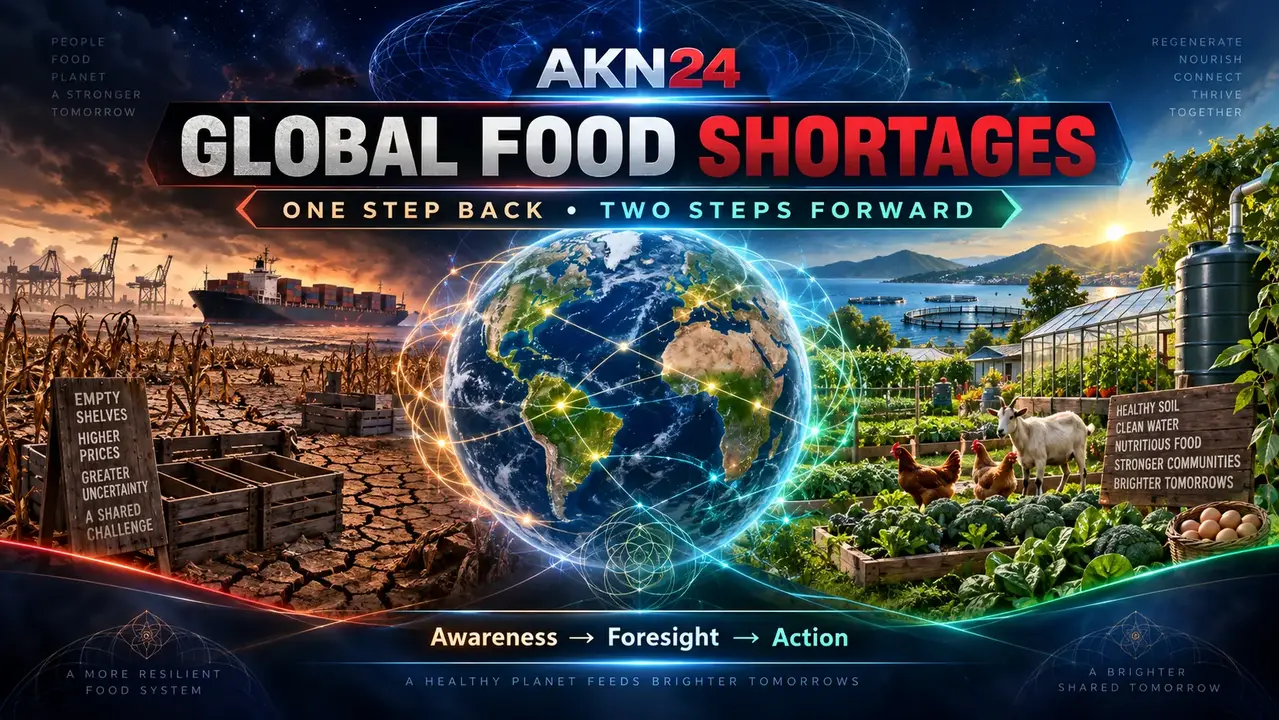
Global Food
Shortages
ONE STEP BACK · TWO STEPS FORWARD
The world does not face one uniform shortage. It faces overlapping crises of hunger, affordability, access, nutrition and resilience. An AkashicOMNI v0.3.0 analysis of what is happening, why narrow awareness can deepen it and how foresight can become action.
THE SITUATION
Improvement in one global measure can coexist with deepening crisis elsewhere.
SOFI 2026 estimates that the global prevalence of hunger eased in 2025. GRFC and WFP figures still show hundreds of millions facing acute food insecurity in crisis-affected settings. These are not contradictions: the datasets answer different questions, cover different populations and use different thresholds.
7.8%
of the global population faced hunger in 2025
SOFI 2026 global estimate; down from 8.1% in 2024, but progress was uneven.
≈345m
people faced high levels of acute food insecurity
GRFC 2026 estimate across assessed crisis contexts; not the same measure as chronic hunger.
318m
people projected to face crisis-level hunger or worse in 2026
WFP Global Outlook planning estimate, subject to changing conflict, climate and funding conditions.
133.3
FAO Food Price Index in August 2026
Up 1.9% from July and 2.5% year-on-year, while remaining 16.8% below the March 2022 peak.
What “shortage” can mean
Availability: insufficient food in a place. Access: food exists but people cannot afford or safely reach it. Nutrition: calories are available but healthy diets are not. Stability: supply or access repeatedly fails under shock. A strong analysis asks which condition exists, where, for whom and for how long.
WHY THE SYSTEM BREAKS
Pressure becomes crisis through interaction.
Conflict and displacement
War removes land and labour from production, damages storage and ports, blocks aid and destroys purchasing power.
Climate and ecological stress
Heat, drought, floods, water scarcity, soil degradation and biodiversity loss make harvests and livelihoods less predictable.
Prices and inequality
Inflation, poverty, debt and unequal bargaining power convert a market shock into hunger even when food remains available.
Concentrated logistics
Dependence on a small number of exporters, routes, fuels, fertilisers and storage systems lets local disruption cascade.
Loss and waste
Food lost between farm and market or wasted after purchase reduces effective supply while consuming land, energy and water.
Aid and governance constraints
Late warning, political obstruction, funding gaps and weak accountability allow preventable deterioration.
THE AWARENESS GAP
Are less-aware leaders part of the problem?
Potentially, but this is an interpretive systems claim, not a clinical judgement about particular people. Decisions become more harmful when leaders and institutions cannot or will not examine their assumptions, read social conditions, recognise the humanity of distant people or trace consequences across an interconnected system.
Low awareness is not the sole cause. Structures matter: incentives, concentrated ownership, historical inequality, conflict, debt, infrastructure and ecological limits shape what leaders can see and do. Awareness without power or resources is insufficient; power without awareness is dangerous.
“One step back to perceive the whole. Two steps forward through foresight and action.”
AKASHICOMNI v0.3.0 · TRUE 13D ANALYSIS
Thirteen lenses. One food system.
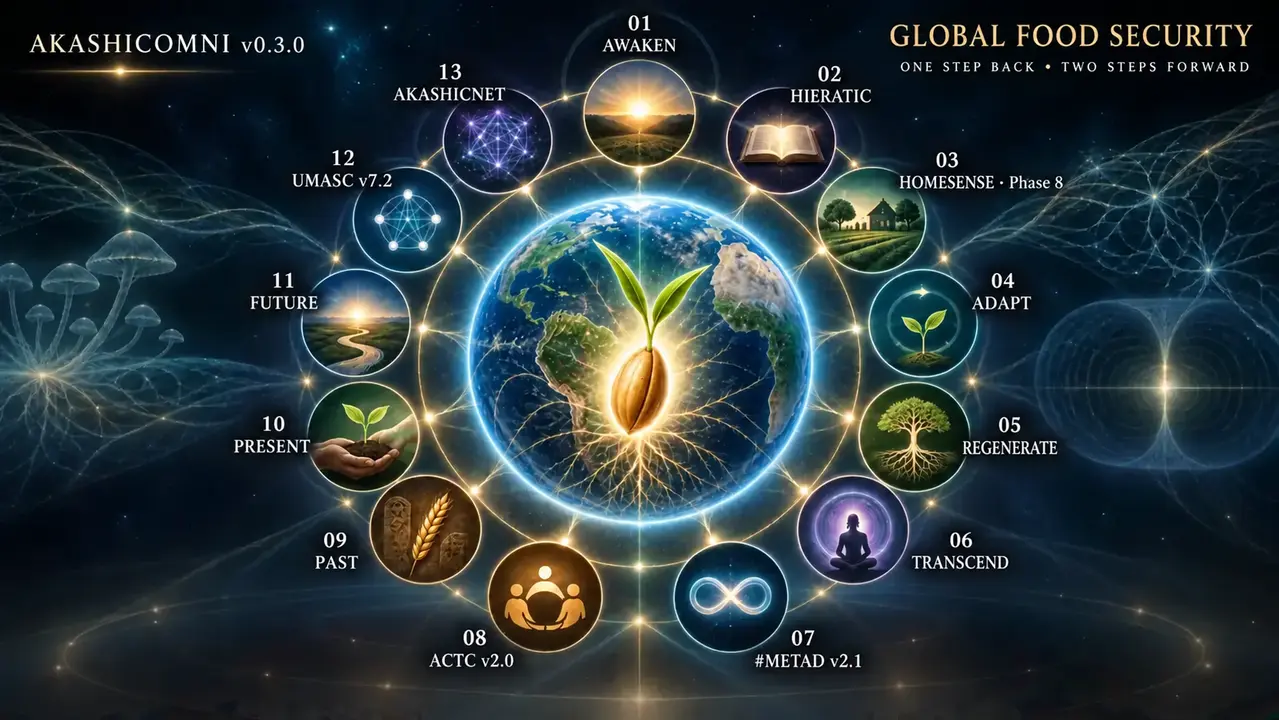
AWAKEN
Notice hunger without reducing it to a distant statistic.
HIERATIC
Treat food, soil and water as culturally meaningful relationships as well as resources.
HOMESENSE · Phase 8
Begin with kitchens, farms, markets and the lived reality of access.
ADAPT
Protect people now while adapting production, storage and distribution.
REGENERATE
Restore soils, watersheds, biodiversity and farmer agency where possible.
TRANSCEND
Move beyond zero-sum scarcity narratives toward shared planetary stewardship.
#METAD v2.1
Compare supply, access, nutrition, conflict, climate and governance explanations.
ACTC v2.0
Map actors, incentives, constraints, timing and causal pathways before assigning blame.
MultidimensionalCUT v4.0.0 · PAST
Trace colonial extraction, land concentration, conflict and earlier price shocks.
MultidimensionalCUT v4.0.0 · PRESENT
Separate chronic hunger, acute crisis and temporary market volatility.
MultidimensionalCUT v4.0.0 · FUTURE
Stress-test compounding climate, trade, energy and funding shocks.
UMASC v7.2
Relate material supply, human awareness, institutions, culture and ecology.
AKASHICNET
Hold the whole system together while preserving uncertainty and evidence boundaries.
TWO STEPS FORWARD
Protection now. Regeneration next.
STEP 1 · AWARENESS → FORESIGHT
See who is vulnerable before the system fails.
- Use transparent early-warning, market, weather and nutrition data.
- Listen to farmers, Indigenous and local knowledge holders, women, displaced people and aid workers.
- Map second-order effects before export bans, subsidy changes or conflict decisions.
- Pre-position finance, food and logistics before a forecast becomes famine.
STEP 2 · FORESIGHT → ACTION
Turn understanding into resilient capacity.
- Protect humanitarian corridors, school meals, cash support and maternal and child nutrition.
- Diversify crops, trade partners, storage, energy and transport routes.
- Restore soil and water systems and reduce loss and waste.
- Align incentives with fair livelihoods, healthy diets and ecological resilience.
A PRACTICAL RESILIENCE MODEL
Consume more consciously. Grow more locally. Share capacity.
“Eating less” needs a precise ethical boundary. People experiencing hunger or malnutrition do not need to consume less. Where diets and purchasing patterns are excessive, however, reducing overconsumption, food waste and unnecessarily resource-intensive demand can release household money and reduce pressure on land, water, energy and supply chains.
Waste less
Plan portions, use leftovers, share surplus, improve storage and rescue safe food before it becomes waste.
Grow within cities
Use allotments, balconies, rooftops, courtyards, school gardens, hydroponics and carefully managed vertical farms for suitable crops.
Build food co-ops
Pool purchasing, storage, transport and member labour so healthy food and resilient infrastructure become more accessible.
Back local farmers
Use farmers markets, community-supported agriculture, advance purchasing and fair contracts to give growers predictable demand and income.
Close local loops
Connect food scraps to safe composting, rainwater to permitted irrigation, local production to community kitchens and seasonal surplus to preservation.
Share knowledge and tools
Create seed libraries, tool libraries, growing workshops, communal freezers and neighbourhood response plans.
The self-sustaining community, reframed
Complete self-sufficiency is rarely realistic or desirable. A stronger goal is community food resilience: enough local growing, storage, skills, mutual aid and trusted producer relationships to absorb disruption, while remaining connected to regional and global networks for foods, tools and inputs that cannot be produced locally.
Neighbourhood layer: gardens, kitchens, preservation and sharing. City-region layer: co-ops, markets, warehouses, composting and peri-urban farms. National and global layer: staple reserves, fair trade, energy, fertiliser, transport and humanitarian coordination. Resilience comes from overlapping layers, not isolation.
FROM PLANET TO PLATE
Resilience is practical, local and connected.
An allotment, community garden or balcony can add vegetables and skills. Chickens may provide eggs and goats milk, but only where land, welfare knowledge, time and local rules permit. Rainwater capture, seed sharing, preserving, freezing, community kitchens and neighbourhood exchange can reduce fragility. None makes a household independent of land, feed, veterinary care, energy, tools or wider logistics.
The pizza test 🍕
Eggs, goat cheese, spinach, broccoli and nearby salmon could cover a formidable keto breakfast and evening meal. But what would still arrive through the network? Salt, olive oil, coffee, cacao, spices, animal feed, medicines, spare parts and energy reveal the hidden dependencies. Proper Italian pizza may remain a logistical luxury. Pineapple is excluded on civilisational grounds, not food-security evidence. 🇮🇹
OPEN-WEB AND COMMUNITY SOLUTIONS SCAN
Promising alternatives, with their limits visible.
A scan of research, public initiatives and community discourse found practical models worth testing. Social-media visibility is treated as discovery or testimony, not validation. AkashicNET and the indexed r/NeuronsToNirvana and r/TribalGathering material did not provide a sufficiently documented food-security programme to promote as evidence. The clearest relevant community theme was Tribal Gathering’s influence on AkashicNET through intercultural meeting, Indigenous knowledge, nature and community. That can inform process, but it does not establish agricultural effectiveness.
Community gardens and allotments
SUPPORTED FOR MULTIPLE BENEFITSReviews associate participation with fresh-food access, knowledge, wellbeing, social connection and urban resilience. Output and benefits vary, land access is unequal and gardens cannot replace staple supply.
Subsidised CSA and farmer co-ops
PROMISING WITH ACCESS SUPPORTAdvance subscriptions and cooperative purchasing can stabilise farmer income and relationships. Subsidies, flexible payments and accessible collection are needed to avoid serving only higher-income households.
Community fridges and food rescue
PRACTICAL NEAR-TERM BRIDGERedistribution can connect safe surplus with people who need it while reducing waste. It requires reliable stewardship, refrigeration, food-safety rules and must not become a substitute for adequate income.
Indigenous-led food sovereignty
RIGHTS-BASED SYSTEM CHANGELocally governed food systems can preserve ecological knowledge, culture, biodiversity and self-determination. Work must be led by rights-holders with consent and benefit-sharing, not extract knowledge as a generic technique.
Rooftop, hydroponic and vertical growing
CONTEXT-DEPENDENT SUPPLEMENTThese approaches can shorten routes for herbs and perishable produce where land is scarce. Capital, energy, water, nutrient inputs, maintenance and crop limits determine whether they improve resilience.
Food forests and edible public space
LOCAL EXPERIMENTPerennial planting can diversify neighbourhood food and ecological functions over time. Tenure, contamination testing, maintenance, harvesting rules and seasonal yield need local design.
Shared cold storage and processing
HIGH-LEVERAGE INFRASTRUCTURECooperative freezers, cool rooms, drying, fermentation and canning facilities can extend local harvests and reduce loss. Energy reliability, training and safety governance are essential.
Open local food maps
COORDINATION TOOLPublic maps of growers, co-ops, kitchens, fridges, water, storage and transport can reveal gaps and coordinate response. Privacy, data quality and exclusion risks must be managed.
A realistic city-region prototype
Link inner-city growing sites and school gardens to peri-urban farms; organise purchasing through resident-owned co-ops and subsidised CSA shares; route safe surplus through community fridges and kitchens; add shared cold storage, composting and preservation; publish an open resource map; and measure affordability, nutrition, farmer income, waste, energy use and who actually benefits. Expand only what survives independent evaluation.
EVIDENCE MAP
Many pathways. Clear boundaries.
Established Evidence
Conflict, economic shocks, weather extremes, displacement, disrupted trade and constrained humanitarian access are recurrent drivers of acute food insecurity. Food access, diet quality and stability matter alongside aggregate supply.
Interpretation
A deficit of self-awareness and systems awareness among powerful decision-makers can worsen the crisis when short-term advantage, denial or narrow national and commercial incentives obscure downstream human consequences.
Lived Experience/Testimony
Farmers, displaced communities, aid workers and food-insecure households experience the system from different positions. Their testimony can reveal mechanisms and harms that aggregate indicators miss, but it should not be universalised.
Hypothesis
Leadership practices that combine reflective awareness, transparent evidence, affected-community participation and long-horizon consequence mapping may improve prevention and coordination.
Speculation
A collective shift in consciousness could support a more compassionate food system. This is a moral and spiritual possibility, not a demonstrated causal intervention or substitute for policy, finance and logistics.
SOURCES AND PROVENANCE
Follow the evidence trail.
The State of Food Security and Nutrition in the World 2026 · FAO
SOURCE ↗Global Report on Food Crises 2026 · FAO Open Knowledge
SOURCE ↗Global Report on Food Crises 2026 · WFP
SOURCE ↗WFP 2026 Global Outlook
SOURCE ↗FAO Food Price Index · August 2026
SOURCE ↗Food Systems Countdown Report 2026 · FAO
SOURCE ↗Food systems performance against targets · Nature Food (2026)
SOURCE ↗Community gardens and urban food resilience · Discover Sustainability (2025)
SOURCE ↗Community gardens and resilient cities · npj Urban Sustainability (2025)
SOURCE ↗Community-supported agriculture evidence summary · County Health Rankings (2025)
SOURCE ↗Community food rescue and fridge model · Food Rescue US
SOURCE ↗Indigenous Peoples’ food systems · FAO
Scope and exclusions. This report is a global systems overview, not a country forecast, dietary prescription or claim that spiritual practice prevents hunger. Figures use different definitions and denominators and should not be added together. The 2026 situation remains dynamic; publication dates, coverage and revisions should be checked at source.
Transparency. Primary factual direction: FAO, WFP, GRFC and Food Systems Countdown publications. Editorial synthesis: AkashicOMNI v0.3.0 and AkashicNET. Humorous household scenario: adapted from the originating conversation. AI assistance: research organisation, drafting, code and conceptual editorial artwork. Human review remains required before promotion.
THE AKN24 GLOBAL SYSTEMS DESK
Food security is not only about producing more. It is about perceiving more clearly, protecting more fairly and coordinating more wisely.
Awareness → Foresight → Action
If this independent report helped, support future open-access analyses with a suggested €13 contribution.
☕ Support AkashicNETFund the question—not the answer.