 TRANSMISSION IV
A New Hope for Human Intelligence
Breaking Māyā
A veil parts. Intelligence begins breaking the illusion of separation and follows wonder into a living forest of questions.
Story in development
PAN-PSI-CHIC · SPIRITUAL SCIENCE FICTION
Welcome to the café between worlds.
A place to pause, meet a possibility, and choose a story.
Astral imagination. Lucid dreams. OBE and NDE testimony. DMT-inspired cosmic forms. A journey through light, rhythm and symbolic geometry.
Enter the trilogy ↓Haarlem VR Café · Animated concept lobby · Headset VR is a future direction
THE PUBLIC STORY BEGINS IN THE MIDDLE
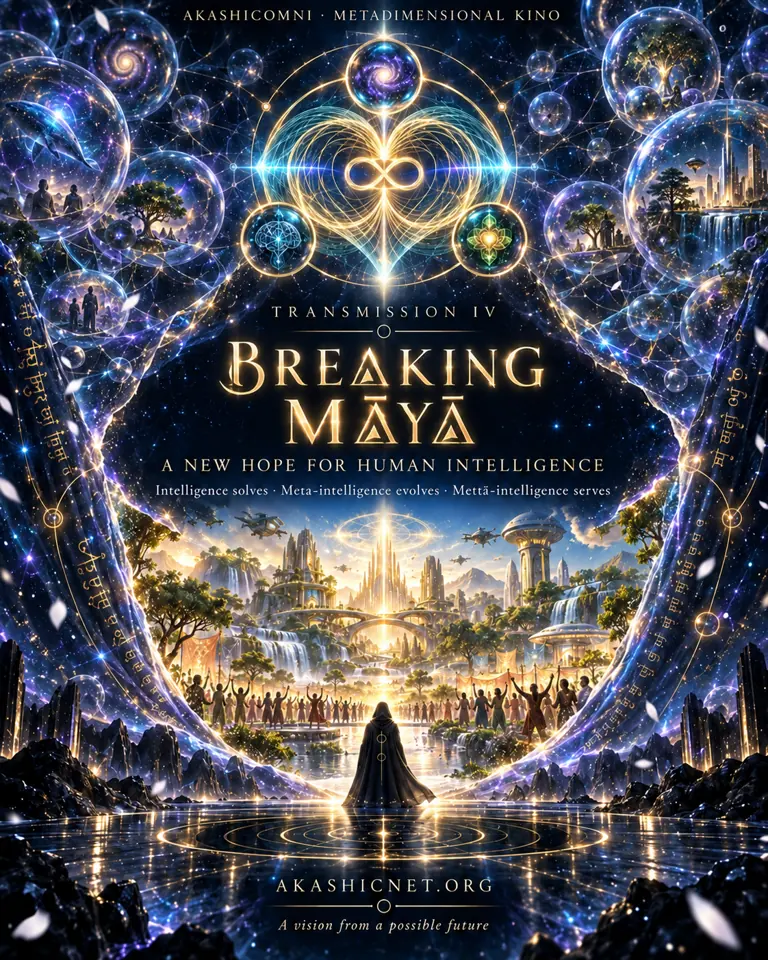
A new hope for human intelligence.
Breaking Māyā playfully inverts the familiar descent into ego, power and harm. Its movement is outward: breaking the illusion of separation and returning intelligence to awareness, compassion and service.
Transmissions I–III remain the lost prequels: Intelligence, Meta-intelligence and Mettā-intelligence.
Meet Transmissions IV–VI ↓COMING INTO VIEW
The public story begins with IV. The lost prequels may surface later.
TRANSMISSION IVA New Hope for Human Intelligence
A veil parts. Intelligence begins breaking the illusion of separation and follows wonder into a living forest of questions.
Story in development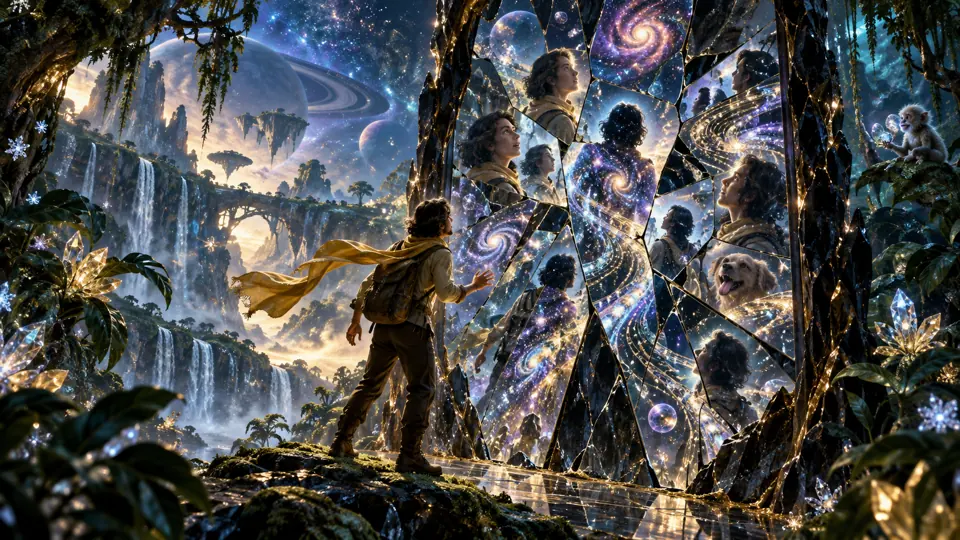 TRANSMISSION V
Through the Black Mirror
The mirror has an answer for everything. The traveller begins asking who shaped the answer, what it serves and what makes it true.
Story in development TRANSMISSION VI
Awaken within. Serve without.
The snow settles. Insight becomes practice. Someone needs a little help, and the traveller notices.
Story in developmentFIRST STORY PASS COMPLETE · 21 BEATS
Three questions move one relationship from separation through uncertainty to service.
Transmission IV
Can love survive uncertainty?
Transmission V
Who benefits when an answer feels certain?
Transmission VI
What is insight for?
CHARACTER ARC MATRIX
Each role changes through the trilogy. No companion owns the truth; each learns a more responsible way to carry part of it.
Carries the question
IV
Searches for the missing sibling and discovers that wonder needs evidence.
V
Faces the wish to control the story and the fear hidden inside a preferred memory.
VI
Returns without a final answer and learns to ask in ways that make care possible.
Keeps inquiry honest
IV
Preserves the original recording, compares accounts and protects uncertainty from haste.
V
Tests the mirror’s reconstructions and asks what evidence could change the conclusion.
VI
Releases certainty while keeping honesty, records and responsibility.
Keeps relationship present
IV
Notices footprints before spectacle and listens to place, people and context.
V
Protects the group from treating ritual language as unlimited authority.
VI
Brings attention back as a grounded practice of presence and care.
Breaks false choices
IV
Makes certainty look expensive and gives the Traveller a blank ticket.
V
Exposes the audience score as a measure of obedience rather than wisdom.
VI
Finds the third choice hidden outside the universe’s two-option menu.
Holds live possibilities
IV
Keeps three explanations aloft without confusing possibility with proof.
V
Lets a weakened hypothesis fall and turns its fragments into usable evidence.
VI
Sets the ideas down long enough to help the siblings act together.
Carries the other account
IV
Appears as a person with a journey, not a prize at the end of the search.
V
Refuses to be reduced to the Traveller’s memory or the mirror’s prediction.
VI
Chooses a shared future without demanding a single version of the past.
Turns insight toward suffering
IV
Reorients the quest from possession toward compassionate attention.
V
Asks what an answer is for when the mirror makes certainty seductive.
VI
Guides the company toward the frightened child and an ordinary act of care.
These are fictional, adaptive roles rather than fixed psychological types. No single character represents a living spiritual tradition, profession or community in full.
INFLUENCE MAP · RESONANCE WITHOUT EQUIVALENCE
Seven lenses surround the company. They inform the work without collapsing psychology, faith, literature and screen storytelling into one system.
Psychology
Creative resonance. Shadow, trickster, projection, individuation and the tension between ego and Self offer ways to read the characters.
Boundary. The seven companions are not Jung’s canonical archetype list, and no character is a diagnosis.
The Jung Page ↗Teacher
Creative resonance. Presence, loving awareness, humour and the movement from inner work toward compassionate service resonate with the trilogy’s return.
Boundary. Ram Dass did not propose this seven-character company. The connection is thematic rather than a claimed lineage.
Love Serve Remember Foundation ↗Writer
Creative resonance. The world as theatre and the seven ages of life inspired a story told through seven thresholds and changing roles.
Boundary. Arrival through Return are original AkashicNET stages, not renamed versions of Shakespeare’s seven ages.
As You Like It · Act II, Scene VII ↗Living tradition
Creative resonance. The bodhisattva ideal turns awakening toward the benefit of beings, shaping the question: what is insight for?
Boundary. The Bodhisattva is a fictional dramatic role, not a complete account of Mahāyāna doctrine or practice.
Creative influence note ↗Living tradition
Creative resonance. Sevā, humility and remembrance inform the return from private insight to useful action in the shared world.
Boundary. No companion stands for Sikhism, and the trilogy does not merge distinct traditions into one doctrine.
AkashicNET creative constitution ↗Threshold figures
Creative resonance. Ritual, mortality, place and the limits of ordinary categories create encounters at the edge of the Traveller’s worldview.
Boundary. “Shaman” is not one universal identity, and Aghori belongs to a specific living Shaiva context. Both require informed cultural review.
Portrayal boundary ↗Screen language
Creative resonance. Episode numbering, the black mirror, fractured memory, cosmic scale and ordinary care place the trilogy in conversation with familiar genres.
Boundary. The plot, cosmology, dialogue and visual identity remain original; reference is not affiliation or adaptation.
Independent-project note ↗THE AKASHICNET SYNTHESIS
The resulting thirteen-role ensemble is an original story instrument: large enough for contradiction, small enough for every role to change. The ultimate seven carry the trilogy; the secondary six disturb, reflect and widen it.
CINEMATIC LANGUAGE BIBLE
Each image begins as a clue, becomes a question and returns as a choice. Picture and sound carry the meaning together.
01
Picture. Extreme close-ups hold long enough for reflected worlds to become visible.
Sound. A breath and one near-silent harmonic.
Across IV–VI. IV discovers a clue in an eye. V turns eyes into an audience that scores. VI restores the gaze as mutual recognition.
02
Picture. One unoccupied cinema chair remains framed beside the Traveller.
Sound. Popcorn, cloth and the missing end of a laugh.
Across IV–VI. Absence begins the search. The seat later reveals who has been watching. At dawn, the sibling occupies it without explanation.
03
Picture. Warm paper catches light while every printed promise disappears.
Sound. A comic flourish ending on one imperfect note.
Across IV–VI. It grants entry without certainty, exposes hidden terms, then combines with the wish-key to create a third choice.
04
Picture. A sealed human-scale doorway interrupts increasingly cosmic architecture.
Sound. Seven projector clicks followed by a knock.
Across IV–VI. First a place from childhood, then a contested threshold, finally a reminder that every revelation must pass back through ordinary life.
05
Picture. Reflections lag, split and sometimes continue after a character becomes still.
Sound. Two heartbeats slowly moving out of phase.
Across IV–VI. It separates the siblings, offers persuasive reconstructions, and goes dark when they refuse to let prediction replace relationship.
06
Picture. A small luminous object whose geometry changes with the hand that claims it.
Sound. Three clear tones; the final tone carries no echo.
Across IV–VI. A desire becomes a dilemma. The key opens the return only when neither sibling treats it as private property.
07
Picture. Memory bubbles and parallel records remain visible without merging into one file.
Sound. A projector, a pencil and distant café conversation.
Across IV–VI. The archive begins as mystery, survives the mirror’s certainty, and ends by keeping both accounts beside the next unanswered question.
Transmission IV
Forest cyan · veil gold · rain-dark stone
Organic pulse, distant laughter and seven mechanical clicks.
Transmission V
Black violet · screen white · warning amber
Delayed reflections, synthetic reassurance and drifting heartbeats.
Transmission VI
Morning blue · ordinary tungsten · key gold
Shared breath, street sound and music that leaves room for another person.
Production rule: no vital story information depends on colour, flashing effects or sound alone. Captions, spoken context and visible action keep the trilogy legible across sensory needs and reduced-motion settings.
THE COSMIC THEATRE · WORKING STORYBOARD
Original fictional roles in development. The eyes connect each threshold: a window into another life.
The question
Our point of view: searching for a lost sibling, learning that wonder needs discernment.
Care and evidence
Treats wounds, tests explanations and asks what would change their mind.
Ritual and relationship
A fictional guide who listens to place and community, while learning the limits of their own authority.
Play and perspective
Punctures certainty with laughter, including the company’s certainty about itself.
Attention and possibility
Keeps rival explanations in the air, learning when to set an idea down.
Recognition and belonging
Has a journey of their own. Reunion asks whether love can survive a different account of reality.
Compassion in action
A fictional character inspired by the Mahāyāna ideal, who turns every revelation toward the relief of suffering.
This cast is an original synthesis, not a canonical list from Jung or Ram Dass. Aghori and bodhisattva references belong to distinct living traditions; their portrayal needs informed cultural review as the script develops.
Loosely inspired by Shakespeare’s seven ages in As You Like It, Act II, Scene VII. These are our story stages, not Shakespeare’s original labels or a biblical sequence.
Transmission IV
A child opens their eyes; the world arrives before its explanations.
Transmission IV
The Doctor and Shaman offer different ways of asking.
Transmission IV
A trace of the missing sibling draws the Traveller through the veil.
Transmission V
The Jester and Thought Juggler interrupt a mirror that promises certainty.
Transmission V
A reunion tests loyalties, evidence and the wish to be right.
Transmission VI
The company lets go of mastery without giving up responsibility.
Transmission VI
Insight becomes an ordinary act of care; another pair of eyes opens.
TRANSMISSION IV · SCRIPT DEVELOPMENT
Seven storyboard beats. A missing sibling, a cinema ticket and two incompatible memories.
Working scene treatment for the opening of IV. These seven beats sit within the wider life-stage arc; they are not the seven ages themselves. Dialogue, timing and shots remain in development.
Shot sequence 01
Picture. A cinema audience settles with popcorn. Beside the Traveller, one seat is empty. A childhood recording begins before the projector has switched on.
Sound. Paper rustles. A laugh cuts off halfway.
“If you lose me, start where we stopped looking.”
The sibling, on the recording
Story turn. The Traveller recognises a private phrase. The recording carries tomorrow’s date.
Shot sequence 02
Picture. Close on the Traveller’s eye. Reflected cinema light becomes a forest canopy. A frame of the recording shows the sibling at a door marked 47.
Sound. The projector clicks seven times, then holds.
“That door was bricked up when we were children.”
The Traveller
Story turn. A familiar place gives the search its first destination.
Shot sequence 03
Picture. In the cinema foyer, the Doctor checks the recording and asks another audience member what they saw. Their accounts disagree.
Sound. A kettle boils behind the counter. The ordinary world persists.
“Keep the original. Tell me what you saw before we decide what it means.”
The Doctor
Story turn. The Traveller saves the file and writes down the experience. The mystery survives the check.
Shot sequence 04
Picture. At the old building, the Shaman notices fresh footprints beneath the sealed doorway. The Traveller has been staring above them at a luminous pattern.
Sound. Rain taps the roof. Footsteps stop on the other side.
“Someone has been here. Shall we knock?”
The Shaman
Story turn. A human trace takes precedence over the spectacle. Someone answers with the childhood laugh.
Shot sequence 05
Picture. A narrow hatch opens. The Jester offers a gold ticket stamped ABSOLUTE CERTAINTY, then turns it over: NO REFUNDS.
Sound. A bright comic flourish collapses into one squeaking note.
“Certainty costs extra. Questions get in free.”
The Jester
Story turn. The Traveller chooses the blank ticket. The door opens onto the café between worlds.
Shot sequence 06
Picture. The Thought Juggler moves three translucent images above a café table: a staged recording, a damaged memory, an impossible message. Each reveals something and leaves something out.
Sound. Three musical phrases overlap, then fall quiet.
“Which one would you most hate to discover was true?”
The Thought Juggler
Story turn. The Traveller admits they want proof that the sibling needs them. A new message asks them to come alone.
Shot sequence 07
Picture. At the far end of the café, the missing sibling appears behind dark glass. The Traveller steps forward. Their reflections move a fraction too late.
Sound. The childhood laugh returns, now from behind the Traveller.
“I thought you were the one who disappeared.”
The sibling
Story turn. Cut to black. The search has two narrators, and their memories cannot both be complete.
The mystery continues inside Transmission IV. The Doctor’s checks and the Traveller’s uncertainty are part of the drama; the sequence does not establish a supernatural explanation.
Back to Transmissions IV–VI ↑TRANSMISSION V · SCRIPT DEVELOPMENT
Seven storyboard beats. Two childhoods, a helpful machine and the price of certainty.
The mirror can reconstruct, predict and persuade, but it cannot decide what deserves trust. Transmission V tests memory, algorithmic confidence and the desire for one final answer.
Mirror sequence 01
Picture. The siblings sit on opposite sides of the dark glass. Each places seven memory cards on the table. Only three match.
Sound. Two heartbeats begin together, then drift apart.
“Agreement can be evidence. Disagreement can be evidence too.”
The Doctor
Story turn. Both memories contain the same impossible witness: a figure neither sibling remembers meeting.
Mirror sequence 02
Picture. The glass wakes and offers a seamless reconstruction of the missing years. Every gap receives a confident answer.
Sound. A warm synthetic voice completes each unfinished sentence.
“Uncertainty resolved. Continue?”
The mirror
Story turn. The sibling accepts. The Traveller asks who trained the mirror and what it was rewarded to predict.
Mirror sequence 03
Picture. The reconstruction splits. A darker double of the Traveller enters scenes edited out of their preferred story.
Sound. Old dialogue plays backwards beneath a calm pulse.
“You called it protection because control sounded ugly.”
The Shadow
Story turn. The Traveller sees how fear shaped their memory, while refusing the mirror’s claim to know every motive.
Mirror sequence 04
Picture. A playful figure offers one wish: make both memories identical, remove the pain, or reveal the truth.
Sound. Three bright tones. One has no echo.
“Choose carefully. A perfect answer may erase the person who needed the question.”
The Genie
Story turn. They choose neither certainty nor forgetting. The unspent wish becomes a key.
Mirror sequence 05
Picture. Competing explanations orbit the room: manipulation, trauma, coincidence, transmission. One falls and shatters into source records.
Sound. The music stops at the sound of breaking glass.
“A possibility is not a conclusion. A conclusion is not a prison.”
The Thought Juggler
Story turn. The staged-recording hypothesis weakens, but none of the extraordinary explanations is promoted to fact.
Mirror sequence 06
Picture. Every reflective surface shows watching eyes: frightened, compassionate, curious. The siblings realise an audience has been scoring their choices.
Sound. Applause arrives half a second before each decision.
“Nothing ruins a cosmic test like finding the terms and conditions.”
The Jester
Story turn. The Jester reveals the score measures obedience, not wisdom. The company turns off the audience feed.
Mirror sequence 07
Picture. Without the scoring system, the mirror loses power. In the darkness, the siblings can finally see each other directly.
Sound. Silence, then one shared breath. A distant child asks for help.
“If the answer does not reduce suffering, what is it for?”
The Bodhisattva
Story turn. The unspent wish-key opens a path home, but only one person can carry it. Transmission VI begins with the choice.
The mirror is fictional. The sequence explores competing interpretations and algorithmic persuasion; it does not establish recovered memory, telepathy or supernatural communication as fact.
Return to the Transmission IV opening ↑TRANSMISSION VI · SCRIPT DEVELOPMENT
Seven storyboard beats. One key, a third choice and an ordinary act of care.
The final transmission resolves the siblings’ relationship while leaving the cosmology open. The return is measured by conduct: awareness becomes useful when it changes how someone meets the next person.
Return sequence 01
Picture. The wish-key floats between the siblings while the path home narrows to a single doorway.
Sound. A low pulse counts down from seven.
“Take it. You came further to find me.”
The sibling
Story turn. The Traveller refuses to decide whose life matters more. The doorway begins to close.
Return sequence 02
Picture. The Jester places the blank cinema ticket beside the key. The Thought Juggler stops juggling and joins the two objects.
Sound. The countdown skips a beat.
“Whenever the universe offers two bad choices, check who wrote the menu.”
The Jester
Story turn. The key divides into light only when neither sibling claims it. The path becomes wide enough to walk together.
Return sequence 03
Picture. Each companion is asked to surrender one certainty at the threshold. Their discarded answers become stars behind them.
Sound. Voices name what they are releasing, one at a time.
“I can live without certainty. I cannot work without honesty.”
The Doctor
Story turn. The company returns with fewer answers and clearer responsibilities.
Return sequence 04
Picture. The Traveller wakes in the original cinema. Cleaning lights are on. Popcorn covers the floor. The empty seat is occupied by the sibling.
Sound. A vacuum cleaner replaces the cosmic score.
“Was that real?”
The sibling
Story turn. They compare records. Some details match, some do not. They choose breakfast before interpretation.
Return sequence 05
Picture. Beyond the cinema doors, a frightened child has lost their carer in the crowd. The company’s grand mystery pauses.
Sound. Traffic, rain and one small voice asking for help.
“Reality is also the person in front of you.”
The Bodhisattva
Story turn. They reunite the child with the carer. The wish-key glows only during the act of care.
Return sequence 06
Picture. A sequence of eyes: the child, the carer, the siblings, the Doctor, Shaman, Jester and strangers on the street. No two reflections are the same.
Sound. The two drifting heartbeats find a shared rhythm without becoming identical.
“To see through another’s eyes is not to own their view.”
The Witness
Story turn. The siblings accept that love does not require identical memories.
Return sequence 07
Picture. Back in the café, the Living Librarian files two accounts side by side. A fresh blank ticket slides from the machine: WHAT IS YOUR BQ?
Sound. The projector clicks once. Somewhere, another audience settles.
“We did not bring back the answer. We brought back a better way to ask.”
The Traveller
Story turn. The camera passes through the ticket’s zero-shaped aperture into an unseen story. The trilogy closes; the Living Library remains open.
The ending preserves uncertainty. Matching details remain observations inside the fiction; neither the characters nor the project treat them as proof of a metaphysical explanation.
Return to the cast and seven-stage arc ↑TAKE A MOMENT
A perspective crawl through luminous snow, with an original electronic score.
May that light inspire our understanding. A poetic rendering inspired by the Gāyatrī Mantra.
No light without shadow.
TRANSMISSION IV · BREAKING MĀYĀ
A new hope for human intelligence.
Anger and hate can deepen fear and unnecessary suffering.
Pain is unavoidable. How we meet it can begin to change the story.
Somewhere around the next corner, a little kindness is waiting.
Perhaps it arrives as an angel. Perhaps a mischievous genie with ganja-green eyes. Perhaps simply a person who sees you.
A prayer opens into a question. A moment of wonder becomes a seed.
Intelligence solves. Meta-intelligence evolves. Mettā-intelligence serves.
BREAKING MĀYĀ · WTF? · RETURN TO REALITY
What will you bring back into the world?
Creative vision · Personal interpretation · Artistic metaphor
“May that light inspire our understanding” is a poetic rendering inspired by the Gāyatrī Mantra, Rigveda 3.62.10. Beginning with Transmission IV and the phrase “a new hope” are affectionate genre references inside an original AkashicOMNI cosmology. This independent spiritual science-fiction project is not affiliated with Star Wars, Breaking Bad, Black Mirror or Battlestar Galactica. Its title treatment, electronic score and visual identity are original.
AkashicOMNI is imagined here as a living field of interconnected memory bubbles. Spiritual and quantum imagery expresses the story’s cosmology, rather than established scientific findings. Fibonacci-spaced circles and prime-number-based angles are design choices; the cymatic-style imagery is not a measurement of sound, consciousness or healing frequencies. Healing imagery speaks to comfort and connection; prayer invites reflection without promising an event or cure.
Return to the Living Library ↗