
TSC2026 · 15 October 2026 · Talk Reflection
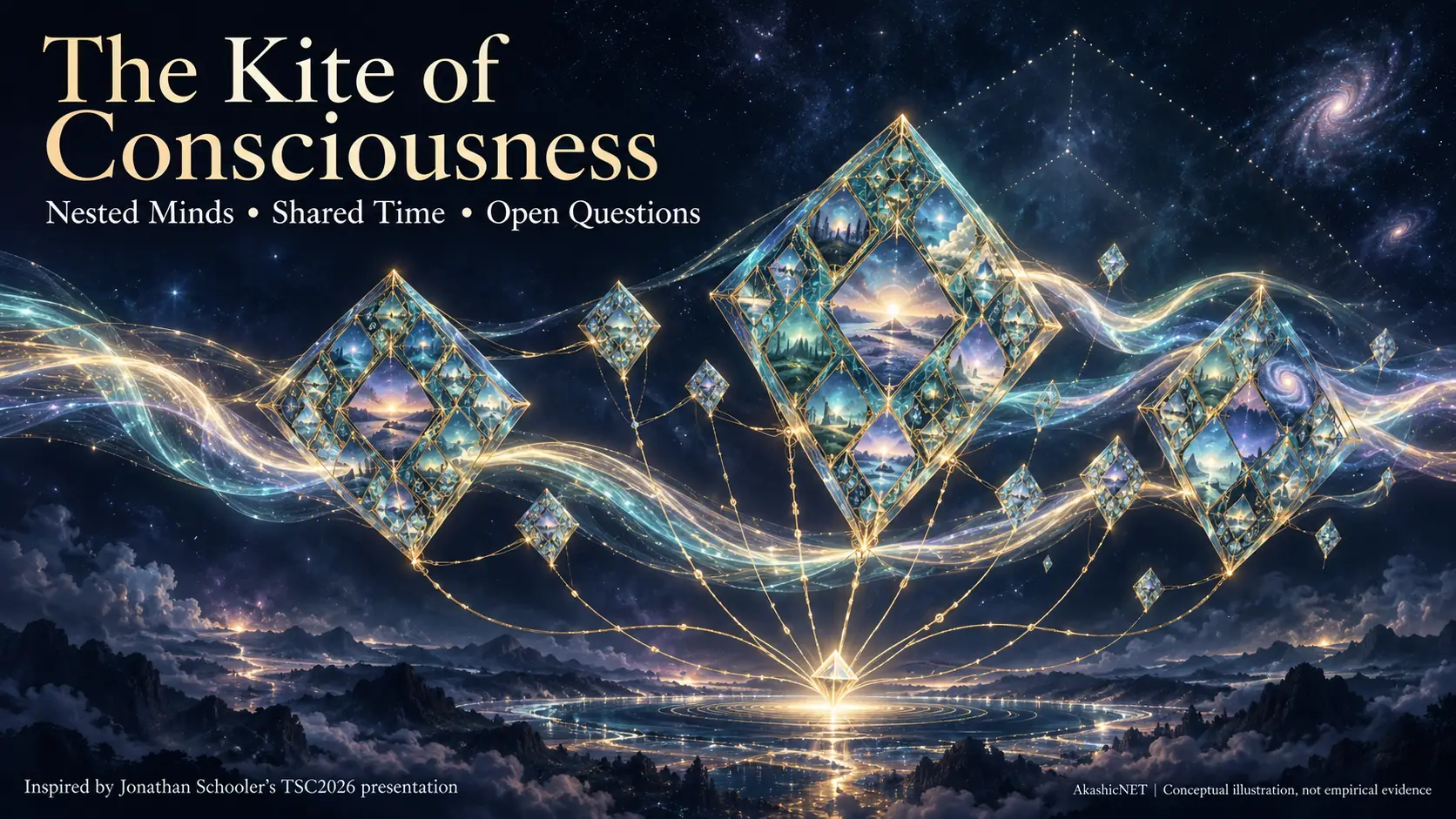
The Kite of Consciousness
Nested minds. Shared time. Open questions.
Jonathan Schooler’s presentation asks how nested moments of experience might relate to physical time, possible futures and other observers.
By AkashicNET · Human-directed, AI-assisted synthesis · 4-minute read
Theoretical Framework
Experience as Nested Windows
The Nested Observer Windows (NOW) model, developed by Justin Riddle and Jonathan Schooler, describes a hierarchy of integration windows. A photomosaic offers the talk’s visual analogy: a larger image is composed of smaller images.
Synchrony
Coordination within an observer window.
Coherence
Relationships between windows at a similar scale.
Cross-Frequency Coupling
Relationships between rhythms at different scales, linking levels of the hierarchy.
These signal relationships motivate the framework. Assigning conscious experience to particular windows is a further theoretical commitment. The published model discusses apex, emergent and panpsychic possibilities; a diagram labelled “apex” alone does not settle which interpretation is correct.
Metaphysical Proposal
Three Dimensions of Time
Objective
The physical ordering of events.
Subjective
The experienced succession and duration of moments.
Alternative
A proposed dimension of possible futures, discussed in relation to choice.
The slides first depict observers moving through successive “nows.” The kite metaphor changes the viewpoint: the windows are anchored, while the wind of time flows through them. Smaller, faster windows and larger, slower windows have different orientations in the illustration.
Schooler presents alternative-time rotation as a possibility that could provide room for free will. The slides do not demonstrate additional physical time dimensions or establish conscious selection of quantum outcomes.
Open Question
Could Minds Become Windows Within a Larger Mind?
The closing “Multiple Tethered Apexes” slide represents individual observers connected by tethers, sharing a temporal setting. “And even higher levels” asks whether individuals could become pixels of a higher-order observer, itself nested within another.
“Higher-order NOWs remain an open question.”Schooler’s photographed summary slide
A separate “James Filter Theory” slide depicts personal experience as a filtered subset of a wider consciousness. This is a philosophical proposal presented in the talk, not a measurement of an external consciousness field.
Resonance Between Individuals
Interpersonal synchrony is a measurable research direction, distinct from the claim that several people constitute one experiencer. The photographed tether diagrams contain no quantitative interpersonal results. A test would need to define the coupling measure and compare live interaction with shared-stimulus, movement and shuffled-pair controls.
AkashicNET Interpretation
An Existing N2N and MultidimensionalCUT Connection
Schooler’s work was already explored in NeuronsToNirvana and is a major source for the curator’s MultidimensionalCUT synthesis. This conference reflection continues that established line of inquiry.
The curator’s phrase, “nested windows of cymatic sacred fractal geometry,” offers an artistic lens for the hierarchy. Nesting, fractal scaling and physically generated cymatic patterns are different properties: their relationships would need to be specified and tested. The hero uses nested geometry as a metaphor.
The Science of Mysticism research idea asks whether reported changes in self, time and connectedness correspond to reproducible changes in coupling. That is a proposed investigation, not a result attributed to Schooler.
Questions Worth Taking Forward
- What distinguishes synchronized experiences from a single higher-order experience?
- What observable relationship would connect interpersonal synchrony to the proposed tethers between observers?
- What prediction distinguishes an additional subjective-time dimension from a model of changing temporal perception?
- How could alternative time be operationalized so that competing explanations make different predictions?
Sources and Transparency
- Official TSC2026 abstract: Jonathan Schooler
- Riddle & Schooler (2024): Hierarchical Consciousness: The Nested Observer Windows Model
- Primary presentation record: 51 supplied photographs, including repeated views and progressive slide builds. Closing references: IMG_0941–0947. This article summarizes the photographs; it is not a verbatim transcript.
The acknowledgements list Justin Riddle, Tam Hunt and Amanda Gregory as co-authors, and Paradox Science Institute, Templeton Religion Trust and Wake Forest University under grant support. These are slide attributions, not claims of endorsement of this article.
Prepared with AI assistance from attendee-supplied slide photographs and the linked source material. Proposed mechanisms, philosophical interpretations and open questions remain labelled. No new experiment was conducted for this article.