
11 October 2026 · Session Notes in Progress
Research at the Edge of Consciousness
NDEs, OBEs and Past Life Memories
Sunday morning · Bay View Room · San Diego local time (PDT)
Part 1: 8:30–10:15 am · Part 2: 10:45 am–12:30 pm
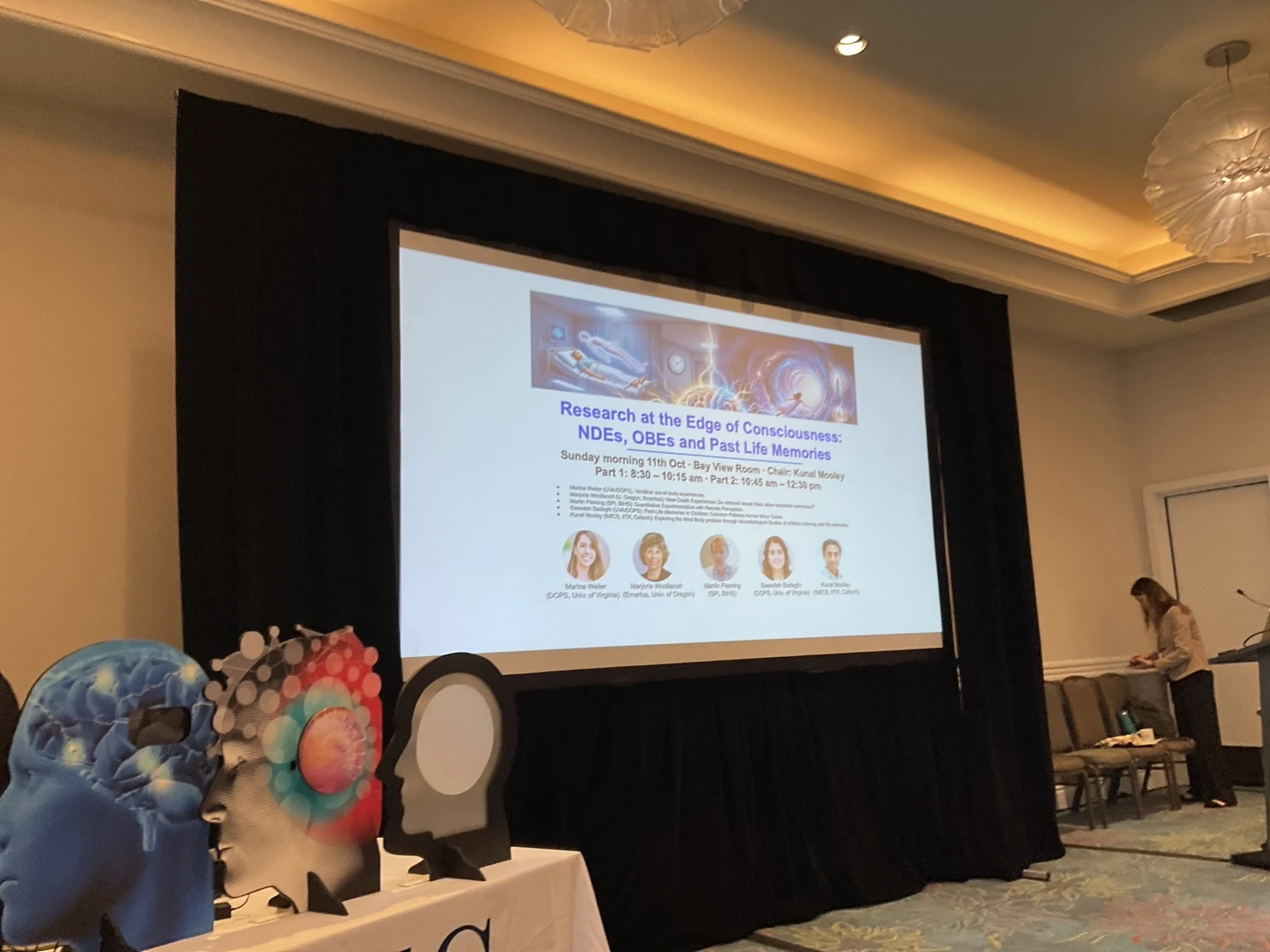
Session title, room and times transcribed from the photographed opening slide.
An Evolving Session Record
This page begins with an attendee photograph of the opening slide. Further photos and notes will be added as they are supplied and reviewed, followed by a session summary.
Current coverage: sixteen photographs covering the session setting, Martin Fleming’s introduction, qualia, the model demonstration, the hard problem, his framework, Proposition 2, the remote-viewing definition, experimental framing and coordinate-viewing procedure. No presentation findings, numerical results or panel answers have yet been summarised. This is an independent AkashicNET account, not an official conference transcript.
Source 01 · Attendee Photograph
The Opening Slide
Source 02 · Attendee Photograph
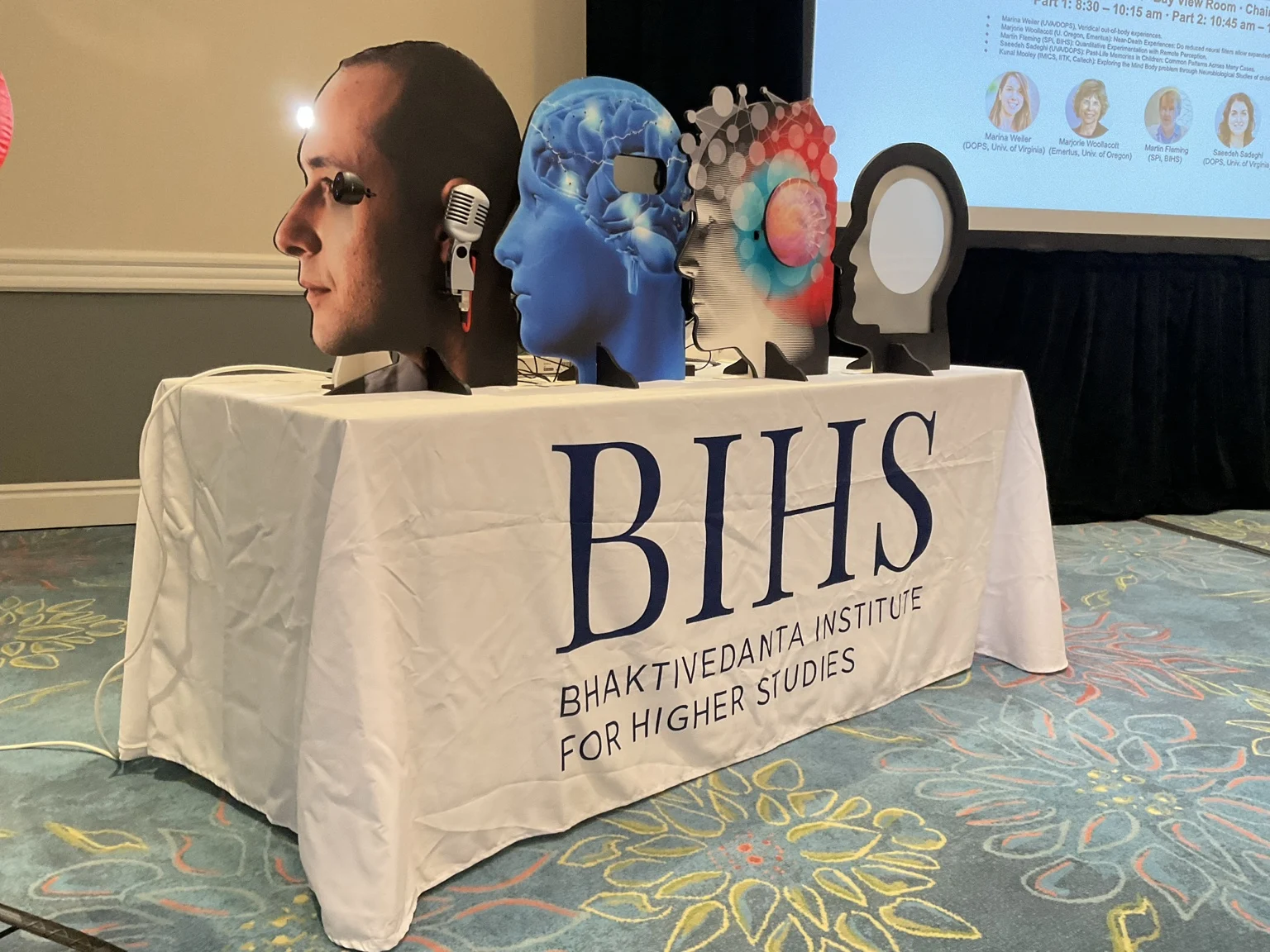
BIHS Display in the Session Room
Sources 03–04 · Talk Introduction · Notes in Progress
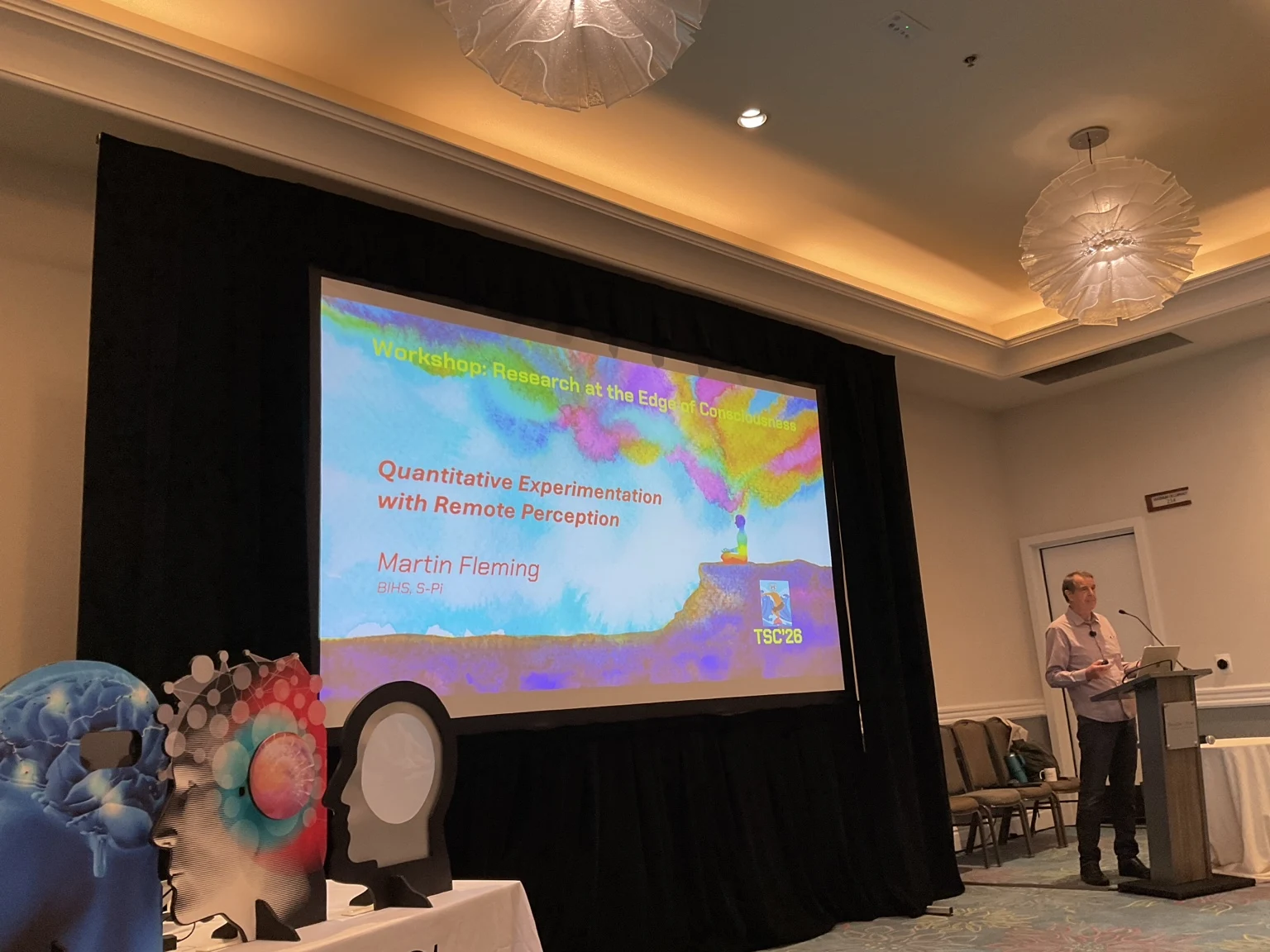
Martin Fleming: Quantitative Experimentation with Remote Perception
Affiliations shown on the title slide: BIHS, S-Pi.
Fleming opens with the question: “Does Consciousness depend entirely on the brain?” His outline moves from an analysis challenging that assumption, to a framework intended to account for observations and analysis, then to a testable proposition related to remote-viewing experimentation.
What these slides establish: the talk’s topic and proposed structure. They do not yet supply the analysis, the framework’s details, a specific testable prediction, experimental methods or results. The question remains open in this session record.
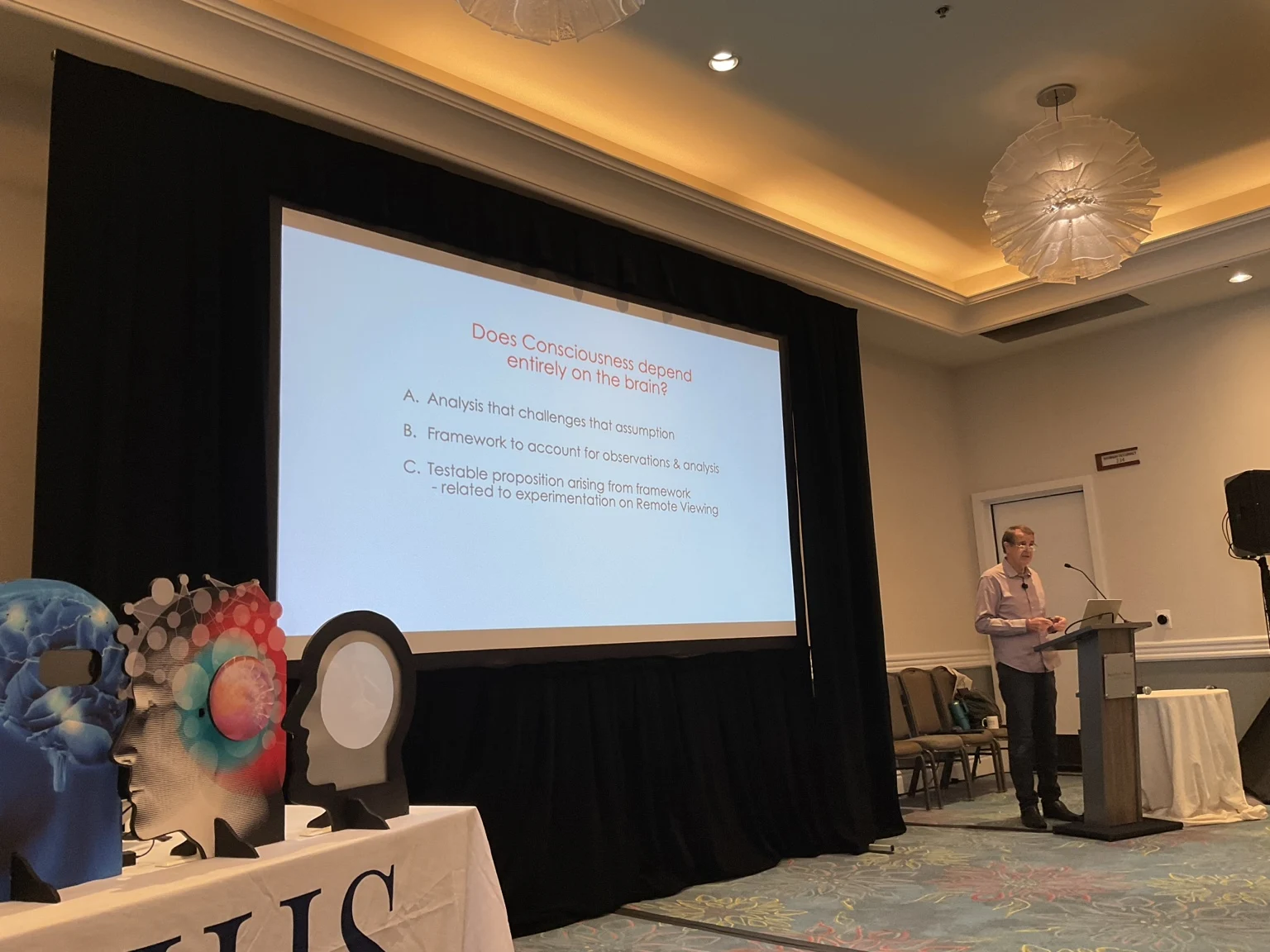
Read the outline slide transcription
Does Consciousness depend entirely on the brain?
- Analysis that challenges that assumption
- Framework to account for observations & analysis
- Testable proposition arising from framework
- related to experimentation on Remote Viewing
For the next slides: capture the proposed prediction, target selection, blinding, scoring, sample size, comparison with chance and any reported uncertainty. These are AkashicNET note-taking prompts, not claims that the speaker has already addressed those details.
Sources 05–08 · Conceptual Setup · Slide-Based Summary
Unified Experience & Qualia
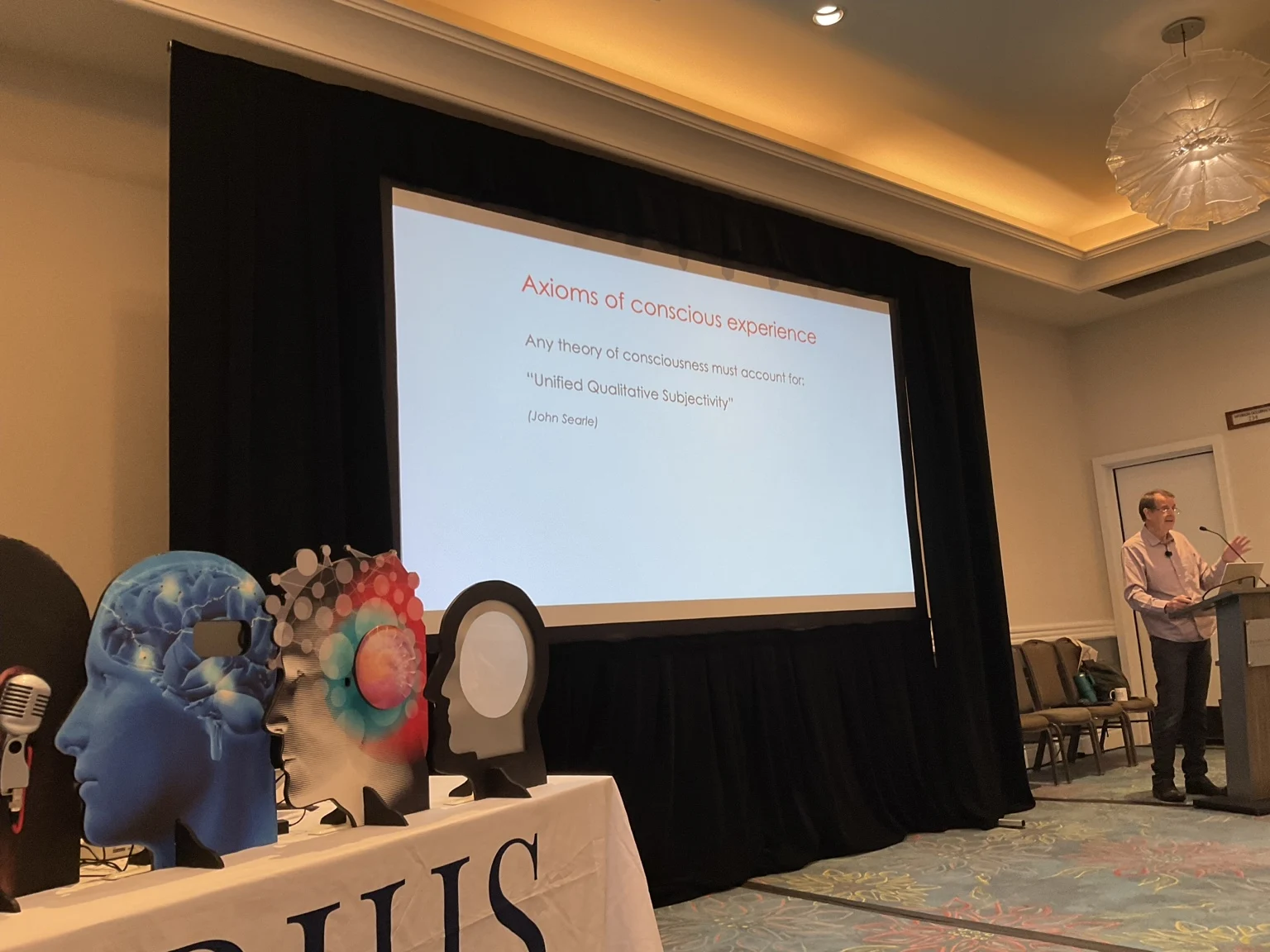
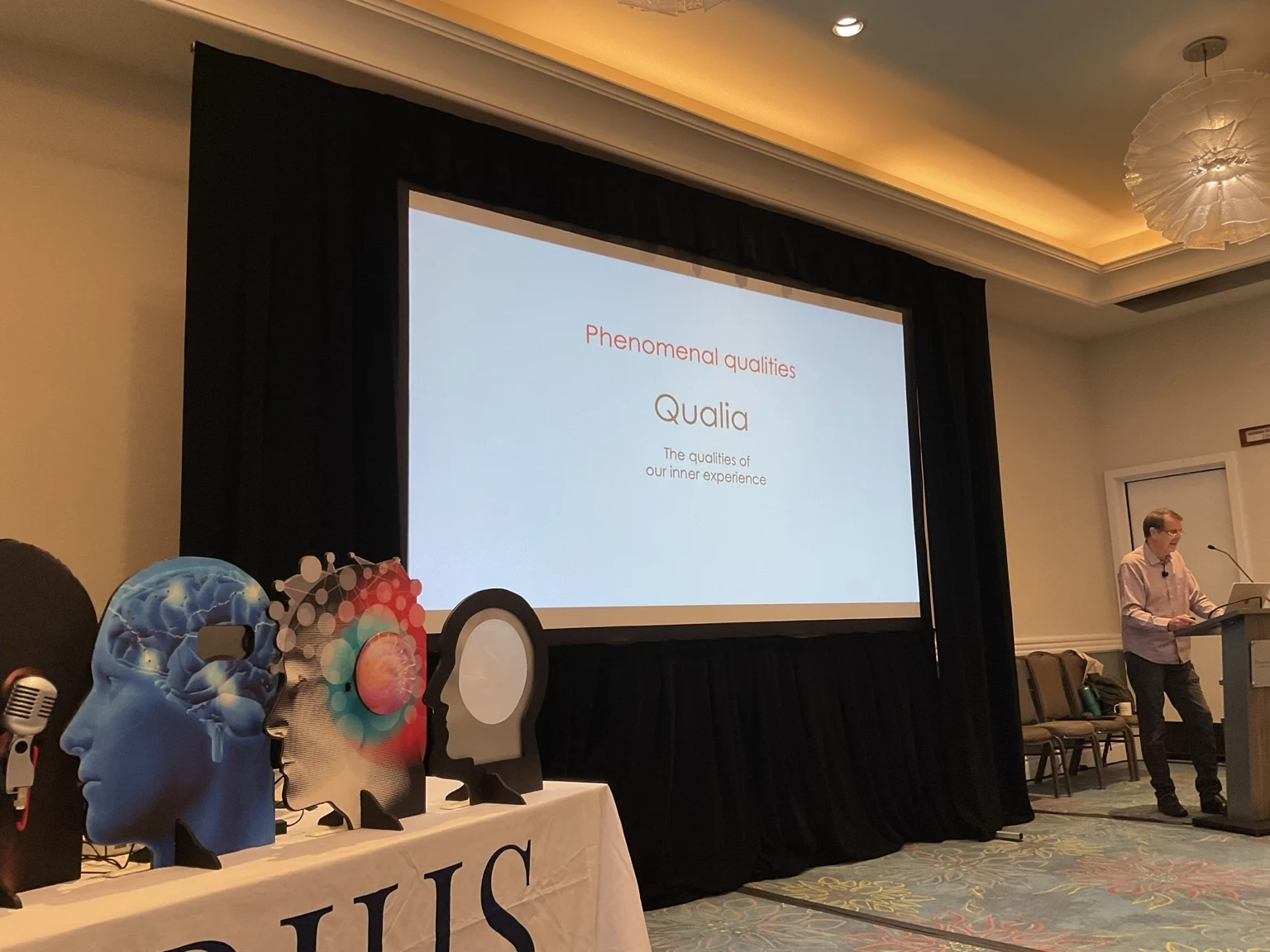
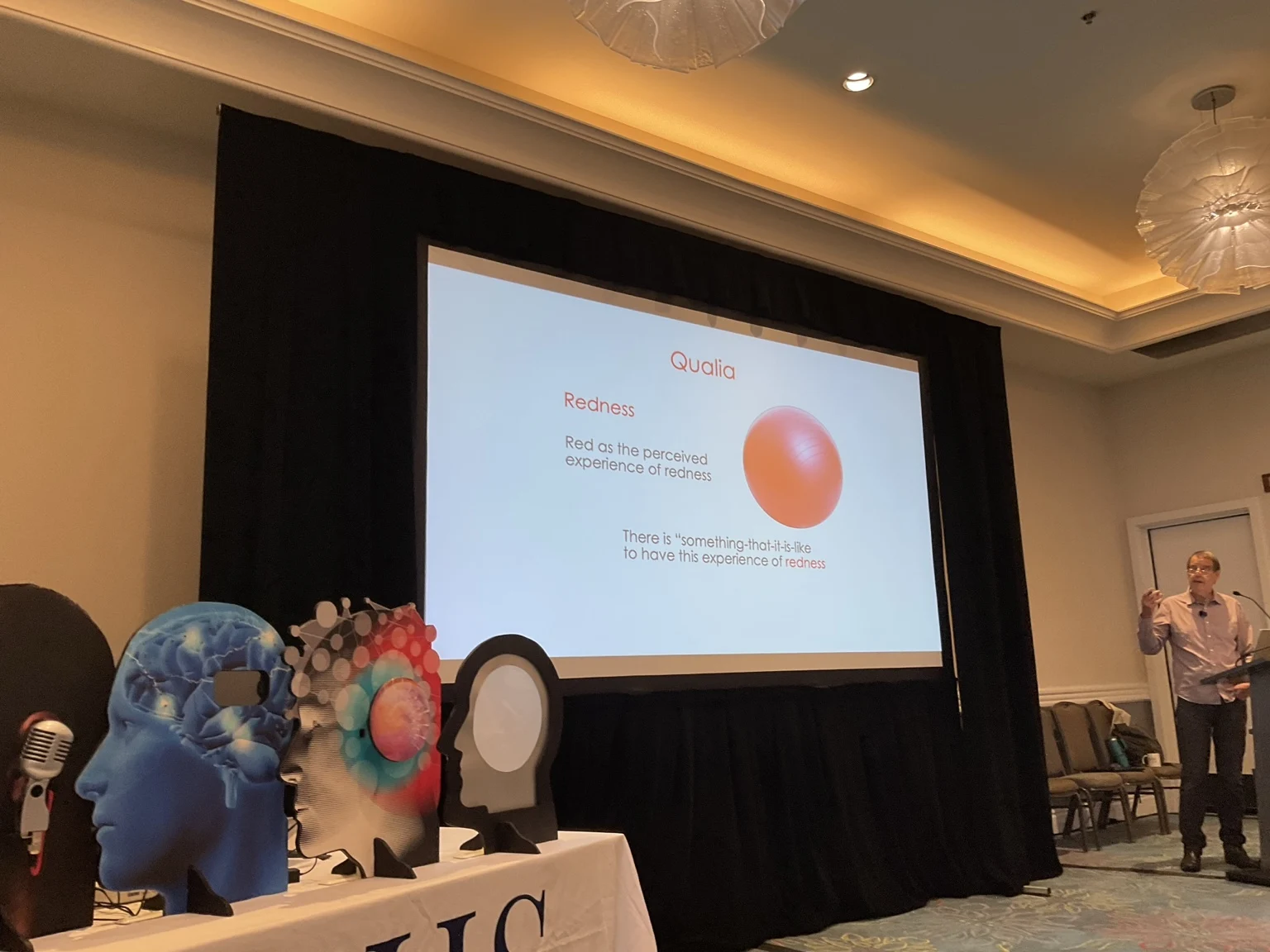
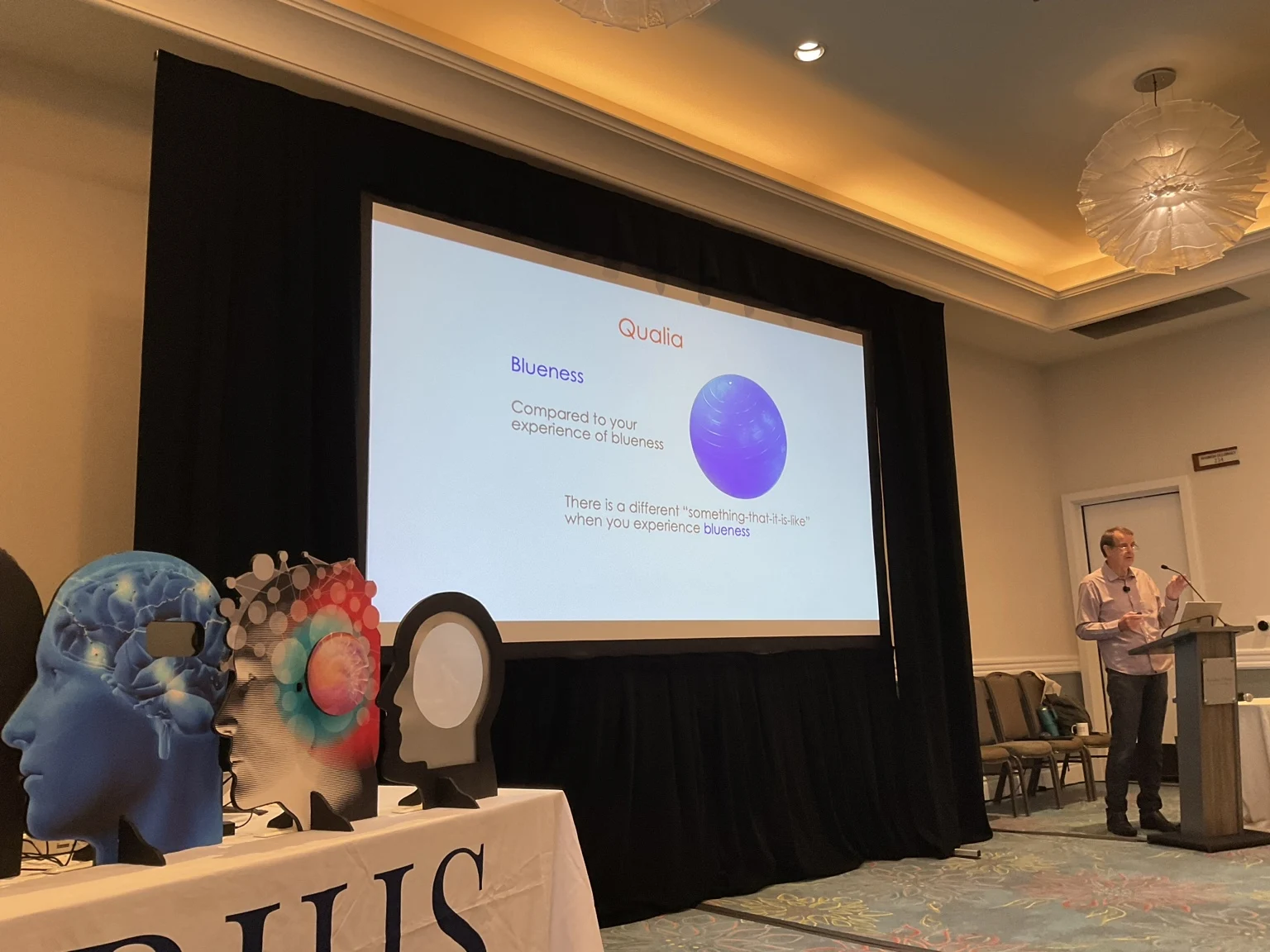
Fleming’s next slides set out what he asks a theory of consciousness to explain. A slide titled “Axioms of conscious experience” names “Unified Qualitative Subjectivity” and attributes the phrase to John Searle. The following slides introduce qualia as the qualities of inner experience, contrasting the experience of redness with blueness.
Summary of this sequence: the talk focuses on the subjective character of experience, illustrated through colour. These are conceptual examples; the photographs do not yet show an experiment or establish whether consciousness is independent of the brain.
The explanations below paraphrase the photographed slides. Quoted phrases are transcribed from them. No spoken commentary has been inferred.
Source 05: Axioms of Conscious Experience
The slide says any theory of consciousness must account for “Unified Qualitative Subjectivity”, attributed on the slide to John Searle. This attribution has not been independently checked.
Source 06: Phenomenal Qualities: Qualia
The slide defines qualia as “The qualities of our inner experience.”
Source 07: Qualia: Redness
A red ball illustrates the perceived experience of redness and the idea that there is something it is like to have that experience.
Source 08: Qualia: Blueness
A blue ball provides a comparison: the slide describes a different subjective quality when experiencing blueness.
Open editorial question: how will the talk connect these features of experience to a specific prediction in the proposed remote-perception experiment? Proposition 2 below now supplies the proposed connection: direct access to information without sensory acquisition. Its operational test and results remain pending.
Source 09 · Demonstration Photograph
The Illuminated Head Models
The demonstration photograph shows a red object at the left, a row of head-shaped models, lights on the blue brain-shaped model and a small display with coloured traces. The presenter stands beside the display, with one hand on the rightmost model.
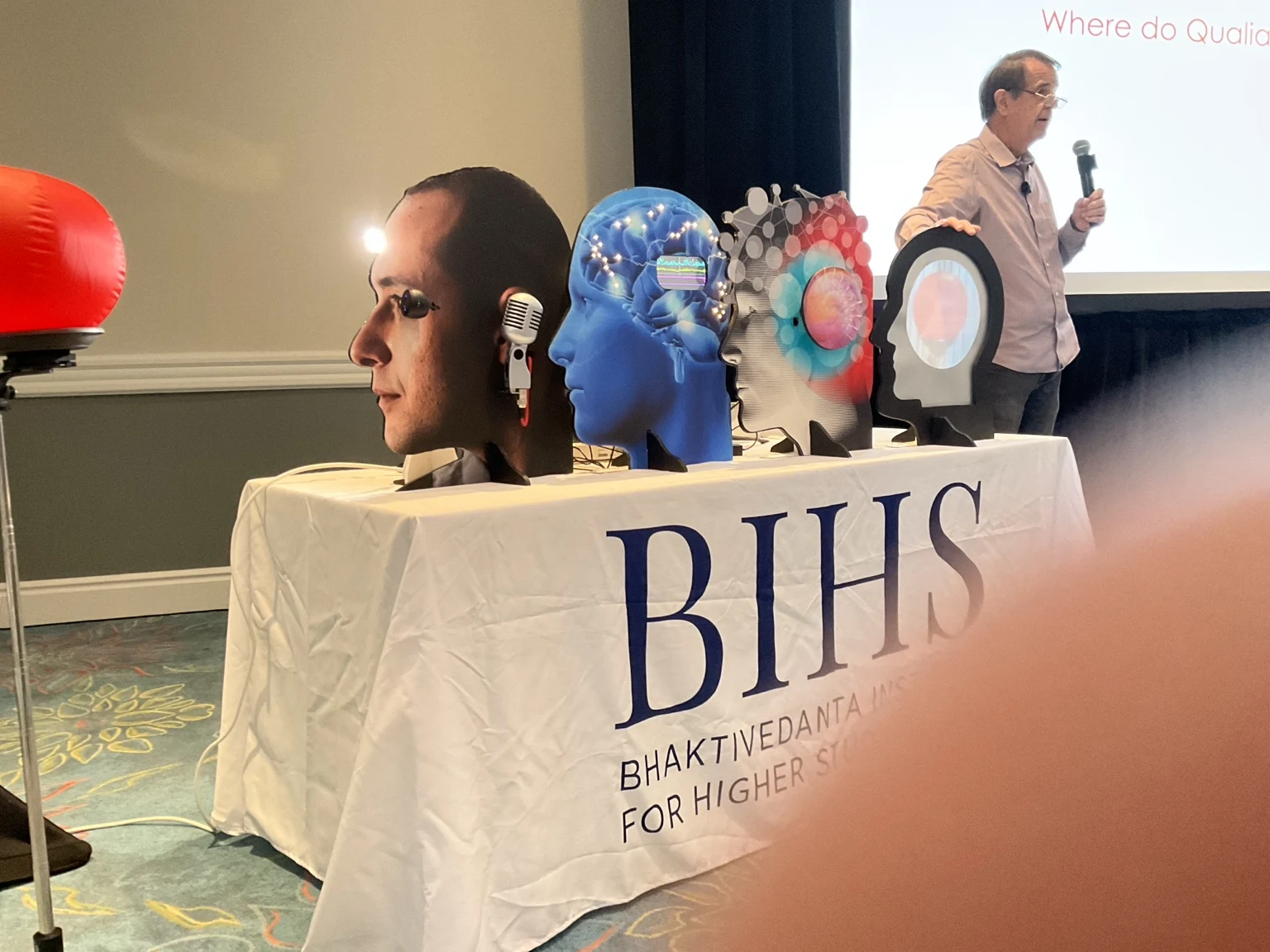
Interpretation pending: the photograph documents the demonstration setup. The presenter’s explanation of each model, the lights and the traces has not been supplied. The image alone does not establish what the traces measure or provide a test of remote perception.
Sources 10–11 · Conceptual Framework · Slide-Based Summary
The Hard Problem & Three Categories
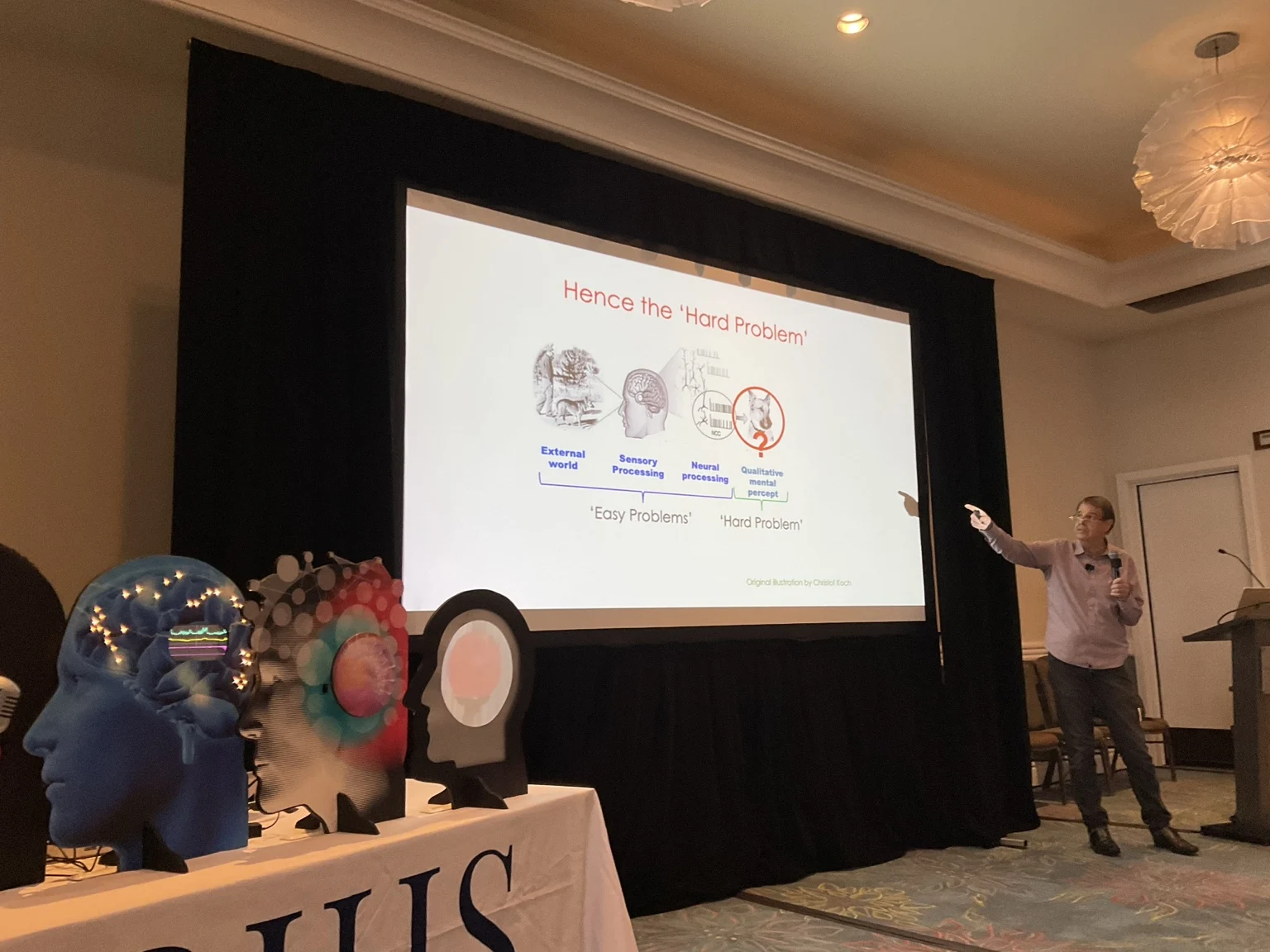
The slide titled “Hence the ‘Hard Problem’” distinguishes external-world, sensory and neural processing from a qualitative mental percept. It groups the processing side under “Easy Problems” and marks the step to qualitative experience as the “Hard Problem”, with a question mark.
The following slide, “Three categories of Properties & Functions”, introduces the following grouping:
| Category | Slide Labels |
|---|---|
| Tangible | External world; sensory processing; neural processing |
| Mental | Mental qualities |
| Conscious | Subjective consciousness |
Scope of the claim: this records the distinctions in the presentation. The diagram alone does not demonstrate that these are independently existing substances or that consciousness operates independently of the brain.
Source 10: Hence the ‘Hard Problem’
Source 11: Three Categories of Properties & Functions
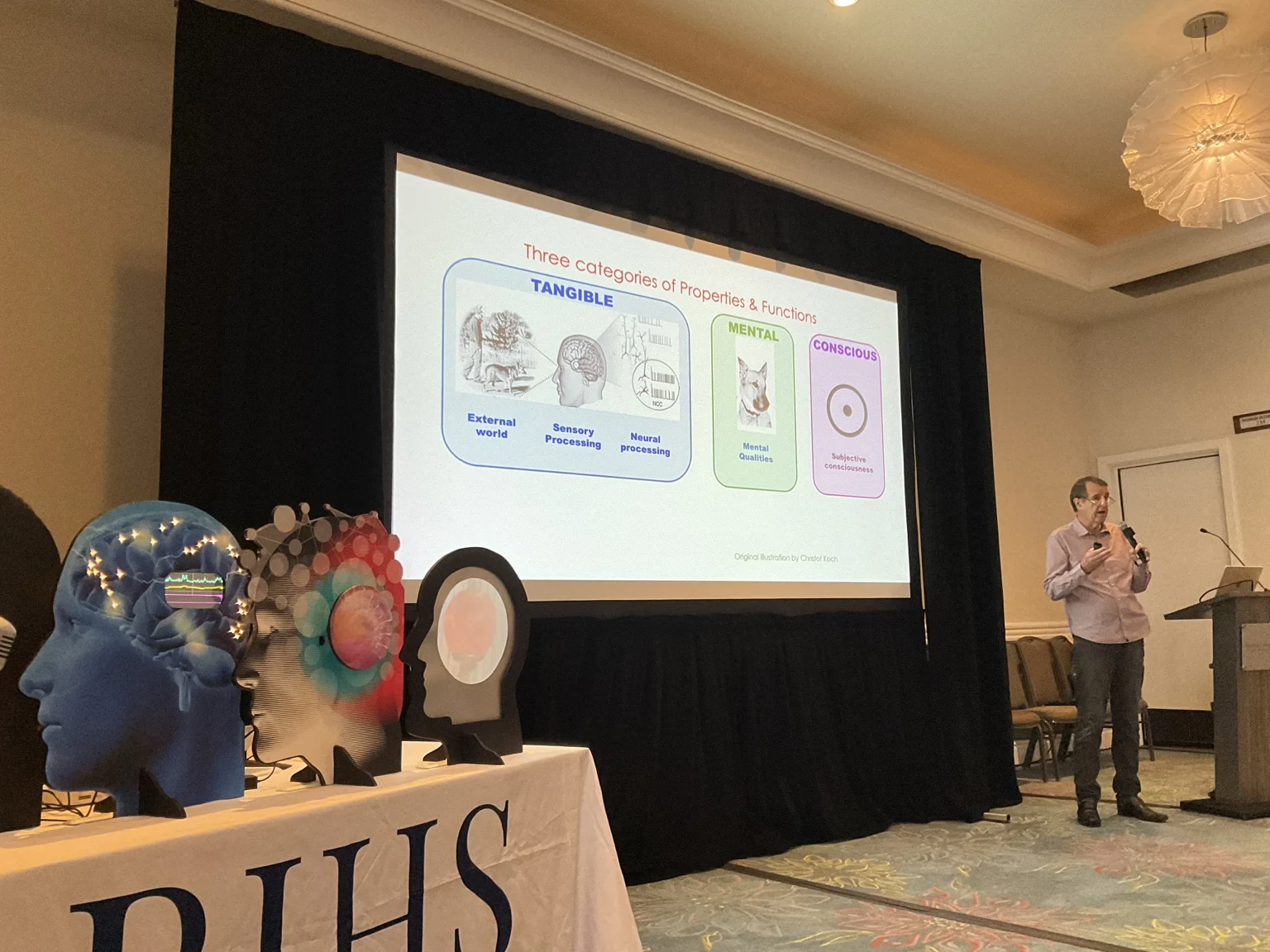
Both slides credit an “Original illustration by Christof Koch”. This is the attribution visible on the slides; the original illustration and any adaptations have not been independently checked, and the credit does not establish Koch’s endorsement of the three-category framework.
Open editorial question: how are “mental qualities” and “subjective consciousness” distinguished operationally, and what experiment could test that distinction? No answer is supplied by these two slides alone.
Sources 12–13 · Speaker’s Hypothesis · Testing Details Pending
The Proposed Process of Remote Viewing
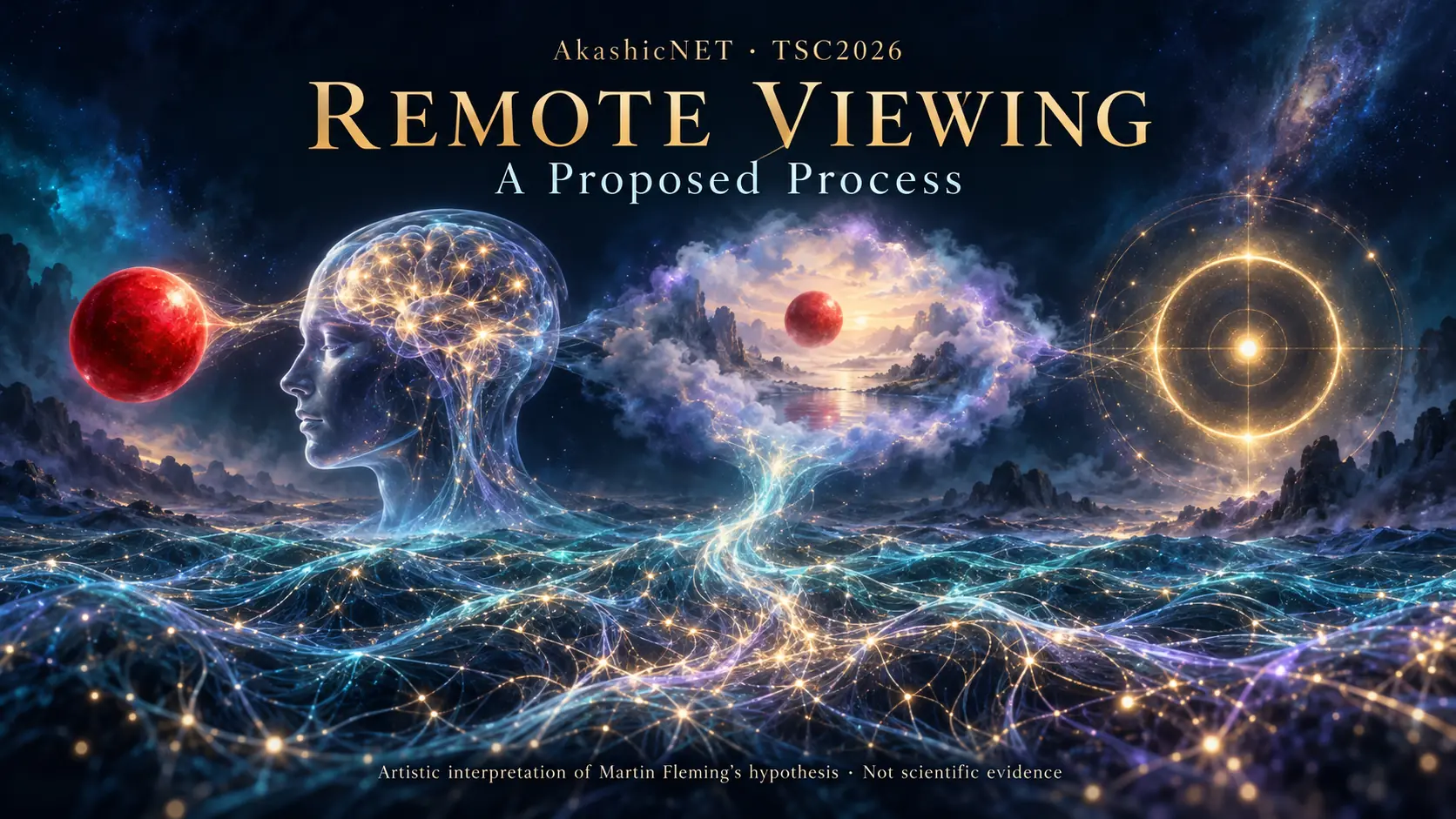
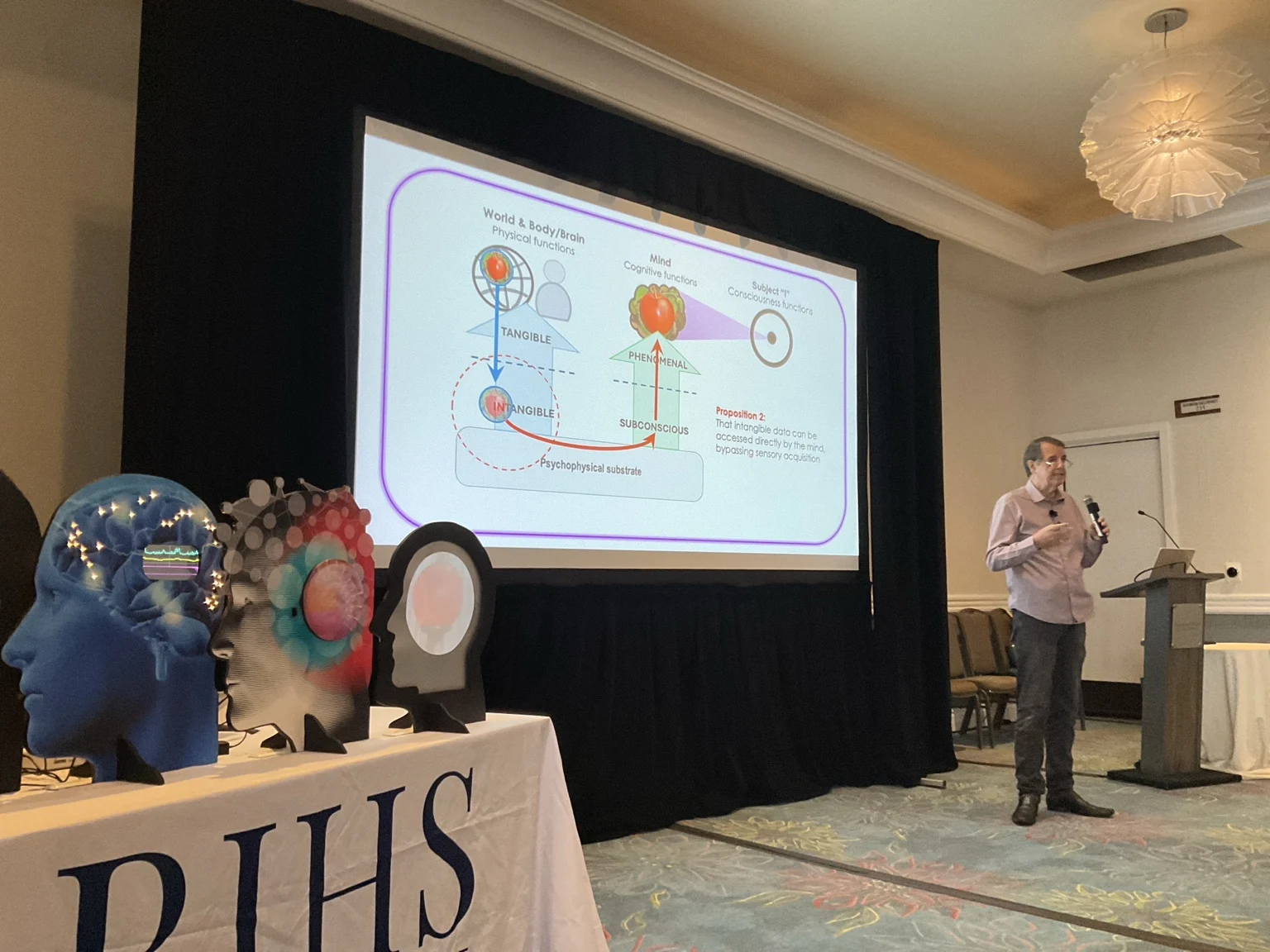
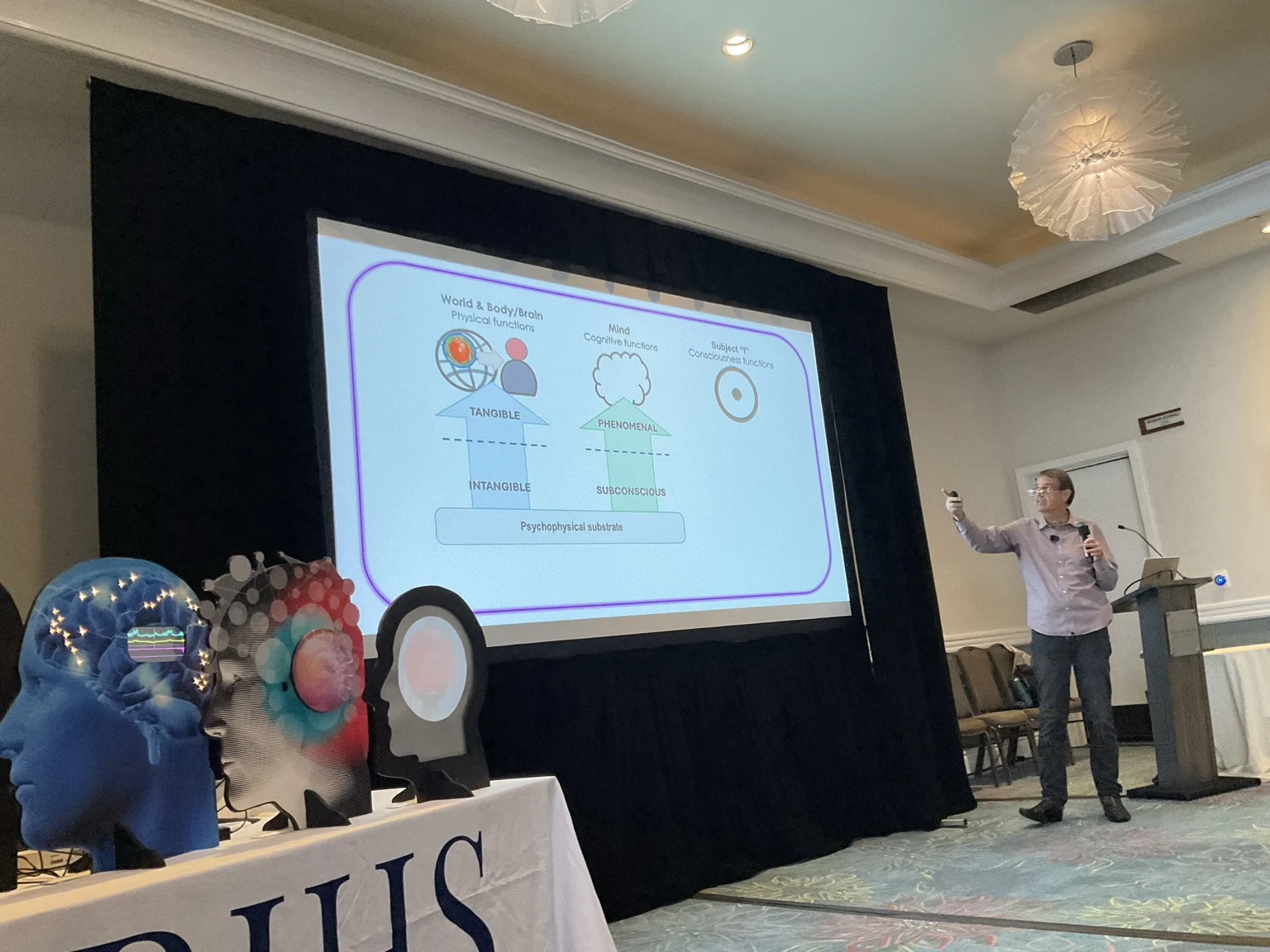
The new diagrams expand Fleming’s framework. They label three domains: “World & Body/Brain” with physical functions, “Mind” with cognitive functions, and “Subject ‘I’” with consciousness functions. Beneath the tangible and phenomenal labels sit “intangible” and “subconscious”, above a box labelled “Psychophysical substrate”.
One slide adds a proposed route from intangible data through the subconscious to phenomenal experience. Its text states:
Proposition 2: “That intangible data can be accessed directly by the mind, bypassing sensory acquisition.”
Attendee’s note on the spoken explanation: Fleming described this diagram as the process of remote viewing. In the context of the slide, the proposed route bypasses sensory acquisition and brings intangible data into the mind through the subconscious. This is a paraphrase based on the attendee’s report, not a recording or verbatim transcript.
Status: this is a hypothesis presented by the speaker. The arrows depict his proposed route; they are not measured information flows in the supplied material. No experimental methods, numerical results or independent verification are shown on these two slides. A slide stating Proposition 1 has not been supplied.
Source 12: Proposition 2 and the Proposed Route
Source 13: The Underlying Framework Diagram
AkashicNET editorial questions for the experimental section: what information must be identified, how is ordinary sensory access excluded, how are responses scored against chance, and what result would count against the proposition? Even a positive result would require a further argument to identify the proposed substrate as its cause.
Sources 14–15 · Speaker’s Definition & Experimental Framing
Remote Viewing / Perception
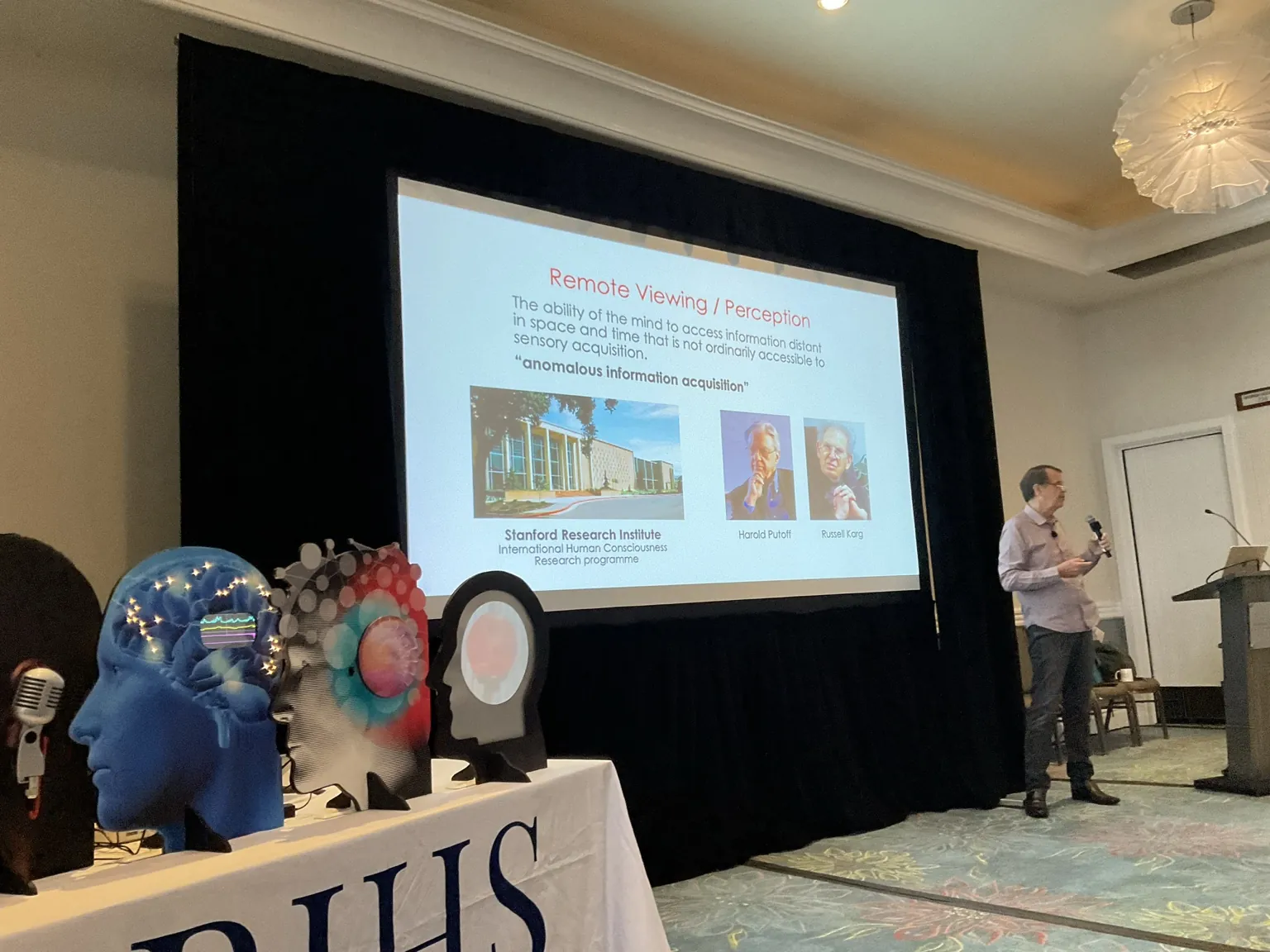
Fleming’s slide defines remote viewing as the mind accessing information distant in space and time that is ordinarily unavailable through sensory acquisition. It calls this “anomalous information acquisition”. This records the speaker’s definition of the proposed ability.
The slide references Stanford Research Institute, an “International Human Consciousness Research programme”, Harold Puthoff and Russell Karg. These are references shown in the presentation; their historical context has not yet been independently checked for this record.
Source 14: Remote Viewing / Perception
An Empirical Framing
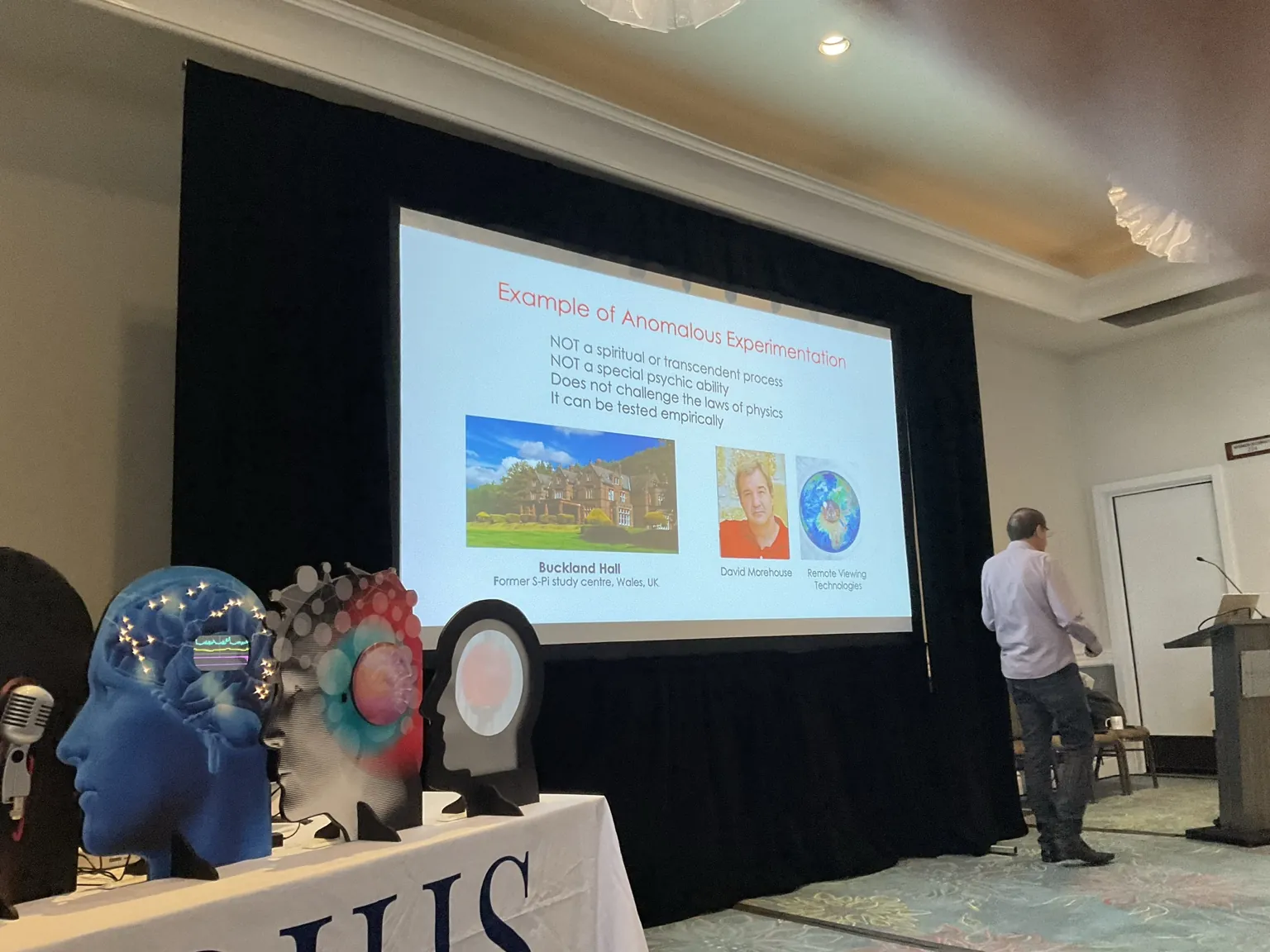
In a slide titled “Example of Anomalous Experimentation”, Fleming states that this is neither a spiritual or transcendent process nor a special psychic ability. He also states that it does not challenge the laws of physics and can be tested empirically. These are the presenter’s characterisations; this slide does not supply a protocol or results.
The accompanying labels identify Buckland Hall as a former S-Pi study centre in Wales, UK, and reference David Morehouse and Remote Viewing Technologies.
Source 15: Example of Anomalous Experimentation
Source 16 · Procedural Outline · Results Pending
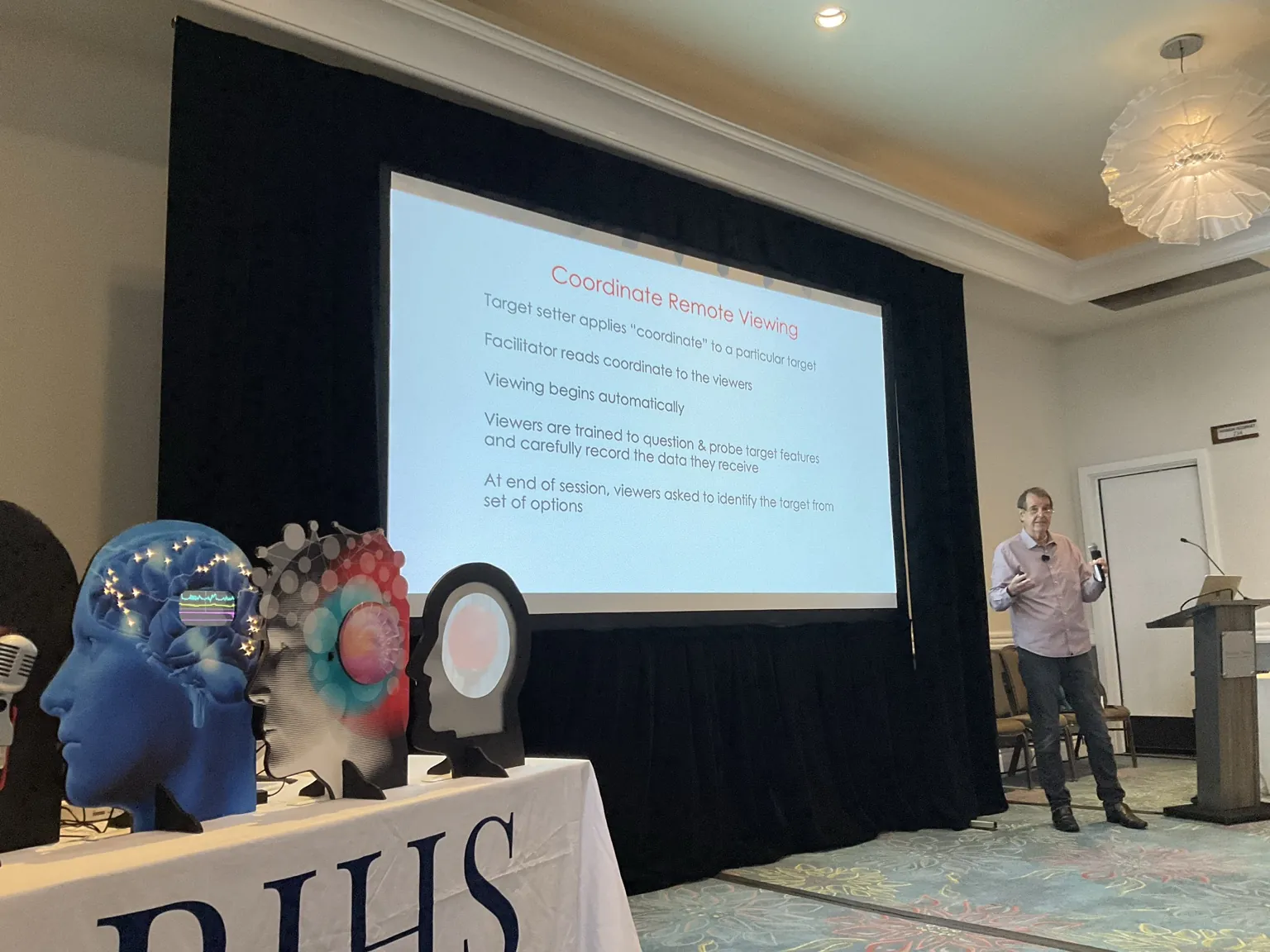
Coordinate Remote Viewing
Fleming’s next slide outlines the procedure as follows:
- A target setter assigns a “coordinate” to a particular target.
- A facilitator reads the coordinate to the viewers.
- The slide states that viewing begins automatically.
- Viewers are trained to question and probe target features, and carefully record the data they report receiving.
- At the end of the session, viewers are asked to identify the target from a set of options.
This is the speaker’s procedural description. The slide does not specify how coordinates or targets are selected, what the facilitator knows, how sensory leakage is prevented, how many options are offered, or how performance is scored against chance. No outcome data are shown.
Source 16: Coordinate Remote Viewing
Framework & Procedure Received · Results Pending
Findings, Evidence & Limitations
Each talk summary will identify the speaker and source, the reported observation, the method and relevant limitations. Speaker interpretations will be distinguished from measured results and independently checked sources.
- Near-death experiences (NDEs): presentation notes pending.
- Out-of-body experiences (OBEs): presentation notes pending.
- Past life memories: presentation notes pending.
No conclusion about consciousness beyond the body or the interpretation of past-life reports is drawn from the opening slide.
AkashicNET Editorial Questions · Not Panel Statements
What Will We Look For?
- What was directly observed, and what is an interpretation of that observation?
- How were accounts recorded, timed and independently checked?
- Which alternative explanations were tested, and what evidence remains missing?
- What future observation would help distinguish the competing explanations?
Personal Reflections & AkashicNET Connections
Awaiting the attendee’s reflections. These will be labelled as personal experience or interpretation and kept distinct from the speakers’ findings.
Connections to the wider Living Library will be added when the supplied session material supports a useful comparison.
Sources & Transparency
Source received: sixteen attendee photographs: the opening slide, BIHS display, Martin Fleming’s title and outline, four qualia slides, a model demonstration, the hard-problem and three-category slides, two psychophysical-substrate framework slides including Proposition 2, a remote-viewing definition, an anomalous-experimentation slide and a coordinate remote-viewing outline, supplied in this conversation. One attendee note additionally reports that Fleming described the diagram as the process of remote viewing. No full talk, recording, paper or Q&A has yet been reviewed for this page.
Updated: 11 October 2026, with Fleming’s remote-viewing definition, experimental framing and coordinate-viewing outline, alongside his framework, Proposition 2 and an attendee note on his explanation. Human-directed, AI-assisted page preparation and transcription. One AI-generated hero illustration was added at the attendee’s request; it is separate from the sixteen source photographs. Unreadable text and missing material remain unverified. Subsequent additions will identify their sources and corrections.