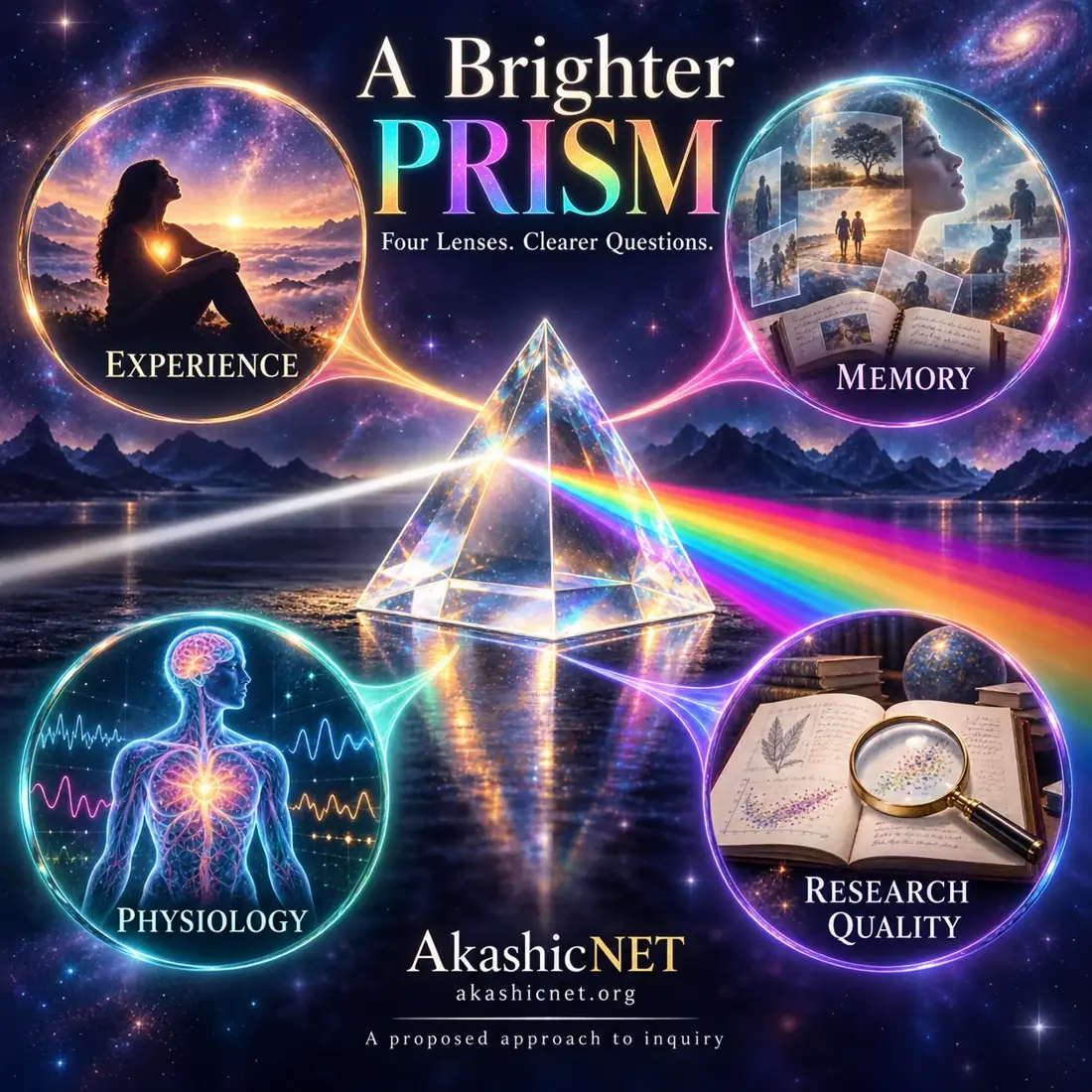
A brighter PRISM through several separate lenses: experience, memory, physiology and research quality. This is a proposed way to organise inquiry into consciousness and unusual experiences. Each lens asks a different question; together they help make both information and uncertainty easier to see.
This four-lens introduction complements the existing PRISM pre-alpha v0.2 interface. It is not a new technical release, validated scale or combined score.
01 / THE FOUR LENSES
Let each question keep its own shape.
Open a lens for a practical prompt and the limit of what it can establish.
01
Experience
What was it like for the person?
Begin with the person's own words. Record sensations, emotions and perceived meaning, distinguishing descriptions from interpretations. Respect for an experience can coexist with uncertainty about its explanation.
Question & boundary
Ask: What do you remember experiencing?
Keep in view: An account describes experience; it does not by itself establish its external cause.
02
Memory
How was the account recalled and recorded?
Preserve the earliest available account and its date. Distinguish spontaneous details from prompted answers and later reflections. Note what information was available before each retelling without assuming dishonesty.
Question & boundary
Ask: When was this first recorded, and what questions were asked?
Keep in view: A later interpretation should not silently replace an earlier account.
03
Physiology
What bodily conditions were documented?
Identify the measurements, medication records and clinical observations that actually exist. Separate measured values from estimates. Examine whether the recording interval can be linked to the reported experience.
Question & boundary
Ask: What was measured, when, and what remains unknown?
Keep in view: A gap in monitoring remains a gap; it does not establish what happened within it.
04
Research Quality
What can the investigation support?
Examine study design, advance outcome definitions, comparison groups, blinding, missing observations and ordinary information routes. Consider competing explanations and independent replication.
Question & boundary
Ask: Which conclusions follow from the design, and which exceed it?
Keep in view: A careful investigation can still leave its central question unresolved.
Four complementary lenses. AI-generated conceptual artwork; traces and geometry are symbolic, not measurements.
02 / A WORKED EXAMPLE
Follow the information, not just the impression.
Imagine a hypothetical account of an unusual experience during a medical emergency. The four lenses separate the description, its recording history, the clinical observations and the strength of the investigation. This is an illustration of reasoning, not a real participant record or an instruction to recruit participants.
Preserve the account.What did the person describe? Separate their words from an editor’s interpretation.
Trace the record.When was it first documented? Which details followed prompts or exposure to new information?
Check the observation window.Which measurements exist, and can their timing be linked to the reported experience?
Qualify the inference.What follows from the design? Where do competing explanations and unknowns remain?
A vivid account does not by itself establish physiological timing. A carefully conducted study can still leave its central question unresolved.
03 / A PRISM OF EXPRESSION
Cosmic. Comic. Organic. Many ways of seeing.
Different art styles can invite different forms of attention: the spaciousness of a cosmic painting, the humour of a comic, the movement of organic neon and the texture of a collage. Here they celebrate varied ways of noticing and expressing, including neurodivergent perspectives. No style is assigned to a diagnosis.
One scene, several artistic languages. AI-generated metaphor for varied perspectives and expression.
Cymatic-inspired patterns and sacred-geometry-inspired forms provide an artistic atmosphere. They are not measurements, brain maps or evidence of a physical mechanism.
04 / A MULTIDIMENSIONAL SUMMARY
More perspectives. No higher score.
More dimensions of a question, not a higher score. Here, 'higher-dimensional' means holding several distinct perspectives in view. It is an artistic and conceptual metaphor, not a claim about extra physical dimensions.
Respect the experience. Preserve the record. Examine the observations. Qualify the conclusion.