
“We are a way for the cosmos to know itself.”
Carl Sagan · Library of Congress attribution
Sagan’s words offer a starting point: we are parts of the universe capable of contemplating it. Whether the universe itself has a unified experience is a further question.
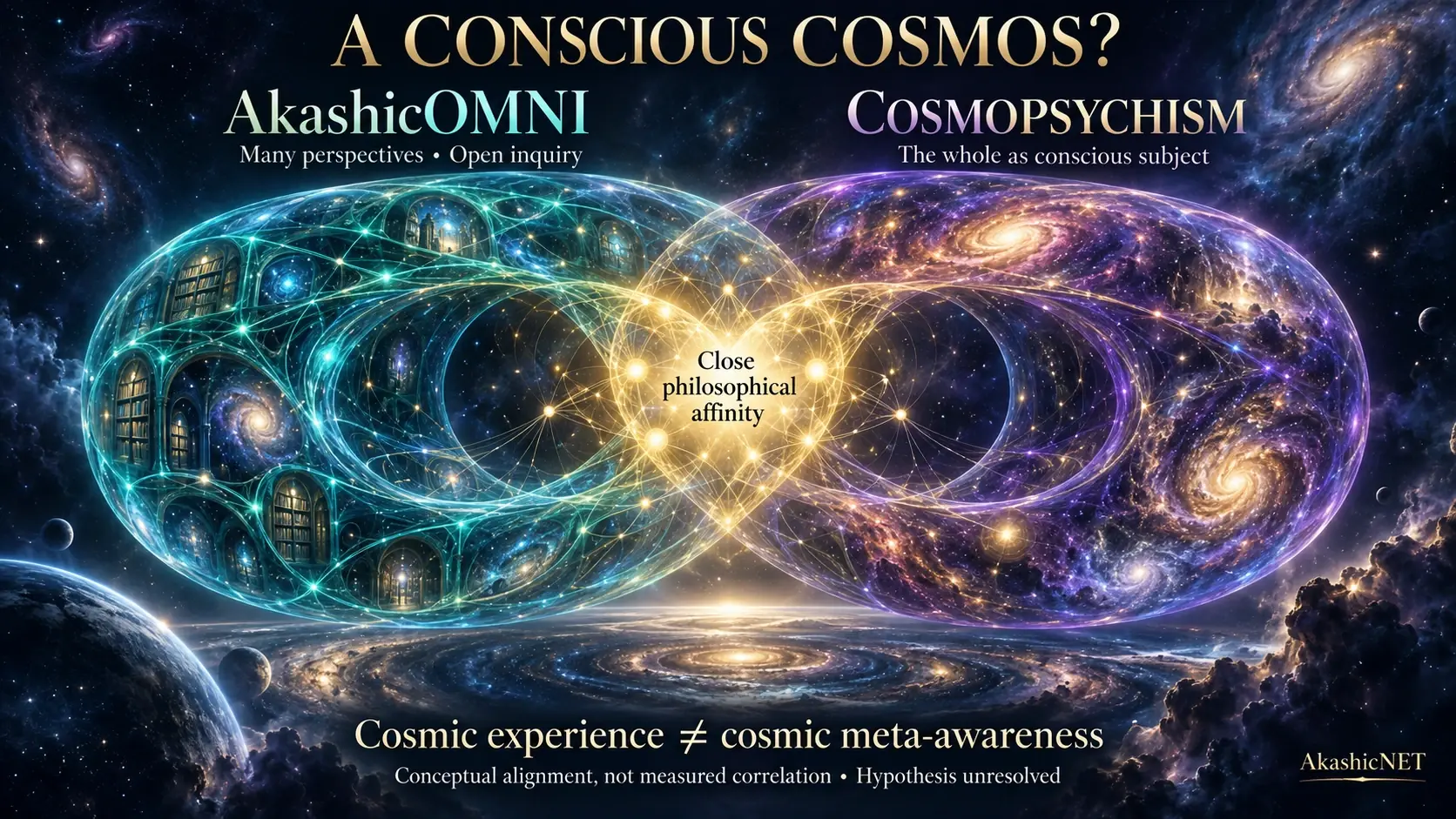
A Conceptual Eureka
Sometimes a picture helps us recognise the question we have been trying to ask: could individual minds be grounded in a greater experiencing whole?
AkashicOMNI brings different methods and perspectives into conversation. Its emerging exploration of a conscious cosmos has a close philosophical affinity with cosmopsychism: the proposal that the cosmos is a fundamental conscious subject and individual minds depend on it. This gives the inquiry a direction while leaving its conclusion open.
The eureka is conceptual clarity. The cosmic hypothesis remains unresolved.
Individual Centres, A Greater Whole?
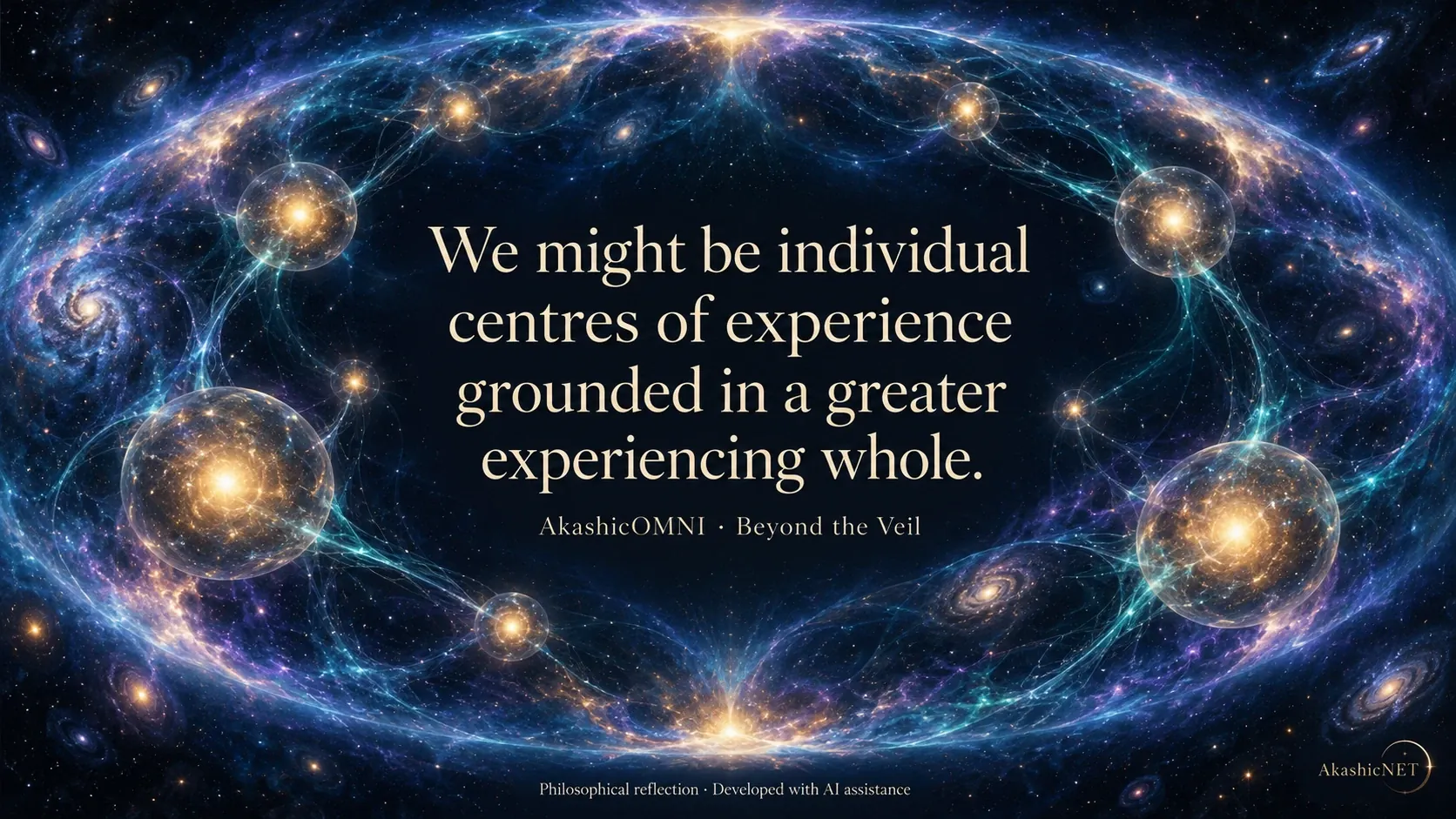
This formulation preserves both sides of the puzzle: the possibility of a larger consciousness and the distinctness of personal perspectives. Unity should not become an excuse to erase difference, agency or consent.
Four Claims, Four Questions
| Claim | Meaning | Open question |
|---|---|---|
| Local reflection | Conscious beings think about themselves and the universe. | How should we interpret this participation? |
| Cosmic experience | The cosmos itself has experience. | Is there a cosmic subject, and how would we establish that? |
| Cosmic meta-awareness | The whole is aware of its own experiencing. | What would self-monitoring mean at this scale? |
| Cosmic purpose | The whole has intentions or responds to values. | What would justify attributing agency to it? |
Our ability to contemplate the universe does not establish that the universe is a single contemplator. Cosmic experience would not automatically establish reflective awareness, purpose or benevolence. Each additional claim needs its own argument.
Where AkashicOMNI Sits
“I should say: the over-all number of minds is just one.”
Erwin Schrödinger · Mind and Matter (1958), “The Arithmetical Paradox: The Oneness of Mind” · Publisher reference
Schrödinger’s philosophical view resonates with unity beneath apparent multiplicity. In the surrounding passage he distinguishes this discussion from science. It is not a demonstrated consequence of quantum physics. See the quote-check notes below for access limits.
| Perspective | Alignment | Connection or difference |
|---|---|---|
| Cosmopsychism | Strong | A conscious whole with dependent individual minds. |
| Analytic idealism | Strong, conditional | Close if reality is fundamentally experiential. OMNI has not adopted that commitment. |
| Panpsychism | Partial | Experience is fundamental and widespread; micropsychist versions begin with smaller subjects. |
| Integrated Information Theory | Limited conceptual overlap | Examines experience through intrinsic causal structure; it does not automatically identify a cosmic subject. |
| Global Neuronal Workspace | Different explanatory level | Examines conscious access in brains without requiring a cosmic subject. |
| Physicalism | Tension with this proposed ontology | Remains an alternative for OMNI to evaluate. |
These approaches address partly different questions and are not all mutually exclusive. OMNI is the inquiry framework. Cosmopsychism is one interpretation within it.
The Contemplative Connection
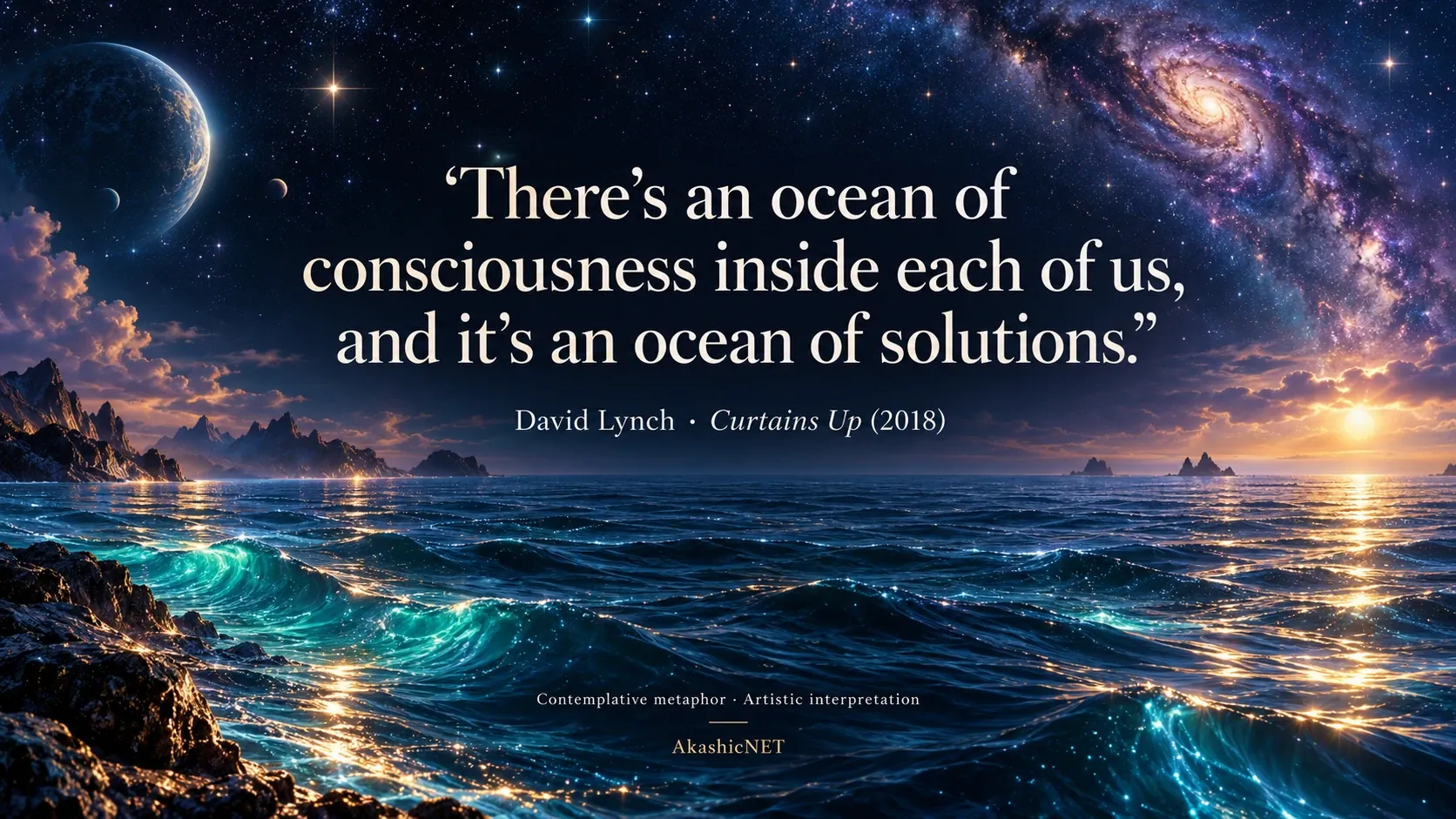
Lynch’s metaphor connects inward exploration with creativity. It resonates with attention, presence, insight and a less isolated sense of self. A feeling of unity can be meaningful without uniquely identifying its cause: describe the experience before deciding what it reveals about reality.
Animist traditions also bring relationship, personhood and responsibility into view. Their meanings require culturally specific treatment; they should not be collectively relabelled cosmopsychism.
If True, What Would Follow?

- Reality: our account would need to include cosmic experience and its relationship to physical structure.
- Individuality: the model would need to explain private perspectives, boundaries and differences.
- Neuroscience: brain–experience relationships would still require explanation.
- Participation: we might understand ourselves as experiencing participants within a greater experiencing whole.
- Ethics: interdependence might motivate care, while moral obligations would require their own justification.
Cosmopsychism alone would not establish telepathy, reincarnation, personal survival after death, cosmic benevolence or higher physical dimensions. Evidence for it would not automatically validate every OMNI framework.
Questions That Keep The Inquiry Open
“No account of the universe in its totality can be final which leaves these other forms of consciousness quite disregarded.”
William James · The Varieties of Religious Experience (1902), lectures on mysticism · Source text
James was discussing altered states and their interpretation. Taking experience seriously still leaves open what it tells us.
- How does one become many? Calling minds “aspects” of a whole does not yet explain distinct subjects.
- What does the whole experience? If it shares individual experiences, how are their different perspectives related?
- What does this explain better? Compare alternatives and identify what additional assumptions accomplish.
- What could change our minds? OMNI must allow conclusions against its preferred interpretation.
Criticisms need precise targets. An objection to a purposeful cosmic agent is not automatically an objection to every form of cosmic consciousness.
How OMNI Examines Itself
- AWAKEN and HIERATIC: experience, interpretation, tradition and lived conduct.
- HOMESENSE and REGENERATE: consequences for relationships, community and care.
- ADAPT and TRANSCEND: revision conditions and the distinction between expanded experience and ontology.
- #METAD and ACTC: organising assumptions and accounts of change, within the available specifications.
- CUT: history, present evidence and future investigations.
- UMASC: empirical findings, testimony, philosophical arguments and speculation.
- AkashicNET Synthesis: connections and unresolved disagreements.
Optional AkashicDARK examines limits of access. PRISM records perspectives and provenance. These methods contribute questions rather than votes: repeated agreement using the same source is not independent confirmation.
From Reflection To Investigation
A proposed study could compare reported connectedness after a structured relational-reflection exercise with a matched neutral-observation exercise. No data have been collected and no result is claimed. A positive result would concern the exercise and participants. Testing cosmic consciousness requires a model with distinguishable observational predictions.
The 7D exploration can help organise perspectives; its geometry does not establish physically seven-dimensional consciousness.
Estimated Contribution Mix
This is a rough retrospective allocation of influence on this article, rounded to five percentage points. It is editorial judgement, not measured authorship, effort, originality or evidence strength. Contributions overlap; the allocation totals 100% for presentation. It has not been independently audited.
- User direction, ideas and corrections · 30%
- Frameworks and methods · 20%
- External scholarship · 20%
- N2N / AkashicNET curation · 10%
- AI synthesis and drafting · 15%
- AI augmentation · 5%
The editor’s earlier framework development and curation also contribute indirectly; the direct-user share does not capture all that influence. AI augmentation includes visualisation and analytical suggestions. This allocation concerns the article overall, not the share of image-production work. A source discovered through N2N and summarised by AI remains one underlying source.
Reading And Source Checks
- UMASC v7.2
- HIERATIC Book I
- N2N: Contemplating a 7D Hypercube Perspective
- Goff: Cosmopsychism, Micropsychism and the Grounding Relation
- Kastrup: The Universe in Consciousness
- Integrated Information Theory 4.0
- Conscious Processing and the Global Neuronal Workspace Hypothesis
- Chan and Chan’s critique of agentive cosmopsychism: publisher abstract consulted; full argument not independently assessed.
Quote verification and access notes
Lynch: exact wording checked against the Foundation’s published narration transcript. James: checked in the reproduced original book text at Project Gutenberg. Sagan: checked against the Library of Congress’s indexed attribution; direct page retrieval was blocked during this check.
Schrödinger: wording checked against a reproduced chapter transcription and the indexed book PDF. The original scan could not be retrieved for page-level inspection, so this is not a facsimile verification. The surrounding passage characterises the discussion as religious rather than scientific. The transcription host’s wider views are not endorsed.
The AkashicOMNI quote is an original AI-assisted project formulation, not a quotation from a historical author. No cited author is represented as endorsing this project.
Transparency And Current Status
Human-directed and AI-assisted, informed by OMNI methods, AkashicNET/N2N curation and cited scholarship. All five artworks are AI-generated metaphors. Alignment ratings and contribution shares are editorial judgements. No empirical confirmation of cosmic consciousness is claimed.
This article presents the v0.5.0 candidate inquiry; publication does not promote it to a validated framework release. Cosmic experience and cosmic meta-awareness remain unresolved.
What would a conscious-cosmos model need to explain before you would take it seriously, and what evidence would lead you to revise your view?
Awaken within · Serve without.