
N2N SIGNAL & SYNTHESIS · CONSCIOUSNESS RESEARCH · 23 OCTOBER 2026 · 4 MIN READ
Does the brain alternate between seen and suppressed images
15 times a second?
A new primate preprint reports fast alternation between neural representations during binocular flash suppression. It is an intriguing temporal signal, not evidence that consciousness itself switches off and on at 15 Hz.
🟢 DIRECT EVIDENCE REPORTED BY THE PREPRINT
What was measured
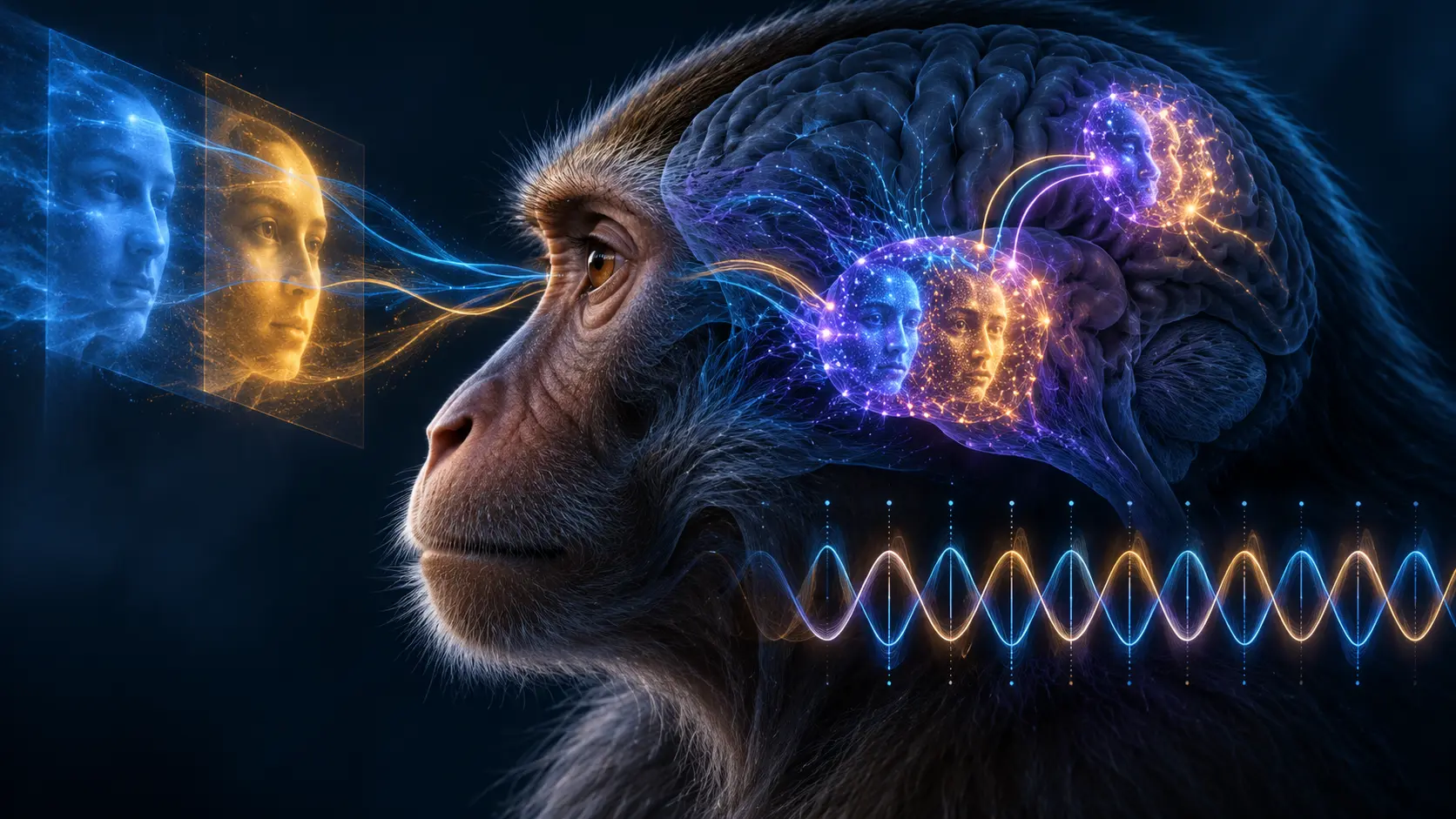
The authors used high-density Neuropixels recordings in face-selective regions of the primate inferotemporal and prefrontal cortex during binocular flash suppression. In this paradigm, competing images are presented so that one dominates perception while the other is suppressed.
They report that neural representations of the consciously perceived and suppressed stimuli alternated at approximately 15 Hz. Stimulus tuning was stronger during the microepochs classified as representing the consciously perceived image.
🟡 SCIENTIFIC INTERPRETATION
A temporal selection process, not a consciousness clock
The result is consistent with the brain repeatedly resolving competition between visible and suppressed content. That could help explain how a stable percept emerges from rapidly changing neural activity.
It does not establish that subjective consciousness disappears and reappears 15 times each second. The study did not directly sample subjective experience within every microepoch, and neural decoding is not identical to moment-by-moment phenomenology.
What would make the claim stronger?
- Trial-level behavioural reports aligned to the neural microepochs.
- Clear animal counts, effect sizes, uncertainty and preregistered analyses.
- Causal perturbation of the proposed rhythm, plus independent replication across regions and laboratories.
🔵 N2N SYNTHESIS & CONTEXTUALISATION
Content selection is not meta-awareness
This preprint concerns which stimulus representation wins access to neural processing. Meta-awareness asks a different question: whether awareness can recognise its own current contents and processes. It may operate at a higher-order descriptive level, but this study neither measures nor establishes a transcendent level above consciousness.
N2N angle: the brain may organise perceptual contents through rapid alternation, while the capacity to notice those contents remains a separate hypothesis requiring separate measures.
🟣 FUTURE HYPOTHESIS
If meta-awareness changes the stability, timing or reportability of these alternating representations, experiments combining perceptual rivalry with confidence ratings, introspective accuracy and causal neural perturbation could test the idea.
Primary source: Rapid alternation of conscious and suppressed stimulus representations in the primate brain. bioRxiv preprint. DOI: 10.64898/2026.10.15.759299.