

We spend our lives within Earth’s magnetic environment. An X post asks what a stronger background field might mean for health. Its starting point is Fan et al.’s long-term mouse study. The paper reports a result worth examining closely, while leaving human longevity and habitat design unresolved.
What was tested?
The researchers began with 24 healthy male C57BL/6 mice: eight sham controls, eight in an upward-oriented field and eight in a downward-oriented field. Magnetized or unmagnetized plates sat beneath the cages. The reported field varied approximately 70–220 millitesla (mT) from head to toe. Earth’s background field is measured in microtesla, thousands of times weaker. This apparatus tested a particular, position-dependent laboratory exposure rather than a uniform planetary environment. Primary paper ↗
Exposure began at age 52 weeks. The protocol used 16 hours per day for the first five weeks, then 24 hours per day, seven days a week until natural death. This is more precise than the abstract’s shorthand description of continuous exposure.
Survival: a modest median shift
| Group | Median | Change versus sham | Oldest mouse |
|---|---|---|---|
| Sham | 105.5 | Reference | 121 |
| Upward field | 111.5 | +6.0 weeks · +5.7% | 126 |
| Downward field | 109.0 | +3.5 weeks · +3.3% | 141 |
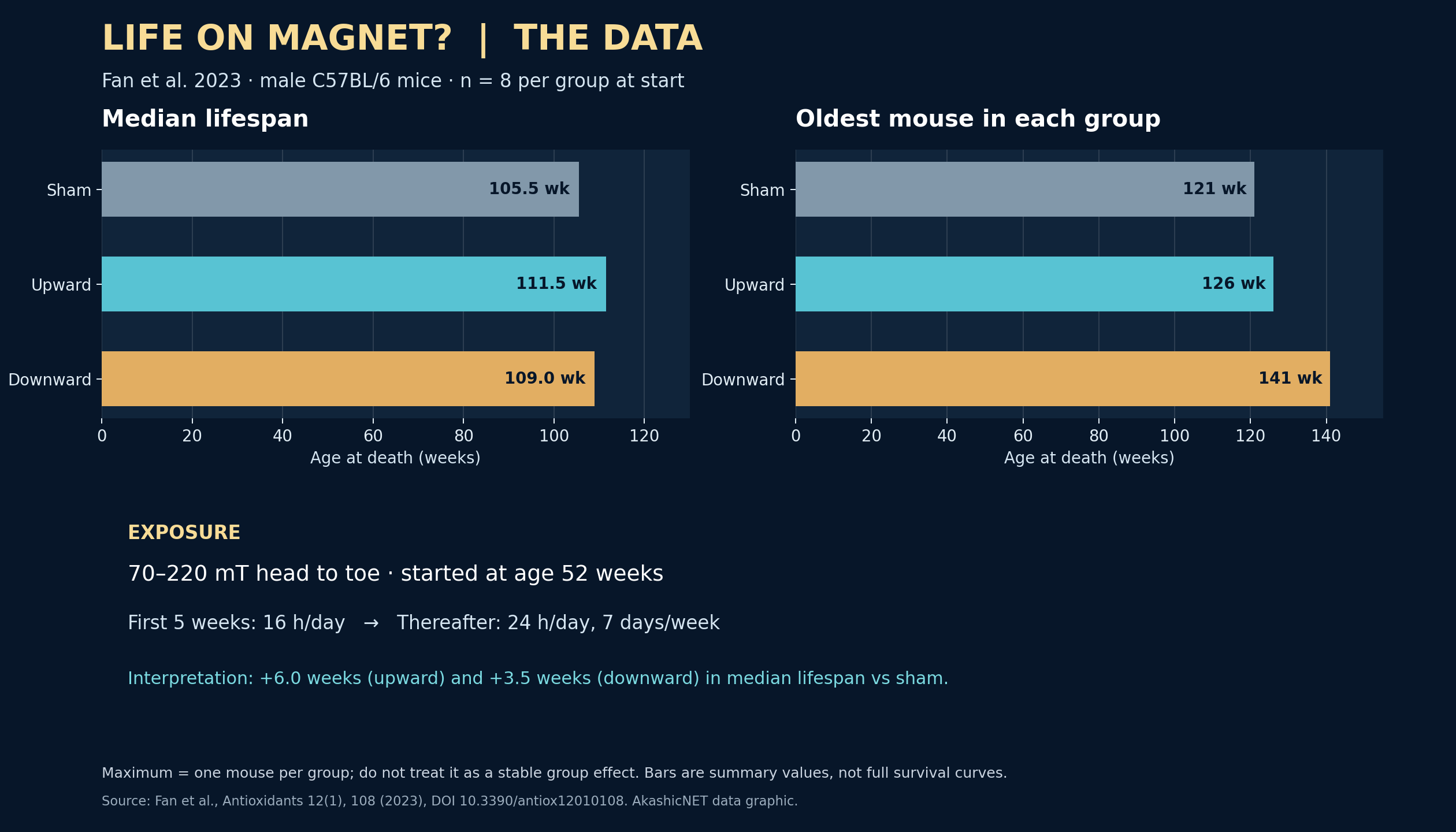
The paper presents survival curves for the two orientations separately and then pools the exposed mice. The pooled view compares 16 exposed mice against eight controls; the separate curves remain essential because the orientations cannot be assumed equivalent. With only eight mice per original group, a group’s maximum lifespan is especially sensitive to one animal. The median is more informative, yet its uncertainty and reproducibility need independent investigation.
Movement: a late-life snapshot
At 107 weeks, exposed mice travelled farther and moved faster in an open-field test. The authors report roughly 358% and 337% increases in distance travelled for upward and downward groups versus sham. The comparison occurs after some original animals had died. It therefore describes the survivors available at that age and cannot show that every originally assigned mouse experienced the same improvement. Earlier elevated-plus-maze findings were mixed: some exploration measures differed, while others did not.
Memory: account for swimming speed
In the Morris water maze, mice learn where to find a hidden platform. The combined exposed group’s escape time was reported as 36.49% shorter than sham on the fourth training day. The exposed mice also swam faster. Faster arrival can reflect navigation, movement, or both. Search strategies and the subsequent platform-removed probe trial provide further spatial information, so the careful description is better performance on selected spatial-learning measures. Behavioural video analysis was blinded, a useful protection against observer bias. Methods and results ↗
Oxidative stress: a pathway to test
The study examined oxidative-stress-related measures in aged mouse brain tissue and in PC12 cells subjected to a laboratory senescence model. The cell assays included superoxide dismutase, catalase and malondialdehyde. Together, the animal and cell observations make a redox pathway plausible. They do not establish that reduced oxidative stress caused longer survival; a measured marker can be a consequence or companion of another process.
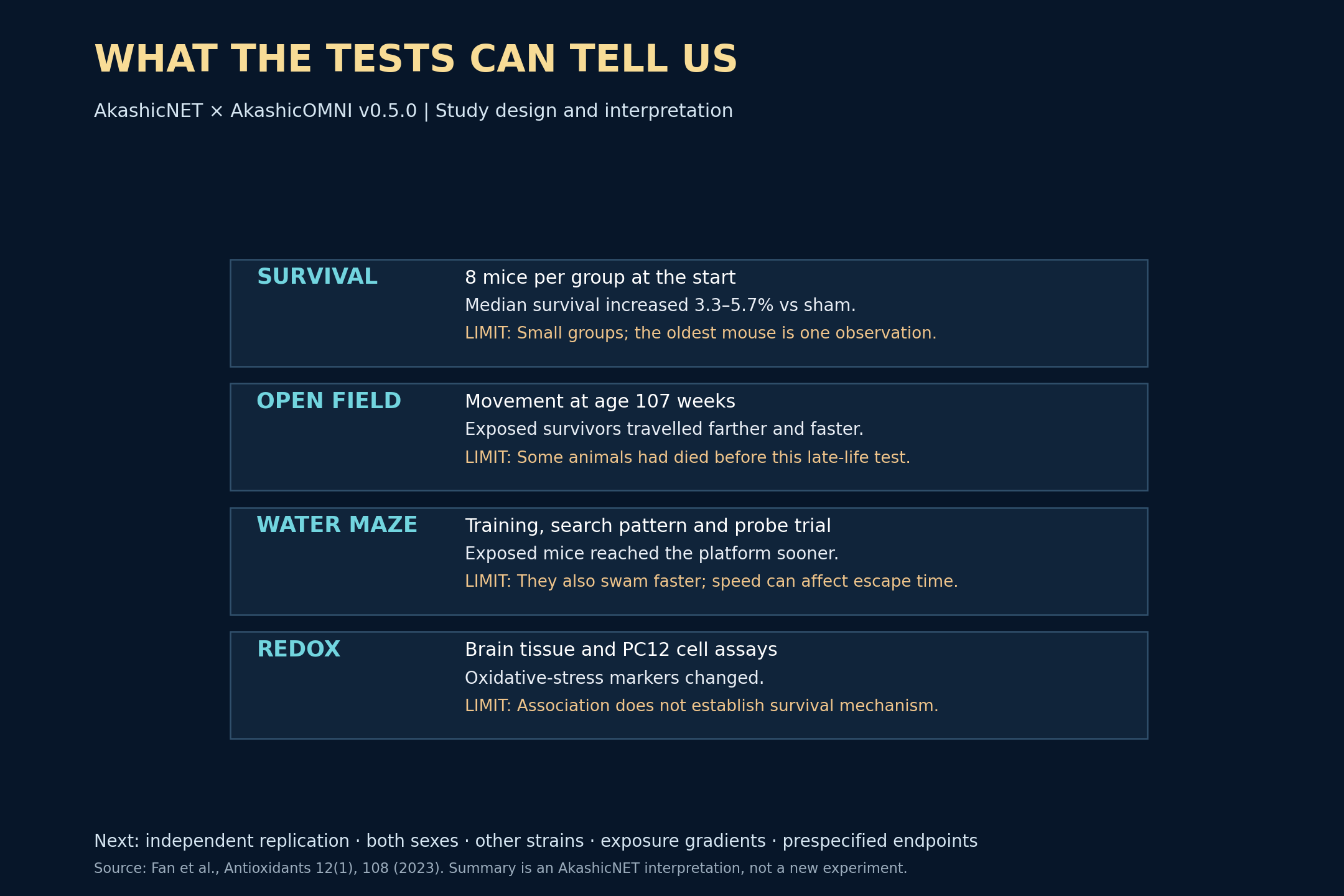
Survival, several behavioural endpoints, tissue findings and cell assays create many comparisons. Individual significant results should be read in that context. A preregistered primary outcome, effect estimates with uncertainty and independent replication would make the overall evidence easier to judge.
The N2N connection: related, not replicated
An earlier r/NeuronsToNirvana analysis of magnetic bacteria and lifespan examines another 2026 experiment. Researchers fed the magnetotactic bacterium Magnetospirillum magneticum AMB-1 to C. elegans worms, reporting an increase in mean lifespan from 17.17 to 24.62 days (43.39%) and investigating iron-related damage and ferroptosis. Worm study ↗
That intervention differs fundamentally from exposing mice to an external static field. The N2N post explicitly cautions that the worm result does not mean magnetism makes humans live 43% longer. These studies form two connected research questions, not mutual confirmation.
| Question | Fan et al. | AMB-1 study |
|---|---|---|
| Organism | Male mice | C. elegans worms |
| Intervention | External static field | Magnetotactic bacterium as food |
| Reported lifespan measure | Median | Mean |
| Human benefit established? | No | No |
AkashicOMNI: follow the claim across scales
AkashicOMNI v0.5.0 is used here as an interpretive lens, not as a result of either study. Field strength, cellular response, whole-organism survival, cross-species generalisation and habitat design are distinct levels. Each step needs its own measurements. A useful connection makes the next question clearer; it does not make the next claim true.
New companion analysis · 1 Oct 2026: Earth’s Magnetic Field, Mitochondria and Ageing examines a separate Pink1 fruit-fly experiment under magnetic shielding, including its survival–movement trade-off and the steps needed to test human relevance.
Future implications
- Replicate survival independently with clear group counts over time, uncertainty estimates and causes of death.
- Test the exposure space in females, other strains, multiple field strengths and durations, and both orientations.
- Separate cognition from physical performance where movement or swimming speed changes.
- Test the mechanism directly with measurements over time and interventions on candidate pathways.
- Study people and space habitats on their own terms. The mouse result supplies no validated field strength for a spacecraft or Mars base.
Evidence ledger
| Claim | Status |
|---|---|
| Exposed mice had longer reported median survival | Established evidence within this experiment |
| Selected movement and maze measures improved | Established evidence within the measured tests |
| Reduced oxidative stress caused longer survival | Hypothesis |
| The worm experiment replicates the mouse result | Unsupported: different intervention |
| Stronger fields increase human longevity | Unresolved hypothesis |
| Mars habitats need a 70–220 mT background | Speculation; no design recommendation |
Measure the field. Replicate the result. Test the mechanism. Keep the question open.
Sources and provenance
- Fan et al. (2023), Life on Magnet, Antioxidants 12(1), 108 — primary mouse experiment and figure data.
- Ding et al. (2026), AMB-1 and C. elegans lifespan — primary worm experiment.
- AkashicNET × r/NeuronsToNirvana magnetic-bacteria analysis — self-curated contextual comparison.
- Retrospective geomagnetic-disturbance and heart-attack study — separate observational context.
- Original X post — supplied in text by the article curator; its linked page was not independently accessible during drafting.
Transparency report
Approximate editorial contribution to this article: original researchers 40%; user direction and curation 25%; AI research assistance, synthesis and visual production 15%; self-curated N2N work 10%; original X post 5%; other sources 5%. These are subjective estimates of how the article was assembled, not scientific authorship or ownership shares. The paper’s authors remain the source of their findings. The hero is AI-generated conceptual art; the two data panels were built from reported study values and explicitly labelled interpretation limits.