
N2N SIGNAL & SYNTHESIS · 6 NOVEMBER 2026 · 8 MIN READ
What survives
replication?
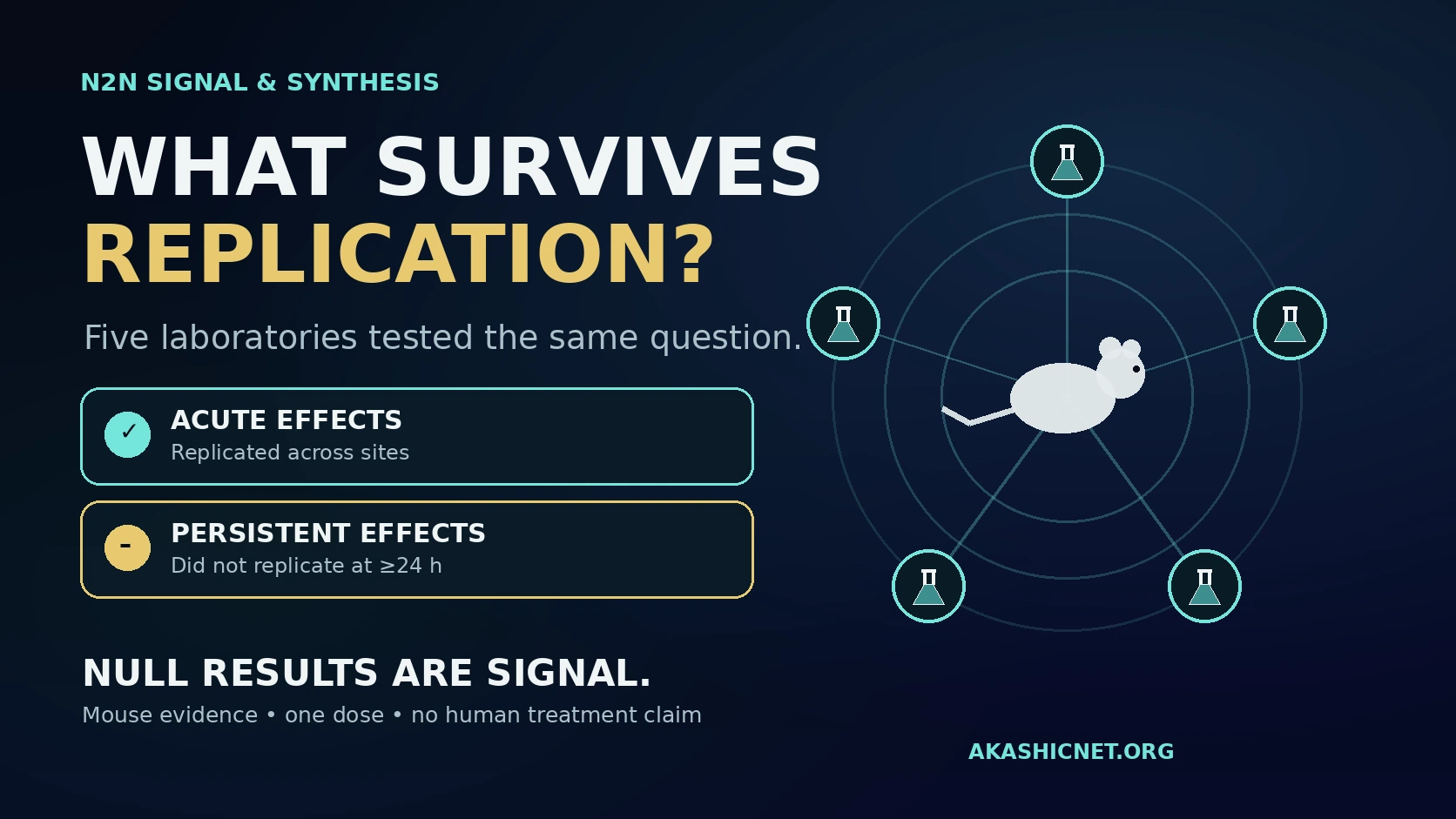
The week’s strongest psychedelic-science signal is a useful corrective: several acute effects of psilocybin replicated across five mouse laboratories, while the claimed persistent effects did not.
THIS WEEK’S READING PRIORITY
Replication before narrative
A result can be statistically interesting in one laboratory and still fail to travel. Multi-site work makes site effects and fragile outcomes visible. Here, the most informative result is mixed: some acute behavioural effects were robust, while several longer-lasting claims were not.
A null result narrows the claim. It does not erase the molecule, prove ineffectiveness in people or settle a clinical question the animal experiment did not test.
01 · STRONGEST READ
Which psilocybin effects replicate across five laboratories?
Five independent laboratories tested 2 mg/kg intraperitoneal psilocybin in male and female C57BL/6J mice, with roughly 200 mice per experiment across sites. Acute avoidance and anxiety-related changes, plus reduced fear expression, replicated. Persistent effects at least 24 hours later on anxiety-like or depression-like behaviour and fear extinction did not.
N2N angle: replication is not a failure of psychedelic science. It is how the field learns which signals deserve to survive.
02 · STRONG READ
LSD-assisted psychotherapy: a promising estimate with a small evidence base
Five randomised trials involving 227 participants produced a pooled standardised mean difference of −0.69 for depressive symptoms (95% CI −0.96 to −0.42). Three trials were rated low risk of bias and the review was registered in PROSPERO. The review also records three hospitalisations and one episode of acute anxiety with delusions as severe events considered possibly treatment related.
N2N angle: report benefit and harm from the same evidence table, rather than allowing efficacy to outrun safety.
03 · MECHANISM WATCH
Psilocybin, astrocytes and GABA metabolism
The study links psilocybin with reduced nucleus-accumbens GABA and changes involving astrocytic NFATc4 and ALDH5A1. The reported experiments used small groups, commonly three to six mice or cells from four animals.
N2N angle: glial cells belong in the psychedelic mechanism story, but a cellular pathway is not yet a treatment explanation.
04 · CONCEPTUAL ANALYSIS
Test consciousness theories through concrete regularities
Overcoming Essentialism argues that consciousness science can make progress by testing specific empirical regularities and contrasts rather than waiting for agreement on a single definition of consciousness.
N2N angle: theory counts matter less than whether rival accounts survive the same discriminating test.
AKASHICNET × N2N × AKASHICOMNI v0.5.0
One signal, three responsibilities
What the combined analysis adds
Replication lens. The five-laboratory study shifts attention from whether psilocybin “works” to which effects survive changes of site and context. Acute mouse effects look more portable than the tested persistent outcomes. The next useful variables are dose, route, sex, laboratory conditions and prospectively defined cross-site heterogeneity.
Translation lens. The LSD meta-analysis concerns people and symptoms, but it combines only five varied trials. The mouse replication cannot validate or refute that clinical estimate. Animal behaviour, cellular mechanism and psychotherapy outcomes occupy connected but distinct evidential levels.
Mechanism lens. Astrocytic NFATc4, ALDH5A1 and GABA metabolism form a candidate pathway. To move from association to explanation, future work should manipulate the pathway, reproduce the effect independently and test whether it mediates behaviour across doses and models.
Consciousness lens. The essentialism analysis offers a practical rule for the entire briefing: compare theories using concrete empirical regularities. Meta-awareness, transcendence and altered experience each require their own operational measures rather than being inferred from neural or behavioural change alone.
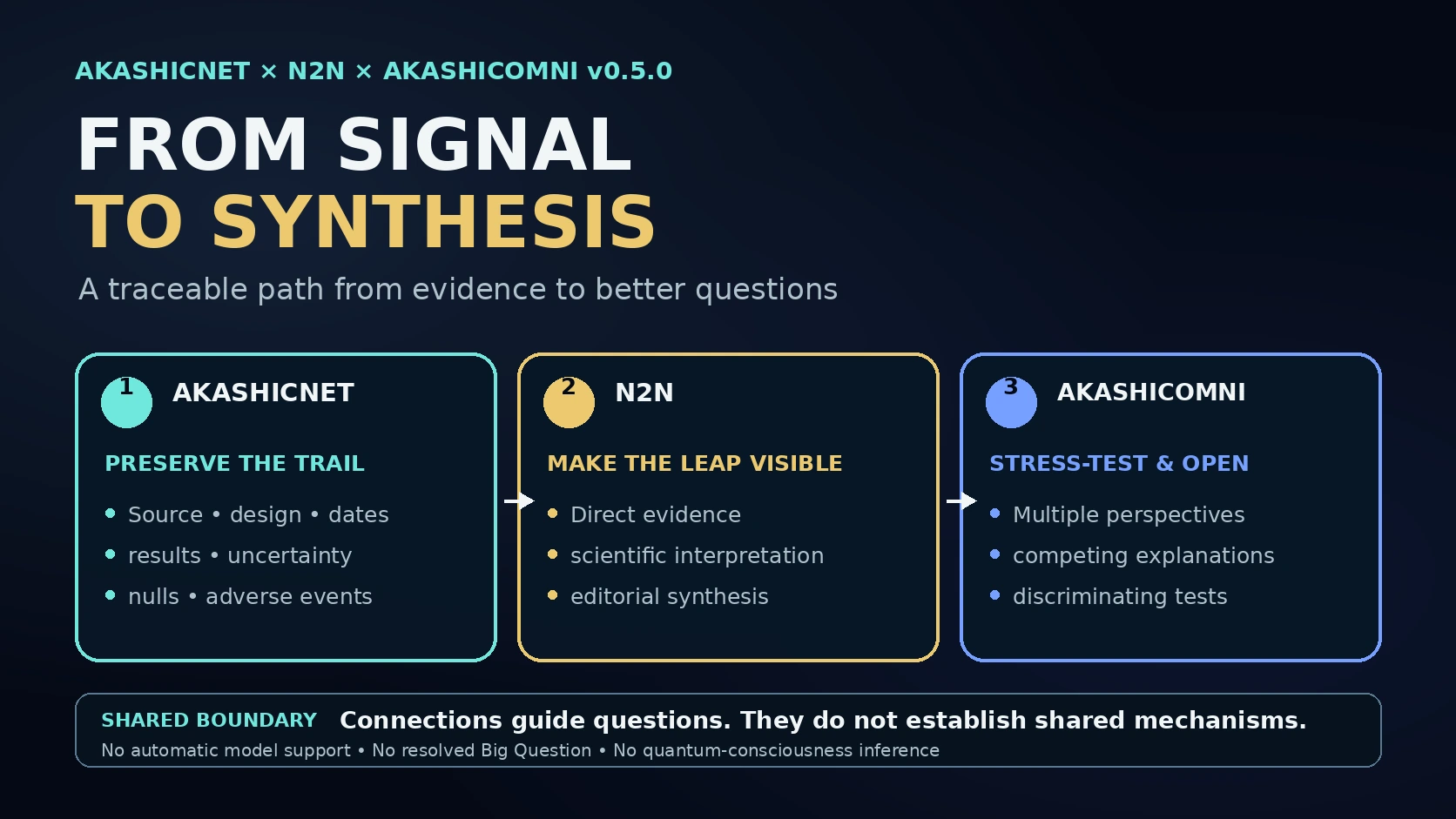
Synthesis: follow the signal across levels, but never let a connection between topics masquerade as evidence for a connection between mechanisms.
Three discriminating next steps
- Preregister a multi-site dose-and-route replication that estimates site heterogeneity rather than treating the laboratory as background noise.
- Run adequately powered human trials with credible masking, standardised adverse-event reporting and longer follow-up.
- Test whether the proposed astrocyte pathway causally mediates measured behaviour, then examine its relevance in human tissue or validated translational models.
FRONTIER PHYSICS · CONSEQUENTIAL METHOD SIGNAL
Bell nonlocality at telecom wavelength
A peer-reviewed Nature Communications experiment directly generated entanglement between a single rubidium atom and a 1530 nm telecom photon. The reported entanglement fidelity exceeded 91.4%, and the CHSH parameter was 2.455 ± 0.077, above the local-realistic bound of 2.