
RESEARCH IN FOCUS · 11 OCTOBER 2026 · 2 MIN READ
Remote Viewing:
Above Chance?
A positive statistical finding. An explanation still to test.
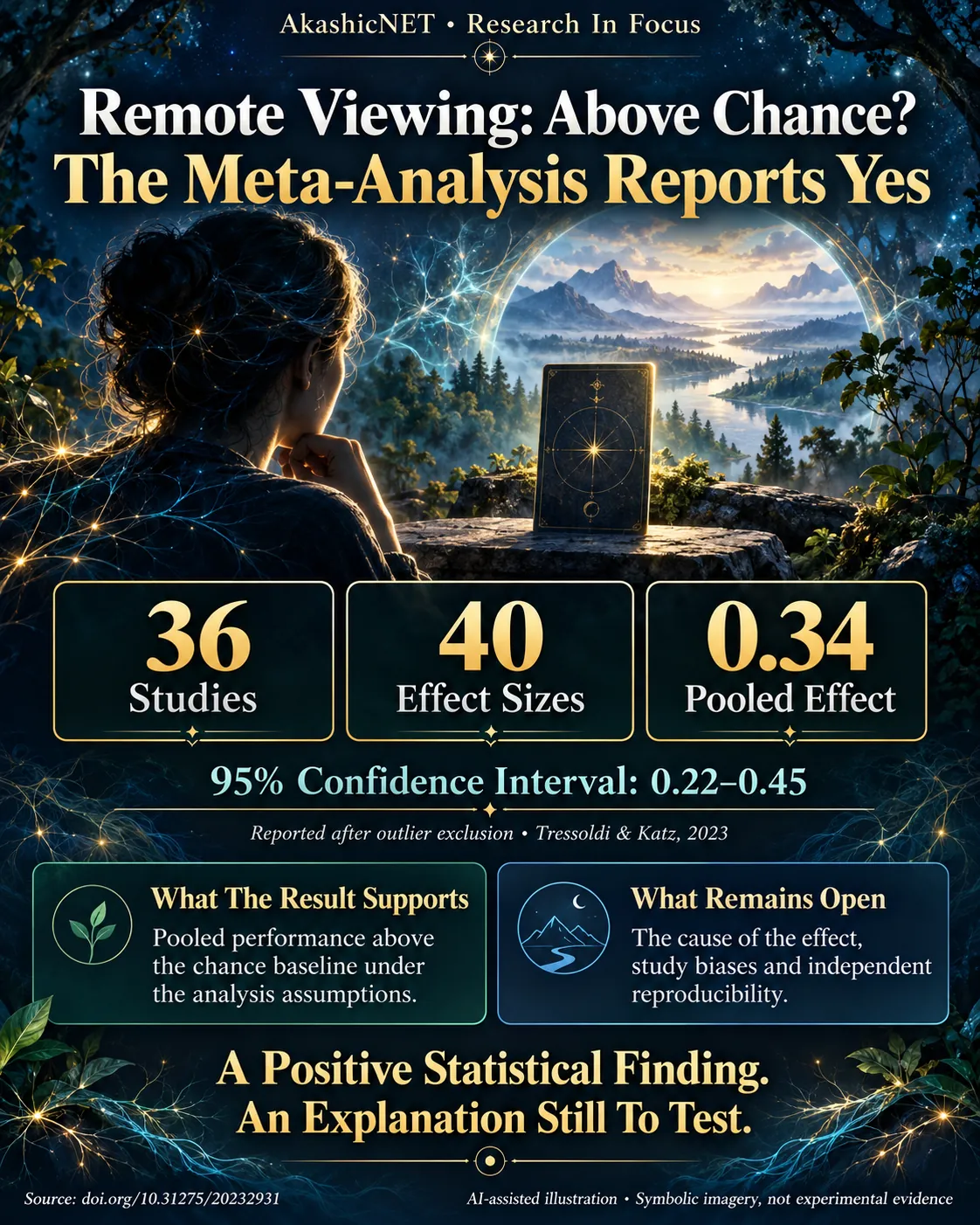
What The Meta-Analysis Reports
Patrizio E. Tressoldi and Debra Katz’s Remote Viewing: A 1974–2022 Systematic Review and Meta-Analysis (2023) assembled 36 studies and 40 effect sizes. The publisher abstract reports an average effect of 0.34, with a 95% confidence interval of 0.22–0.45, after excluding outliers.
Above Chance Under The Analysis Assumptions
The reported interval excludes zero. This is a positive statistical finding worth examining seriously. It does not identify the cause of the effect or give the probability that chance caused the results.
A pooled effect of 0.34 is not a 34% accuracy rate. Study counts are not participant counts. The combined participant denominator has not been verified for this editorial summary.
Open Inquiry, Testable Explanations
A noetic perspective can take anomalous experience seriously while keeping explanation open. Candidate explanations require discriminating tests: anomalous information acquisition, sensory leakage, scoring flexibility, selective reporting, dependence between results and other design or analysis effects.
The authors report no signs of publication bias. That is their analysis result, not a guarantee that all relevant biases are absent. A meta-analysis also cannot substitute for independent, preregistered replication with blinded scoring and safeguards against information leakage.
These findings concern remote-viewing tasks. They do not establish consciousness surviving death, telepathy, quantum mechanisms or a particular spiritual interpretation. BQ001 remains UNRESOLVED.
What Would Move The Question Forward?
- Audit the included studies, outlier rules, scoring and dependence between effect sizes.
- Compare preregistered analyses with all-study and sensitivity results.
- Run independent, adequately powered replications with concealed targets, blinded judging and openly available methods and data.