
AkashicINQUIRY030 · Munich Neuroscience Lectures

Can Mitochondria Shape a Tissue’s Electrical Signals?

A question for Martin Picard, Columbia University, ahead of his public lecture in Martinsried on 7 December.

Time and venue
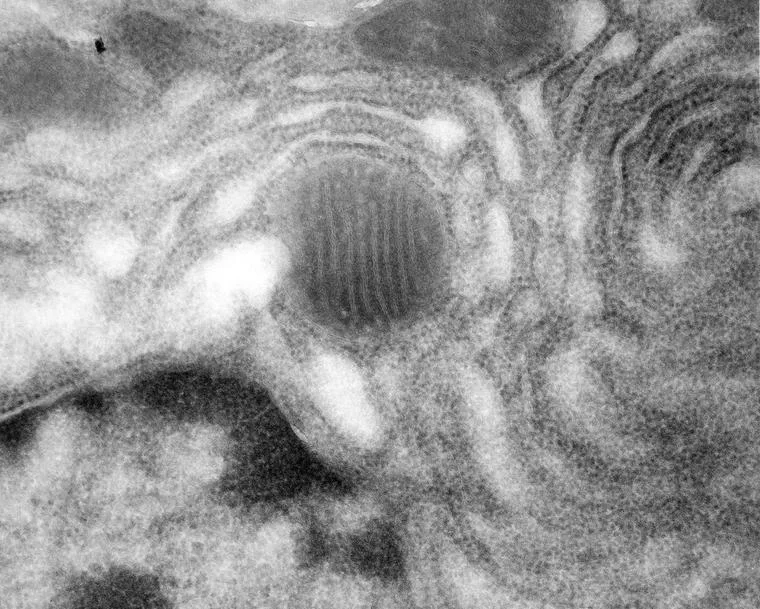
Black-and-white electron micrograph showing closely spaced folds inside an oval mitochondrion.
The folds are cristae, part of the inner mitochondrial membrane. Mike Kayser / Wellcome Collection · CC BY 4.0 · WebP conversion.

Attend the lecture

The energy resistance principle across the body, brain, and mind

When
Where
LMU Biocenter · B01.019
Großhaderner Straße 2
82152 Planegg-Martinsried
Admission
Open to the public
No registration required
Host
Prof. Angelika Harbauer
Munich Neuroscience Lectures

The host confirmed the time, room and public access on 26 November. Use the details above if you see a different time on the LMU faculty listing.

AkashicABSTRACT · Pre-lecture guide

What Does “Resistance” Mean Here?

Think of a cell doing work, such as pumping ions across its outer membrane. Where does the energy come from? Electrons from food move through a chain of reactions in mitochondria. Some of the energy released builds a proton gradient across their inner membrane. That gradient can drive the production of ATP, which the cell can spend on work including ion pumping.

Martin Picard and Nirosha J. Murugan propose that the constraints on this flow can help explain both useful work and cellular stress. They call this the energy resistance principle. It is a framework for asking questions across scales. One such question is whether the arrangement of a tissue’s electrical signals changes in a predictable way as its energy supply changes. Read the 2025 Cell Metabolism Perspective.

The Munich listing gives the lecture title. For a preview in Picard’s own words, the Max Planck Institute for Human Development has published an abstract for his separate Berlin talk on 10 December under the same title.

AkashicNEXUS³ · Discern / Deepen / Synthesis

Two Membranes, Two Measurements

Discern · What was measured?

Mosharov and colleagues measured mitochondrial features in 703 small samples from a section of one donor’s brain. Their whole-brain map extends those observations using modelling. Regional differences in respiratory capacity give researchers a place to look. They tell us little on their own about what that person felt. Human brain study · Nature, 2025.

Deepen · Where is the voltage?

Inside a mitochondrion, a voltage forms across its inner membrane. At the surface of a cell, a different voltage forms across the plasma membrane. In regenerating flatworms, Beane, Morokuma, Lemire and Michael Levin linked changes in cell-surface voltage to the proportions of regrowing organs. Their experiment leaves open how mitochondrial metabolism might shape that pattern. Planarian study · Development, 2013.

Synthesis · What else could explain it?

A tissue under general metabolic strain may simply slow down. A more specific claim predicts which cells’ voltage changes first and how the pattern spreads, even when tissues have comparable energy availability and viability. Measuring both the metabolic response and the spatial voltage pattern would help distinguish the two explanations.

“If two tissues have similar ATP levels but different patterns of mitochondrial activity, would you expect the electrical signals between their cells to differ? What measurement would persuade you?”

AkashicNET’s question for the discussion, drawing on Michael Levin’s TSC2026 talk.

AkashicFUTURES · Research scenarios

What Would Change the Answer?

A repeatable pattern appears

A change in mitochondrial activity consistently precedes the same spatial change in cell-surface voltage. If the timing and location also hold in fresh samples, the next question is which signal connects the two membranes.

General fatigue accounts for it

The apparent pattern disappears when energy availability, tissue health and workload are matched. That would favour a simpler explanation within this setting. Either result would help narrow the claim.

What Do We Hear When Someone Says “Energy”?

AkashicSPIRIT

A listening practice

In Buddhist mettā practice, goodwill can begin with listening. If a friend says “I have no energy today”, consider asking “What does that feel like for you?” Tiredness, grief and a crowded week can all be described in those words. Let their answer guide any offer of help.

AkashicVISION

Who gets to interpret the result?

Imagine a future study collecting both energy measurements and accounts of fatigue. Let participants help choose the outcomes that matter. When the measurements and the accounts disagree, report both. The discrepancy could point to an experience the instrument misses.

Reading and listening

Before You Go