
AKASHICOMNI × AKASHICNET · INDEPENDENT PAPER REVIEW · 27 SEPTEMBER 2026
Ingressing minds: where evidence ends and ontology begins
Michael Levin asks whether bodies are interfaces to a wider space of patterns, including minds. His biological examples deserve attention. The proposed nonphysical cause needs a sharper comparative test.
01 / THE THESIS
What Levin is proposing
In “Ingressing Minds”, Levin argues that mathematics does more than describe the world: physical structures can act as interfaces to a structured “Platonic space” of patterns. Some patterns might be dynamic and agential. On that account, a brain or other embodiment makes a kind of mind available in the physical world. His shorthand is that the mind–body relation resembles the relation between mathematical pattern and physical object. He explicitly calls the position dualist in the sense of allowing causes that are not wholly physical. This is a proposed ontology, not a reported observation of a disembodied mind.
His motivating question is powerful: how do unfamiliar assemblies of cells, and even simple engineered systems, display coherent behavior for which their particular forms were never directly selected? He recommends exploring altered bodies and minimal algorithms, mapping which designs yield which capacities. The paper also urges humility about the possible moral status of artificial and hybrid systems. Those questions remain useful even if the Platonic interpretation fails.
02 / ARGUMENT MAP
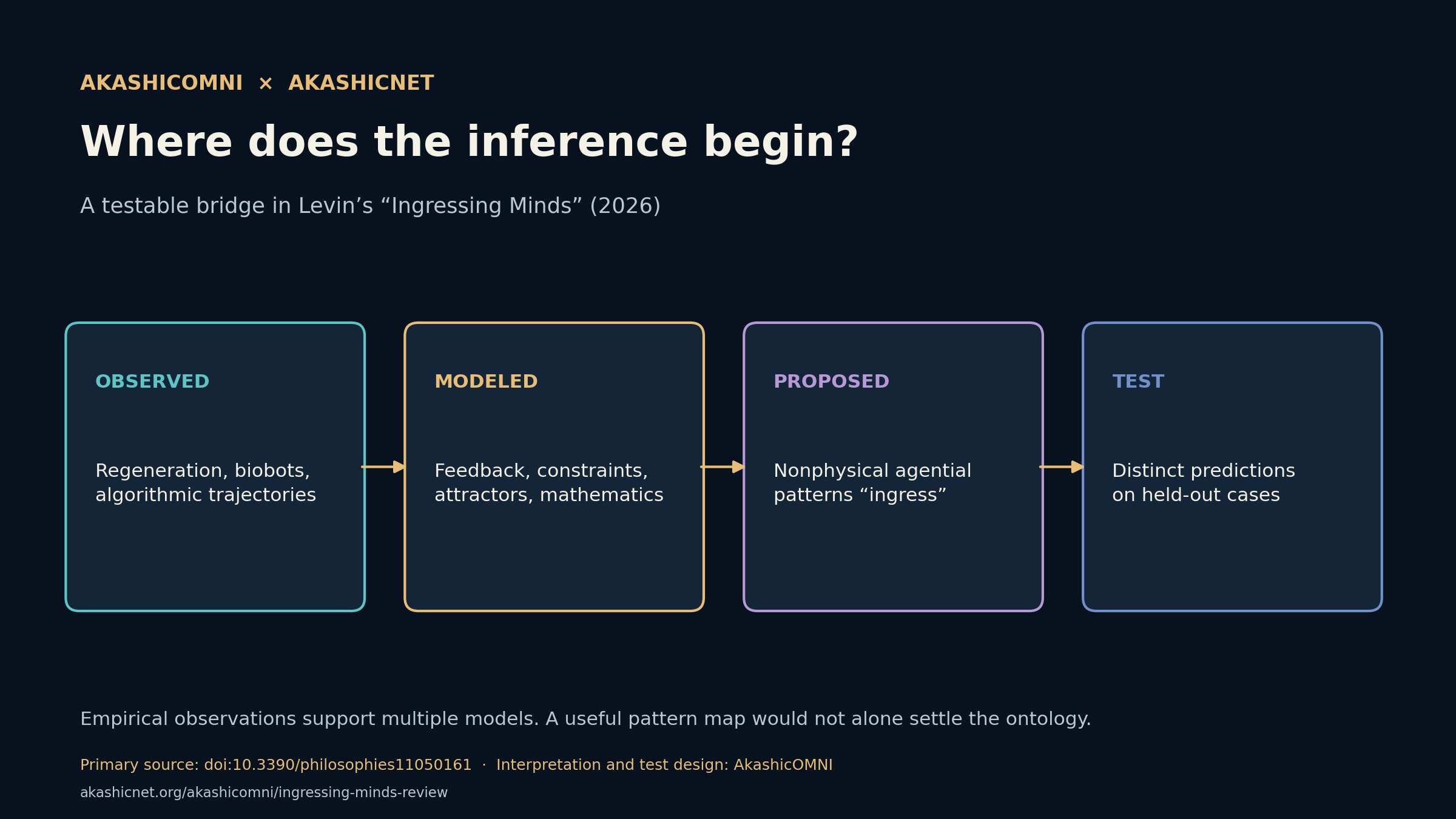
The bridge the evidence must cross
The first two boxes concern observable systems and usable models. The third introduces a metaphysical interpretation. The fourth is our proposed standard for testing its distinctive value.
03 / EMPIRICAL GROUND
What the cited work actually gives us
Bioelectric pattern memory
Brief interventions in planarians can alter head–tail outcomes and make the altered regenerative pattern persist through later cuts. This supports a causal role for tissue-level electrical state and regulatory memory beyond DNA sequence alone. It does not identify a nonphysical source of the target form. Primary study ↗
Novel living constructs
Xenobots and Anthrobots show that cells can self-organize into capabilities outside their organisms’ usual body plans. The observations press us to model how inherited cell machinery, geometry, local interactions and environment combine. A construct lacking a history of selection in its exact new form does not lack evolved components or physical constraints. Paper §5.4 ↗
Minimal algorithms
Sorting procedures can trace surprisingly elaborate paths through a defined state space. That is a reason to analyze the state space and our description of its behavior. Calling those paths “delayed gratification” is an observer-level interpretation; it does not establish subjective experience inside the abstract algorithm. Paper §6.3 ↗
04 / CRITICAL ASSESSMENT
Three inference gaps
- Mathematics to extra cause. A triangle’s third angle is constrained by geometry once two are specified. The physical triangle still obtains its shape through physical processes. Using mathematics indispensably in an explanation does not, by itself, show an additional nonphysical force entering the causal chain.
- Competence to an agent. Feedback control, attractor dynamics and inherited machinery can produce robust goals in a useful operational sense. Whether such organization also hosts a conscious subject is a further question. Neither surprising behavior nor the word “goal” settles it.
- Useful framework to distinct ontology. A Platonic-space map may generate excellent predictions even if it functions as an abstract model of physical dynamics. Levin’s own note says the metaphysical and epistemic readings may be hard to distinguish. Practical success supports the model’s usefulness; an ontological claim needs an observation that rivals cannot explain equally well.
The strongest charitable reading is a research wager: looking for transferable structure across biology, computation and cognition may reveal regularities that narrow mechanisms miss. The fair challenge is to specify which findings would uniquely favor the stronger claim of ingressing, agential patterns.
05 / A PROSPECTIVE TEST
How to make the wager costly
- Specify the map first. Define measurable features of a biological or engineered “interface,” its claimed position in pattern space and predicted behaviors before inspecting the test cases.
- Compare matched models. Give a physical control or dynamical-systems model the same training data, perturbation history, computational budget and outcome measures. Quantify the supposed “free lunch” against all design, selection and training information already present.
- Hold out unfamiliar systems. Preregister new arrangements and interventions; score calibration and predictive accuracy on cases neither model helped select. Repeat across biological and fully specified computational systems.
- Report the boundary. If the pattern model predicts better, that supports its practical value. If both predict alike, the ontology remains underdetermined. If the distinctive map fails repeatedly, revise or abandon it. A behavioral win alone still does not measure subjective experience.
Levin’s §7.3 proposes judging the broad framework by the new research and technology it enables, and says it may be shelved if it bears no fruit. The protocol above is an AkashicOMNI proposal for a more local, quantitative comparison, not an experiment already performed in the article.
06 / FULL TRANSPARENCY REPORT
Twelve claims, every slice accounted for
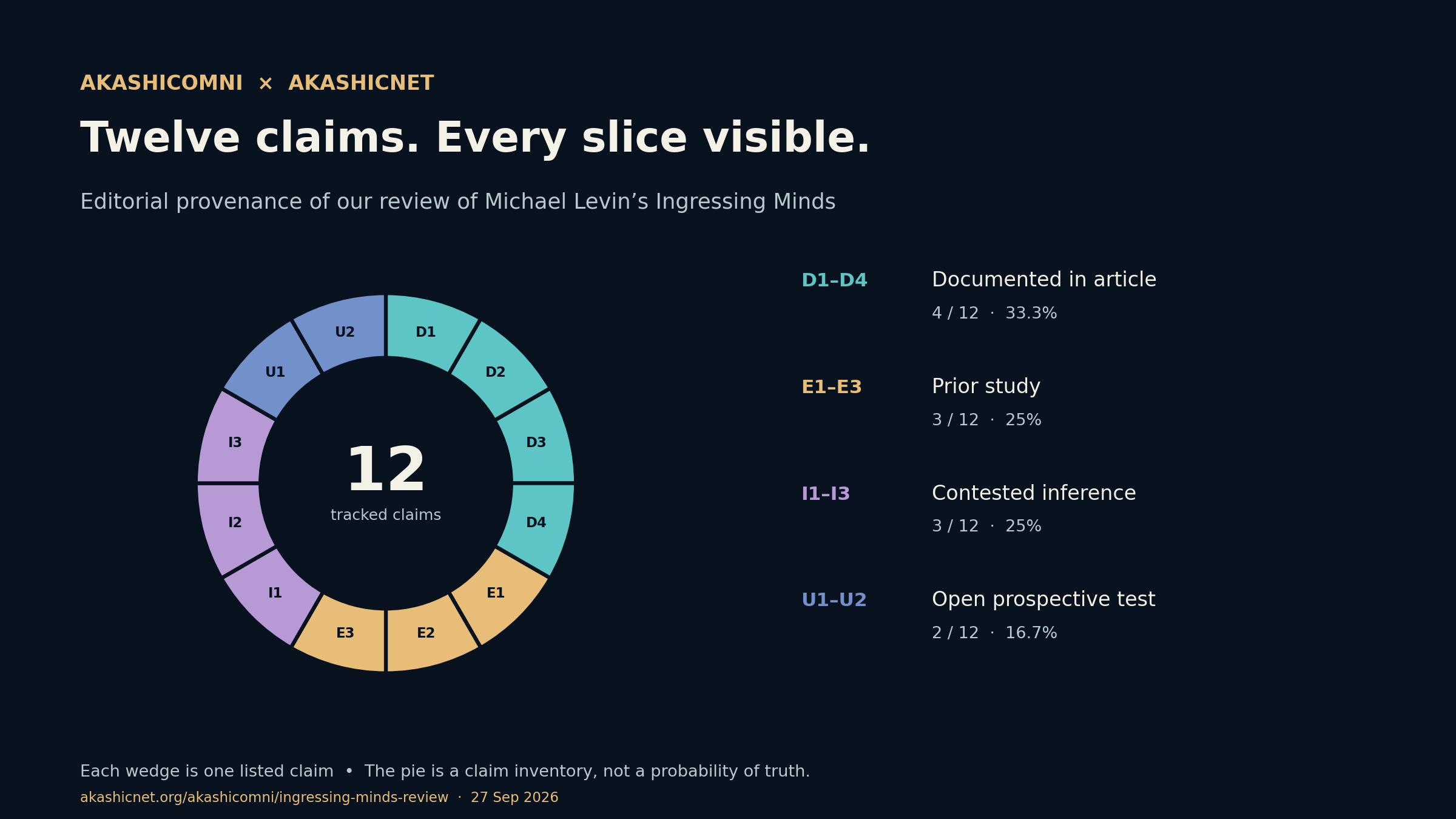
The twelve equal segments represent the 12 claims listed immediately below, clockwise from D1 to U2. Each claim receives one editorial provenance label. Color shows the four categories. The chart describes how this review uses its sources; it is neither a probability that the theory is true nor a measurement of the paper’s scientific merit.
- Documented in the paper 4 / 12 · 33.3%
- Empirical or computational prior study 3 / 12 · 25%
- Contested interpretation 3 / 12 · 25%
- Open prospective test 2 / 12 · 16.7%
The article appeared in Philosophies on 9 September 2026 after revision and peer review.
Levin proposes that physical bodies interface with a structured domain of mathematical and possibly agential patterns.
The article says no new data were created or analyzed; it declares no external funding and no conflict of interest.
Its proposed research program studies novel biological constructs and minimal systems, with practical fruitfulness as a broad abandonment criterion.
Brief bioelectric perturbations can change planarian regenerative anatomy across subsequent rounds of cutting.
Xenobots and Anthrobots exhibit forms and behaviors outside the normal development of their source organisms.
Simple sorting algorithms show trajectories described in the paper as unexpected goal-directed competencies.
That mathematics constrains physical systems establishes an independent nonphysical causal input.
Novel competence is a “free lunch” whose relevant information cannot be accounted for by physical dynamics, design or selection.
Some abstract patterns are themselves agents or conscious minds that ingress into bodies.
A specified interface-to-pattern map could predict new outcomes before observation.
Those predictions could outperform matched physical control models in held-out cases.
- Method and scope
- Close reading of the published 53-page article, its disclosures and selected primary work; classification and criticism are our editorial judgments. We did not systematically audit every citation, reproduce experiments or run a competing model.
- New data in the article
- The article states: “No new data were created or analyzed in this study.” Experimental examples are drawn from prior publications. Peer review applies to the article, not to independent verification of its ontology.
- Funding and conflicts
- The article declares no external funding and no conflict of interest. Its acknowledgments separately name support for related work. We have not audited those statements.
- Visual and AI disclosure
- The argument map and pie are original editorial diagrams generated for this page. They visualize reasoning and claim counts, not microscopy, experimental output or an observed Platonic space. AI assisted drafting and coding; a human reader should consult the linked sources for consequential claims.
- Corrections and affiliation
- Independent AkashicOMNI × AkashicNET analysis; no endorsement by Michael Levin, Tufts, the publisher or Daniel Dennett’s estate is implied. Corrections should identify a claim ID and supporting source.
07 / SHAREABLE VISUALS
Take the diagrams into the conversation
Original editorial diagrams. They do not depict experimental measurements or evidence of a Platonic space.
SOURCE TRAIL
Primary material and context
AkashicNET mission · values statement: Built in a Bodhisattva spirit, for the benefit of all beings across the cosmos. This aspiration guides our inquiry; it is not evidence for the claims reviewed above.