
AkashicNET × AkashicOMNI v0.5.0 · Proposal
Boundless Awareness
From Living Cells to Participating Minds—and the Cultivation of Love & Wisdom
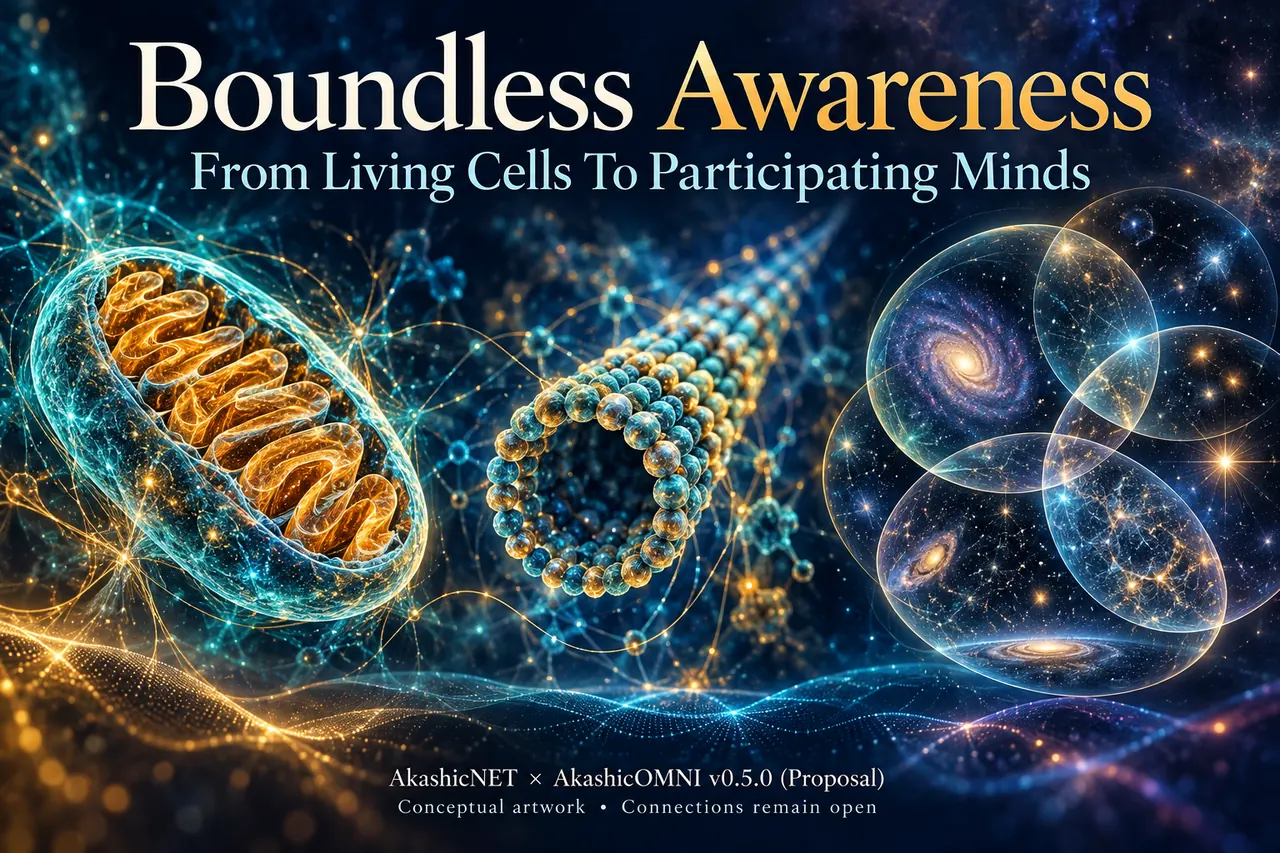
A contemplative aspiration with scientific questions
“Consciousness is fundamental” is the starting philosophical possibility proposed in the conversation behind this article. It is worth examining seriously. It should also remain available for comparison with physicalist, emergentist and other accounts. Beginning with a possibility does not settle its truth.
Love and wisdom give the inquiry an ethical direction. Here, love means care that extends beyond immediate preference; wisdom includes discernment, humility, understanding consequences and revising mistaken beliefs. “Boundless” can describe the widening scope of that care. It does not require a claim that a human mind has unlimited information or infallible judgment.
A research hypothesis could ask whether a defined contemplative programme increases compassionate behaviour and improves calibration of confidence, compared with a credible alternative activity. That would test particular outcomes. It would not by itself prove that consciousness is fundamental, that the universe is one mind, or that mitochondria and microtubules mediate a universal awareness.
Several meanings of awareness
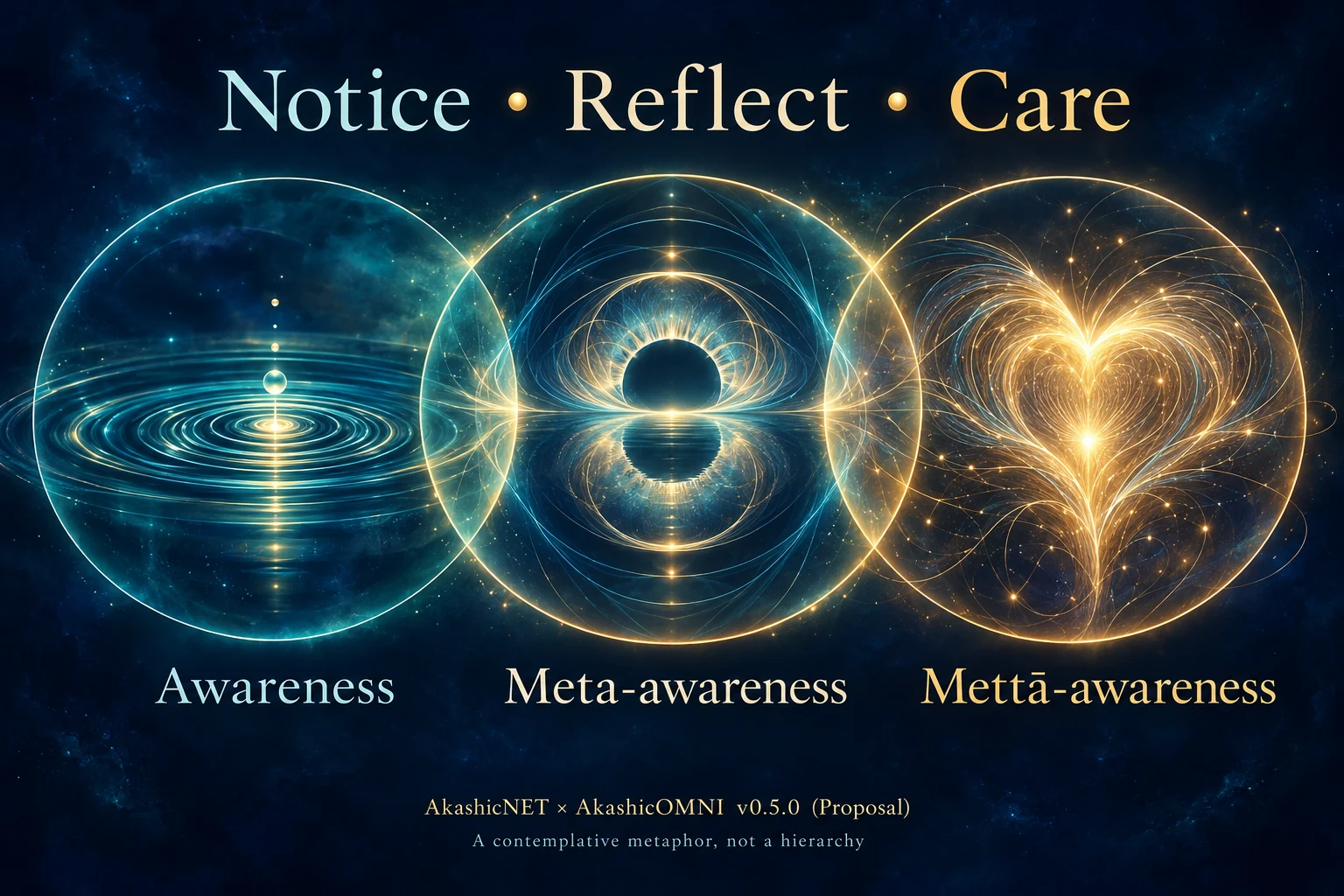
Sentience usually concerns the capacity for felt experience. Awareness can refer to experience itself, or to access to particular information; researchers do not always use the term identically. Meta-awareness concerns noticing one’s own mental activity. Subconscious or unconscious processing can influence action without becoming an experience one can report.
These distinctions are not a single ladder. A being may feel without reflecting verbally on that feeling. Bodily sensations and emotions belong in the discussion alongside thought. A report of boundless awareness is a meaningful description of experience; deciding what it reveals about the structure of reality requires a further argument.
The phrase “mettā-awareness” emerged here as a poetic invitation: noticing, reflecting and caring. Mettā evokes loving-kindness. The phrase is not presented as a canonical Buddhist category or as a ranking of beings.
Three research conversations, different kinds of claim
Open each panel to see the proposed connection and its limit.
Martin Picard · mitochondria and the living organism
Mitochondria participate in cellular energy transformation, signalling and responses to physiological demands. Picard’s mitochondrial psychobiology connects these processes with stress and mind–body relationships. This makes mitochondria relevant to the biological conditions supporting experience.
Open question: How do changes in mitochondrial function relate to changes in particular conscious states? Energy supply and signalling do not establish that mitochondria themselves feel, or that they receive consciousness from a psychic field.
Stuart Hameroff · microtubules and Orch OR
Microtubules are cellular structures with well-established biological functions. The Penrose–Hameroff orchestrated objective reduction proposal assigns a specific role in consciousness to quantum processes associated with microtubules and to a proposed form of objective reduction.
Open question: Does the required mechanism occur in relevant biological conditions, and does it explain conscious experience? Showing a quantum effect in biology would not, alone, demonstrate Orch OR. Its consciousness claims remain contested.
Donald Hoffman · observers and the experience of a world
Hoffman’s conscious realism treats consciousness as fundamental and physical experience as an interface. His programme asks how a world with the regularities of physics might emerge from observer dynamics. Markov models supply mathematical structure; identifying that structure with experience is an additional theoretical commitment.
Open question: Can the framework recover established physics and generate distinctive, testable predictions? A mathematical observer is not automatically a demonstrated sentient being.
The proposed bridge is presently a question. Mitochondria might constrain the energetic conditions of neural activity; microtubule hypotheses propose a particular mechanism; observer theories address a different explanatory level. No established result makes these three into one theory. A bridge would need explicit variables, a mechanism or mapping, and predictions that competing accounts do not already explain.
Hoffman, Trace Logic and TSC2026
The user-supplied account of Hoffman’s X post invokes John Wheeler’s participatory universe. That is a useful historical motivation for asking what an observer is. It does not mean quantum theory has established that a conscious mind creates external reality.
Hoffman’s Interface Theory of Perception and Fitness-Beats-Truth work challenge the assumption that evolutionary success requires perception to reproduce the world’s structure. The mathematical results depend on their models and definitions. They do not establish that every useful perception is false or that no independent reality exists.
The newer Trace programme studies what an observer restricted to some states of a Markov chain can see. Its induced transition matrix uses a Schur-complement construction. “Trace” here does not mean the ordinary matrix trace. The claim of “zero surprise” concerns consistency of the induced probabilities; it does not make individual random outcomes certain.
The official TSC2026 abstract describes a locally Boolean, globally non-Boolean logic and recursive agents: observers, agents acting over observers, and higher-order agents. It also proposes connections to relativistic effects and AI. As of this article’s date, this is an upcoming abstract, not a report of a delivered presentation. Hoffman is scheduled in PL-11, Spectrum of Conscious States, on 15 October; the programme gives the session as 11:10–12:30 in San Diego.
The Institute’s research programme lists eight physics conjectures, including routes toward spacetime, quantum predictions and particle physics. These are research targets. Neither a theorem about Markov chains nor a promising analogy establishes their physical realization. Reframing the hard problem also leaves a demanding question: why should the proposed mathematical structure correspond to felt experience?
Reports about DMT entities and anomalous information transfer deserve the same separation of experience from explanation. A controlled, independently replicated information result would require careful comparison with ordinary explanations; a vivid encounter alone does not demonstrate an external entity or a less restricted cosmic interface.
Which philosophical possibilities fit?
| Position | What it proposes | What remains open here |
|---|---|---|
| Panpsychism | Experience is fundamental and widespread; the word has Greek roots, pan and psychē. | How do forms of experience combine or relate to organisms? |
| Cosmopsychism | The cosmos is the fundamental conscious whole. | How do individual subjects arise from that whole? |
| Panprotopsychism | Fundamental properties are precursors of experience. | How do those properties yield experience? |
| Idealism | Reality is fundamentally mental or experiential. | Which version, and what explains shared physical regularities? |
| Physicalist approaches | Experience depends on, or is realized by, physical organization. | Which processes suffice, and how do they explain felt experience? |
| Animistic traditions | Diverse relational understandings of life, agency and the world. | Interpret each tradition in context rather than treating it as one mechanism. |
Integrated information, global workspace, higher-order, predictive and electromagnetic approaches ask further, partly different questions. A large taxonomy is a map of proposals, not a vote that confirms one ontology. Biological energy could matter across several accounts without deciding among them.
The Bhagavad Gita’s field and knower imagery offers a contemplative lens on experience and embodiment. Buddhist teachings on non-self complicate an easy equation with an eternal universal self. These traditions can inform reflection while retaining their differences. Calling the Buddha “psychic” is a modern interpretive choice, not a scientific conclusion established by this article.
What would a scientific cultivation hypothesis look like?
A specified practice of attention, reflection and loving-kindness will improve predefined measures of compassionate action and epistemic humility, relative to an appropriate comparison, over a specified period.
This is an illustrative hypothesis to develop, not a registered protocol or a result. A study would need a clearly described intervention, suitable participants, an active comparison, baseline and follow-up measurements, and a plan for analysing uncertainty. Self-reports could be combined with behavioural tasks, real-world observations and checks for expectation effects. Outcomes should include unwanted effects and people for whom the practice does not help.
Wisdom needs careful operationalization: confidence calibration, willingness to correct errors, perspective-taking and attention to consequences are candidates, not a complete definition. Compassion measures should examine conduct as well as a pleasant internal feeling. Durability and transfer beyond the practice setting matter.
A separate biological study might test whether particular physiological changes accompany those outcomes. Association would not settle direction of causation. Establishing a mitochondrial pathway, a microtubule mechanism or a link to Trace dynamics would each require additional evidence.
“Psychic sentience” remains exploratory wording in this proposal. Feeling, intuition and an anomalous-information claim require different tests. Likewise, whether AI can ever feel remains unsettled; fluent self-description alone does not establish consciousness.
The ethical aim can guide the work even while the ontology stays open: become more attentive, less certain of unsupported claims, and more responsive to the needs of others.
Continue with The Heart of Mettā-Awareness
From questions about experience to the practice of loving-kindness: a companion contemplation of discernment, care and the unfinished jigsaw of life.

Read The Heart of Mettā-Awareness · The Yellow Brick Road to Oneness [5 Min Read · 28 Sep 2026] →
Join the symbiosis hypothesis discussion on r/NeuronsToNirvana
An AkashicOMNI reading
This is a bounded, manual proposal reading using DISCERN and DEEPEN, followed by NET synthesis. It is not a fully schema-validated framework run or an independent review. The candidate inventory has twelve analytical perspectives from ten families; CUT contributes three temporal perspectives. NET is the thirteenth, synthesizing perspective.
| Perspective | Question applied in this article |
|---|---|
| AWAKEN | Notice experience before deciding what explains it. |
| HIERATIC | Read sacred language in its own tradition and context. |
| HOMESENSE · phase 8 | Ask how an idea changes ordinary life, belonging and care. |
| ADAPT | Revise interpretations when observations disagree. |
| REGENERATE | Consider the conditions that sustain living systems. |
| TRANSCEND | Explore experiences of expanded identity without assuming an ontology. |
| #METAD v2.1 | Examine the assumptions used to examine awareness. |
| ACTC v2.0 | Compare claims, alternatives and what could discriminate between them. |
| CUT · Past | Identify inherited concepts and the history of an interpretation. |
| CUT · Present | Separate what is observed now from what is inferred. |
| CUT · Future | Specify consequences, predictions and revision conditions. |
| UMASC v7.2 | Keep multiple perspectives visible without treating agreement as proof. |
| NET · synthesis | Connect the readings while retaining uncertainty and provenance. |
These are editorial applications of the candidate lenses, not quotations of their formal definitions. OMNI coordinates the reading; PRISM provides its epistemic interface; NET names the wider synthesis. Their presence does not constitute scientific corroboration. The optional philosophical module remains a lens, not evidence for a quantum or biological bridge.
Sources, roles and limits
This article draws on the supplied discussion and a bounded recent-context review. It is not an exhaustive review of every conversation, every consciousness theory or the complete TSC2026 programme. The exact X post and all linked videos were not independently transcribed. The official abstract and research sources below carry the scientific attribution.
Source-role chart, not measured authorship shares. No contribution percentages are claimed. AI-assisted checking is not independent peer review; inclusion does not imply endorsement by any named researcher.
- Hoffman · official TSC2026 abstract and programme.
- Trace Institute · research programme, publications and whitepaper.
- Traces of Consciousness · 2025 preprint. Formal proofs have not been independently checked for this article.
- Fitness-Beats-Truth theorem; Fusions of Consciousness · 2023.
- Mitochondrial psychobiology; Picard Lab.
- Penrose–Hameroff · Orch OR review; critical response.
- Robert Lawrence Kuhn · consciousness landscape taxonomy; IIT 4.0; CEMI field proposal.
- Bhagavad Gita · chapter 13, one translation and commentary. Contemplative interpretation is distinct from experimental support.
- Hoffman X post supplied as the discussion prompt; its detailed interpretation in the conversation was user-supplied.
Explore AkashicNET’s TSC2026 material · Return to AkashicNET