
HOMESENSE858 · Economic companion · 20 October 2026
WORKING DRAFT · ATTENDEE FEEDBACK PENDING
The resources beneath the gift
Material security, voluntary generosity and the institutions that could connect them.
Historical 2024 accounts, current operational guidance and clearly labelled community scenarios. No population, location or available budget is assumed.
The resources beneath the gift
Material security may make generosity easier. Dependable provision still needs money, capable people, infrastructure and accountable institutions.
Burning Man offers a documented example of gifting within a temporary city supported by a monetary economy. It does not demonstrate a permanent universal basic income (UBI) or an unconditional guarantee of everyone's essential needs.
What this addition contributes
A comparison of organiser accounts, participant provisioning and collective services; three possible community structures; a budget specification; named responsibilities; environmental checks; and questions for forthcoming attendee accounts.
Build on the existing chapter
HOMESENSE858 already distinguishes unconditional income, complementary essential services and voluntary exchange. This companion develops the funding and delivery questions without assuming local prices or a funded pilot.
| Evidence | Interpretation | Proposal |
|---|---|---|
| Official accounts and operational rules; weighted Census estimates. | Money, time, supplies and shared infrastructure all sustain gifting. | A protected material floor with voluntary sharing alongside it. |
| Historical 2024 finance; current operating guidance labelled separately. | A budget balance alone cannot ensure real access or fair workload. | No population, location, income amount or available budget is assumed. |
Status: HOMESENSE858 remains a working draft. Attendee accounts have not been incorporated or invented. No community economy is operational or financially validated by this review. Burning Man Project has not endorsed the proposal.
AI assistance: source retrieval, synthesis, scenario design and document production. Independent human economic and methodological review remains pending. Research inspected 19–20 October 2026; adapted for this public working-draft companion on 20 October 2026.
Security first. Generosity by choice.
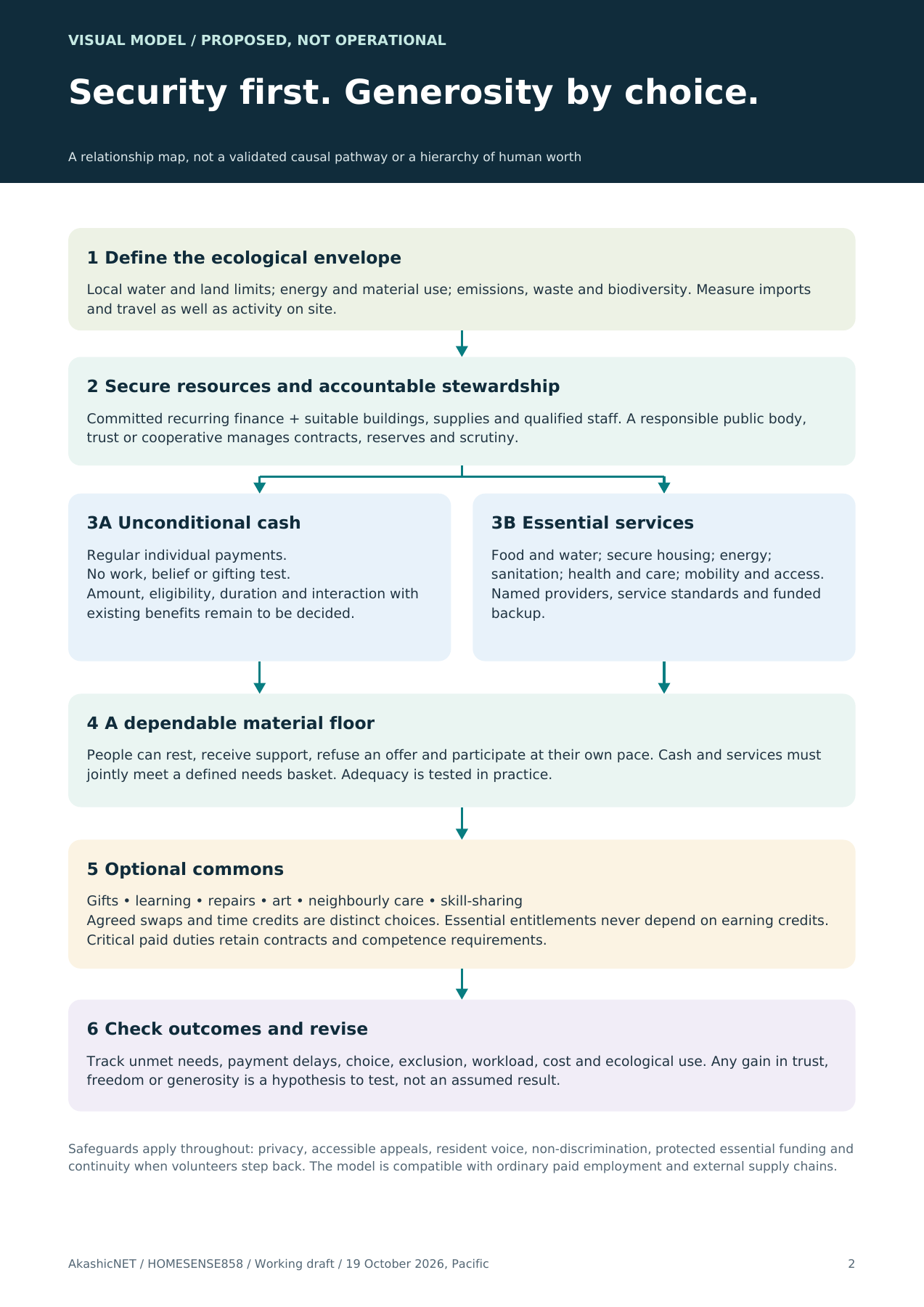
Ecological envelope → committed resources and stewardship → unconditional cash + essential services → material security → optional commons → evaluation and revision. All arrows express proposed institutional relationships, not proven causal effects.
Safeguards apply throughout: privacy, accessible appeals, resident voice, non-discrimination, protected essential funding and continuity when volunteers step back. The model is compatible with ordinary paid employment and external supply chains.
Read the accounts on their own terms
| 2024 measure | Management reporting | IRS Form 990 |
|---|---|---|
| Revenue | USD 57.519m | USD 56,039,635 |
| Expenses | USD 68.199m | USD 66,661,446 |
| Revenue less expenses | USD -10.680m | USD -10,621,811 |
Management figures are published to USD thousands; the filing gives dollars. The rounded management shortfall is USD 10.7m. [S02] [S03]
The official bridge subtracts USD 767,000 of cost of goods sold from both revenue and expense, then donated-services adjustments of USD 712,000 and USD 770,000 respectively. These are reporting treatments, not a second loss. [S02]
Transcription check: the displayed rounded expense bridge sums to USD 66.662m, while its displayed endpoint is USD 66.661m. The USD 1,000 discrepancy is left unresolved; the exact filing total above is retained.
| Platform / comparator | Published 2024 figure |
|---|---|
| Black Rock City platform expenses | USD 58.113m, about 85% of all expenses |
| BRC expense / stated population | USD 840 per attendee; denominator 69,141 |
| Main-sale ticket comparator | USD 575; USD 265 below that average cost |
Tickets remain the principal revenue source, with philanthropy and other income supplementing them. Human-related costs, equipment, outside services and permits are major cost areas. [S02]
What these figures do not establish
The main-sale comparison is not the average realised ticket yield or the loss on every ticket. The organisational shortfall is an accounting result, not a direct cash-runway measure. BRC platform costs are not the full participant-funded economy, and a short-lived event's average cost is not a yearly essential-needs budget.
The filing reports USD 6,555,401 in contributions/grants and USD 47,787,655 in programme-service revenue. Programme-service revenue must not automatically be relabelled ticket revenue. [S03]
Management accounts, the 990 and organiser commentary share an institutional source. They are complementary records, not independent confirmations of economic feasibility. Restricted gifts, spendable cash, net assets and recurring income need separate treatment in any future budget.
The economy beyond the ticket
| Layer | What is documented | What still needs measuring |
|---|---|---|
| Participant supplies | Current guide requires participants to bring water, food, shelter and personal supplies. [S05] | Travel, equipment, camp payments, lost earnings, care cover, storage, repairs and disposal by household. |
| Collective services | Sanitation and emergency support coexist with self-provision; ice is sold and general rubbish collection is absent. [S06] [S07] | Whether access is dependable across camps and disabilities; any off-site treatment or transport bills. |
| Targeted infrastructure | Civic water supports eligible art/camp groups with bulk tanks; it is not an individual universal supply. [S08] | Who is eligible, what is paid and who handles shortfalls. |
| Volunteer work | Roles differ in commitment; volunteering rarely brings a free ticket. [S09] | Hours, skill, injury risk, burnout and replacement costs, including preparation and strike. |
A participant-side financial signal
The 2024 weighted Census reports median travel spending of USD 2,000 excluding tickets, with lower and upper quartiles of USD 1,000 and USD 3,000. Its published median interval is USD 2,000-2,400. The question is about travel to/from BRC; it is not a complete attendance-cost inventory. [S11]
There were 5,938 online responses, adjusted using entry-sample characteristics. Weighting addresses measured selection differences; self-report, residual non-response and people unable to attend remain limitations. [S10]
Do not multiply the median by attendance. A median is not a mean; shared purchases and reimbursements can overlap. Do not add tickets, camp dues and organiser costs together as if each were a separate final resource use.
The Census methods page uses a population figure of 72,000, whereas the finance comparison uses 69,141. The definitions are unreconciled here. No aggregate participant spending is estimated.
What transfers, and what does not
| Dimension | Burning Man / BRC | HOMESENSE858 requirement |
|---|---|---|
| Purpose and duration | Temporary participatory city; year-round organisation and wider cultural activity. | Continuous provision across illness, ageing, seasons and emergencies. |
| Gifting | A gift carries no required equivalent return. Cultural principle, not an audited outcome. [S04] | Optional gifts remain distinct from services, wages, swaps and credits. |
| Income | No UBI demonstrated by inspected sources. Participants arrive with resources. | Define a regular individual cash entitlement, eligible population, adequacy and durable funding. |
| Essential needs | Participant provisioning plus shared event infrastructure. [S05] [S06] | Define a needs basket, funded suppliers, access standards and fallback capacity. |
| Access | Ticketing and preparation impose material conditions. Current Ticket Aid offers reduced-price access by application. [S12] | Coverage cannot depend on earning sharing credits; remove disability, digital and financial barriers. |
| Labour | Paid staff, contractors, volunteers and camp effort coexist. [S02] [S09] | Budget essential staffing and relief; keep voluntary work voluntary and visible. |
| Authority | Organiser roles and public-land governance operate alongside camp responsibilities. [S06] [S14] | Choose accountable institutions; specify who owes what to whom, with review and appeal. |
| Evidence | Finance, operational records and surveys document particular years and domains. | No demonstrated budget or operational guarantee; a proposal awaiting testing and attendee input. |
Transferable questions concern coordination, meaningful participation, shared assets and responsibility. Permanent provision adds housing tenure, care across the life course, replacement of infrastructure, legal remedies and persistent supply obligations. An enjoyable or generous week cannot settle those questions.
Three structures to examine
| Scenario | Institutional structure | What it could test / main gap |
|---|---|---|
| A / Neighbourhood commons | An existing civic group funds a coordinator, venue, tools and access support. Ordinary public services, benefits and housing remain the material base. | Test voluntary repair, learning and care exchanges without withdrawing existing support. This is not a UBI or essentials-guarantee trial. Main gap: whether participation helps people whose needs are currently unmet. |
| B / Housing and services cooperative | A resident-governed cooperative or land trust holds assets; qualified providers deliver services. A separately funded trust could test unconditional cash for a defined group and term. | Test pooled assets and service delivery. No guarantee until capital, recurring costs, access rights and exit arrangements are funded. A finite cash pilot cannot prove permanent universal funding. |
| C / Public guarantee with local commons | A competent public authority establishes funded cash entitlements and service responsibilities; community groups offer voluntary activities alongside professional provision. | Closest institutional fit for broad entitlement and risk pooling. Requires lawful authority, democratic agreement, fiscal capacity, suppliers and evaluation; none is secured here. |
Choose the promise before costing the structure
For each scenario define who is covered, which needs are met, service quality, opening and closing dates, eligibility changes, resident voice and an exit/continuity plan. Newcomers, children, disabled people and people choosing not to volunteer need explicit treatment.
A cooperative can distribute resources it actually controls; it cannot assume taxing powers, permanent donor support or universal access to outside services. Public provision also needs implementation capacity and reliable supply. These scenarios are alternatives for discussion, not three approved stages.
The ILO identifies predictable income security, essential healthcare, state responsibility, legal entitlements and accountable administration as social-protection foundations. That supports the institutional questions, not the feasibility of this proposal or a particular UBI design. [S15] [S16]
The minimum financial specification
Start with two ledgers: the guarantor's cash budget and the whole system's real resources. Cash transfers are an expense to the fund and income to residents; do not count the transfer and the goods it buys twice as resource consumption.
| Input to establish | Required evidence / accounting treatment |
|---|---|
| Coverage and cash | Eligible people by period; regular payment amount; duration; needs-related supplements; interaction with taxes and existing benefits. Gross cash transfers = sum of eligible people × payment. |
| Services and capacity | Demand by need, contracted unit costs, staff cover, accessible buildings, food/water/energy supply and specialist referrals. Identify what cash buys versus what is delivered in kind. |
| Capital and renewal | Land/buildings, installation and working capital; asset ownership, repair schedule and replacement plan. Separate capital cash outlays from depreciation. |
| Recurring income | Committed unrestricted grants/public allocations; conservative net trading surplus after costs; lawful levies only where authorised. Record restrictions, duration and counterparty concentration. |
| Buffers and liabilities | Opening liquid cash, ring-fenced funds, debt payments, insurance, contingencies and minimum liquidity. Net assets or pledged gifts are not automatically spendable cash. |
| In-kind and volunteer inputs | Record quantities, reliability and hours separately. Credit only feasible substitutions for a specified need. Replacement valuations are sensitivity estimates, not cash in the bank. |
Period-by-period cash check
Closing unrestricted cash = opening unrestricted cash + committed usable receipts - cash payments.
Cash payments include income support, service contracts, staffing, administration, capital, repairs and debt service as applicable. Closing cash must meet an agreed reserve floor in every period, not just at year end.
Record tax recovery and avoided duplicate programme spending only when legally and operationally credible. Show baseline, downside and funding-loss cases. No revenue, endowment return, volunteer saving or multiplier is assumed in this companion.
Separate affordability from availability. A fully funded payment can still fail if there are no suitable homes, care workers or water supplies. Every budget line needs a corresponding capacity check.
Who is responsible when help is needed?
| Responsibility | Accountable role to appoint | Minimum safeguard / observable check |
|---|---|---|
| Cash entitlement | Fund/public authority; payment operator | Timely payments; accessible non-digital route; privacy; correction and appeal; no work or gifting test. |
| Housing and utilities | Landlord/trust plus utilities providers | Secure tenure; maintenance and accessibility; outages and arrears tracked; emergency accommodation plan. |
| Food, water and sanitation | Contracted operators with named service lead | Adequate reliable supplies; quality control; backup supplier; unmet demand and interruptions logged. |
| Health and care | Qualified providers with public/insurance partners | Clear scope and referral cover; continuity for chronic needs; waiting times, access and out-of-pocket burden reviewed. |
| Essential labour | Service employer/operator | Paid cover where needed; training, rest, protection and relief. No dependence on indefinite unpaid heroics. |
| Optional commons | Participant council and supported coordinator | Consent, choice to decline, accessible matching and complaints. No public ranking of personal worth or needs. |
| Finance and scrutiny | Treasurer/board plus independent reviewer | Restricted funds tracked; conflicts disclosed; procurement scrutiny; reserves and service performance published in aggregate. |
| Remedy and continuity | Independent complaints route; named backup body | Accessible appeal, anti-retaliation, remedy and funded transition if provider/funder fails. |
Unconditional income does not abolish professional duties, agreed paid shifts or proportionate safety rules. If nobody volunteers for indispensable work, the options are paid cover, redesign or a smaller honest promise. Removing a person's essential support for declining a gift task would contradict this model.
Governance must separate donors' influence from residents' rights. People must be able to dissent, change beliefs, rest or leave the commons without losing essential services. Verify jurisdiction-specific duties only once a location and legal form are selected.
An ecological ceiling and a stress test
A clean event site does not account for the full footprint of travel, imports, construction, energy, food and waste treatment. The 2024 AfterBurn describes energy initiatives and also reports strain on a smaller Recycle Camp strike crew. These are useful operational leads, not proof of whole-system carbon neutrality. [S13]
BLM's archived 2019 announcement documents environmental assessment, mitigation and monitoring in the public-land setting. It is not evidence that every impact is eliminated or that the current permit is certified by this review. [S14]
| Stress scenario (illustrative) | Response to specify before promising support |
|---|---|
| A major donor withdraws | Identify restricted versus usable cash; test month-by-month runway; activate funded continuity; pause expansion before exposing residents to an unfunded promise. |
| Volunteers step back or care demand rises | Cost qualified replacement labour and respite; simplify optional activity; preserve essential access without coercive contribution rules. |
| Prices rise or a key supplier fails | Reprice the needs basket; use alternative suppliers and contingency capacity; check real availability, queues and payment adequacy. |
| Drought, heat, outage or ecological limit | Apply local limits and essential-use priorities; budget resilient infrastructure and access adaptations; reduce discretionary throughput first. |
Measure outcomes, not just activity
Material: missed meals, insecure housing, unmet care, outages, payment delays and time waiting.
Agency and fairness: ability to refuse, unequal access, complaint resolution, distribution of unpaid work and who leaves.
Financial: cash coverage, commitment expiry, reserve adequacy, concentration of funding and full replacement costs.
Ecological: water stress, energy demand, emissions including travel/imports, material reuse, waste and habitat effects.
Track totals and per-person measures together. Efficiency gains can be outweighed by greater consumption. Define local thresholds with affected residents and relevant expertise, including neighbouring and Indigenous communities where applicable; their agreement cannot be presumed.
Possible mechanism to test: security reduces constraints, enabling more chosen contribution. Alternatives include simple purchasing power, more social contact or participant selection. Better well-being without increased gifting is still a valuable outcome.
What the attendee accounts should test
Invite contrasting experiences: first-time and returning attendees; camp organisers and unaffiliated campers; low-income or aid-ticket participants; disabled people and carers; build/strike workers; and, separately, people who wanted to attend but could not. This is purposeful qualitative sampling, not a representative survey.
| Ask for a concrete episode | What it helps test |
|---|---|
| 1. What did someone give you, and what happened next? | Generosity in practice; whether return, gratitude, status or labour was expected. |
| 2. Could you decline a gift, activity or shift without consequences? | Consent and informal coercion; distinguish employment or agreed duties. |
| 3. Which essentials were always available, and which ran short? | Reliability, quality, waiting and fallback arrangements. |
| 4. What did you pay before, during and after attending? | Ticket/fees, travel, supplies, camp contributions, repairs, storage and cleanup. |
| 5. Who paid shared costs, and who absorbed overruns? | Hidden subsidies, donor concentration, debt and accounting transparency. |
| 6. What unpaid time or lost income did attendance require? | Preparation, caring cover, build, service shifts, strike and recovery. |
| 7. Who could not join, and what would have changed that? | Affordability, disability access, social networks, documentation and time barriers. |
| 8. Who did repetitive, dirty or difficult work? | Work distribution, recognition, rest and burnout. |
| 9. What happened when someone was ill or could not contribute? | Support independent of capacity; service boundaries and unmet needs. |
| 10. How were conflict, safety concerns and complaints handled? | Accountability, fair hearing, retaliation risk and practical remedy. |
| 11. What happened to waste, equipment and duties after departure? | Costs shifted onto workers, neighbours or ecosystems. |
| 12. What could work all year, and what depended on a short visit? | Transferability; paid work outside the event; novelty and deferred obligations. |
Record year, role, duration and context; separate direct observation from hearsay and interpretation. Invite receipts or diaries optionally and redact identifiers. Obtain explicit permission for quotations, attribution and publication; allow anonymity and withdrawal before publication. Private inbox messages are not automatically cleared for public use.
Preserve negative and contradictory accounts. Do not convert a few stories into percentages or claims about all Burners. Offer contributors an accuracy check of their passages; their accounts can revise the draft without becoming endorsements.
What remains open
The evidence boundary
| Claim | Assessment | Revision condition |
|---|---|---|
| Gifting relies on material support and organisation. | Supported within the inspected records; no total economic valuation. S02-S11 | Participant ledgers or clearer institutional boundaries could refine the account. |
| More security causes more voluntary generosity. | Hypothesis. This review supplies no causal test of that pathway. | Comparative, ethically designed outcomes including null and adverse findings. |
| The proposed economy can guarantee essentials indefinitely. | Unestablished. Inputs, authority, supply and durable finance are unresolved. | Costed plan, commitments, capacity checks, independent scrutiny and sustained delivery evidence. |
| Burning Man validates or endorses HOMESENSE858. | Not established; no endorsement claimed. | Only explicit authorised endorsement could support endorsement wording; it would not prove feasibility. |
Before a fuller edition: incorporate consented attendee accounts; keep contradictions visible; confirm financial transcription and definitions; obtain human review of the comparison. Any proposed pilot needs its own mandate, scope, costed capacity, committed resources and evaluation. No forced publication deadline is introduced.
Sources and access notes
S01 / HOMESENSE858 public working draft
Project context; includes 18 October editorial update. Not independent evidence.
S02 / Burning Man Project: Summary Financial Information
2024 management accounts, BRC platform table, per-attendee calculation and reconciliation. Organiser reporting.
S03 / Burning Man Project 2024 Form 990
Part I, lines 8-19 (PDF page 2). Primary tax filing; not a separate economic impact evaluation.
S04 / The 10 Principles
Gifting, decommodification, communal effort, civic responsibility and environmental ethos. Norms, not measured outcomes.
S05 / 2026 Survival Guide: Survival
Personal provisioning requirements and weather preparation. Current guidance, not a 2024 expenditure record.
S06 / Public Infrastructure
Shared infrastructure, sanitation, ice sales and no general garbage collection.
S07 / Emergency Services Department
Event emergency provision; does not establish comprehensive permanent healthcare coverage.
S08 / Civic Water Program
Eligibility and bulk delivery limits; not universal individual water provision.
S09 / Volunteering
Departmental commitments, year-round roles and rare free-ticket arrangements.
S10 / BRC Census 2024: Introduction
Survey methods, weighting, sample size and population denominator; microdata not reanalysed.
S11 / BRC Census 2024: Travel logistics
Section 5.6.1 travel spending excluding tickets. Weighted survey estimates, not audited receipts.
S12 / 2026 Ticket Aid Program
Reduced-price access with application and documentation conditions. No claim all financial barriers are removed.
S13 / 2024 AfterBurn
Recycle Camp and Regeneration sections. Organiser operational reports, not independent whole-footprint verification.
S14 / BLM: 2019 environmental impact statement announcement
Independent government source for environmental assessment and monitoring context. Archived 2019 announcement, not current permit certification.
S15 / ILO: Social Protection Floors Recommendation No. 202 overview
Institutional principles and basic income security plus essential healthcare. Not a recommendation that every country adopt UBI.
S16 / ILO World Social Protection Report 2024-26, Chapter 3
Sections 3.3-3.5: adequacy, finance and institutional capacity. No local cost estimate imported.
Existing research record inspected
AkashicNET-Integration-Map-2026-10-18.html, version 2, IC-010 “Compassion Into Practical Care” (current Library text inspected). The reading was limited to the relevant entry, not a fresh audit of every integration claim.
Scope: a selected primary-source review, not a systematic review or independent financial audit. Official Burning Man publications share provenance; Census data are survey estimates. BLM and ILO supply independent institutional context, not validation of HOMESENSE858. The previously cited cash-transfer and compassion studies were not re-reviewed here.
Unresolved: participant economy total; complete volunteer-hours valuation; population-definition and rounded-reconciliation discrepancies; hidden costs and exclusion; full environmental footprint; local budget and legal form; attendee testimony. No evidence that these uncertainties are resolved is implied.