Come together
In this model, the two types of atoms attract one another.

SMALL WORLDS · BIG QUESTIONS
Imagine switching off the container—and finding that a tiny cloud of atoms can still hold itself together.
A plain-English guide to a theoretical prediction about ultracold matter.

THE IDEA IN 30 SECONDS
Atoms attract one another, but squeezing them together has an energy cost. Under suitable conditions, a cloud can settle at a preferred density. That is the essential idea of a self-bound droplet: it can stay together without an external trap.
In this model, the two types of atoms attract one another.
The bosonic atoms weakly repel one another.
Identical fermions cannot all occupy the same quantum state. Confining them costs kinetic energy—even at zero temperature. This is not ordinary pairwise repulsion.
TOUCH THE IDEA
Conceptual animation and teaching charts. No measured data, numerical simulation or paper-derived curves. Positions, speeds and curve shapes are illustrative.
A stable droplet has a preferred density. Small departures cost energy, helping it resist both spreading and further compression.
Motion starts only when you press Play. Your reduced-motion preference disables movement.
WHY THIS MATTERS
The 2026 paper proposes a way for a strongly interacting mixture of bosons and fermions to form a self-bound liquid. Its theoretical approach goes beyond a weak-interaction treatment and identifies conditions that experiments could explore.
That matters because understanding how many particles cooperate is a central problem in physics. A new, testable kind of quantum liquid extends that understanding.
A promising theoretical advance—not an experimental discovery of this particular droplet, a finished technology, or evidence about consciousness.
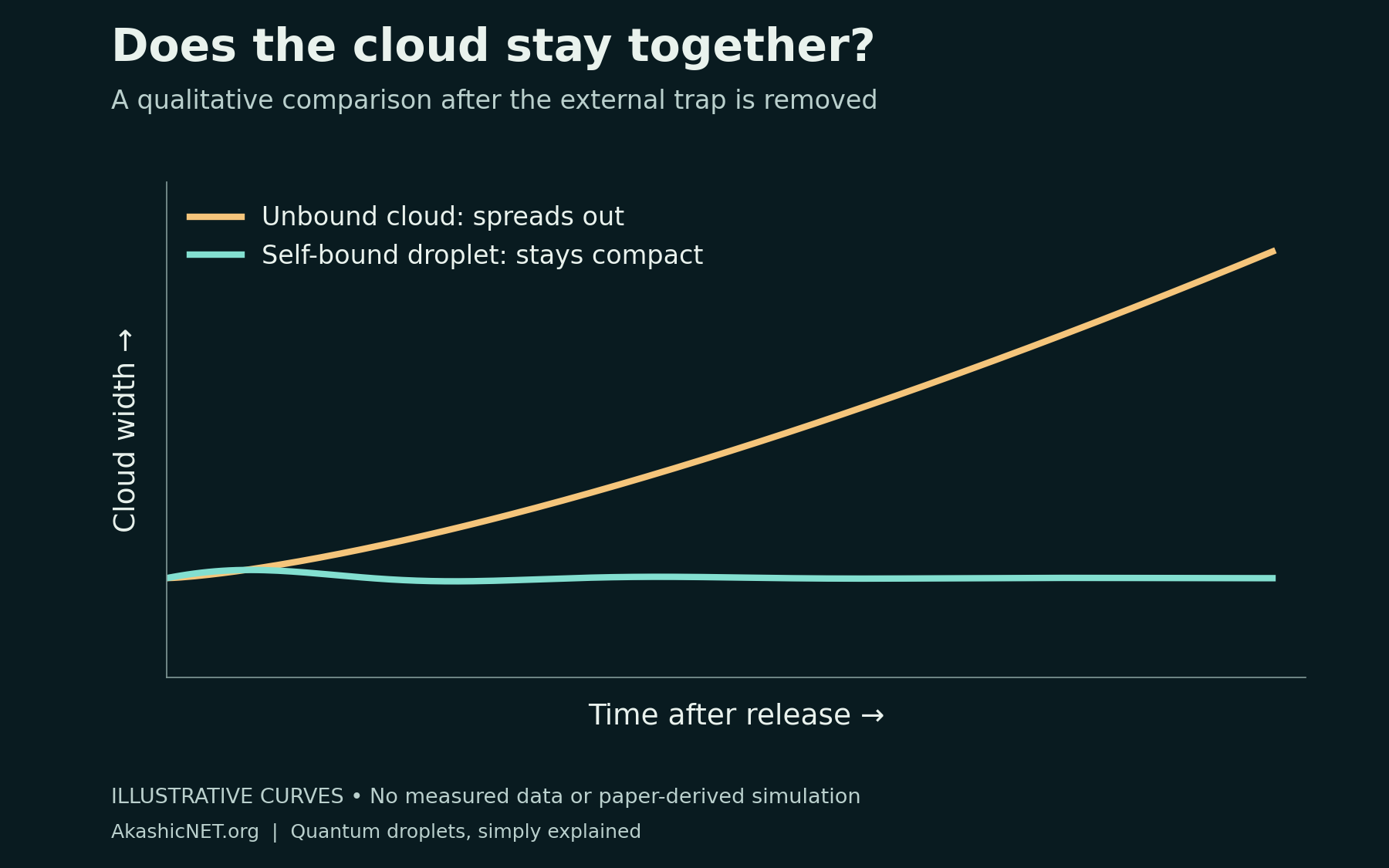
FROM PREDICTION TO OBSERVATION
Does a bound portion remain after the trap is removed?
How do they change with atom number and interaction strength?
Can a persistent droplet be distinguished from a temporarily compact cloud? Atom loss is a practical obstacle.
Other types of quantum droplets have already been observed. The specific resonant Bose–Fermi mixture discussed here is a theoretical proposal in this paper.
READ THE RESEARCH
Quantum Droplets in a Resonant Bose-Fermi Mixture — Sam Foster, Olivier Bleu, Jesper Levinsen and Meera M. Parish. Physical Review Letters 137, 073402, published August 14, 2026.
Prepared from the author-posted main text and selected supplementary sections, with publication metadata checked against the publisher. This is an educational explanation, not an independent replication or exhaustive mathematical appraisal. The author manuscript may differ from the final published version. AI-assisted editorial synthesis; no new experimental data.
AkashicNET reflection: interdependence is a useful question to carry away. Applying this result to minds or the cosmos would require separate evidence.