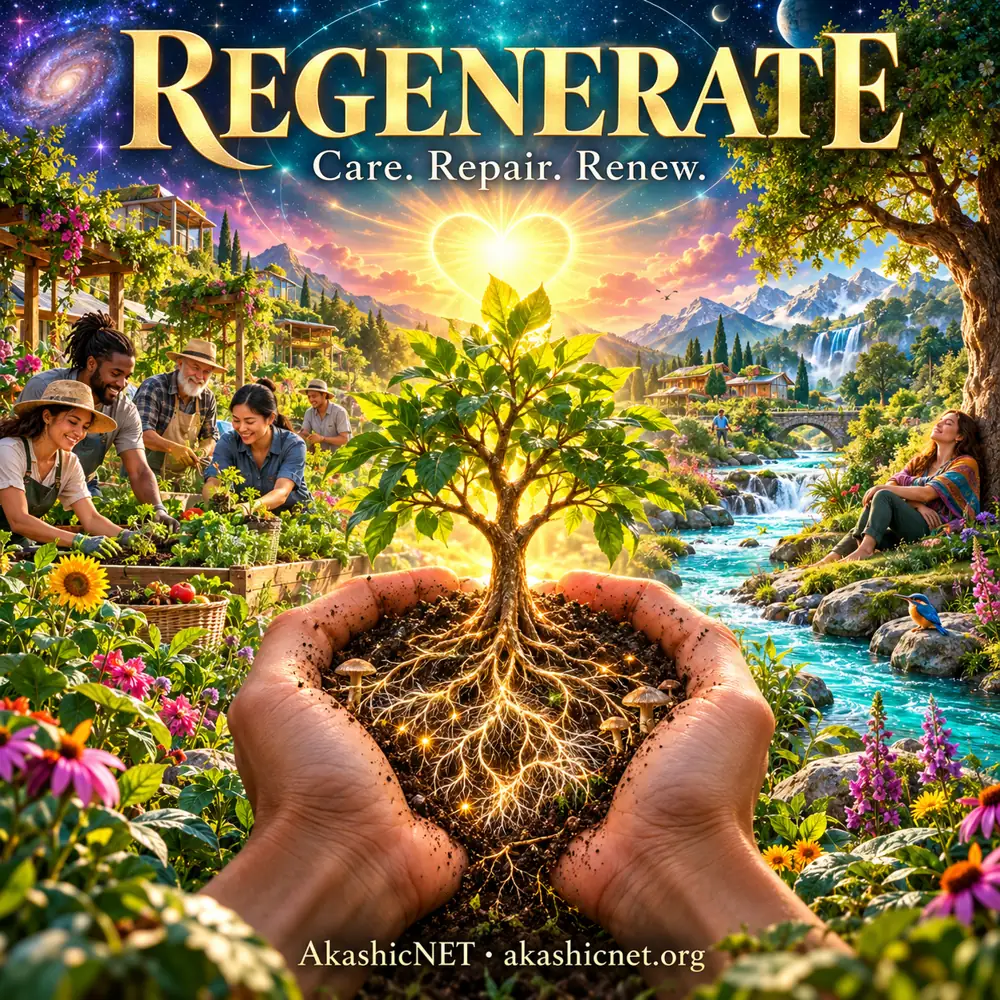
AI-generated conceptual artwork. A vision of care and renewal.
FROM WONDER TO EVERYDAY CARE
A flourishing future needs somewhere to begin.
Sometimes that place is a damaged landscape. Sometimes it is a neglected shared space, an overburdened relationship or a day with too much to carry.
REGENERATE is AkashicOMNI’s perspective on renewal. This introduction proposes a way to ask what needs care, what can be repaired and what would help people and living systems flourish. It starts with attention to the actual situation, including limits, resources and the people affected.
“Let the care we imagine become the care we practise.”Original AkashicNET reflection · AI-assisted
Renewal does not have to mean returning to an idealised past. A changed situation may call for a different arrangement: more accessible, more reciprocal and easier to sustain. Some losses cannot be reversed. Care still matters.
FOUR PLACES TO ASK THE QUESTION
Start close. Keep the wider world in view.
01
Personal Capacity
What would make everyday life more manageable?
Begin with the person’s own priorities, available energy and practical circumstances. Making room for rest, asking for help or simplifying one obligation can be a chosen act of care. Nobody has to earn their worth through productivity.
A Question To Carry
Ask what feels possible. Avoid turning recovery into another performance target.
02
Relationships
What would make care more mutual?
Listen before proposing a solution. Repair may involve an apology, a clearer boundary, a shared responsibility or accepting that someone needs distance. Kindness includes consent and the freedom to decline.
A Question To Carry
Who is doing the caring, and can they say no without penalty?
03
Communities
What would leave people with more agency?
A repair café, accessible meeting space or shared garden can provide a concrete setting for a local proposal. Let those affected shape the purpose, resources and decision-making. Plan who will maintain it after the launch.
A Question To Carry
Who benefits, who carries the work, and whose voice is missing?
04
Living Systems
What would ecological repair mean here?
Name the place, the pressures and the intended outcome. A local restoration proposal needs relevant expertise, permission, a suitable timescale and observations that can reveal both progress and unintended effects.
A Question To Carry
What would we observe before calling this regeneration?
These are proposed organising areas, not a validated scale or a clinical programme. Personal, social and ecological outcomes need different kinds of evidence; they cannot be combined into one “regeneration score”.
A SMALL BEGINNING
Notice. Choose. Care. Review.
Notice
Describe one situation before deciding what it means. What is depleted, neglected or difficult? What is already working?
Choose
Agree one modest, reversible action with the people involved. Set a limit on time, cost and effort. Decide what would make you stop or change course.
Care
Try the action at a manageable pace. Keep a brief record of what actually happened, including friction and unexpected effects.
Review
Ask whether the situation improved, for whom and at what cost. Continue, adapt or stop. A disappointing result is useful information.
Participation can look like a conversation, a sketch, a voice note or a few written lines. Make room for different access needs, attention styles and energy levels. Rest and opting out belong in the plan.
HYPOTHETICAL EXAMPLE · NO RESULTS CLAIMED
A shared garden, with shared responsibility.
Imagine neighbours considering an unused planter. First they ask who wants to take part and obtain permission. They choose one small planting task with a fixed budget, suitable local advice and an agreed watering rota.
At an agreed review date, they record plant survival, water use, spending and who actually did the work. They also ask whether anyone felt excluded or overburdened. Attractive photographs alone would not show ecological recovery or a fair distribution of effort.
If the rota depends on one exhausted volunteer, the next action may be to reduce the project’s size. Regeneration should be assessed alongside the conditions that make care sustainable.
WITHIN THE JIGSAW OF LIFE
Different perspectives. A shared responsibility to ask.
PRISM000 helps separate kinds of information. REGENERATE asks what care and repair would require. AWARE keeps human worth in view; ADAPT brings attention to feedback and change; OMNI places these perspectives in conversation.
“Mind and body, heart and spirit” can express a personal philosophy of wholeness. Here, the heart and luminous connections in the artwork are metaphors for care and belonging. They do not establish a biological mechanism or a conscious cosmos.
Publishing a 000 introduction makes the proposal easier to discuss. It does not by itself establish effectiveness or complete an AkashicOMNI v0.5.0 release.
What would change your mind?
Before calling an action regenerative, ask what deterioration would look like, whose experience could challenge your judgement and whether the same improvement could have happened without the action. Preserve disagreement alongside encouragement.