Logical
Examines whether conclusions follow from reasons and whether an argument is consistent.

AKASHICNET · AN EXPLORATORY FRAMEWORK
Explore 19 interconnected lenses across six flexible groups through interactive charts—a living, exploratory map of intelligence, awareness and wisdom.
Choose a situation to see a practice prompt and highlight the relevant groups on the wheel.

Select a wedge to see its lenses and definitions.
GROUP 1 / 6
Clear reasoning, numbers, quantities and patterns.
Select a lens for its working definition.
Reasoning and reflection bring claims, patterns and our own assumptions into view. These lenses work together when we ask both whether an argument holds and how we arrived at it.
Could support clearer decisions, more precise research questions and better correction of mistakes.
Makes assumptions visible and gives different explanations a fair comparison.
Over-analysis can delay action. Formal models can omit lived context, values or information that is hard to quantify.
Write one claim, one alternative explanation and one observation that could distinguish them.
Reflection prompts and proposed uses, not measured outcomes.
The wheel contains 17 lenses. Creativity and practical adaptation add two more, making 19 in total. They can be used with any group. Select either below to highlight all six groups.
Guiding values: Awareness · Compassion · Discernment · Wise Action
What shapes their use: Culture · Knowledge · Learning · Resources · Accessibility · Environment
Select an example to see how its lenses work together. The wheel highlights the groups used in that example. These combinations are prompts for reflection.
Choose a pair to examine its working distinctions and overlaps.
Examines whether conclusions follow from reasons and whether an argument is consistent.
Works with quantities, structures and formal relationships.
Both can use precise rules and structured reasoning. Mathematics often uses logic, while logical reasoning need not involve numbers.
Planning a journey: check whether the proposed route meets your requirements, then calculate travel time and cost.
Working distinctions for reflection, not evidence of separate, independently validated faculties.
Use the links to share a lens directly. The final two apply across all six groups.
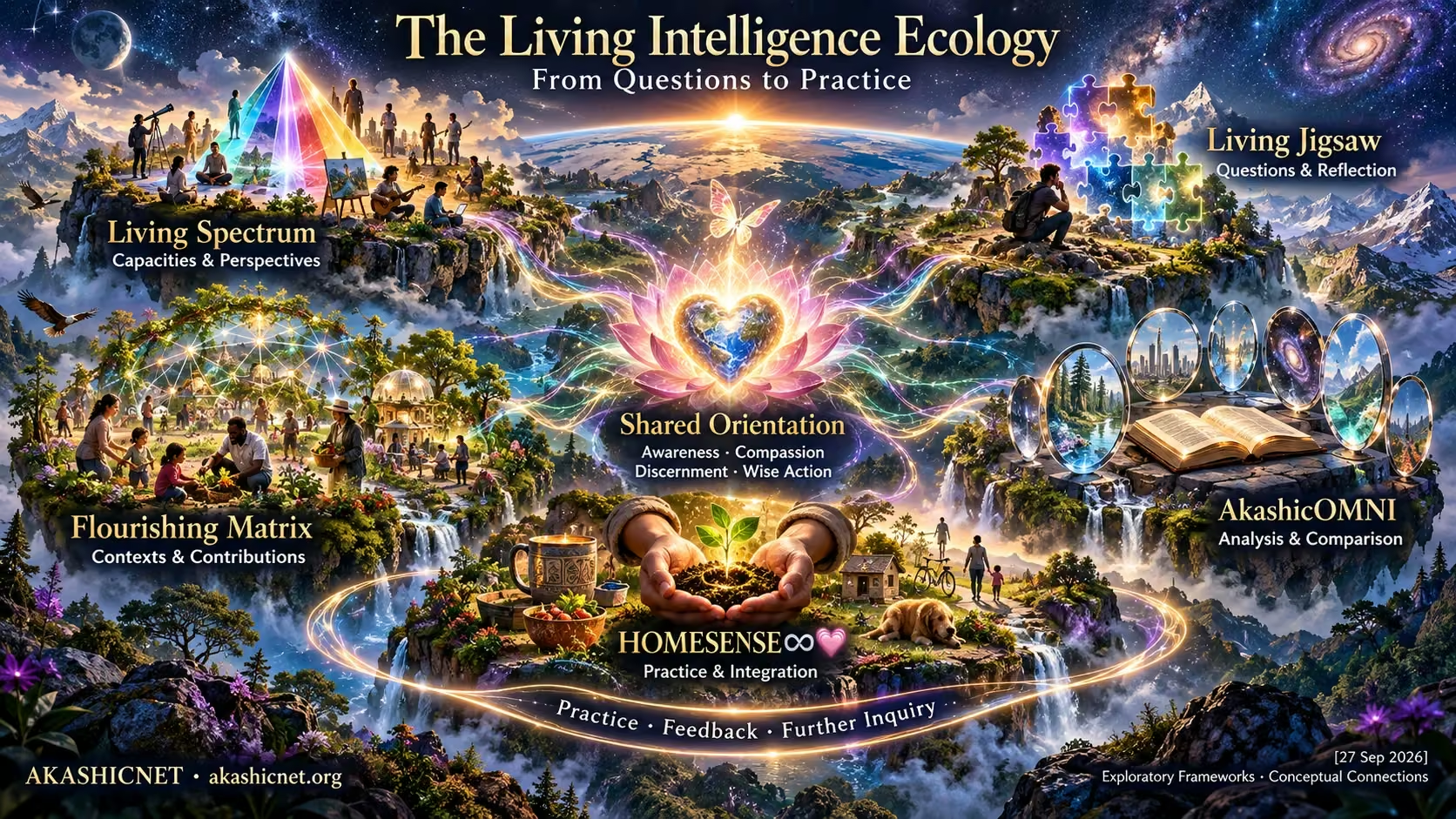
CONNECTED FRAMEWORKS
This chart links the Spectrum to other AkashicNET frameworks. Select a name to read what that framework offers, then use its link to explore. The connections organise ideas; they do not represent measured relationships.
Capacities & perspectives
Which perspectives help us understand this situation? Explore the 19 working lenses without treating them as a test or ranking.
Explore this framework →Practice → Feedback → Further inquiry
TRANSPARENCY · THIS EDITION
Subjective, AI-proposed allocation—not measured authorship. Contributions overlap; the historical review is incomplete. Rounded estimates total 100% for presentation. Artwork is excluded.
The user's aims, category choices, approvals and editorial decisions.
Editorial influence is not a measure of time, effort, ownership or scientific credibility.
The 27 Sep 2026 edition groups 17 lenses and adds two spanning lenses. Bodily Awareness narrows the earlier Bodily label to internal signals; Kinesthetic covers coordinated movement. All labels remain open to review.
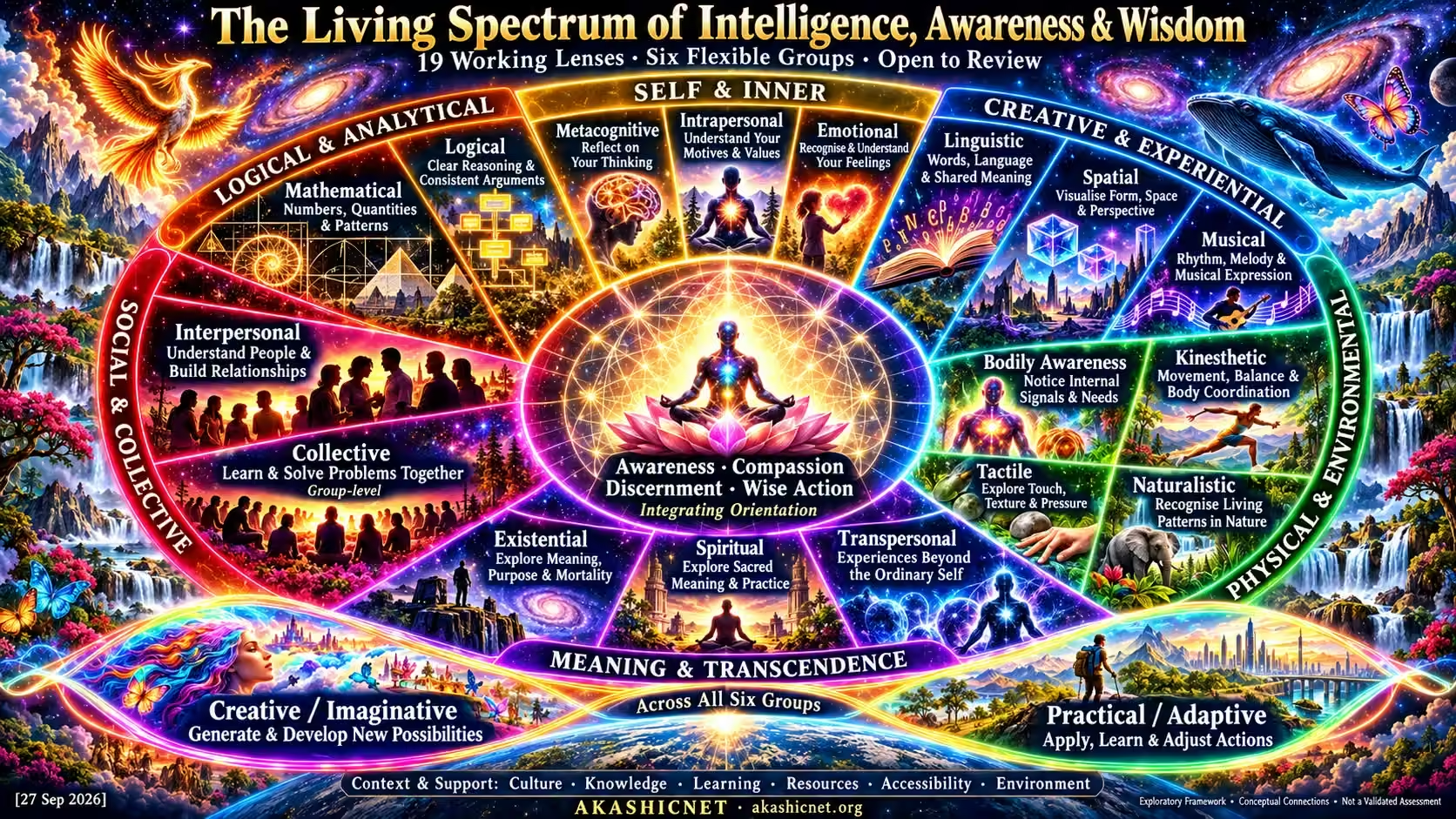
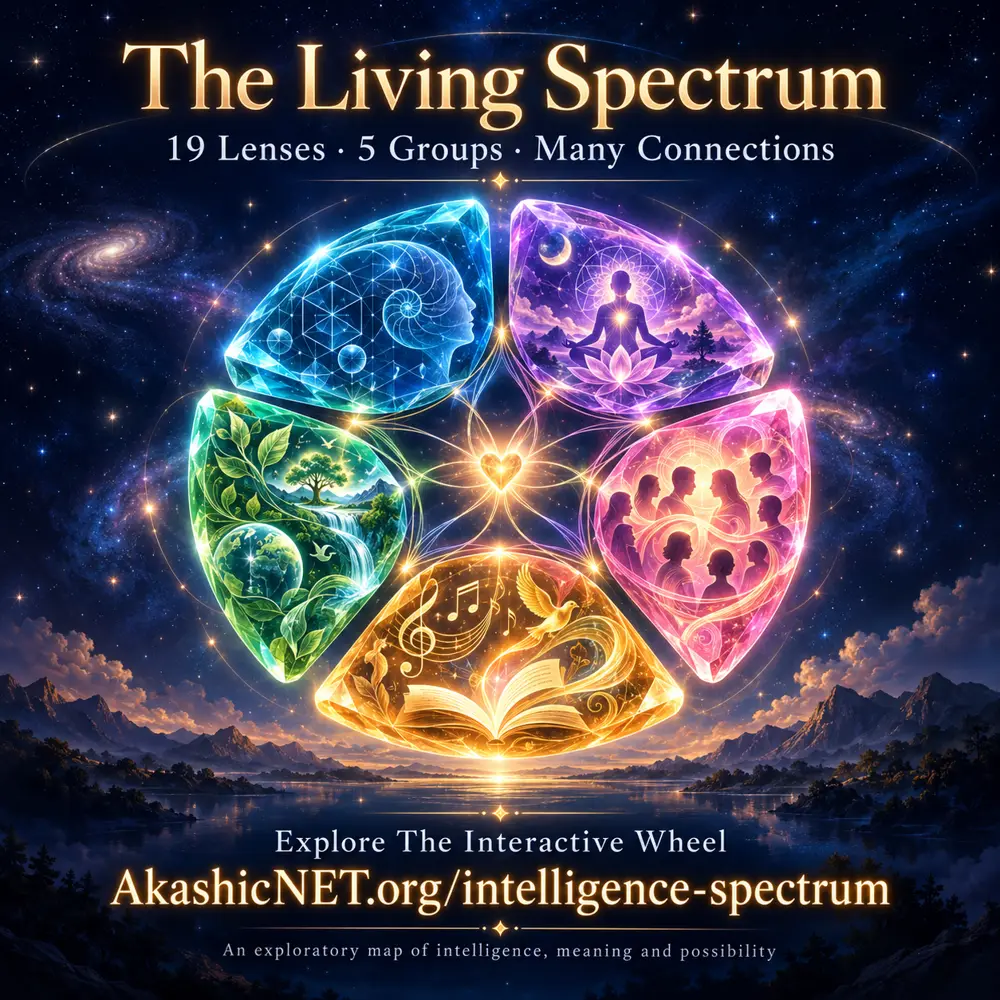
The equal wedges organise ideas; their sizes do not represent scores, quantities or scientific importance. These are proposed, overlapping lenses, not nineteen independently validated faculties or a ranking of human worth.
Spiritual and transpersonal inquiry welcome questions of meaning, connection and wider consciousness. This map leaves their interpretations open. It complements AkashicOMNI v0.5.0’s twelve analytical perspectives plus synthesis. This wording was reconciled on 22 October 2026; the Living Spectrum’s dated 19-lens edition is unchanged.
AkashicNET Editorial · 27 Sep 2026 · AI-assisted organisation, artwork and implementation · Working proposal