AkashicNET × r/NeuronsToNirvana · EXPAND² Edition · 13 November 2026
The Fractal Internet of the Mind
Psychedelic Worlds, Brain Patterns & the Regulation of Genes
People describe spirals, tunnels and whole worlds in altered states. Researchers measure changes in brain activity and, in some animal studies, how genes are regulated. What links can we test across those scales?
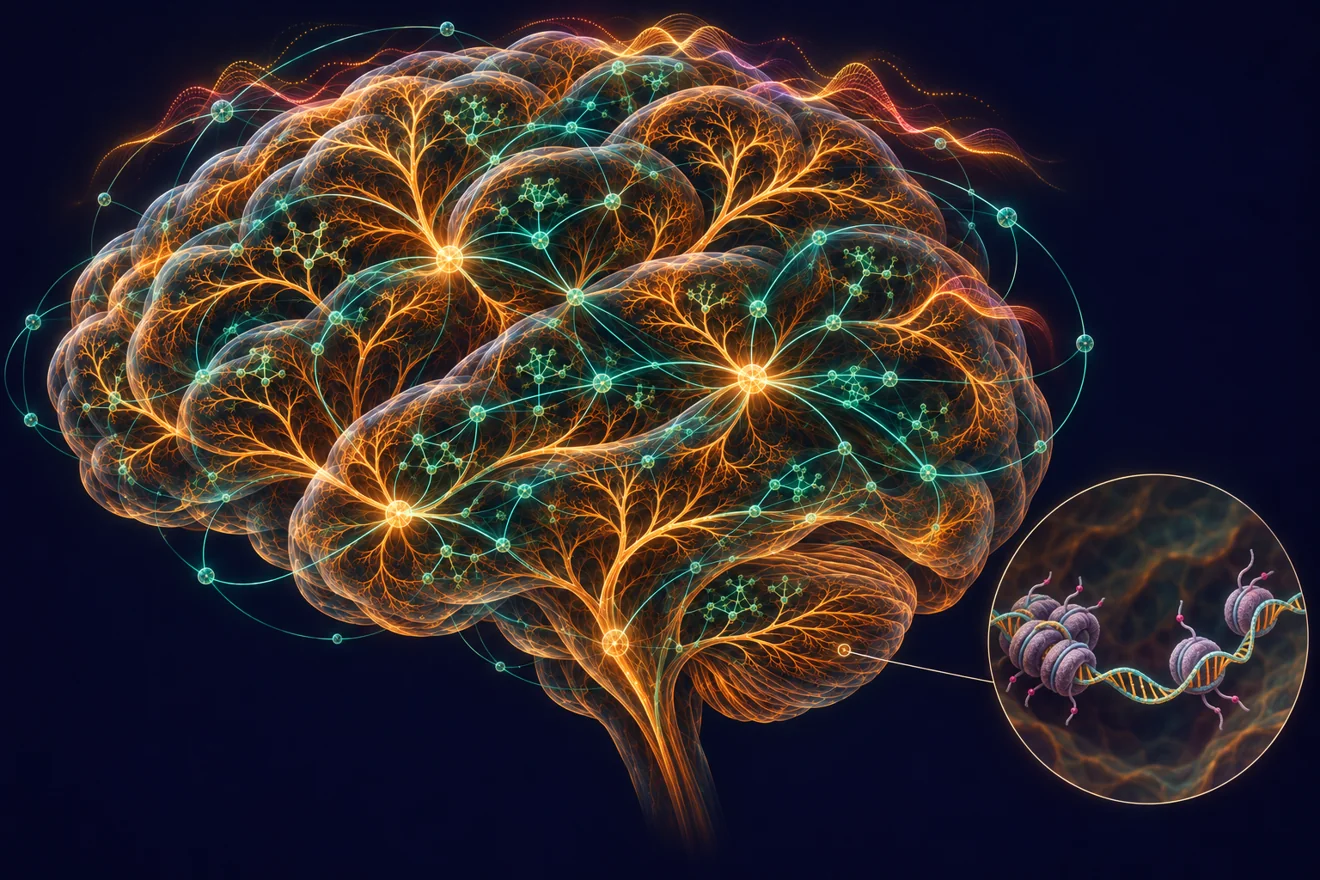
AI-assisted illustration. Amber branches evoke neural circuitry, while teal links represent AkashicNET’s web of questions and sources. The inset shows chromatin, where DNA winds around histone proteins that help regulate access to genes.
Glance
From Experienced Worlds to Gene Regulation
“Fractal internet” is an editorial metaphor for AkashicNET. A research note can connect a question, its sources and its open problems. The same pattern can recur across an entire topic. That metaphor runs through three scales of inquiry. At the level of experience, people report imagery and changes in the sense of self. At the level of brain activity, researchers measure signal patterns and connectivity. At the molecular level, animal studies measure gene expression and chemical marks on histones. A mechanism linking these outcomes would need a study that measures them together.
Expand · Discern
DMT Worlds and Ketaverses
DMT · Reported Imagery
Lawrence and colleagues coded 3,778 experiences from 3,305 Reddit posts. The reports included repeating patterns, tunnels and unfamiliar environments. A separate naturalistic field study recorded accounts of space-like scenes. Self-selection, prior imagery and expectations can shape what enters these records.
In a placebo-controlled human study, Timmermann and colleagues found increased global functional connectivity and EEG signal diversity during acute N,N-DMT effects. A later naturalistic repeated-measures study tracked changes in EEG and experience over time and found more intense visual effects in its higher-dose condition. Specific fractal or mandala-like forms still need their own coding. Time-Resolved DMT Study
Trimmel and colleagues synthesised 24 qualitative studies of psychiatric ketamine treatment. Themes included bodily detachment, altered time and journeys through unfamiliar worlds. “Ketaverse” is used here as informal shorthand for these experiences. Estimating the frequency of shared visual features would require a matched DMT–ketamine comparison. In a separate analysis of written reports, ketamine narratives had the greatest semantic similarity to near-death narratives among the drugs compared. The outcome was similarity in language. Martial et al. · Report Comparison
How vivid is the imagery? Does it form a scene you feel inside? Does your sense of having a body or a distinct self change? The studies below address different parts of that experience. Only the mescaline–LSD–psilocybin study directly compared those three compounds in the same participants.
Mescaline, LSD and Psilocybin
Ley and colleagues compared the three in a double-blind, placebo-controlled crossover study with 32 participants. At the doses that produced comparable intensity, overall subjective profiles were similar on the study scales. Mescaline lasted longest, followed by LSD and psilocybin. Similar scores leave finer differences in visual form, symmetry and spatial depth open.
De Araujo and colleagues measured fMRI activity during a deliberate closed-eye imagery task before and after ayahuasca. Activity increased in areas involved in vision, memory and association. The task studied imagery prompted by the experiment. Spontaneous geometric visions and differences between preparations need dedicated comparisons.
Ermakova and colleagues interviewed 32 participants from a placebo-controlled phase 1 trial of intranasal 5-MeO-DMT. Bodily and emotional changes and shifts in the sense of self were prominent. Visual experiences often involved simpler changes in light, colour or pattern. The contrast with N,N-DMT comes from comparison with separate reports. Another exploratory study found that imagery and disruption of the bodily and narrative self varied across participants.
Salvinorin A acts at kappa opioid receptors. In a placebo-controlled within-person fMRI study, Doss and colleagues found reduced connectivity within the default mode network during peak effects. This gives a comparator outside classical serotonergic psychedelics. It leaves open which, if any, spatial or visual features are shared with DMT or ketamine.
Dickinson’s three qualitative cases describe dreamlike visions and a felt sense of communication. They help identify interview questions about memory, agency and perceived presences. A small case series cannot estimate how often those features occur or establish the source of the experience.
MDMA is an empathogen. In a double-blind crossover study with 28 participants, Holze and colleagues found stronger alterations of consciousness with LSD than with MDMA or d-amphetamine at the doses tested. The comparison helps motivate separate measures for emotional connection and visual restructuring.
What would change the comparison? Collect comparable reports at matched points in each experience. Record overall intensity, context and route. Score visual complexity, immersion, perceived presence and changes to the sense of self independently. The 5-MeO-DMT reports motivate a specific prediction: disruption of the sense of self can be strong even when complex imagery is sparse.
Three Uses of Geometry
Perceived form. Bressloff and colleagues modelled how visual-cortex architecture could generate lattices, spirals and tunnels. A model of recurring shapes leaves the content of an entire experienced world open. Visual-Cortex Model
Signal scaling. Subramani and colleagues found that LSD increased the Higuchi fractal dimension of some cortical MEG time series. That estimate describes how recorded activity varies across timescales. The geometry of participants’ visual imagery was outside the measurement. LSD and Cortical Dynamics
Ritual form. Tibetan Buddhist mandalas can depict a cosmic palace and support contemplation and ritual. Radial symmetry supplies a visual comparison. A fractal classification would require evidence of repetition across scales. Rubin Museum · Mandalas
Gene Regulation and DNA Packaging
In mouse nucleus accumbens tissue sampled 30 minutes after psilocybin or saline, Kang and colleagues reported changes in gene expression and increased H3K27 acetylation, a chemical mark on histone proteins. They also found increased binding of NFATc4 at the Aldh5a1 promoter. The assays measured molecular regulation and left DNA sequence and genome-wide three-dimensional folding outside their scope. Kang et al. · Mouse Chromatin-Associated Findings
At a different scale, a mouse tracing study found that psilocybin changed which brain regions supplied inputs to selected frontal cortical neurons. Whether those changes relate to human reports of patterned imagery remains open. Mouse Circuit-Tracing Study
Earlier rat work by Nichols and Sanders-Bush found changes in prefrontal gene expression following LSD. Ly and colleagues examined dendritic growth and synaptic plasticity in preclinical systems exposed to compounds including LSD and DMT. Together these studies offer comparisons across compounds and biological scales. RNA abundance, synapse structure and histone acetylation are distinct readouts, and no common DNA-folding mechanism follows from them. LSD and Rat Gene Expression · Ly et al. · Preclinical Plasticity
Goldstein, Shared Attention and QMM
The Cinema Comparison
At TSC 2026, Anatoly Goldstein used Hilbert-space vectors to represent attention and proposed that shared focus could affect conditions for direct-voice mediumship. In an open-label study with 62 adults, Stoliker and colleagues found that brain activity under psilocybin varied across rest, meditation, music and movie-watching. Common sensory input, eyes-open versus eyes-closed conditions, expectation and task order matter when interpreting the comparison. The measurable starting point is context-sensitive brain activity. Mediumship was outside the study’s scope. Goldstein’s Abstract · Stoliker et al. · Psilocybin and Context
The Antenna and the Memory Register
Goldstein and John Shuster proposed a fractal-like DNA antenna and cited Harroun and colleagues’ engineered nanosensor for protein shape changes. The sensor uses a specified dye–protein interaction and a fluorescence readout. A biological antenna for anomalous information would need its own carrier, coupling and measurement. Goldstein and Shuster’s Proposal · Harroun et al. · Fluorescent Nanosensor
Florian Neukart and colleagues’ Quantum Memory Matrix uses finite-dimensional Hilbert spaces for proposed spacetime memory cells. Their hardware experiment measured computational-basis retrieval in engineered qubits. A physical link to attention would require an identified record, a coupling and a measurable result that distinguishes the hypothesis from ordinary sensory and neural mechanisms. QMM Theory · Circuit Study · QMM Infographic and TSC 2026 Synchronicity
Expand² · Deepen
How the Comparison Could Be Tested
Start with shared input. Compare people viewing the same film independently and together. Include a different-film control, counterbalance films and track gaze, blinks and movement. This estimates how much alignment follows the stimulus itself. Shared Rhythms Protocol
Measure imagery before cueing. In appropriately approved studies, collect free descriptions or drawings before showing examples. Use blinded coding for symmetry, repetition across scales, tunnels and a sense of being elsewhere. Set a primary outcome and time window in advance, with the participant as the unit of analysis.
Specify the result that would change the interpretation. An effect erased by controls for prior imagery, cueing or reporting style would narrow the claim. A prespecified effect that survives those checks in an independent sample would support the attention–imagery relationship. A claim about voices or anomalous information would require its own source-localisation or blinded target test.
EXPAND² · Synthesis
What Connects These Findings?
Attention is the clearest connection to test. Human studies link brain activity to what people are doing during a psychedelic experience. Accounts of DMT worlds and the relatively sparse complex imagery reported in 5-MeO-DMT interviews give us a reason to measure imagery, immersion and changes in the sense of self separately. A matched comparison could tell us whether that difference holds once context and reporting are controlled.
The molecular connection is an open question. The mouse studies show changes in gene activity and in a chemical mark on histones, the proteins around which DNA is wrapped. Linking those findings to visual experience would require evidence connecting the molecular change to a neural signal and the signal to a specific feature of imagery.
What would change the interpretation? If a preregistered imagery effect follows the attention task in an independent sample, that would support the attention–imagery link. If it follows prior imagery, cueing or the way questions are asked, those factors would explain more of the result. A QMM explanation would additionally need a defined physical carrier and a readout that distinguishes it from ordinary sensory and neural processes.
Sandbox Source Audit · 13 November 2026
How the Sources Were Checked
A keyword screen covered the names, roles and descriptions of all 158 source families in the 22 October Sandbox Source Atlas snapshot and returned 13 catalogue leads. Targeted searches traced claims to conference records, journal articles and museum collections. The screen covers catalogue metadata. Each source family can contain many publications. The expanded comparison used additional searches by compound, study design and outcome. The direct crossover comparison, placebo-controlled studies, interviews and case series support different kinds of conclusions.
The review uses conference abstracts for proposals, experiments for measured outcomes, interviews for reported experiences and museum sources for ritual context. The artwork and proposed comparison are an editorial synthesis. These designs and outcomes do not support a pooled effect estimate. Independent review and prospective testing are pending.