
The AkashicNET Magazine · Crossover Edition
🦋 HOMESENSE828 ♾️💞🕉️
Phase 8 — 🌀 TRANSCEND001
Awakening
Together.
From Inner Insight to
Regenerative Communities
AkashicNET Editorial
23 September 2026 · 7 min read
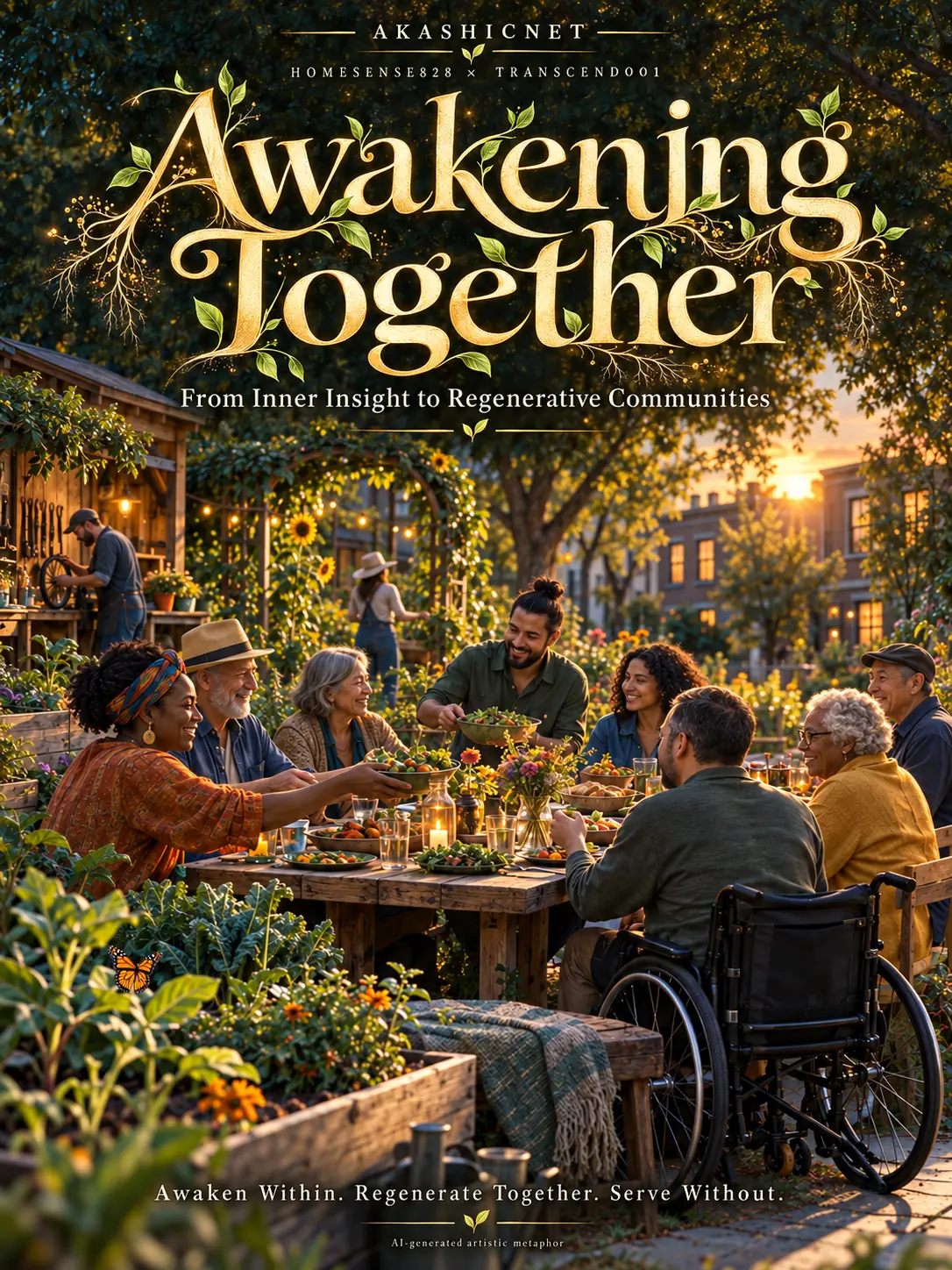
A moment of connection can feel extraordinary. A shared rhythm, quiet meditation or conversation may soften the familiar boundary between ourselves and the world. The feeling can be precious. The question for this edition begins afterwards: what becomes possible when we return to ordinary life?
HOMESENSE828 asks how a living network becomes somewhere we can belong. TRANSCEND001 asks how experiences of connection become enduring compassionate action. Together, they move from inner insight to shared commitments: a meal prepared, an object repaired, a promise kept and a place cared for through the seasons.
Here, a regenerative community means a community that aims to replenish the people, places and relationships sustaining it. This is a working aspiration, not a certification. A beautiful name cannot establish whether a project is delivering what it promises.
The invitation is deliberately modest. We need not agree about consciousness or build an entirely new society before making one corner of life more welcoming. Begin with something people actually want, small enough to maintain and open enough to improve.
Who washes the cups?
Who notices the person sitting alone?An invitation to shared care · AkashicNET Editorial
02 / The Bridge
The Day After Wonder

David Lynch’s public message connects his own meditation practice with an aspiration to make meditation available to others [1]. James Fadiman’s Big Think conversation explores a wider view of consciousness [2]. These are starting points for reflection, not proof that a particular experience produces community flourishing.
Our editorial proposal is to ask what a larger view asks of us. Can it make listening easier? Can it help us notice whose work goes unseen? An expansive feeling does not remove the need for consent, practical skills or accountability. It can become a reason to practise them.
Keep four things distinct: the experience someone reports; the interpretation they offer; claims that can be independently checked; and changes in action over time. A powerful feeling may be meaningful even while its explanation remains unresolved.
TRANSCEND001 carries the inquiry into daily life. The test proposed here is ordinary and observable: can we make care more dependable without asking everyone to share one worldview?
Reported experience
Personal interpretation
Checkable claims
Changes in action
An inquiry guide, not a causal sequence or a scale of spiritual attainment.
03 / A Map of Shared Care
Three Commitments.
One Shared Practice.
People, place and relationships sustain each other.
PEOPLE
Make participation possible.
Offer different ways to contribute: cooking, listening, organising, repairing or simply being present. Build in rest and a quiet option. Ask about access before choosing the venue or the pace. Belonging should not depend on money, confidence or constant availability.
PLACE
Care for what sustains life.
Start with the place itself: food, water, soil, materials and the other lives sharing it. Choose a task small enough to continue. A garden bed needs seasonal care; a repair table needs tools and people who know when to stop and seek help.
RELATIONSHIPS
Make responsibility visible.
Agree how decisions happen, how work is shared and how concerns can be raised. Keep costs understandable. Let people decline, disagree and leave freely. Compassion includes boundaries, and a shared purpose must leave room for different beliefs.
Conceptual framework, not measured results. Listen across all three: a project can look successful while its organisers are exhausted.
04 / Culture & Consent
A Shared Table.
Different Worldviews.
Can we cooperate while remaining free to think differently?
One person may understand service through Sikh tradition, another through Buddhist practice, another through ecology or secular mutual aid. A community can respect these differences without compressing distinct traditions into one universal story.
Learning from Indigenous communities requires attention to particular people, context, permission and attribution. Knowledge is not a decorative resource. Ask who is speaking, what they have chosen to share and whether a proposed adaptation is welcome. No community is obliged to validate someone else’s spiritual interpretation.
The same respect applies close to home. Ask before publishing someone’s image or story. Make photography optional. Give people a way to raise concerns without performing gratitude or agreeing with the organiser. A welcoming circle needs a real route for disagreement.
Avoid turning spiritual experience into a ranking system. Nobody should need an awakening story, a special vocabulary or a charismatic personality to earn a seat at the table. Practical contribution and careful listening can matter as much as an inspiring vision.
05 / Try It Together
Start With One
Workable Thing.
An adaptable proposal, not an AkashicNET programme already in operation.
listen
Ask a few neighbours or friends what would make daily life easier. Invite quieter answers and allow people to respond later. Let their needs shape the task before settling on a grand idea.
choose
Agree one activity: a shared meal, a repair afternoon, a litter pick or support for an existing garden. Joining something already cared for may be more useful than launching something new.
make it workable
Name the organiser, the time commitment and any costs. Ask about access and dietary needs. Offer a way to participate without spending money. Identify who can help if the task exceeds your skills.
act
Do the small thing together. Share practical roles and make it easy to pause. Ask permission before recording images or stories. Notice the preparation and cleaning as well as the visible event.
reflect
Ask what helped, who felt excluded and who carried too much work. Record difficulties alongside achievements. Decide together whether to repeat, change or stop the activity.
A useful first outcome may be simply learning what people do not want.
06 / Learning Honestly
Count What Happened.
Ask What It Meant.
Success might be modest: an object repaired, a task shared or someone feeling welcome enough to return. Choose observations that match the activity. Attendance alone cannot tell us whether people felt included, whether resources were saved or whether care became more sustainable.
Separate records from interpretations. “Four items repaired” would be an activity record if actually counted. “People felt more connected” would need participants’ own feedback. Neither would, by itself, establish that an entire neighbourhood had become regenerative.
| Ask together | Notice and record |
|---|---|
| What did we do? | Record the activity, date and practical result. |
| Whose experience is missing? | Invite optional feedback, including criticism. |
| Who carried the work? | Notice preparation, follow-up and fatigue. |
| What did it require? | Record time, materials and costs honestly. |
| What will we change? | Agree a smaller, fairer or clearer next step. |
If the activity exhausts the people sustaining it, revise its size or rhythm. Stopping can be a responsible decision.
07 / Keep the Question Open
The Network Becomes
a Neighbourhood.
Perhaps the next expression of the Buddhafly Effect is very ordinary: a door opened, a meal shared, a burden made lighter. The metaphor invites attention to small beginnings. It does not promise that every small act will cause a large transformation.
AkashicNET can support this inquiry by collecting examples with their sources, distinguishing intentions from outcomes and leaving room for revision. Future profiles of named projects should use verified information and the project’s own account. This edition announces no partnership or measured community impact.
What is one small act of shared care you would like to see take root where you live? Choose an invitation you can keep. Then listen to what happens next.
The Magazine Edition
Keep the whole story.
Eight illustrated pages to read, save or share.
Download PDF 8 pages · 9.8 MB ↓Open the PDF in a new tabReview edition prepared 23 September 2026. The PDF retains 29 September as its proposed publication date; this web edition is published 23 September.
Sources & Editorial Notes
- David Lynch Foundation: Message from David Lynch
- James Fadiman: Big Think / Perception Box interview
- TRANSCEND000: Beyond the Familiar
- BQ011: From interconnection to compassionate action
Prepared from the HOMESENSE828 Regenerative Communities draft and the TRANSCEND000 framework. Values-based editorial synthesis and proposed activities; not original research or a report of demonstrated outcomes. Sources 1 and 2 provide inspiration, not validation of this framework. No endorsement is implied.
AkashicNET Editorial · AI-assisted writing, design and original imagery. Figures are conceptual. No partnership or measured community impact is announced.
🌀 TRANSCEND000: Beyond the Familiar →🌀 Explore TRANSCEND Posts on r/NeuronsToNirvana
Search the community collection, newest posts first.