
AkashicNET v0.17 × N2N × AkashicOMNI v0.5.0 · 21 October 2026
Plants Under
Anaesthesia
What changes, what remains unknown, and what this means for consciousness.
Public working appraisal · Open to review · AI-assisted
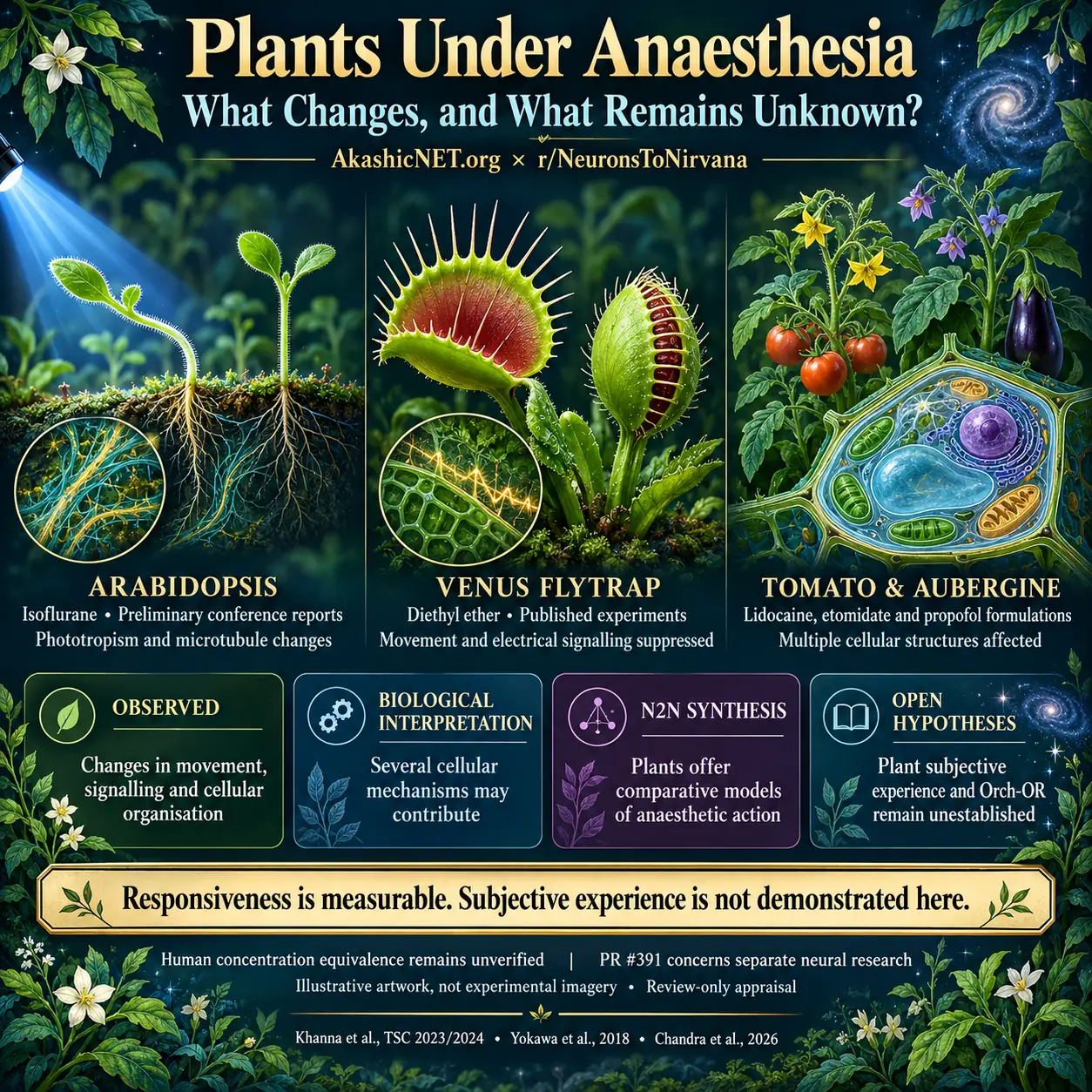
Prepared with AI assistance for researcher review. The original appraisal assessed a supplied summary. The quoted X thread was subsequently inspected: Hameroff’s quoted post is dated 19 September 2026, and the surrounding post 20 September. Publication does not imply scientific endorsement or promotion of an accepted evidence classification.
What the Experiments Actually Report
| Source | Organisms and exposure | Measurements and findings | Qualification |
|---|---|---|---|
| Khanna and colleagues, TSC 2023, abstract 104, PDF p. 62 | Young Arabidopsis thaliana seedlings; isoflurane, numerical concentrations unreported. | Reversible inhibition of blue-light phototropism; red-light growth effects; GFP-tubulin destabilisation in controls, with cop1-mutant resistance. | Authors describe animal-dose similarity and human clinical relevance. This is a conference report without numerical dose-response, sample-size or statistical details. |
| Khanna, Malkovskiy and MacIver, TSC 2024, abstract 228, PDF pp. 356–357 | Arabidopsis expressing GFP-tubulin, including cop1 mutants; isoflurane concentrations again unspecified. | Reports altered microtubule dynamics linked to phototropism/development, mutant tolerance and preserved photoreceptor activity. | Direct microtubule binding is the authors' mechanistic interpretation; the abstract does not provide an independently assessable binding assay. Do not count related abstracts as independent replications. |
| Yokawa et al., 2017 online / 2018 volume | Dionaea muscipula (Venus flytrap); nominal 15% diethyl-ether vapour. | Trap closure disappeared after 1 hour and recovered about 15 minutes after removal. A separate electrical protocol used 2 hours' exposure and measured action potentials recovering over approximately 900 seconds. | Movement and electrical excitability, not subjective experience, were measured. This was not an isoflurane–microtubule experiment or a MacIver paper. |
| Chandra et al., 2026, DOI 10.1021/cbmi.5c00288 | Two-week tomato (Solanum lycopersicum) and aubergine (S. melongena); 1-hour medium exposure: lidocaine 1% w/v, etomidate formulation 0.2% v/v, Neorof/propofol formulation 1% v/v; ± sodium azide 2 mM. | Imaging of roots/stems and other tissues reports microtubule fragmentation/disassembly, reduced tubulin signal, partial recovery, organelle changes and chromatin redistribution. | Neither isoflurane nor MacIver's authorship. Preserve Table 1's formulation units: 1% v/v of a propofol product is not 1% w/v active propofol. No phototropism or flytrap-closure assay. |
Plant microtubules are real cellular structures. Their roles in structure, transport and growth make disruption biologically important without making it consciousness-specific. The 2026 authors explicitly reject microtubule disruption as a unique diagnostic target of anaesthesia. Their proposed chromatin biomarker is an interpretation requiring independent validation, not a consciousness test. 2026 paper
Species correction: The retrieved isoflurane phototropism work used Arabidopsis, not sunflowers. Sunflower tracking should not be presented as an experimental result from those abstracts.
Conference Correction
TSC2026's official programme dates the San Diego meeting to 11–16 October. “Upcoming” was chronologically appropriate in the September post, but is stale when recirculating it on 21 October.
The 13 October concurrent programme lists MacIver's frontal-cortex frequency talk. Its abstract describes rat recordings during sleep and isoflurane exposure, using righting-reflex and tail-clamp endpoints.
The preliminary correction also needs qualification: the 11 October workshop programme separately lists MacIver under “Plant” in The Varieties of Non-Human Consciousness, chaired by Hameroff. Therefore, “his concurrent talk was not about plants” is accurate; “he had no plant-related contribution” is not. A programme confirms scheduling, not actual delivery or experimental details.
Does the Human Concentration Claim Hold?
Only as an attributed, preliminary report. The 2023 abstract distinguishes similar concentrations to animal loss of consciousness from clinically relevant human concentrations affecting plant microtubules. It supplies no numbers to verify either comparison.
For context, an official isoflurane label gives adult MAC values around 1.05–1.28% in oxygen, varying with age and co-administered drugs. MAC concerns movement suppression to a noxious stimulus, not a direct measurement of subjective experience (Eger et al., primary study; publisher reproduction of its abstract). Inspired gas, alveolar concentration, dissolved concentration and tissue exposure are not interchangeable. Human label values cannot fill the missing plant measurements.
N2N Evidence Layers
| Layer | Defensible wording |
|---|---|
| Direct evidence | Plant movement, electrical signals and cellular organisation change under specified anaesthetic exposure. Separate peer-reviewed experiments from preliminary conference reports. |
| Supported scientific interpretation | Shared cellular machinery can help explain sensitivity across organisms; cytoskeletal effects may contribute alongside membrane signalling and metabolism. |
| N2N synthesis | Plants offer comparative models for studying anaesthetic mechanisms. This is a research connection, not evidence that plants experience unconsciousness. |
| Speculative hypotheses | Plant subjective experience remains untested here. An Orch-OR explanation additionally requires evidence for its proposed orchestrated quantum processes and objective reduction; these experiments do not measure them. Theory source |
A concrete competing explanation comes from Scherzer et al. (2022): in Venus flytraps, ether suppressed propagating calcium/electrical signals while local touch-triggered calcium responses persisted. GLR channels were proposed as targets, not conclusively identified. Disrupted signal transmission can explain lost movement without invoking lost experience.
EXPAND²: From Wonder to a Testable Question
Life can coordinate complex responses without a brain. The useful question is which processes explain those responses, and what observation could distinguish an experiential account from a non-experiential one. Here consciousness means subjective experience; sensing, adaptation and task-defined learning do not automatically establish it.
Manual, AI-assisted application of the AkashicOMNI v0.5.0 Public Review Specification, awaiting independent review. AkashicNET v0.17 supplies provenance and source-dependence safeguards; N2N supplies accessible synthesis. This is not a validated software assessment, an evidence score or a change to canonical records. Agreement between frameworks is not independent corroboration.
Separate the claims
Identify the species, agent, endpoint and source. Distinguish observation from interpretation.
Compare explanations
Check rival pathways, replication, source dependence and results that could change the assessment.
Keep the boundaries
Connect findings without promoting them into proof of subjective experience.
DISCERN · Eight Claims to Keep Separate
PC01 Some plant movements and electrical responses can be reversibly suppressed by anaesthetics.
Direct evidence. Supported for tested species, agents and endpoints; does not measure experience.
Source IDs: S01, S04. Replicate or contradict the specified species-agent-endpoint finding under matched conditions.
PC02 Isoflurane affects Arabidopsis phototropism and microtubule dynamics.
Direct observations reported in abstracts. Preliminary; author-reported conference findings, not a complete independently appraised dataset.
Source IDs: S02, S03. Inspect full quantitative data and independent reproduction.
PC03 The plant effects occur at doses exactly matching human unconsciousness.
Comparative dose claim. Exact match unverified. Abstract reports similar or clinically relevant concentrations without numerical curves.
Source IDs: S02. Supply numerical exposure-response comparisons using explicitly distinguished endpoints.
PC04 Microtubules causally contribute to the plant anaesthetic response.
Proposed scientific mechanism. Plausible and testable; specificity and causal mediation remain unresolved.
Source IDs: S02, S03, S06. Selective causal intervention and rescue, with independent pathway and viability controls.
PC05 Anaesthetics inhibit sunflower tracking in the cited experiments.
Species-specific empirical claim. Not established by retrieved sources; Arabidopsis and sunflower must remain distinct.
Source IDs: S02, S03, S05. Provide a direct sunflower-specific anaesthesia experiment.
PC06 Plants show robust associative learning.
Contested empirical generalisation. Positive report, unsuccessful replication and methodological rebuttal; no blanket resolution.
Source IDs: S09–S11. Agreed preregistered multi-laboratory replication with positive controls.
PC07 These findings establish subjective experience in plants.
Consciousness hypothesis. Not established. Behavioural and cellular endpoints do not uniquely identify experience.
Source IDs: S01–S11. Define and independently validate theory-linked discriminators for experience.
PC08 Plant anaesthesia confirms Orch-OR or a universal conscious field.
Mechanistic/metaphysical hypothesis. Not established; quantum mechanism, conscious relevance and broader ontology are separate claims.
Source IDs: S02, S03, S07, S08. A distinctive quantum/OR prediction tested against rival mechanisms in relevant living conditions.
DEEPEN · Multiple Routes to the Same Observable Change
Membranes and signalling
Ion channels, calcium and electrical propagation
Microtubules
Dynamics, cellular organisation and transport
Other cellular processes
Energy status, growth and stress responses
Anaesthetics alter human consciousness and plant physiology, but a shared drug response does not make the affected functions equivalent. Recovery helps distinguish a reversible physiological state from irreversible injury under the tested conditions; it does not distinguish lost experience from a temporary signalling block.
The microtubule hypothesis deserves precise tests. Resistance in cop1 mutants is informative, but mutations that affect light responses and development do not isolate one binding site or a uniquely quantum process. Related 2023 and 2024 conference abstracts must not be counted as independent replications without dataset provenance.
Adjacent Evidence, Different Scope
Kalra et al. (2023) studied excitation-energy migration in isolated microtubules and its reduction by anaesthetics. This does not establish plant experience, functional necessity in a living organism or objective reduction. Depolymerisation and reduced excitation transport are different measurements.
Khan et al. (2024) reported delayed loss of righting reflex after a microtubule-stabilising drug in rats; the main experimental group contained eight rats. This supports further investigation of microtubules but does not measure plant experience or uniquely select a quantum mechanism.
Plant learning also requires careful boundaries: Gagliano et al. (2016) reported associative learning in peas; Markel (2020) did not reproduce it in a larger blinded study; the original authors disputed the conditions. The dispute remains relevant, and neither a positive learning result nor a failed replication alone settles subjective experience.
Twelve Perspectives, One Evidence Base
Each perspective below is applied as a question or interpretive lens, not a validated theory. Twelve reviews of one dataset still examine one dataset. Coverage follows the public manual specification; this is not an audit of every original framework post.
01 · AWAKEN
Notice where wonder becomes an assumption. Ask whether “the plant senses light” describes a measured response or claims felt seeing. Human attention can improve observation without becoming evidence of plant awareness.
02 · HIERATIC
The living-tree or toroidal-heart image can express kinship and care. Treat that as symbolism. No specific Indigenous tradition is adjudicated here; tradition-specific evidence and authority are insufficient for such a claim.
03 · HOMESENSE
A person may feel connected, comforted or inspired by plants. Respect the reported human experience while leaving its external explanation open. Practical care for a garden does not require certainty about a plant’s inner life.
04 · ADAPT
Distinguish evolved responsiveness, physiological plasticity, habituation and associative learning. Define the task, controls and endpoint rather than treating “learning” as one undifferentiated category.
05 · REGENERATE
Use the inquiry to support proportionate ecological care and avoid gratuitous harm. That is an ethical recommendation, not a measurement of plant suffering or a claim that every experimental intervention is equivalent.
06 · TRANSCEND
Explore cognition beyond familiar brain-centred examples while retaining testable definitions. Crossing a conceptual boundary can generate a better question; it does not establish that the proposed answer is true.
07 · #METAD
Compare ordinary signalling, microtubule-mediated function and consciousness-linked explanations. Ask what each predicts differently. Agreement on the same observation does not select a winner.
08 · ACTC
Track agent, context, sequence and proposed cause: exposure comes before the endpoint, but temporal order does not identify the mediator. Use causal language only at the strength supported by intervention and controls.
09 · CUT · Past
Keep research lineage and publication dates visible. Sunflower physiology, anaesthesia experiments and community discussions have different histories; the 2026 promotion should not be framed as the first observation of plant anaesthetic sensitivity.
10 · CUT · Present
State what has actually been measured and what was accessible. Several key claims remain abstract-level. Current manual OMNI availability supersedes earlier unreleased-candidate wording; software validation remains a separate issue.
11 · CUT · Future
Specify results that would strengthen or weaken a mechanism. Favour independent replication, selective rescue, simultaneous pathway measurements and learning tasks with positive controls.
12 · UMASC
Map molecule, cell, organism, ecosystem and human cultural interpretation without treating those scales as empirically equivalent. A shared term such as “information” does not establish a shared kind of awareness.
Optional DARK: distinguish limits of observation from conclusions about reality. Difficulty measuring another organism’s experience permits neither certainty nor proof of absence. This additional check does not change the baseline twelve perspectives.
What Could Change the Assessment?
These are conceptual research directions, not experiments reported as completed.
| Proposed test | Informative result | Remaining boundary |
|---|---|---|
| Independent reproduction | Publish full plant dose-response data, randomisation, blinded scoring, exposure verification, recovery and uncertainty; reproduce the result elsewhere. | Replication strengthens the particular endpoint, not every theory linked to it. |
| Selective perturbation and rescue | Change microtubule stability using orthogonal approaches; test whether restoring the relevant microtubule function restores behaviour while other pathways are monitored. | Rescue is stronger when it preserves baseline development and does not broadly reverse stress. |
| Measure pathways together | Record calcium/electrical signals, microtubule dynamics, growth, energy status and viability over the same exposure and recovery period. | Timing alone is insufficient; mediation needs selective intervention and alternative controls. |
| Resolve the learning dispute | Agree a protocol across laboratories, confirm a reliable light-response control, include unpaired cues and test transfer or contingency reversal with blinded scoring. | A reproducible learning result would support a defined capability; experience would remain a further inference. |
| Test a distinctive quantum prediction | Predefine a measurable signature, living-state conditions and a prediction on which a quantum proposal differs from classical alternatives. | An unusual signal or a poor fit to one model is not by itself proof of consciousness or objective reduction. |
Strengthen a microtubule mechanism if independent, selective interventions and rescue establish causal contribution while controlling alternatives. Weaken it if effects track other pathways while the proposed mediator remains intact. A consciousness interpretation requires an additional, justified discriminator; success at an earlier step does not automatically establish a later claim.
Community context: N2N’s plant intelligence discussion (December 2024) and Living Intelligence Brief (June 2026) provide research leads and interpretation, not independent replications. The podcast itself was not reviewed.
Open the EXPAND² Source Ledger
S01 · Yokawa et al. (2018)
Peer-reviewed experiment; accessible methods and results passages inspected.
S02 · Khanna et al. (2023)
Microtubules mediate plant responses to anesthetics. TSC abstract 104, PDF page 62
Official conference abstract inspected; numerical dose-response and full methods unavailable in abstract.
S03 · Khanna, Malkovskiy and MacIver (2024)
Official abstract inspected. Same research lineage as S02; independence of datasets not established.
S04 · Scherzer et al. (2022)
Peer-reviewed primary study; publisher abstract and relevant text inspected.
S05 · Atamian et al. (2016)
Circadian regulation of sunflower heliotropism, floral orientation, and pollinator visits
Primary-paper abstract inspected. Not a sunflower anaesthesia experiment.
S06 · Chandra et al. (2026)
Synchronized Chromatin Reorganization as a Key Biomarker in Anesthetic Effects on Plants
Publisher abstract and indexed publisher/PMC methods and results inspected in the updated appraisal; figures and raw data were not independently audited.
S07 · Kalra et al. (2023)
Electronic Energy Migration in Microtubules
Institution-hosted primary abstract inspected. In-vitro optical work; not a plant consciousness assay.
S08 · Khan et al. (2024)
Microtubule-Stabilizer Epothilone B Delays Anesthetic-Induced Unconsciousness in Rats
Primary abstract and figure captions inspected; publisher and institutional PDF access failed. Endpoint: loss of righting reflex.
S09 · Gagliano et al. (2016)
Learning by Association in Plants
Original primary-paper indexed abstract/discussion inspected; positive associative-learning claim.
S10 · Markel (2020)
Lack of evidence for associative learning in pea plants
Primary replication study; publisher abstract, methods and discussion excerpts inspected.
S11 · Gagliano et al. (2020)
Comment on Lack of evidence for associative learning in pea plants
Original researchers’ rebuttal inspected. Argument about test conditions; not an independent replication.
F01 · AkashicOMNI v0.5.0
Public Review Specification: Cultivating Love & Wisdom
Current public manual method inspected, including twelve-perspective coverage and review-record requirements. Based on rc.4 A; published 1 October, clarified 2 and 7 October 2026.
F02 · AkashicNET v0.17
BQ001 framework comparison, review-only slice
Repository snapshot inspected. Its independence and promotion safeguards inform this editorial application. It is about BQ001, not a validated plant-consciousness classifier.
F03 · AkashicOMNI overview
Current public method and AkashicNET status
Public page identifies AkashicNET v0.17.0 as published pre-release; this is a surface-status check, not a fresh release audit.
N01 · N2N community context
Plant Intelligence, Memory & Communication: Monica Gagliano podcast; source labelled December 2024
Post and comment inspected; podcast itself not listened to. Context and research leads only.
N02 · N2N community context
Post inspected. Its caution about subjective awareness is retained; secondary summary is not independent evidence.
T01 · The Science of Consciousness 2026
Official programme and Sunday workshops
Programme lists MacIver on plants on 11 October. Conference dates 11–16 October, San Diego. Schedule does not verify delivery; no recording assessed.
Public working synthesis prepared with AI assistance for AkashicNET × r/NeuronsToNirvana. Independent human review remains pending. Researcher citations do not imply endorsement. Source material was inspected to the stated access limits; raw-data verification and systematic-review coverage are not claimed.
Separation From AkashicNET PR #391
PR #391, inspected for this appraisal on 21 October 2026, was open and draft. It annotates Luppi et al., DOI 10.1038/s41593-026-02460-4: human and animal neural dynamics across six species. It contains no plant experiment or plant-microtubule test. Its discussion of responsiveness versus experience is useful methodological context, not corroboration of plant consciousness.
Keep each DOI/abstract as a separate source identity. Publication of this working appraisal does not change PR #391, accepted evidence classifications, canonical edges or Big Question status.
Unresolved Checks and Access Limits
Obtain numerical Arabidopsis dose-response data, exposure calibration, biological replicate counts and independent replication. Test microtubule-specific rescue against pleiotropic cop1 effects and alternative signalling mechanisms. Verify matched vehicle controls, active-drug concentrations and specificity against other cellular stressors. Any consciousness claim needs a justified measure that distinguishes experience from ordinary responsiveness.
Official conference pages and abstracts were inspected. The 2026 methods/results were retrieved as indexed publisher and PMC text because direct article access returned blocking pages; supporting figures and raw data were not independently audited. PR comparison is an inspection of its current annotation, not a fresh audit of the Luppi datasets. The quoted social-post date has now been checked in the X thread; the workshop recording remains unreviewed. This is a bounded appraisal, not a systematic review.