

AkashicINQUIRY026 · 25 November 2026
The Science of Enactivism
If you could feel a single tap but see nothing, how would you tell whether someone was tapping back?
AkashicABSTRACT
Enactivism asks how the activity of a living body helps constitute what it perceives. Two experiments gave people a particularly spare way of meeting. Each person could move along a hidden line and feel contact with objects on it. Pairs repeatedly found each other, even when a decoy moved exactly as the partner moved. Their success depended partly on what the two did together. Whether a participant actually felt another person’s presence was a separate, measurable question.
How did Buddhist practice enter enactivism, and which parts of that conversation can an experiment test? In The Embodied Mind (1991), Francisco Varela, Evan Thompson and Eleanor Rosch drew explicitly on Buddhist accounts of dependent arising and identification as they developed enaction. Their project brought contemplative practice into a conversation with cognitive science and phenomenology. Later enactivists differ about living organisation, perceptual skill and the role of mental representations. C1 · C2
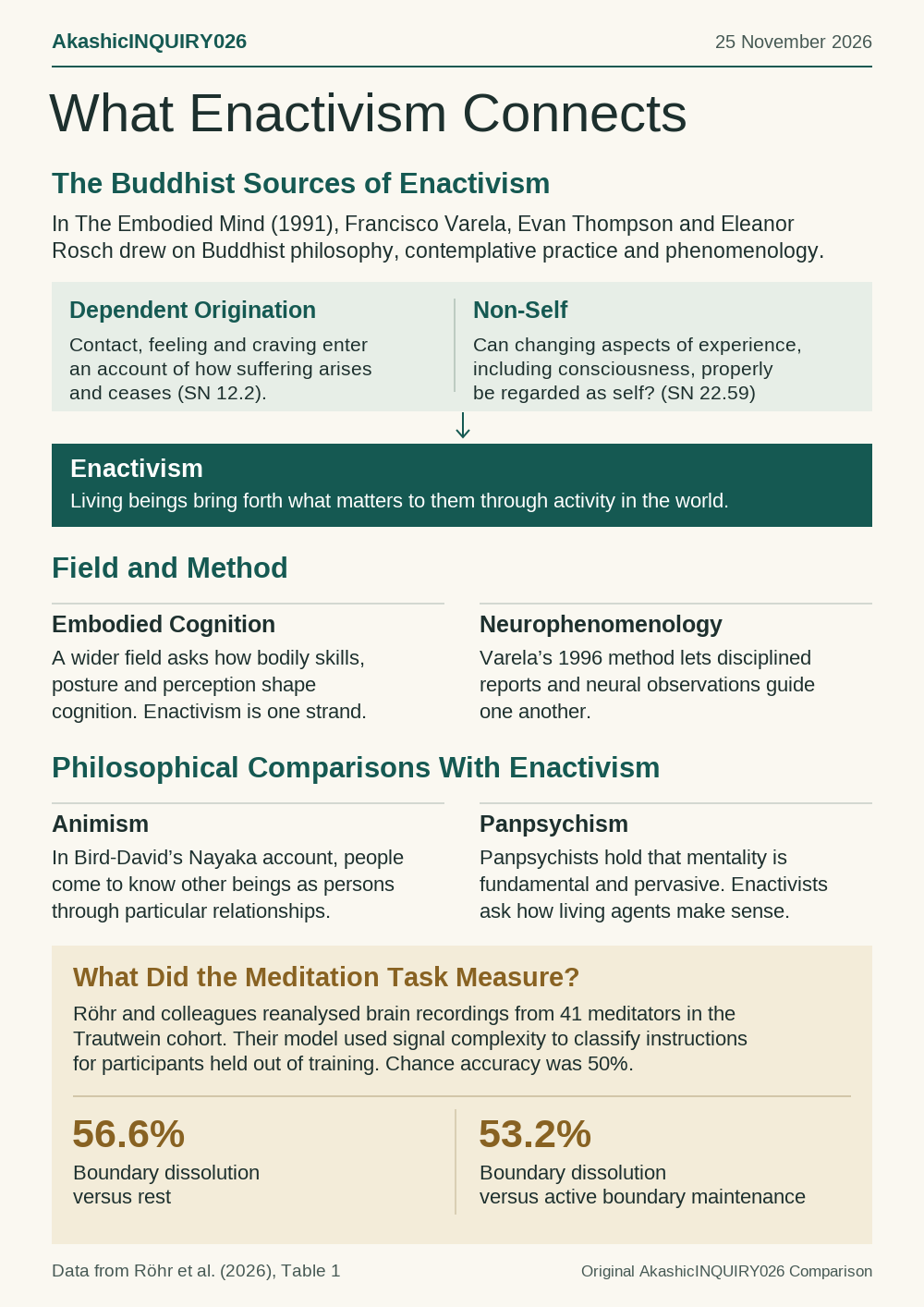
This targeted review compares the founding texts with tactile perception, sensory substitution and meditation studies. Bodily exploration can change what people learn about distance. In one meditation cohort, a model that classified brain recordings from previously unseen people distinguished instructions to dissolve a felt boundary from rest with 56.6% accuracy. Against another meditation instruction it reached 53.2%, with chance at 50%. A separate Isha Yoga study found similarly sized associations for ratings of concentration and non-duality. These findings give researchers ways to investigate experience while leaving the truth of Buddhist non-self and the distribution of consciousness open. The next test is whether neutrally elicited descriptions improve prediction in an independent cohort beyond attention, expectation and task instructions. C4 · C6 · C7 · C8
What Does Action Add to Seeing or Feeling?
Run a fingertip along a key in your pocket. A single pressure against the skin could come from several objects. Tracing the teeth produces a sequence that helps you recognise the key. Your exploratory movement determines which differences you can feel next. A stronger possibility is that the skill of exploring helps make up the perception itself. That is the claim an enactive account has to earn.
Francisco Varela, Evan Thompson and Eleanor Rosch developed this idea in The Embodied Mind in 1991. They proposed that recurrent patterns of sensing and acting help to form our cognitive capacities. Their engagement with Buddhist practice helped frame a question about how experience can be examined from within. The book offers a theoretical argument. Experimental work can test particular predictions that follow from it. Read the chapter on enaction · MIT Press edition and publication history.
Can Two People Find Each Other by Touch?
In a study by Malika Auvray, Charles Lenay and John Stewart, 20 participants worked in pairs. Each person moved a cursor along an invisible line. Touching the partner’s cursor, a fixed object or a moving decoy produced the same tactile signal. The decoy followed the partner at a fixed distance. Meeting the partner meant that both people felt contact at once. Either could turn back and renew it.
Of the clicks people made to identify a partner, 65.9% followed encounters with the partner and 23.0% followed encounters with the moving decoy. But the partners also encountered one another more often. Once the authors accounted for how often each stimulus occurred, the tendency to click showed no significant difference between partner and decoy. Two people could succeed together while an individual encounter remained ambiguous. Auvray, Lenay and Stewart · New Ideas in Psychology (2009), results §3.1.
Accuracy and the Feeling of Presence
Tom Froese, Hiroyuki Iizuka and Takashi Ikegami gave 17 pairs a cooperative version of the task. Players rated how clearly they felt someone else was there. The clearest rating occurred most often when both partners identified each other correctly. One participant made 11 correct identifications and reported no experience of the partner’s presence on any of them. Accuracy and felt presence can come apart even in a task designed to bring them together. Froese, Iizuka and Ikegami · Scientific Reports (2014), Figure 5 and outlier analysis.
A Test That Could Change the Answer
A person might learn which sequence of taps usually goes with a partner. To test how much real-time reciprocity adds, randomly alternate a live partner with replays of a previous partner’s movements. Keep participants unaware of which condition they receive. Match the amount and timing of contact as closely as possible and measure any remaining differences. Record identification, felt presence and the relative timing of both people’s movements separately.
If identification and presence ratings were equally good during well-matched replays, learned sensory cues could account for more of the result. If live interaction retained an advantage after those checks, the case for reciprocity in this task would strengthen. The experiment addresses recognition between two human participants. A general claim about which things in nature experience anything would require other evidence.
What Does a Moving Hand Learn?
Imagine sweeping a finger past a point of light you cannot see. A sensor on the finger picks it up and a small vibrator on your back signals the encounter. After some practice you can say roughly how far away the light is. Now change hands. If you have memorised a set of joint positions, that change ought to be costly. If you have learnt something about the space in which either hand can move, some of the skill should travel with you.
Joshua Siegle and William Warren asked 31 sighted participants to use a device of this kind. Twenty received instructions to attend to the light outside the body and eleven to their arm and the vibrations. Distance judgements improved across training in the first group. Performance transferred when participants changed arm or sat in a rotated position. That makes a look-up rule tied to one set of joints less plausible. Someone could still learn an internal spatial model by moving and attending to the feedback. Both interpretations owe us an account of what the learner can do when the relation between movement and signal changes. S15
This is where the history matters. The authors of The Embodied Mind asked how a world of significance arises for a living perceiver. In Buddhist practice they found ways of examining how a point of view forms and how it comes to feel like a self. In cognitive science they found competing accounts of what perception requires. Chapter 6 works through habitual identification and dependent co-arising. Chapter 8 develops embodied action and Chapter 10 returns to the Buddhist Middle Way. A manipulation of movement can help decide between two accounts of a perceptual skill. Reading those chapters establishes why the founders thought a Buddhist question belonged in the conversation. S01 · S02
A claim as broad as “the body matters” can survive almost any result. One stronger prediction was that responding towards or away from the body would be faster when the movement agreed with the action described in a sentence. In a preregistered 18-laboratory replication, the pooled effect was close to zero. It matters which movement, which words and which timing a theory predicts will make a difference. The next experiment should state them before looking at the data. S04 · S16
Seven Ways of Asking About Experience
| Perspective | Question and Connection to Enactivism | What Would Bear on It? |
|---|---|---|
| Enactivism | How does a living agent’s activity help constitute what matters to it? The original programme emphasises autonomy and sense-making. Sensorimotor approaches emphasise practical knowledge of how sensation changes with action. Radical enactivism disputes the need for contentful representations in basic cognition. | A manipulation can discriminate specified mechanisms. Broad claims about constitution, biological normativity or representation need additional argument. S01 · S03 |
| Embodied Cognition | A wider research programme asks how bodily capacities shape thinking and perceiving. Some accounts retain internal simulation. Establishing a bodily influence leaves open whether that process partly constitutes cognition. | Transfer across postures bears on a learnt spatial skill. A null effect in one language task narrows one prediction. S04 · S15 · S16 |
| Neurophenomenology | Varela’s later methodological proposal asks disciplined descriptions of experience and neural measurement to constrain one another. An interview can suggest how to group trials. A surprising neural result can prompt a return to how the experience was described. | Blinded coding and prediction for held-out people test the additional information supplied by reports. Agreement alone leaves room for shared task demands. S08 · S17 |
| Buddhist Dependent Origination | Under what conditions do suffering and its cessation arise? SN 12.2 specifies relations such as contact conditioning feeling and feeling conditioning craving. Here feeling can be pleasant, painful or neutral. The founding authors engaged these teachings and later Buddhist accounts of groundlessness. S25 | Discourses and their interpretation establish what the tradition teaches. A study can isolate a proposed relationship, such as feeling and subsequent urge. It tests a fragment under defined conditions. S01 · S02 · S05 |
| Buddhist Non-Self | SN 22.59 asks whether changing form, feeling, perception, formations and consciousness warrant appropriation as self. The issue has practical force for attachment and release. It is distinct from the duration of a felt boundary or an experience of unity. | One can study changes in self-location, agency or identification separately. A boundary rating cannot settle the teaching. Mahāmudrā instructions add another historically situated practice. S06 · S09 |
| Animism | In Bird-David’s account of the Nayaka in southern India, relationships help explain how other beings are known as persons. María Sabina’s account of addressing the saint children belongs to a particular Mazatec healing history. Each offers a comparison with relational sense-making. | Ethnography and attributed testimony document distinct practices and interpretations. Neither example is presented as a source of the 1991 project or as representative of all Indigenous peoples. S10 · S23 · S24 |
| Panpsychism | Is mentality fundamental and pervasive in nature? A micropsychist starts with fundamental constituents. A cosmopsychist gives priority to the cosmos as a whole. Each asks a different question from how an organism acquires a world of significance. | Constitutive micropsychism faces the problem of how many subjects could compose one. Human experiments can constrain an added model that makes distinctive predictions. These tasks alone leave the distribution of mentality undecided. S11 |
Thompson later challenged claims that Buddhism enjoys a uniquely scientific status. That criticism matters even when the founding influence is clear. Equally, the fact that an author uses a Buddhist text in a theory cannot make all later forms of enactivism Buddhist. De Jaegher and Di Paolo’s 2007 proposal about sense-making between people is a documented later extension with its own empirical questions. S03 · S07 · S21
Evidence and Competing Explanations
| Study and Unit | Observation | Strongest Rival or Limit |
|---|---|---|
| Auvray et al. (2009) · 20 people in 10 pairs. | 65.9% of identification clicks followed contact with the partner and 23.0% with the moving lure. Clicks per stimulation did not differ significantly between them. | Reciprocal movement generated more opportunities for contact. A correct click alone gives little information about recognition on a matched encounter. S12 |
| Froese et al. (2014) · 17 pairs. | Mutual correct judgements were associated with clearer felt presence. One player made 11 correct identifications with no reported presence on those occasions. | Confidence and accuracy can dissociate. Repeated observations from one individual do not describe a population. S13 |
| Wagemann et al. (2026 issue) · open-ended reports from 54 participants. | Four participants described something like dancing together in six coded passages. The study also records uncertainty about when to signal recognition. | A first-person metaphor can guide interview design. Its frequency in this task or an interviewer’s coding cannot identify a mechanism. S26 |
| Siegle and Warren (2010) · 31 device users, two instructional groups. | Distance learning and transfer favoured a skill that survived changes of arm or orientation. | Instructions also changed attention and strategy. An internal spatial estimate could generalise to a new posture. S15 |
| Morey et al. (2022) · preregistered replication in 18 laboratories. | No lab found a reliable effect of the tested action–sentence compatibility manipulation. The pooled estimate lay near zero. | A precise challenge to this task and timing. Other versions of embodied cognition make different predictions. S16 |
| Lutz et al. (2002) · four trained participants, repeated visual trials. | Participants’ descriptions of readiness tracked pre-stimulus EEG synchrony and response times in a stereogram task. | Attention prepares people for visual targets. Participant-derived categories and a very small sample limit generalisation. S17 |
| Trautwein et al. (2024) · 46 experienced meditators recruited, 45 usable MEG records. | The 12 people classified by interview as reporting full dissolution had a larger posterior medial high-beta reduction for dissolution versus active maintenance. The subgroup difference was inconclusive against rest. | Selection, effort, attention and learned reporting can covary with the instructed state. The subgroup accounts for part of the result. S18 |
| Röhr et al. (2026 issue) · 41 members of the same cohort. | The across-person complexity classifier reached 56.6% versus rest and 53.2% versus active boundary maintenance. A classifier using 27 Hz power reached 50.7% against the active control (p = .154). | Epoch classification addresses which condition a person was instructed to enter. An association with a condition has limited specificity for the experience within it. S19 |
| Saketh et al. (2026) · Isha Yoga sample and meditation-naïve controls, 53 with both EEG tasks and ratings. | Ratings of non-duality and concentration explained 8.2% and 8.0% respectively of variation in the EEG timescale difference between breath-watching and an external attention task, in separate models. | Similar explained variance leaves specificity open. Eye condition, attentional demand and practice history differ. This independent sample tests a different practice and measure. S20 |
| Hutcherson et al. (2008) · controlled brief loving-kindness exercise. | Participants showed more positive responses to unfamiliar people on explicit and implicit measures relative to a matched control exercise. | The task measured a change in the participant’s social response. A receiver’s ability to identify a concealed target would be a separate outcome. S22 |
Meling’s 2022 comparison of an enactive model with Tibetan Mahāmudrā belongs alongside these studies as a source of hypotheses. Its proposed loosening of the distinction between an observer and an observed object is more specific than bodily boundary loss. The article compares a model with practice instructions. It reports no new participant data. S09
Predictions That Could Change the Assessment
Is a Partner Recognised Because the Partner Responds?
A three-way comparison. Compare a live human, a replay and a responsive algorithm. Earlier perceptual-crossing work already explored replay. Cross what participants are told about the partner with what actually generates the feedback. Counterbalance blocks and log the duration, rate and temporal structure of contacts. Estimate both the total live effect and the residual effect at comparable exposure. Because reciprocity can itself create encounters, predefine that those analyses answer different questions. S12 · S13 · S14
Prediction. A simple encounter-frequency account predicts no residual advantage after matching opportunity. A contingency account predicts that both live partners and responsive algorithms outperform replay on partner-like target versus lure sensitivity (d′). Identification improving with the instruction alone would favour expectation. Analyse dyads as units, report intervals and test an equivalence margin fixed before collection. A residual live-human advantage would motivate a search for unmatched cues before interpreting it as human-specific recognition.
What Transfers When the Body Moves Differently?
Train the sensory substitution skill, then independently vary the arm used and the mapping between movement and the signal. Fit a joint-angle look-up model and a spatial model on training trials. Fix both models before the transfer test and compare their distance errors on unseen postures. Keep target distributions, feedback delay and instructions matched. S15
Prediction. Preserved accuracy on a new arm when spatial geometry is preserved, followed by a selective rise in error when that geometry is broken, favours the spatial model over a fixed joint-specific rule. If the fixed rule predicts held-out errors as well, that version of the spatial interpretation loses support. An internal spatial model can make an equivalent prediction. This design tests specified models rather than adjudicating representation in general.
Do First-Person Descriptions Add Predictive Value?
Two sites could preregister a comparison of boundary dissolution with equally demanding boundary maintenance or focused attention. Record eyes, respiration, movement, alertness and expectation. Use neutral questions to distinguish bodily edges, agency and the sense of an observer. Have interviewers or independent coders blind to condition assign ratings. Learn all features, thresholds and model settings on one site, then lock them for the second. S08 · S17 · S18 · S19 · S20
Prediction. On held-out participants, interview dimensions should improve prediction of a prespecified neural feature over a baseline containing instruction, concentration and physiological covariates. Compare paired prediction errors and confidence intervals at participant level. Power for a smallest useful improvement, declare that threshold in advance and make rest a secondary comparison. If the active-control contrast shows equivalence within that margin, downgrade specificity even if rest remains distinguishable. This tests the value of first-person measurement. A separate practice-specific study would be needed to examine Meling’s proposed subject–object transition.
Claim Table
| Claim | Warrant and Source | Limit or Check |
|---|---|---|
| C1 · Direct Intellectual Influence | Documented in the 1991 book and its revised edition. S01 · S02 | The volumes are two editions of one work. Later varieties have distinct commitments. |
| C2 · Text and Interpretation | Conditionality, identification and later Mahāmudrā modelling have identifiable textual sources. S03 · S05 · S06 · S09 | No general scientific verification of non-self, awakening or a shared ultimate reality. |
| C3 · Reciprocal Encounter | More frequent mutual contact and occasional separation of success from felt presence in defined tasks. S12 · S13 | The per-contact result limits individual-recognition claims. See the proposed comparison of live, recorded and algorithmic partners. |
| C4 · Body and Task | Posture transfer challenges a joint-specific rule. A multisite null narrows a language prediction. S15 · S16 | Distinct tasks cannot be pooled as a single effect of embodiment. |
| C5 · First-Person Method | Readiness reports covary with a visual task’s neural and behavioural measures. S08 · S17 | Test independent coding and cross-person prediction. |
| C6 · Meditation and Its Comparator | Same-cohort MEG and an independent EEG study support bounded task associations. S18 · S19 · S20 | Active maintenance and concentration constrain neural specificity. |
| C7 · Relational Comparison | Situated accounts and metaphysical arguments permit careful comparison. S10 · S11 · S23 · S24 | Cultural authority and the distribution of experience are separate questions. |
| C8 · Research Proposals | Three specified tests follow from competing explanations identified above. S14 · S15 · S19 · S20 | Proposed here as designs. Outcomes remain unknown. |
| C9 · Mettā and Felt Connection | A controlled experiment measured participants’ evaluations of unfamiliar people. S22 | Felt connection, detecting another person’s attention and identifying concealed information need distinct measurements. |
Sources and Evidence Limits
The AkashicNEXUS³ review traced each claim to its source, compared the strongest alternative explanation and identified which observation could change the assessment. The AkashicENHANCE³ checks traced the founders’ own chapters, examined what happens when a meditation task is compared with an active control and checked the study labels in the figure against the text.
These 26 references belong to 24 source families. Two editions of one book share an origin. Two analyses of the same meditation cohort share participants. Each entry identifies the relevant passage or result and the limits of the comparison.
- S01 · Francisco J. Varela, Evan Thompson and Eleanor Rosch · The Embodied Mind (1991, revised 2017)
The authors explicitly develop enaction through dialogue with cognitive science, phenomenology and Buddhist practice. Publisher description and contents, especially chapters 6, 8 and 10. The two editions represent one historical work.
- S02 · Varela, Thompson and Rosch · Selfless Minds and the book contents
The treatment of dependent co-arising and habitual identification is visible inside the founding work. Chapter 6, pp. 105–130 and chapter 10, pp. 217–234 in the revised edition. Chapter locators establish engagement with these ideas.
- S03 · Daniel D. Hutto · Enactivism · Internet Encyclopedia of Philosophy
Distinguishes original, sensorimotor and radical programmes and objections to their commitments. Sections 2a–c and subsequent criticisms. One scholar’s philosophical survey.
- S04 · Lawrence Shapiro and Shannon Spaulding · Embodied Cognition · Stanford Encyclopedia of Philosophy
Embodiment encompasses multiple views on the role of the body, including representational accounts. Sections 2.1, 2.4 and 5. How to establish a constitutive role is disputed.
- S05 · Saṃyutta Nikāya 12.2 · Analysis of Dependent Co-arising · translation by Ṭhānissaro Bhikkhu
Sets out specific conditions for the arising and cessation of suffering, including feeling and craving. Definitions of contact, feeling, craving and clinging. Translation of a discourse, without experimental observations.
- S06 · Saṃyutta Nikāya 22.59 · The Not-Self Characteristic · translation by Ṭhānissaro Bhikkhu
Examines identification with each of five changing aggregates, including consciousness. Questions about control, change and what merits identification as self. Different translations render the aggregates differently.
- S07 · Evan Thompson · Beyond Buddhist Exceptionalism (2020)
Challenges the retrospective claim that Buddhism has a privileged scientific status. Author’s argument in a Yale University Press essay. Interpretive criticism by a co-author of the founding book.
- S08 · Francisco J. Varela · Neurophenomenology (1996)
Proposes mutual constraints between disciplined first-person descriptions and cognitive research. Journal of Consciousness Studies 3, 330–349. Methodological proposal. The author also co-authored S01.
- S09 · Daniel Meling · Knowing the Knowing (2022)
Develops an enactive interpretation of Tibetan Mahāmudrā instructions and non-dual knowing. Frontiers in Psychology, Hypothesis and Theory, DOI 10.3389/fpsyg.2022.778817. No new participant dataset.
- S10 · Nurit Bird-David · ‘Animism’ Revisited (1999)
Uses Nayaka ethnography in southern India to interpret personhood through relationships. Current Anthropology 40(S1), S67–S91. Context-specific ethnography and analysis.
- S11 · Stanford Encyclopedia of Philosophy · Panpsychism
Surveys the fundamental and ubiquitous mentality thesis, its varieties and objections. Sections 2.1–2.4 and 4.2–4.4. The subject-combination problem concerns particular versions.
- S12 · Malika Auvray, Charles Lenay and John Stewart · Perceptual Interactions in a Minimalist Virtual Environment (2009)
In ten dyads partner encounters were more frequent, with no significant partner–lure difference in clicks per stimulation. Results §3.1. Percentages of clicks and probabilities per stimulation have different denominators.
- S13 · Tom Froese, Hiroyuki Iizuka and Takashi Ikegami · Embodied Social Interaction (2014)
One participant made 11 correct judgements without reporting felt presence on those occasions. 17 dyads, Figure 5 and outlier analysis. One case cannot estimate prevalence.
- S14 · Malika Auvray and Marieke Rohde · Perceptual Crossing (2012)
Reviews interaction, replay and simulation variants and challenges for explaining social judgement. Review of the paradigm, partly covering S12. Do not count reviewed datasets again.
- S15 · Joshua H. Siegle and William H. Warren · Distal Attribution and Distance Perception in Sensory Substitution (2010)
Distance learning and transfer across changes of arm or posture constrain explanations based on the learnt position of particular joints. Participants, learning phase and transfer phase. Instructions differed, leaving attention and learnt spatial inference open.
- S16 · Richard D. Morey and colleagues · A Preregistered Multilab Non-replication of the Action–Sentence Compatibility Effect (2022)
Across 18 labs the pooled compatibility effect was near zero under a common protocol. Abstract, Figures 6–7 and discussion. Print year 2022, online 2021. Limited to the tested sentence–movement procedure.
- S17 · Antoine Lutz and colleagues · Guiding the Study of Brain Dynamics by Using First-Person Data (2002)
Readiness categories from four participants’ reports covaried with prestimulus EEG dynamics and response times. Methods and results. Repeated trials increase within-person precision. Four people limit generalisation.
- S18 · Fynn-Mathis Trautwein and colleagues · Suspending the Embodied Self in Meditation (2024)
The full-dissolution subgroup showed a larger posterior medial high-beta reduction in dissolution versus active maintenance. The subgroup comparison against rest was inconclusive. Participant flow, phenomenological classification and subgroup results. 46 recruited, 45 usable MEG, 12 in the full-dissolution subgroup.
- S19 · Henrik Röhr and colleagues · Decoding the Self (2026 issue)
Across-participant signal-complexity classification was 56.6% against rest and 53.2% against active maintenance, with 50% chance. Table 1, multivariate logistic regression, Lempel–Ziv complexity. Reanalysis of 41 people in S18. First published December 2025.
- S20 · Malipeddi Saketh and colleagues · Non-duality in Brain and Experience of Advanced Meditators (2026)
Non-duality and concentration ratings accounted for similar fractions of variation in the difference in EEG timescales between two tasks. Figure 6 and Supplementary Table 10. Paired analysis n=53, separate models. Cross-sectional Isha Yoga practitioners and meditation-naïve controls.
- S21 · Hanne De Jaegher and Ezequiel Di Paolo · Participatory Sense-Making (2007)
Explicit later extension of enactive sense-making to the dynamics of interaction. Theoretical article. The proposed causal contribution of coordination needs a task and comparison.
- S22 · Cendri A. Hutcherson, Emma M. Seppala and James J. Gross · Loving-Kindness Meditation Increases Social Connectedness (2008)
A brief exercise changed explicit and implicit responses towards unfamiliar people relative to a matched control. Abstract. Social connectedness and positive evaluations were measured. Concealed-target accuracy was outside the experiment.
- S23 · Katherine Swancutt · Animism · Open Encyclopedia of Anthropology
Surveys distinct anthropological uses of animism and the variety of practices placed under the term. Comparative overview. Use with the locally situated ethnography at S10.
- S24 · María Sabina · oral life history recorded by Álvaro Estrada, English translation by Henry Munn
Her account identifies the saint children as guides in a Mazatec healing relationship. Printed pp. 21–23, as traced in María Sabina & the Science of Animism. Mediated testimony. No archival audio, translation excerpts or images reused.
- S25 · Saṃyutta Nikāya 36.1 · Concentration · translation by Nyanaponika Thera
Distinguishes pleasant, painful and neutral feelings within a teaching about knowing their origin and cessation. Opening classification. Used to clarify the meaning of feeling alongside the conditional sequence in S05.
- S26 · Johannes Wagemann, Leonardo Zapata-Fonseca, Stephen Estelle and Tom Froese · Dancing Together in Virtual Space (2026 issue)
Open-ended reports in a haptic task included descriptions of dancing together in six segments from four of 54 participants. Results on transparency and contact quality. Published online November 2025. Exploratory coding of participants’ descriptions, with one co-author shared with S13.