

AkashicINQUIRY024C3 · Companion to 024 · 25 November 2026 · 7 min read
María Sabina & the Science of Animism
What did María Sabina mean when she said the mushrooms spoke to her?
AkashicABSTRACT
María Sabina recalled asking the saint children for guidance while caring for her sister. She understood the words she heard as a gift from the mushrooms and used them in healing. Álvaro Estrada recorded her account, and Henry Munn translated it into English. Reading it through relational animism invites us to ask whom Sabina recognised as a teacher. Her testimony and the records of two vigils let us examine how she answered. Experiments on perceived agency and human brain activity, alongside measurements of fungal signals, leave the source of the voice unresolved.
What María Sabina Said
In her oral history recorded by fellow Mazatec writer Álvaro Estrada, Sabina recalls asking the saint children for guidance while caring for her sister María Ana. She understood the voice she heard as the mushrooms speaking. One of the beings she called the Principal Ones gave her a white book. When she began to speak, she realised she was reading it. Oral History, pp. 21–23.
“Wisdom is Language. Language is in the Book.”
In Henry Munn’s English translation, Sabina calls herself an interpreter. She says she used one kind of language in caring for the sick and another when seeking to encounter God. She invoked Saints Peter and Paul in the vigil for María Ana. Her own account holds Christian devotion, the saint children and the work of healing together. Printed p. 22 · Printed p. 38.
AkashicNEXUS³ · Cubed Edition
Bronze v0.2.0 · 25 November 2026. After checking all 21 components, this review examined 16 selected references from 13 source families. Two posts from r/TribalGathering supplied leads to sources published by the communities themselves.
1 · Discern · Whose Voice and Which Record?
The example starting on printed p. 21 of the TRACE article transcribes Sabina’s 1956 Folkways performance. Cortés Martínez and Frassani translate tso as dice (“says”) and discuss more than one possible speaker. The recording and that excerpt count as one source family because they document the same performance. UNAM and SIL describe a separate vigil on 12–13 July 1958. SIL credits Florence and George Cowan as translators of the edition issued in 1974. Sabina’s life history with Estrada records how she later understood what she experienced.
- Smithsonian Folkways · Sabina’s 1956 Chant
- Cortés Martínez & Frassani · TRACE
- UNAM · 1958 Velada Selections
- SIL Mexico · 1958 performance and 1974 publication
- University of California Press · Sabina, Estrada, Munn and Rothenberg
2 · Deepen · What Each Approach Can Establish
- Mazatec Language and Ritual
The recorded chant and its translation let readers examine how Sabina’s words move between the singer and the beings she invokes. Frassani cautions that the available comparative recordings are few.
The interpretation applies to the documented examples. A transcription of the same performance shares its source.
- Relational Personhood
Mazatec poet Juan Gregorio Regino describes composing in Mazatec, making his own Spanish versions and bringing sung poetry onto the printed page. Jerome Rothenberg translated Regino’s earlier award speech from the poet’s Spanish. González Romero examines the relationship Sabina describes with the mushrooms. Nurit Bird-David’s account of relational personhood draws on work with the Nayaka.
Relational animism is this inquiry’s term for asking who can enter a relationship as a person. Regino’s poetry provides his own Mazatec perspective. His quotation of Sabina refers back to her words. Bird-David’s Nayaka research belongs to a different community.
- Learning From Place and Governing Through Relationships
At the Citizen Potawatomi Nation Cultural Heritage Center in Shawnee in 2024, botanist Robin Wall Kimmerer described becoming an attentive student of plants, land and water. In its own account of governance, the Anishinabek Nation explains how the Seven Sacred Gifts guide its government and its responsibilities to future generations.
Kimmerer describes her practice of learning. The Anishinabek Nation speaks about the duties of government. Each account keeps its own purpose and setting. The festival roundup and Seven Grandfather Teachings post on Reddit supplied search leads. Neither establishes a shared Indigenous view of consciousness.
- A Buddhist Comparison
In a Pāli monastic story, a deity asks a monk to spare the tree where it lives. Two early discourses address a different question. MN 38 describes six kinds of consciousness according to the conditions that give rise to them. SN 22.59 includes consciousness among the changing aspects of experience that cannot serve as a lasting self.
The tree serves as the deity’s dwelling in the story. Its own capacity for experience remains open. Varela, Thompson and Rosch later drew on Buddhist practice in developing enactivism, an account of how experience takes shape through embodied activity.
- Perceived Agency and Human Brain Activity
Certain movements of simple shapes elicit impressions of agency in laboratory tasks. Separately, controlled psilocybin studies measured mystical-type reports, and repeated fMRI in a small sample detected changes in human functional connectivity.
Agency judgements, self-report scores and brain measurements address different outcomes. Each leaves the external origin of a voice open.
- Fungal Electrical Signals
Blatt and colleagues question whether the observed electrical patterns in fungi justify calling them a language.
Electrical activity, signal reception, linguistic meaning and subjective experience require different measurements.
3 · Synthesis · What Would Change the Answer?
Sabina’s account tells us who she understood herself to be speaking with and what that relationship meant in caring for her sister. Her words support that reading. The identity of an independently acting speaker remains unresolved.
Language. With appropriate authorisation, Mazatec-speaking collaborators could compare the 1956 and 1958 materials, mark where speech is attributed and preserve competing readings where the language leaves the speaker open.
Agency. An experiment with neutral audio could vary acoustic cues and framing independently and measure listeners’ reported speaker identities and confidence. A claim of independently sourced information would require a different test with pre-specified targets, blinding, protection against information leakage and independent replication.
Fungal Signalling. Evidence of a reproducible receiver response, with environmental and instrumental controls, would support a specific form of signalling. The possibility of subjective experience would still require a separate line of evidence.
Who Holds the Record?
1958 archive · HOLD for reuse. UNAM and SIL supply catalogue and edition details. Reuse of the 1958 recordings, images and transcriptions remains on HOLD pending appropriate cultural authority and permissions. Owner and external review of this edition are pending.
The 1957 LIFE spread shows how Wasson and photographer Allan Richardson presented the encounter to a mass readership. Paja Faudree examines the circumstances surrounding the photographs and their circulation. The Harvard catalogue traces archival holdings. Each source answers a provenance question.
- LIFE · 13 May 1957
- Paja Faudree · Cambridge Core
- UNAM · View of Huautla de Jiménez, 1960–1970 (negative 1928)
- Harvard Herbaria · Wasson Archive
- Smithsonian · 1974 Velada Catalogue
Nicolás Echevarría’s film excerpt is an edited audiovisual source. Klea McKenna’s Almost Visible and the Botanical Dimensions Mazatec Project document the Andrade family’s later contributions. Terence McKenna’s recollection records his own comparison with Sabina’s chant. Decisions about reuse also involve community authority and protocols.
Listen and Watch · María Sabina in Mexican Archives
Hear Sabina Sing · Radio UNAM
In Gabinete de curiosidades, presenter and producer Frida Zaldívar introduces a recording of Sabina singing during a velada. The programme notes identify Cayetano García as the host heard on the recording. Listen for the exchange between them. The catalogue gives the programme length (12 min 55 sec) but leaves the date of the recorded vigil open.
See Sabina in Huautla · Filmoteca UNAM
Nicolás Echevarría’s 80-minute documentary María Sabina, mujer espíritu places Sabina’s ceremonial practice alongside daily work in her community. Filmoteca credits Álvaro Estrada for dialogue and Mario Lavista for music. Its 2021 post announced a one-day free screening. The catalogue remains available for the synopsis and credits.
A Short Introduction · Fonoteca Nacional
Mexico’s national sound archive introduces Sabina’s knowledge of Mazatec traditional medicine in a 77-second video. Watch it as a later account of her work, then return to Sabina’s own description of caring for her sister.
Sharing and Reuse
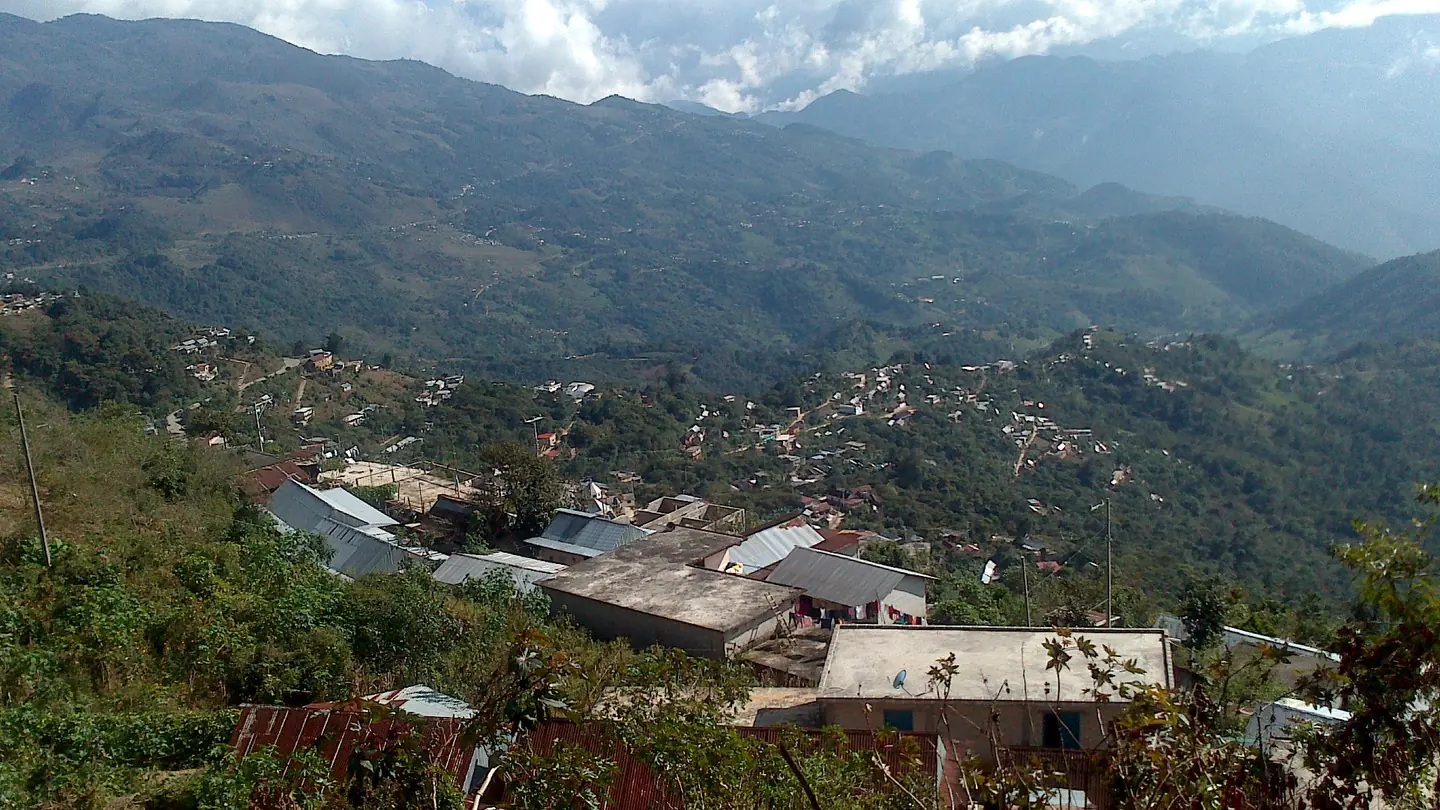
Share the institutions’ original posts and catalogue links. We found no open licence for republishing the programme, film or video. For copies or excerpts, consult Radio UNAM’s copying conditions, Filmoteca’s material requests or Fonoteca’s audio permissions. The 1958 archive remains on HOLD for reuse. The landscape photograph has its own licence in the caption.
AkashicENHANCE³ · Editorial Checks
After the Bronze rerun, this editorial review made three changes. The attribution check identified which 1956 passage the authors translated. The interpretation check kept Sabina’s understanding of the speaker separate from what the studies measured. The reading check named the question the testimony can answer and labelled the two sets of sources by their scope.
The original review records carry the earlier publication number, 024C4. This inquiry is now the third companion to AkashicINQUIRY024.
Ultimate Question
What would it take to study a voice as an experience, a relationship and a possible source of knowledge while giving each question the evidence it needs?
With gratitude to María Sabina, Álvaro Estrada, Mazatec speakers and collaborators, the Andrade family and the researchers and archivists credited above.