

AkashicINQUIRY024 · 25 November 2026 · 6–7 min read
María Sabina & the Book of Wisdom
What does it mean to read a book you cannot touch? María Sabina’s account begins with a vision and returns to the spoken word. Her recorded chant lets us hear that language in her own voice.
AkashicABSTRACT
In her oral history recorded by Álvaro Estrada, the Mazatec healer María Sabina describes seeing a book in a vision and discovering that speaking was how she read it. This inquiry reads that account alongside her recorded chant, translations and a museum film excerpt. The sources illuminate how she understood language and healing, and show how translation and archival context shape what later readers can hear and understand.
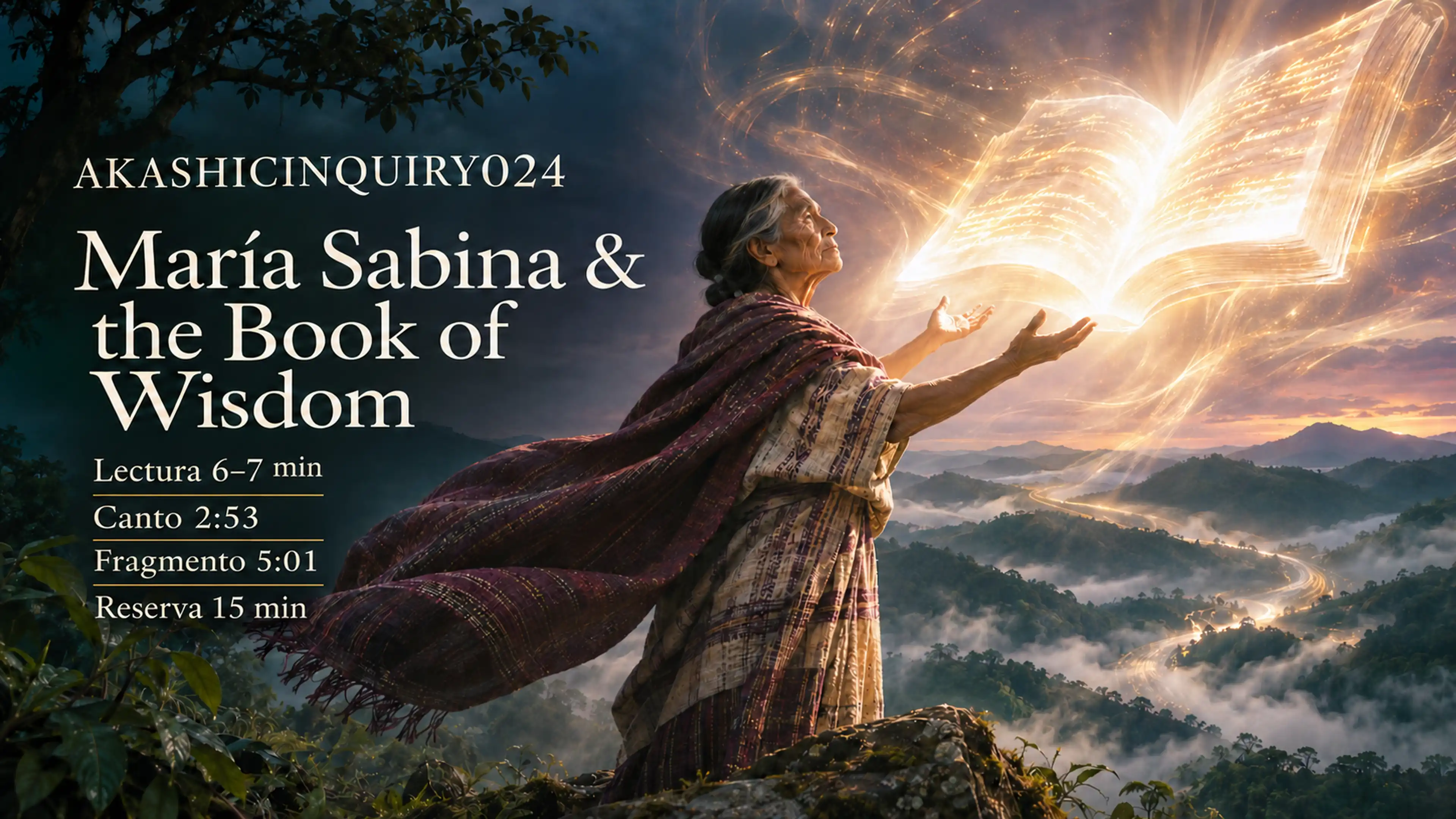
Time to Read, Watch & Listen
Read the inquiry and play both Sabina recordings in about 14–15 minutes.
| Activity | Time |
|---|---|
| Read the inquiry and source notes | About 6–7 min |
| Listen to Chjon Nka | 2 min 53 sec |
| Watch the museum film excerpt | 5 min 1 sec |
The Book of Language
In the oral history she gave to the Mazatec writer Álvaro Estrada, Sabina described a radiant white book that grew to the size of a person. One of the beings she called the Principal Ones entrusted it to her. She could see it and feel the urge to touch it. Her hands met nothing. When she began to speak, she understood that she was reading.
«La Sabiduría es el Lenguaje. El Lenguaje está en el Libro.»
“Wisdom is Language. Language is in the Book.”
Sabina describes receiving words that she could use in her work as a healer. The line makes sense alongside the action of the scene. She finds out what it means to read the book by speaking. Read Estrada’s Spanish text quoted in José Enrique Hernández Assemat’s thesis, p. 161 and Henry Munn’s English translation, pp. 21–22.
A Chant in Three Languages
This line comes from a recorded velada, a night-time ceremony. Estrada’s account of the book is a separate source. Its published versions here are in Spanish and English.
- Huautla Mazatec · Original
- Chjon spiritu jña, tso
- Spanish · Published Translation
- Mujer espíritu soy, dice
- English · AkashicNET Rendering
- “I am a spirit woman,” says the voice.
The line ends with tso, meaning “says”. The grammar leaves room for a voice to be heard without naming the speaker.
Chant by María Sabina, recorded in 1956. Mazatec transcription and Spanish translation by Santiago Cortés Martínez and Alessia Frassani, TRACE 90 (2026), p. 21. The article carries a CC BY-NC-SA 4.0 licence. The English line is an editorial rendering from Spanish.
Follow All Eight Lines
Open the complete Mazatec and Spanish excerpt on printed page 21. These bilingual listening notes follow the published lines in order, including the two repetitions.
| Line | Nota en Español | English Note |
|---|---|---|
| 1 | Se nombra a través del llanto. | She introduces herself through weeping. |
| 2 | En la siguiente imagen aparece el silbido. | The next image brings in the sound of whistling. |
| 3 | Su voz toma la fuerza del trueno. | Her voice takes on the force of thunder. |
| 4 | El sonido se prolonga como un estruendo. | The sound carries on as a rumble. |
| 5 | Aquí aparece la identidad espiritual citada arriba. | Here she invokes the spirit identity quoted above. |
| 6 | Vuelve la imagen inicial del llanto. | The opening image of weeping returns. |
| 7 | Invoca a Jesucristo en primera persona. | She invokes Jesus Christ in the first person. |
| 8 | Repite esa identificación con otra forma del nombre en la transcripción. | The identification repeats with another form of the name in the transcript. |
In lines 1 and 6, Sabina weeps. In line 3, she thunders. Explore the imagery in The Woman Who Weeps and the Sky That Thunders, an illustrated reading of the chant.
Watch & Listen
María Sabina · Chjon Nka · 2:53
The complete issued track corresponding to the chant excerpt above. Recorded in Huautla de Jiménez by Valentina P. Wasson and R. Gordon Wasson in July 1956. Folkways Records, 1957. Official upload supplied by Smithsonian Folkways Recordings, catalogue FW08975_101.
The player connects to YouTube only after you select Load Chant Audio. You can also use the direct link.
Listen on YouTubeCantos de María Sabina · Museum Film Excerpt · 5:01
From María Sabina, mujer espíritu, directed by Nicolás Echevarría. Centro de Producción de Cortometraje, courtesy of Secretaría de Cultura and IMCINE. Excerpt edited by Claudio Mercado and published by the Museo Chileno de Arte Precolombino.
Open Source ↗Blue Streak Episode 2 · Mushrooms & Glossolalia · 1:12:34
Hosted by Klea McKenna and produced by Lux Natura and SpectreVision Radio. The episode brings together a 1977 Hawai‘i field recording, journal reflections and an excerpt from Terence McKenna’s 1991 lecture on mushrooms and human evolution.
The player connects to YouTube only after you select Load Video. You can also use the direct link.
Watch the Official Lux Natura UploadBlue Streak Episode 2 · Podcast Audio · 1:13:38
Klea McKenna, host. Lux Natura and SpectreVision Radio, producers. Audio from the publisher’s podcast feed.
Open Source ↗The players connect to their providers when selected. For copying or editing a recording, use the rights contacts below.
Optional Listening & Viewing
Peter Bergmann made the 2016 True Hallucinations film and makes music as We Plants Are Happy Plants. For the memoir, La Chorrera timeline and film context, open the True Hallucinations deep dive.
| Activity | Time |
|---|---|
| Hear McKenna’s 1993 Sabina passage | 2 min 10 sec, from 1:07:40 Full workshop · 3 hr 8 min 45 sec |
| Hear “The World Is a Labyrinth” We Plants Are Happy Plants featuring Terence McKenna | 6 min 54 sec |
| Listen to the Smithsonian Folkways album on Spotify | About 42 min |
| Watch Blue Streak Episode 2 on YouTube | 1 hr 12 min 34 sec |
| Listen to Blue Streak Episode 2 (MP3) | 1 hr 13 min 38 sec |
| Filmoteca UNAM listing for María Sabina, Mujer Espíritu | Film · 80 min |
| Listen to the True Hallucinations soundtrack playlist on Spotify Curated by We Plants Are Happy Plants | About 1 hr 51 min |
| Watch Bergmann’s full True Hallucinations film on YouTube | About 2 hr 48 min |
| Sample or borrow the True Hallucinations audiobook | Full audiobook · 9 hr 16 min |
Connections Across the Record
- A recorded connection · 11 September 1993, around 1:07:40. In The World and Its Double, McKenna recalls listening to Sabina’s voice and recognising the repeated “says” ending from his own remembered experience. The comparison is his recollection. Her wording can be checked in the Mazatec transcription above.
- A calendar echo · 21 July, thirty years apart. Folkways’ liner notes date the recording to the night of 21–22 July 1956. In a letter dated 27 May 1986, McKenna asked to visit R. Gordon Wasson on 21 July 1986. The published correspondence records the request and Wasson’s reply. The proposed date fell exactly thirty years after the first night.
- 1975 · Two records take shape. Estrada began interviewing Sabina in September 1975 and continued into August 1976. In 1975, Terence and Dennis McKenna published The Invisible Landscape. The books emerged from separate projects. Follow the interview dates in the earlier AkashicNET feature.
- 13 and 64 · Numbers with different histories. In a separate 1958 chant, Sabina invokes thirteen shirts and thirteen pairs of trousers. Cortés Martínez and Frassani discuss the clothing and the number in their Mesoamerican context. The McKennas examined the sequence of 64 hexagrams of the I Ching in their 1975 book.
What do we learn by placing two accounts beside one another, then following each back to the people, language and setting that gave it meaning?
The Monk on the Roof · Source Trail
The roof sketch in the 7D Field Notebook leads to Two Visions of the Sacred. The adjacent notebook section opens the 7D Structure Lab, where the sketch brings three questions together.
- Terence McKenna · Imagination and narrative. Compare his 1993 recollection above with the 1999 Whole Life Expo talk cited in Two Visions. The McKennas Archive also connects family interviews, the documentary and further reading. The 1991 lecture uses “to grok this” in the segment beginning at 25:18. In the related 1970 study by Roland Fischer and colleagues, the measured outcome was perceived space.
- Dennis McKenna · Ethnopharmacology and inquiry. The lab links Dennis’s Purdue biographical record. The university’s MSP 213 collection lists the circa-1971 La Chorrera report and selected digitised papers.
- María Sabina · Mazatec healing and ceremony. The lab links a Smithsonian catalogue record for the 12–13 July 1958 ceremony. Harvard follows Estrada’s testimony in its essay on Mazatec healing and the Book of Language.
Archive Addendum · Huautla, Harvard and the Recordings
On 13 May 1957, LIFE published R. Gordon Wasson’s account of the night of 29–30 June 1955. The opening presents the visiting banker to American readers and refers to Sabina by the name “Eva Mendez”. Set it beside Sabina’s account of the Book of Wisdom. LIFE archive, from p. 100 · AkashicINQUIRY024C2 · Reading the LIFE Spread.
Marcos García de Teresa’s 2019 ethnography traces the María Sabina festival back to a local arts collective in 1998. Its festival section begins on printed p. 173. A later footnote points to Wasson’s correspondence and field diaries at Harvard Herbaria. INAH-hosted thesis · Harvard finding aid.
The finding aid lists the 1956 recording behind Folkways’ 1957 release separately from the 12–13 July 1958 field recordings associated with the Smithsonian’s 1974 publication. It gives distinct access terms for the archives. Read the Source Atlas highlights and full citation trail.
Books & Recordings
María Sabina
- English print and ebook. María Sabina: Selections, edited by Jerome Rothenberg, includes Munn’s English translation of the oral history and selections from recorded chants. University of California Press · Foyles.
- Spanish print. Álvaro Estrada’s Vida de María Sabina: La sabia de los hongos. Siglo XXI Editores México · Casa del Libro.
- Hear the recorded chant. The complete track Chjon Nka (2:53) is supplied by Smithsonian Folkways. Its 1957 album catalogue lists the other issued tracks, also available as an album on Spotify. UNAM’s trilingual edition gives selections from the 1958 ceremony. These are archival recordings and transcriptions. The book listings above give print or ebook editions.
Terence McKenna
- English and Spanish print. True Hallucinations is available from Bookshop.org UK. Pablo López Pavillard’s Spanish translation, Alucinaciones reales, is listed by Agapea.
- English audiobook. Tantor Media’s unabridged edition, read by Al Kessel, runs 9 hours 16 minutes. Apple Books · Google Play Books · NYPL OverDrive.
Archives, Credit & Reuse
Background photograph by Alan Rockefeller · Laccaria squarrosa in San José del Pacífico, Oaxaca · CC BY 4.0 · cropped and blended for this page.
Smithsonian Folkways distributes the 1956 recording and handles requests to reuse its audio. Harvard’s Wasson collection guide lists the 1958 recordings and its reading-room access rules.
Purdue University holds the Dennis and Terence McKenna papers. The independent Archiving Terence McKenna site credits Wasson’s archivist Mark Hoffman as the holder of the letters it reproduces. The Library of Consciousness hosts the 1993 talk. These pages can be shared by link. Lux Natura, McKenna’s family partnership, handles permissions for reuse of his work.
For longer book excerpts, ask UC Press about the English translation or Siglo XXI Editores about the Spanish edition. A reusable illustrated portrait credits Oieusouary, Wikimedia Commons, CC BY 4.0.
The museum film excerpt is presented through the museum’s Vimeo player. Ask the rights holder about republication. The TRACE article and the portrait carry their own Creative Commons licences.