

AkashicINQUIRY024C1 · Companion to AkashicINQUIRY024 · 25 November 2026 · 4 min read
María Sabina and the Book She Spoke
María Sabina recalled seeing a book she could not touch. It stopped appearing in later visions, she said, once she remembered what it contained. What does that tell us about sacred language, and how far can we take a comparison with the Akashic Records?
When Reading Became Speaking
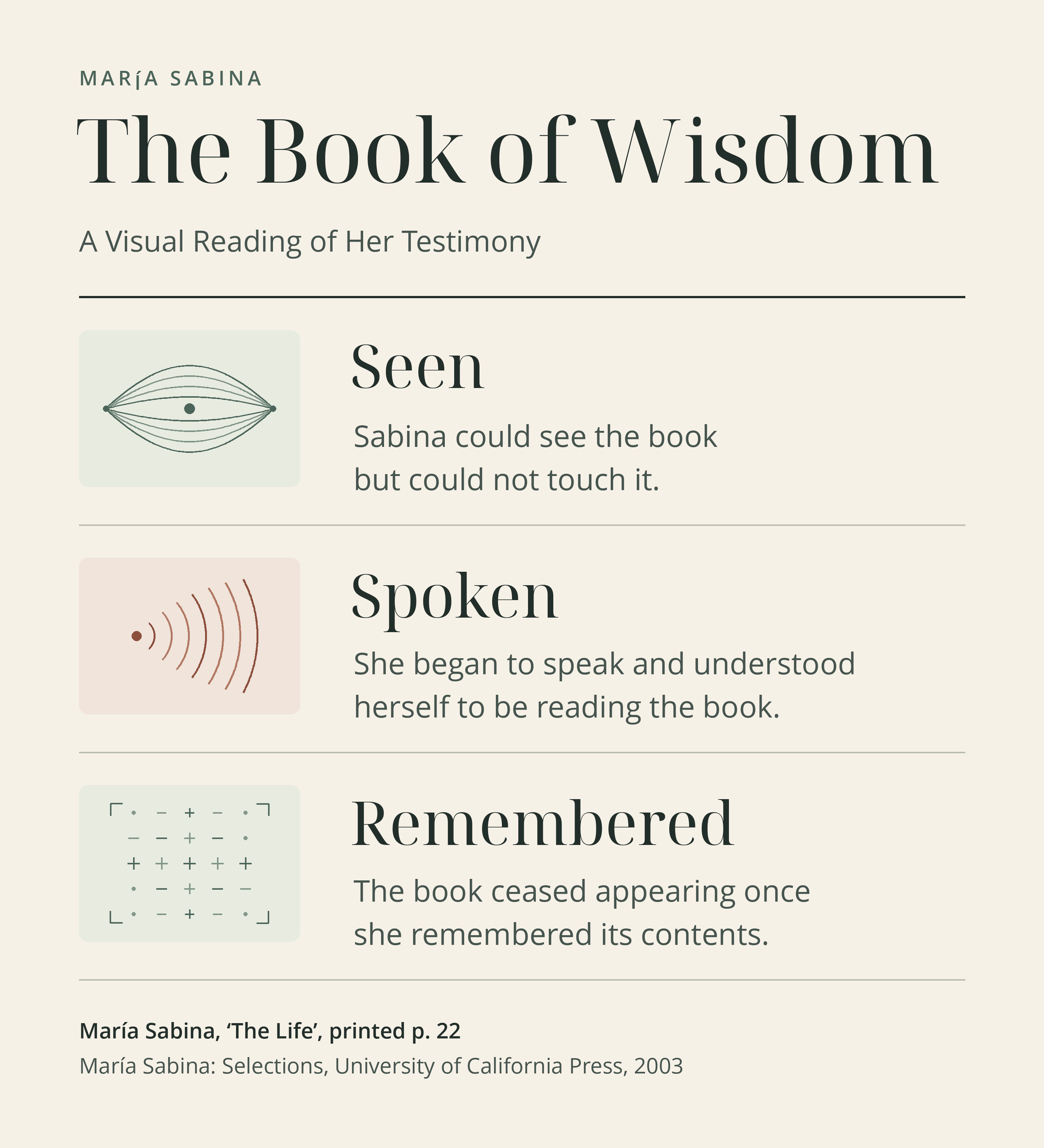
In her oral autobiography, the Mazatec healer María Sabina tells of tending to her sister María Ana. Afterwards, she recalls seeing figures she recognised as the Principal Ones her ancestors had spoken of. An immense book appeared, and one of the figures offered it to her for her work. She saw it clearly. Her hands met no surface. As she contemplated it, she began to speak and understood her speaking as reading the book. The Life, printed pp. 20–22
“Wisdom is Language.” That is how Henry Munn’s English translation renders Sabina’s formulation. The remembered sequence gives the line its force. She sees the book, speaks and later says she carries its contents in memory. After that, the book itself ceases to appear in her later visions. In the story she tells, a book that can only be seen becomes a language she can speak and remember. The Life, printed p. 22
Wisdom in the Work of Care
The episode begins with a sister in need. It matters that the book is given to Sabina for her work. Scholar Osiris Sinuhé González Romero reads this knowledge as relational, grounded in Sabina’s understanding of the mushrooms, her particular role and the work of healing. In a separate essay, Mazatec poet Juan Gregorio Regino describes spoken language as a way his people preserve memory and sustain relationships with the sacred. His perspective gives the English reader a way to think about the scene’s movement from seeing to speaking within a living tradition. Both accounts are rooted in particular speakers and contexts. González Romero · Regino, translated by Jerome Rothenberg
Where the Akashic Records Comparison Leads
The Sanskrit ākāśa has a history of its own. In some classical Indian philosophical accounts, it names ether, understood as the medium of sound. The modern Akashic Records concept took shape much later in Theosophy, which adapted the term. In Clairvoyance, first published in 1899, the Theosophist C. W. Leadbeater proposed that trained clairvoyants could recover scenes from the distant past. The Edgar Cayce tradition presents a related idea. Cayce’s Association for Research and Enlightenment describes his Book of Life as a record of individual thoughts and deeds that he claimed to consult for guidance. Classical Indian philosophy · Alex Nash on the term’s history · Leadbeater, ch. VII · Cayce’s A.R.E.
The comparison works as an analogy about how knowledge is encountered without a physical text. The traditions give that knowledge different purposes and reach. For Leadbeater it is a record of past events. For Cayce it provides guidance through a record of individual lives. In Sabina’s account, the book gives her a language for the work she is called to do. The resemblance belongs to a reading across sources. Each image has its own history. The Life, printed pp. 21–22 · Hanegraaff on Theosophical imagination
What the Evidence Can Establish
The autobiography documents what Sabina recalled and how she understood it. In a different setting, controlled psilocybin research has measured reports of mystical-type experiences and personal meaning. A questionnaire used in that research measures, among other things, the felt quality of encountering a fundamental truth. Whether someone can reliably retrieve independently verifiable information they could not otherwise know is a separate empirical question. The studies cited here measured reported experience, and Sabina’s account gives no independently scored retrieval test. Griffiths et al., 2006 · Barrett et al., 2015
By the end of Sabina’s account of the vision, the book has disappeared and the language stays with her. The enduring part of her story is what she could carry into her work with others.
Sources and Further Reading
The passage comes from María Sabina’s oral autobiography, set down with Álvaro Estrada and translated into English by Henry Munn. The separate 1974 edition of the velada performed on 12–13 July 1958 is documented here through catalogue metadata. University of California Press edition · Smithsonian catalogue · SIL México catalogue
AkashicINQUIRY024 · María Sabina & the Book of Wisdom · AkashicRECORDS · The Continuity Inquiry
Full Bibliographic Source Note
Passage. Sabina, María, with Álvaro Estrada. “The Life.” Translated by Henry Munn. In María Sabina: Selections, edited by Jerome Rothenberg. University of California Press, 2003. ISBN 9780520239531. Printed p. 20 gives the setting of her sister María Ana’s illness. The vision begins on printed p. 21 and the seeing, speaking and remembering sequence is on printed p. 22, the 20th page of the publisher’s excerpt PDF. “Wisdom is Language.” is the article’s sole direct quotation from testimony, checked against the wording, capitalisation and punctuation of Munn’s English translation on p. 22. Publisher’s edition · Printed p. 22 in the excerpt
Transmission. Sabina told the life story that fellow Mazatec Álvaro Estrada set down and arranged. Vida de María Sabina: La sabia de los hongos appeared in Spanish with Siglo XXI Editores in 1977. The Selections source notes on printed p. 203 credit Munn’s English translation, first published in María Sabina: Her Life and Chants (Ross-Erikson, 1981). Jerome Rothenberg edited the 2003 collection. The English line above is cited in that translation. 1977 edition, Indiana University catalogue · 1981 edition, WorldCat
Separate archival record. María Sabina and Her Mazatec Mushroom Velada. Compiled by R. Gordon Wasson with contributions from George M. Cowan, Florence H. Cowan and Willard Rhodes. Ethnomycological Studies 3. Harcourt Brace Jovanovich, 1974. The publication documents a velada led by Sabina at Huautla de Jiménez on the night of 12–13 July 1958. The AkashicNET registry identifies Smithsonian Libraries and Archives record siris_sil_1117373, catalogued as Maria Sabina Sings Her Mazatec Mushroom Velada. siris_sil_784767 is a related Smithsonian catalogue entry for the 1974 edition. The recording made in 1956 that appears on the existing inquiry is a separate Folkways release, issued in 1957. The 1974 edition is cited here for its archival provenance. The autobiographical passage is independently sourced to the UC Press edition. Registry-matched Smithsonian catalogue entry · Related Smithsonian entry · SIL México bibliography · Folkways release
Reuse and cultural context. AkashicNET’s 10 September 2026 source registry marks SRC-SI-MARIA-SABINA-1974 as METADATA_ONLY_HOLD and records CC0 for the catalogue metadata. This companion uses a catalogue link and bibliographic facts. Its artwork uses original abstract shapes, and its text discusses the autobiographical scene through paraphrase and one short, credited line. Community authority over the circulation and uses of living ceremonial knowledge is a separate consideration from archival access. Celidwen and colleagues offer Indigenous-led guidance on this principle. AkashicNET source registry · Celidwen et al., The Lancet Regional Health – Americas 18, 100410 (2023)
- Regino, Juan Gregorio. “The Poet Speaks, the Mountain Sings . . .” Translated by Jerome Rothenberg. In María Sabina: Selections, pp. 191–193. University of California Press, 2003. The cited portion is Regino’s discussion of memory, the spoken word and the sacred. Translator’s copy of the talk · Mexico’s Secretaría de Cultura author record
- González Romero, Osiris Sinuhé. “Psilocybe Mushroom Rituals.” Center for the Study of World Religions, Harvard Divinity School, 9 July 2026. The companion attributes the relational interpretation to González Romero and uses Sabina’s autobiography for the event sequence. Essay
- Stanford Encyclopedia of Philosophy. “Epistemology in Classical Indian Philosophy,” §4, “Perception.” Alex Nash, “The Akashic Records: Origins and Relation to Western Concepts,” Central European Journal for Contemporary Religion 3, no. 2 (2019), 109–124, posted online 2 October 2020. Wouter J. Hanegraaff, “The Theosophical Imagination,” Correspondences 5 (2017), 3–39, especially §8. These sources distinguish classical philosophical usage from the modern esoteric concept. Stanford Encyclopedia · Nash · Hanegraaff
- Leadbeater, C. W. Clairvoyance, first published 1899, ch. VII, “Clairvoyance in Time: The Past.” Edgar Cayce’s Association for Research and Enlightenment, “Akashic Records,” including reading 1650-1. Each source documents how its own tradition characterises the Records. Leadbeater, Cambridge edition · Chapter text · Cayce’s A.R.E.
- Griffiths, R. R., W. A. Richards, U. McCann and R. Jesse. “Psilocybin Can Occasion Mystical-Type Experiences Having Substantial and Sustained Personal Meaning and Spiritual Significance.” Psychopharmacology 187 (2006), 268–283. Barrett, F. S., M. W. Johnson and R. R. Griffiths. “Validation of the Revised Mystical Experience Questionnaire in Experimental Sessions With Psilocybin.” Journal of Psychopharmacology 29, no. 11 (2015), 1182–1190. The companion draws on the measures of reported experience and meaning. Griffiths et al. · Barrett et al.