AkashicINQUIRY024C4 · 27 November 2026 · Listening Companion
When Two Chants Say “I”
Hear a line from María Sabina’s night vigil in Oaxaca alongside a Vedic hymn in which Speech takes the first person.
In Huautla de Jiménez, María Sabina sang a line that moves from “I am” to “says” in a breath. In the opening verse of Rigveda 10.125, “I” comes back five times. Listen for where each tradition puts the voice.
Listen to Both Passages
Huautla Mazatec · Oaxaca · July 1956
María Sabina’s “Chjon Nka”
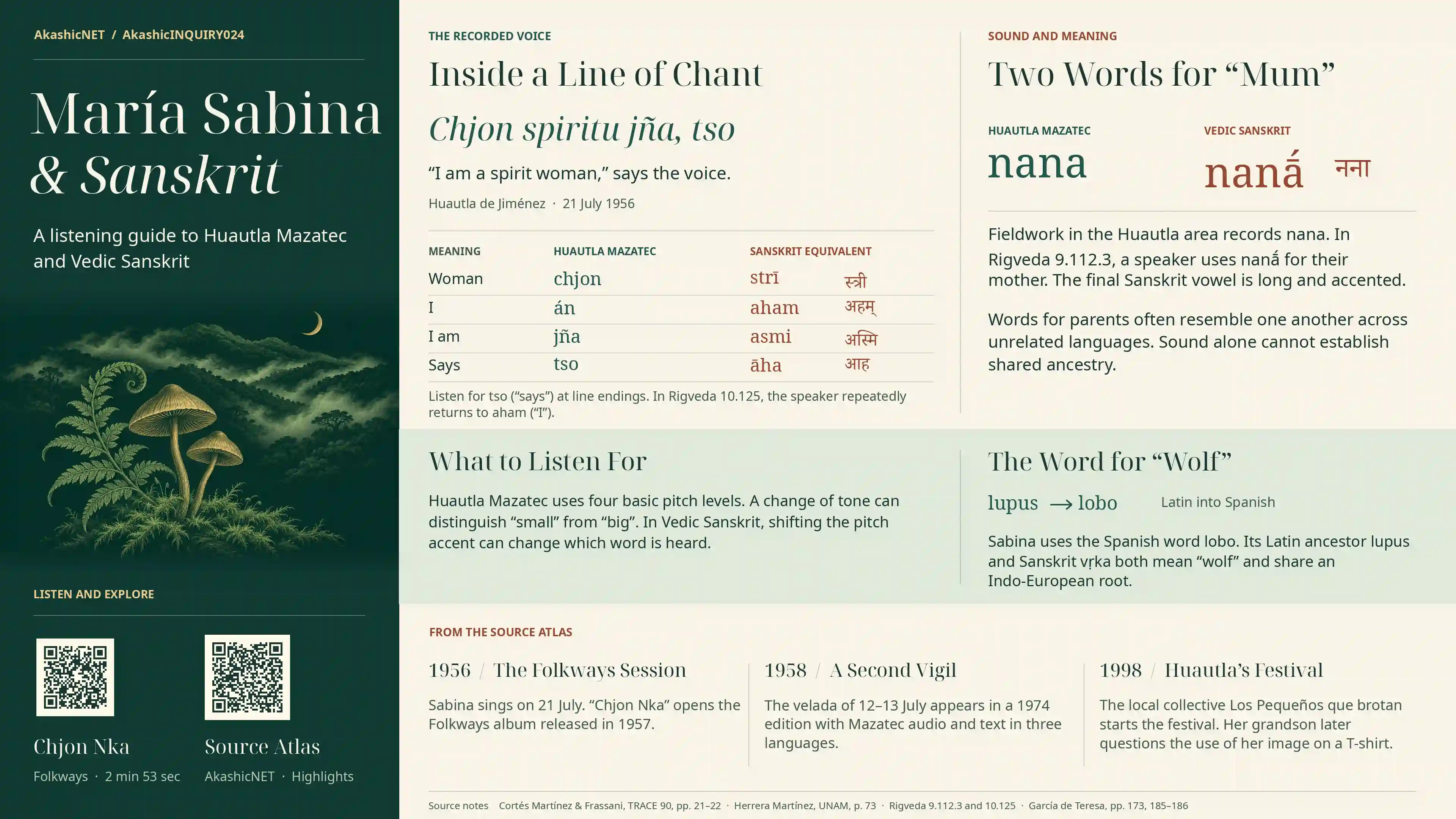
Chjon spiritu jña, tso
“I am a spirit woman,” says the voice. English rendering via Spanish.
Follow the eight lines transcribed by Santiago Cortés Martínez and Alessia Frassani. Six begin with chjon, “woman”. The images change as Sabina weeps, whistles and thunders. In the last two lines she opens with án, “I”.
What stays the same across all eight lines?
Each ends in tso, “says”. The quotation has a voice, but the word leaves its speaker unnamed. Hearing the ending recur gives a different rhythm to the English “I am”.
The player connects to YouTube only after you select Load Chjon Nka. You can also use the direct link.
Start with verse 1. The first person returns as the speaker travels with the gods and declares whom she sustains. Tradition identifies her as Vāc, Speech personified. The hymn itself leaves her name unstated.
Where are the five instances of “I”?
Follow the transliteration of verse 1. Two occur on the first printed line and three on the second. Look for both ahaṃ and aham. Both forms mean “I”.
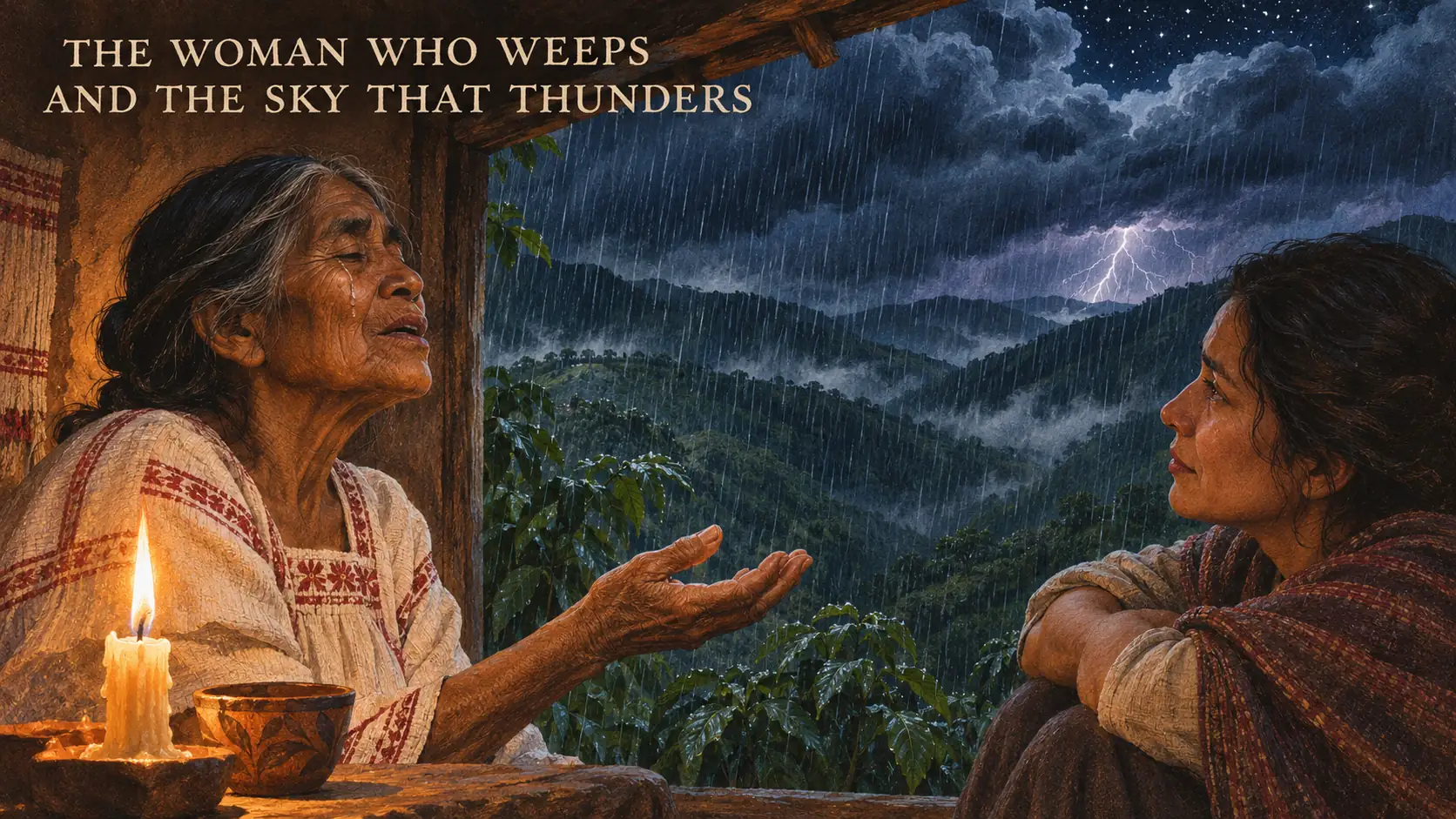
An imagined night vigil in the Sierra Mazateca. AI-generated illustration inspired by Sabina’s chant.
Listen again to the first, third and sixth lines of Chjon Nka. Sabina is the woman who weeps, then the woman who thunders. When the weeping returns, does it sound different to you? Santiago Cortés Martínez and Alessia Frassani hear rain in her tears and thunder in her cries. They describe a healer using her voice to help the person who has come to her. Read their transcription and interpretation, pp. 21–22.
If you hear kindness here, listen for whom she is singing to. If you hear something cosmic, listen for the moment a human voice takes on the scale of the weather. In Rigveda 10.125, the voice expands as Speech herself says “I”. These are ways of hearing two performances. Linguistics offers no measure of a language’s kindness or its distance from the cosmos.
In Agua Flor Fría, in the municipality of Huautla de Jiménez, Silvia Herrera Martínez recorded nana as mamá. A poet in Rigveda 9.112.3 uses nanā́ for their mother while describing the family’s work. The final Sanskrit vowel is long and accented. The Mazatec fieldwork spelling leaves tone unmarked.
Family speech offers a reason for the resemblance. Children and adults in many unrelated language communities use syllables such as na and ma for parents. A claim of common ancestry would need recurring patterns across many other words.
In the transcription of a different vigil, the one held in 1958, Sabina calls herself a wolf woman. The word for wolf in that line is Spanish lobo. Its Latin ancestor, lupus, and Sanskrit vṛka share an older Indo-European word for wolf.
Here the two words sound quite different, yet their history can be followed. Hearing Spanish inside a Mazatec line also tells us something about Sabina as a poet. The language available to her included words from more than one tradition.
This is the night behind “Chjon Nka”. Folkways issued the recording in 1957. The short track gives a reader a way to hear the voice that the printed transcription follows.
12–13 July 1958
A second vigil became the basis for the 1974 edition with Mazatec recordings, a musical score and translations. The two releases preserve distinct performances.
1998, Huautla
Local arts collective Los Pequeños que brotan initiated the festival honouring Sabina. Marcos García de Teresa later documented her grandson asking who had authorised her image on a festival T-shirt.