
Inside the knowledge commons · 23 September 2026
My K9
Infrastructure.
Where the data goes: from a source record to an analysis file, and from a saved file to your screen. A view of AkashicNET’s current workflow.
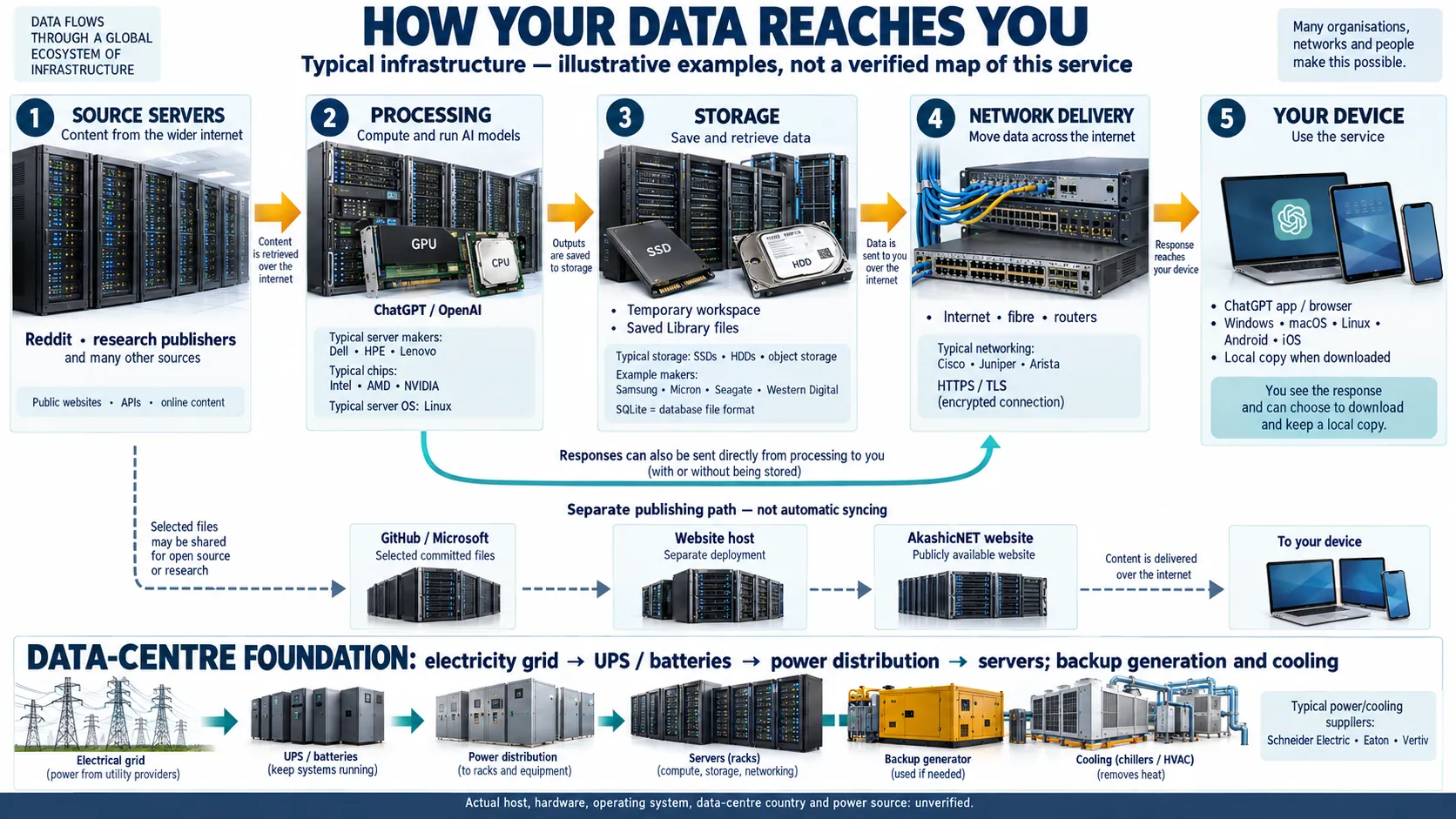
Follow the data
- 01
Source records
Available posts, papers and other sources are reviewed. An inaccessible link stays unresolved; an identifier alone is not a completed read.
- 02
Analysis
Working notes separate source identity, DOI and publication details, topics, claims, limitations and review status. Shared sources are tracked so reposts do not become independent evidence.
- 03
Saved records
Explicit saves preserve reports, the reading ledger and PRISM database files in ChatGPT Library. Selected records are separately committed to GitHub.
- 04
Publication
Selected public material is prepared and deployed through ChatGPT Sites. A saved report or GitHub commit does not automatically update the website.
- 05
Your screen
A response or saved file can reach you directly through ChatGPT. A published article reaches your browser through the website. Downloading creates a separate copy on your device.
What “saved” means here
The temporary working environment holds files while analysis is being performed. Its directory paths identify working locations, not a country, building or particular disk. Temporary files can disappear; they are not the durable record.
ChatGPT Library holds explicitly saved copies of the report, reading ledger and PRISM SQLite database file. SQLite is a database engine and file format: it is not a hosting company or a physical storage device. The database file can be copied between systems; SQLite may also use journal files during transactions. SQLite documentation.
GitHub holds selected versioned records and draft changes. Library, GitHub and the website can therefore contain different versions. A successful save, a commit and a successful website deployment are separate events, each needing its own receipt.
The current software layers
| Service or technology | Role in this workflow | Boundary |
|---|---|---|
| OpenAI · ChatGPT Work and Library | Analysis workspace and explicitly saved files. | Saving a working file does not publish it. |
| GitHub · Microsoft | Selected source files, review records and version history. | The public repository is separate from the Sites publishing repository. |
| ChatGPT Sites · OpenAI | Manages the public AkashicNET site and its releases. | Publication is a distinct deployment step. |
| React, Next.js APIs and Vinext / Vite | The inspected website source uses these application and build layers. | These are software tools, not physical hosting locations. |
| Cloudflare-compatible runtime; D1 and R2 bindings | The site configuration declares a database binding and an object-storage binding. | Declarations do not establish that the analysis ledger or PRISM file was imported into either service. |
| Your browser or ChatGPT app | Displays responses, saved-file links and published content. | A downloaded copy is separate; apps and browsers may also retain cached data. |
The physical layer beneath the software
Software ultimately runs on computers with processors, memory, network interfaces and storage. An illustrative data centre might combine Dell, HPE or Lenovo servers; Intel, AMD or NVIDIA processors; and flash or disk storage from makers such as Samsung, Micron, Seagate or Western Digital. Linux is an example server operating system. These examples are not supplier claims about this deployment.
Networking equipment carries data between systems. HTTPS uses TLS to protect a connection in transit; it does not identify where a file is stored, certify the content’s accuracy or determine who may access a saved copy. Cloudflare’s HTTPS explanation.
Power distribution, batteries or uninterruptible power supplies, backup generation and cooling support typical data-centre operation. Schneider Electric, Eaton and Vertiv are illustrative equipment suppliers. Electricity consumption and cooling requirements depend on the actual facility and workload; no energy-per-query estimate or renewable-energy claim is made here. U.S. Department of Energy: data centres and servers.
What remains unknown
This review has not established the physical disk, server model, data-centre address or country holding each copy; the underlying cloud subcontractors for every stage; or the power source and retention arrangements for this specific workflow. A brand example, domain name or directory path cannot answer those questions.
To verify them would require current provider documentation and account-level configuration or contractual information. The workflow described here is a configuration snapshot, not a complete network trace or an audit of every stored copy.
Fibre on land, cables under the sea
Between a data centre and your device, traffic may travel through several operators’ networks. Fibre-optic links carry signals as light. Terrestrial links connect buildings, cities and network exchanges; submarine fibre cables connect landing stations across seas and oceans. A local or cached response may not cross an ocean at all.
Google’s Dunant system, built with SubCom, is a documented example of a transatlantic submarine cable. It illustrates the separate roles of a network investor or operator and a cable manufacturer and installer. It does not establish that AkashicNET traffic uses Dunant or Google’s network. Google’s Dunant account.
Possible terrestrial route: server → data-centre network → terrestrial fibre → submarine cable if needed → internet provider → home router or mobile network → device. Requests travel towards servers and responses return; the two directions need not take identical routes.
Where satellites can fit
Satellite broadband can provide an access or backhaul segment, especially where wired infrastructure is limited. SpaceX’s Starlink is one example: user terminals communicate with satellites, and the network can use ground gateways and optical links between satellites. Satellite service still connects with terrestrial internet infrastructure. Starlink’s 2024 technical report.
Possible satellite route: device → router and satellite terminal → satellite network → ground gateway → terrestrial internet → service. The satellite segment is optional; there is no evidence from this review that this session or the website’s traffic used one. Satellites and undersea cables are not mandatory consecutive stages.
Fabless design is a supply chain, not a data hop
A fabless semiconductor company designs chips while contracting wafer fabrication to specialist manufacturers. NVIDIA provides a familiar chip-design example; TSMC provides a foundry example. Manufacturing also involves packaging, testing and assembly before chips enter a server, networking device or personal computer. TSMC’s foundry overview and NVIDIA’s company history describe these roles.
Hardware supply chain: chip design → wafer fabrication → packaging and testing → equipment assembly → deployment. This happens before the hardware processes a request. It is not a route through which a user’s analysis data routinely travels. No specific foundry, fabrication site or chip model has been verified for this workload.