NASA · Moon Base phases
NASA describes a sequence from early robotic missions to infrastructure and habitats. Each phase adds dependencies. A roadmap sets direction and supplies no operating record for a completed base.
Agency source
 AKN24
Page Language · Google Translate
AkashicSPACE002 · 27 November 2026
A power controller trips near the lunar south pole. Which decisions can wait for Earth, which belong to the crew and which must a machine make in half a second?
AkashicABSTRACT · The proposal
The Artemis Lunar Surface Autonomous Coherence Architecture (ALSACA) began as a community requirements brief published on 26 May 2026 in r/NeuronsToNirvana. It proposes 30 Earth days of critical operations without direct Earth assistance, distributed control without a central point of failure and autonomous fault detection, isolation and recovery. Dust, thermal extremes, vacuum, radiation and impacts are part of its operating environment. NASA-style describes the document format. The requirements belong to its community author. Original N2N brief · AkashicNET archive record.
AkashicAUDIT · Timing correction
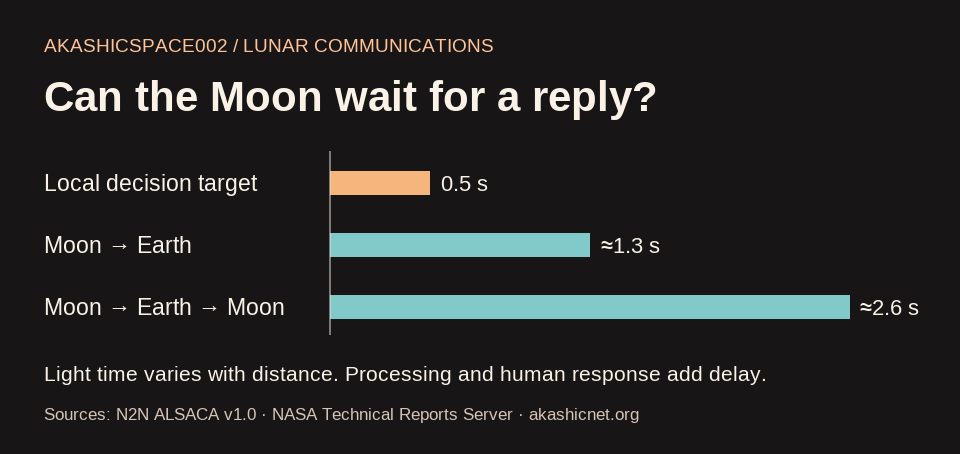
The brief lists 1.3 seconds as a round-trip lower bound. Near the mean Earth–Moon distance, light takes about 1.3 seconds each way. Even an immediate reply arrives roughly 2.6 seconds after transmission. Equipment, routing and human decisions add time. NASA has also studied operational scenarios with 3–14 seconds of one-way delay. A delayed connection eventually carries a command. During a blackout there is no delivery time to count on. NASA lunar communications report · NASA surface operations latency study.
A proposed 500-millisecond local decision deadline expires before a signal from the Moon could even reach Earth.
AkashicLEDGER · Source atlas
NASA describes a sequence from early robotic missions to infrastructure and habitats. Each phase adds dependencies. A roadmap sets direction and supplies no operating record for a completed base.
Agency sourceAn electrodynamic dust shield cleared dust from glass and thermal radiator surfaces on the Moon. A base would still need evidence for seals, joints and repeated exposure over its operating life.
Agency sourceThe 700-square-metre test floor holds about 900 tonnes of lunar simulant. Crews can rehearse movements, tools and handovers on difficult terrain. Vacuum, radiation and prolonged lunar gravity require separate evidence.
Agency sourceSLIM resumed communication after three lunar nights. Contact was last established on 28 April 2024. Survival of one uncrewed lander is evidence about that spacecraft and cannot establish continuous operation of a crewed habitat.
Agency sourceAkashicNEXUS³ · Component, base and crew
A controller can report that it isolated a failing branch while the habitat still loses an essential load. Two redundant controllers can share a bad sensor or power feed. Even when the hardware responds correctly, the crew needs to see which loads are protected, who has authority and what action is reversible.
Replay the same workload under nominal contact, delayed contact and a complete communications outage. Inject a grid fault into each run. Repeat with a shared sensor failure. Preserve timestamps, command authority and load status so a reviewer can reconstruct the outcome.
The brief targets local decisions within 500 ms, grid fault isolation within 2 s, recovery initiation within 5 s and state reports at least every 5 s. It also targets at least 95% successful task allocation under delay. Define the task denominator and count dropped tasks. Record time to restored service separately. A system can begin recovery on time and still fail to restore the load.
AkashicSPIRIT · Crew authority
During the rehearsal, give the crew a second fault while an automatic recovery is underway. Ask them to identify the active hazard, explain the controller’s action and demonstrate a safe handover. Log confusing displays, conflicting commands and times when a crew member cannot regain control. Hazard response takes priority over routine tasks in the community brief.
AkashicFUTURES · AkashicVISION · AkashicSTATE
In a favourable scenario, a local controller isolates the fault and the crew maintains critical services throughout the outage. In a harder scenario, a common power loss disables both the controller and its backup. An independently repeatable, integrated 30-day trial with published failure logs, crew interventions and resource margins would move the architecture beyond a paper proposal. The sources above document individual capabilities. Integrated ALSACA performance remains unverified. The tests described here are proposals.