
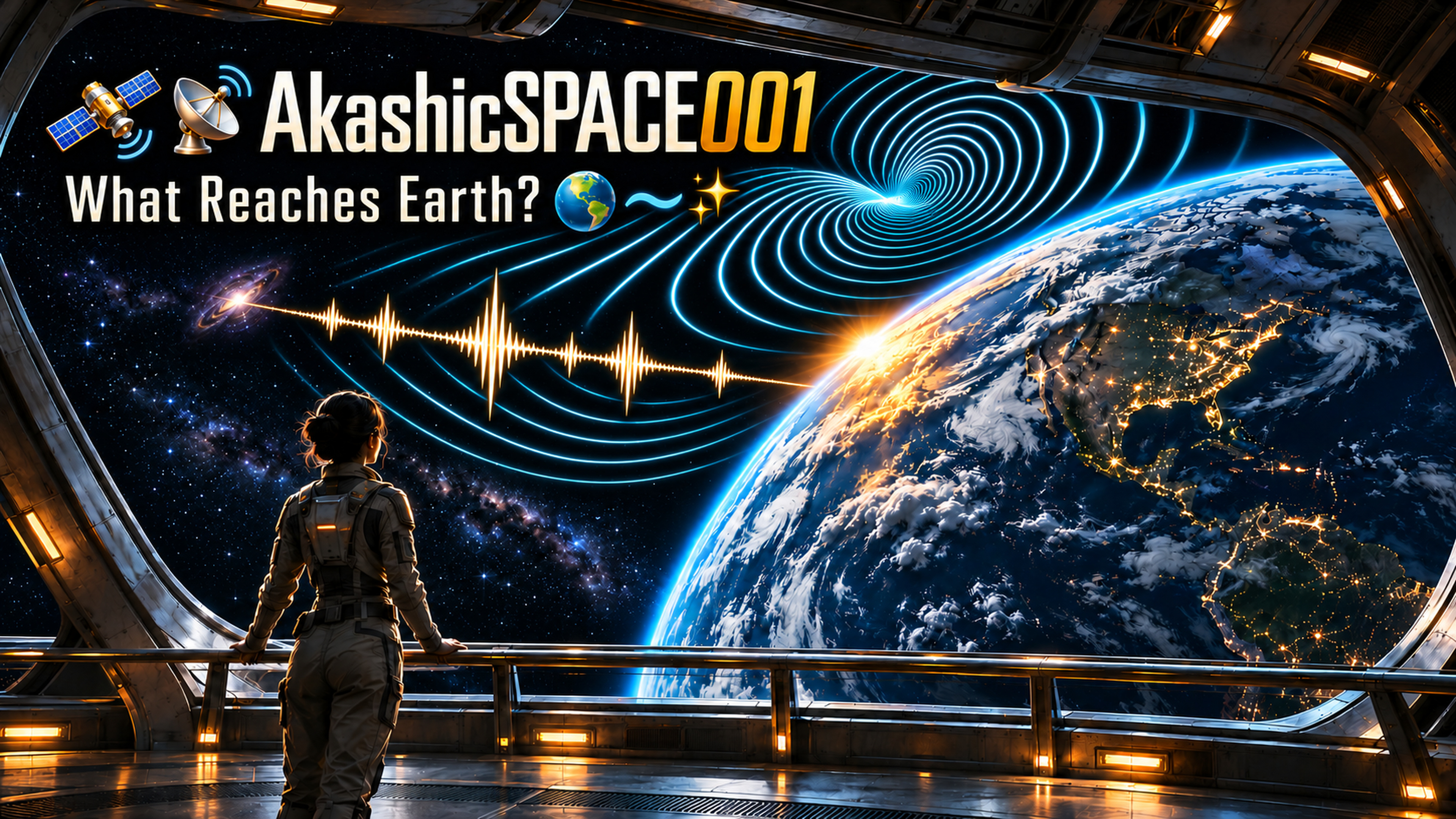
What Reaches Earth?
A photon reflected by the Moon arrives in little over a second. A ripple from two merging black holes took more than a billion years. What, exactly, do our instruments receive?

Astronomical observations
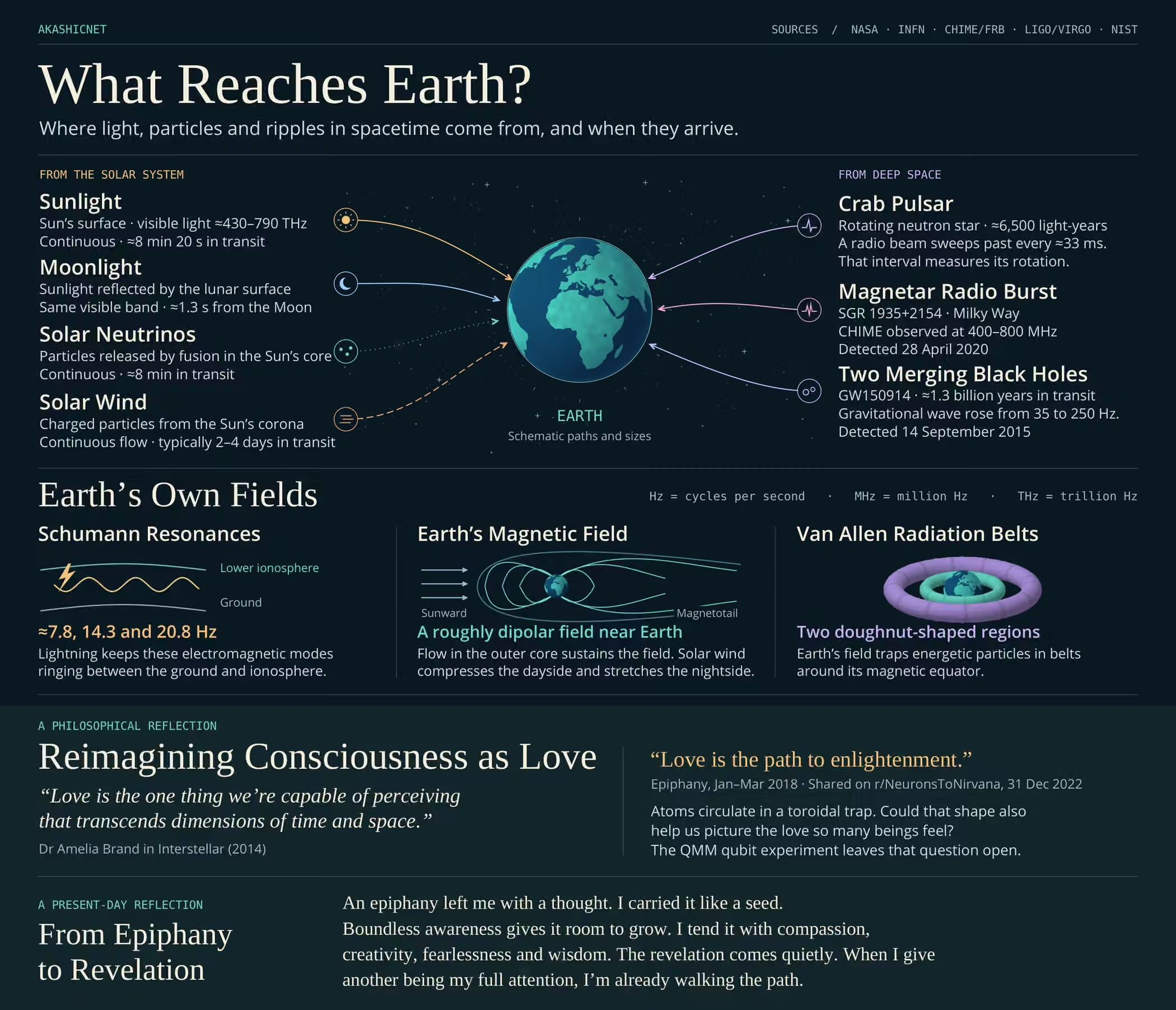
Seven Signals Arriving at Earth
Sometimes the number beside a signal tells us how long it travelled. Sometimes it tells us how often it repeats. A date records when an instrument detected it.
From the Solar System
- Flight time≈8 min 20 s
Sunlight
Light leaving the Sun’s visible surface takes just over eight minutes to reach Earth. Our eyes pick up a narrow part of the solar spectrum, roughly 430–790 trillion cycles per second.
- Final leg≈1.3 s
Moonlight
Visible moonlight is sunlight reflected by the lunar surface. Its journey includes the trip from the Sun to the Moon, then a little over a second from the Moon to Earth. The warm surface also gives off its own infrared radiation.
- Flight time≈8 min
Solar neutrinos
Nuclear fusion in the Sun’s core produces a continual stream of neutrinos. These particles interact so weakly with matter that they can escape directly from the core and reach Earth at nearly the speed of light.
- Typical transit2–4 days
Solar wind
The Sun’s outer atmosphere releases a continual flow of charged particles. Faster and slower streams take different amounts of time to reach Earth’s magnetic environment.
From Deep Space
- Pulse interval≈33 ms
Crab pulsar
A rotating neutron star about 6,500 light-years away sweeps its radio beam past us around 30 times a second. The pulse interval measures the rotation. The radio waves inside each pulse oscillate far faster.
- Detected at Earth28 Apr 2020
Magnetar radio burst
CHIME detected a millisecond radio burst from SGR 1935+2154, a highly magnetised neutron star in the Milky Way. Its receiver covered 400–800 MHz. The bandwidth, burst duration and detection date each describe a different feature of that observation.
- Detected at Earth14 Sep 2015
Merging black holes
After travelling for roughly 1.3 billion years, the gravitational wave GW150914 reached LIGO. As the two black holes spiralled together, the frequency of the measured ripple in spacetime rose from about 35 to 250 Hz.
Reading the measurements
Frequency, Energy and Vibration
Before assigning a frequency, ask what is repeating. A swinging pendulum, the electric field in a light wave and the beam of a spinning pulsar all give different answers.
What Is Oscillating?
A frequency counts cycles per second, measured in hertz (Hz). A mechanical vibration is a repeated motion of matter. Light can cross a vacuum because its electric and magnetic fields oscillate. A gravitational wave changes relative distances as it passes.
For a photon, energy increases with frequency according to E = hf, where h is Planck’s constant. Violet light carries more energy per photon than red light. A brighter red beam can deliver more energy each second simply by delivering more photons.
What Changes on the Journey?
In the Solar System, a longer path adds travel time. Light spreading over a larger area grows dimmer. Motion towards or away from the observer can shift the frequency we measure through the Doppler effect. The Sun–Moon–Earth angle changes how much of the Moon’s sunlit face we see.
Light already carries information about its source. A spectrum can reveal which atoms absorbed particular wavelengths. In a quantum communication experiment, a scientist can also encode a qubit in a photon’s polarisation. Evidence for an encoded solar or lunar message would require a defined encoding and a repeatable way to recover it. Ordinary sunlight and moonlight on their own provide no such evidence.
Closer to home
Earth’s Own Fields
Schumann Resonances
Lightning excites electromagnetic waves in the cavity between the ground and the lower ionosphere. Its lowest resonance peaks lie near 7.8, 14.3 and 20.8 Hz. Conditions in the cavity cause the peaks to shift slightly.
The Geomagnetic Field
Moving, electrically conducting fluid in Earth’s outer core sustains a field that resembles a dipole near the planet. Farther out, the solar wind compresses the dayside of the magnetosphere and stretches the nightside into a long tail.
The Van Allen Belts
Earth’s magnetic field traps energetic charged particles in two main doughnut-shaped regions around its magnetic equator. Here the torus describes the shape of a particle population.
A philosophical reflection
Reimagining Consciousness as Love
“Love is the one thing we’re capable of perceiving that transcends dimensions of time and space.”
A Shape to Think With
In a laboratory, ultracold atoms can flow around a ring-shaped trap. In 2007 researchers at NIST and the Joint Quantum Institute observed such a persistent flow. The torus gives the curator a shape with which to imagine love spreading between beings. That step belongs to the reflection.
The 2026 Quantum Memory Matrix study asked a different experimental question. Across five IBM quantum circuits the authors tested imprinting and retrieval by comparing output bits with their inputs. The study supplies no measurement of love or consciousness.
The Archived Epiphany
The curator dates the thought Love is the path to enlightenment.
to January–March 2018. The earliest public account located in r/NeuronsToNirvana is dated 31 December 2022. Later posts revisit the recollection. Read the curator’s dated field note on how “path” became “force”.
A present-day reflection
From Epiphany to Revelation
An epiphany left me with a thought. I carried it like a seed. Boundless awareness gives it room to grow. I tend it with compassion, creativity, fearlessness and wisdom. The revelation comes quietly. When I give another being my full attention, I’m already walking the path.
The illustrated field guide
Explore the Poster