Independent Book Concept · In Development
The Science of Mysticism
Consciousness, Contemplation and the Search for Evidence
Can we honour profound experience while remaining curious about its explanation? An exploration of consciousness, evidence and the willingness to revise what we believe.

Reading Guide · Expanded Drafts
Chapter Summaries & Read Times
About 41 min across the working and proposed chapters and their on-page notes, at 220 words per minute. Open the longer draft within each chapter to continue reading. Linked reading is separate.
Chapter IAbout 3 min 45 sec
When Experience Feels Like Knowledge
Asks why an experience can feel like knowledge and how to examine a claim separately from the feeling of certainty.
Chapter IIAbout 3 min 15 sec
When the Self Grows Quiet
Explores how attention, memory and bodily awareness might change when the familiar sense of self quietens.
Chapter IIIAbout 3 min 15 sec
When Wonder Moves the Body
Looks at what music and bodily sensations such as chills can tell us about experiences of wonder.
Chapter IVAbout 3 min 15 sec
When Coincidence Becomes Meaning
Uses a diary to put striking coincidences alongside ordinary days and expectations that went unmet.
Chapter VAbout 3 min 15 sec
Who Speaks When a Thought Arrives?
Separates how a thought arrives, whether it is accurate, what it changes and where it might have come from.
Chapter VIAbout 3 min 15 sec
Many Languages of the Sacred
Asks how cultural traditions and research methods shape the language people use for sacred experiences.
Chapter VIIAbout 3 min 30 sec
After the Extraordinary
Follows what happens after a powerful experience, including difficulties and changes in everyday care.
Chapter VIII · ProposedAbout 4 min 45 sec
Different Doors, Similar Experiences
Compares reports of unity and altered self-boundaries across meditation and psychedelics, with attention to context.
Chapter IX · ProposedAbout 2 min 30 sec
The Experience of Returning
What near-death accounts can tell us about experience and change, and what a survival claim would need to show.
Chapter X · ProposedAbout 2 min 30 sec
What a Place Holds
Uses the Joshua Tree reflection and HIERATIC019 to examine how place, ritual and later interpretation shape a testimony.
Chapter XI · ProposedAbout 2 min 30 sec
When a Number Travels
Follows the telephone-study correction into a wider question about how extraordinary claims get quoted, tested and revised.
Chapter XII · ProposedAbout 3 min 30 sec
A Memory of What?
Follows a recalled thought into human remembering, holographic information and a proposed extension to the Quantum Memory Matrix hypothesis.
Chapter XIII · ProposedAbout 2 min 30 sec
What We Make Room For
Connects awareness and compassion to practical choices about participation, accessibility and shared dignity.
Chapter One · Working Draft
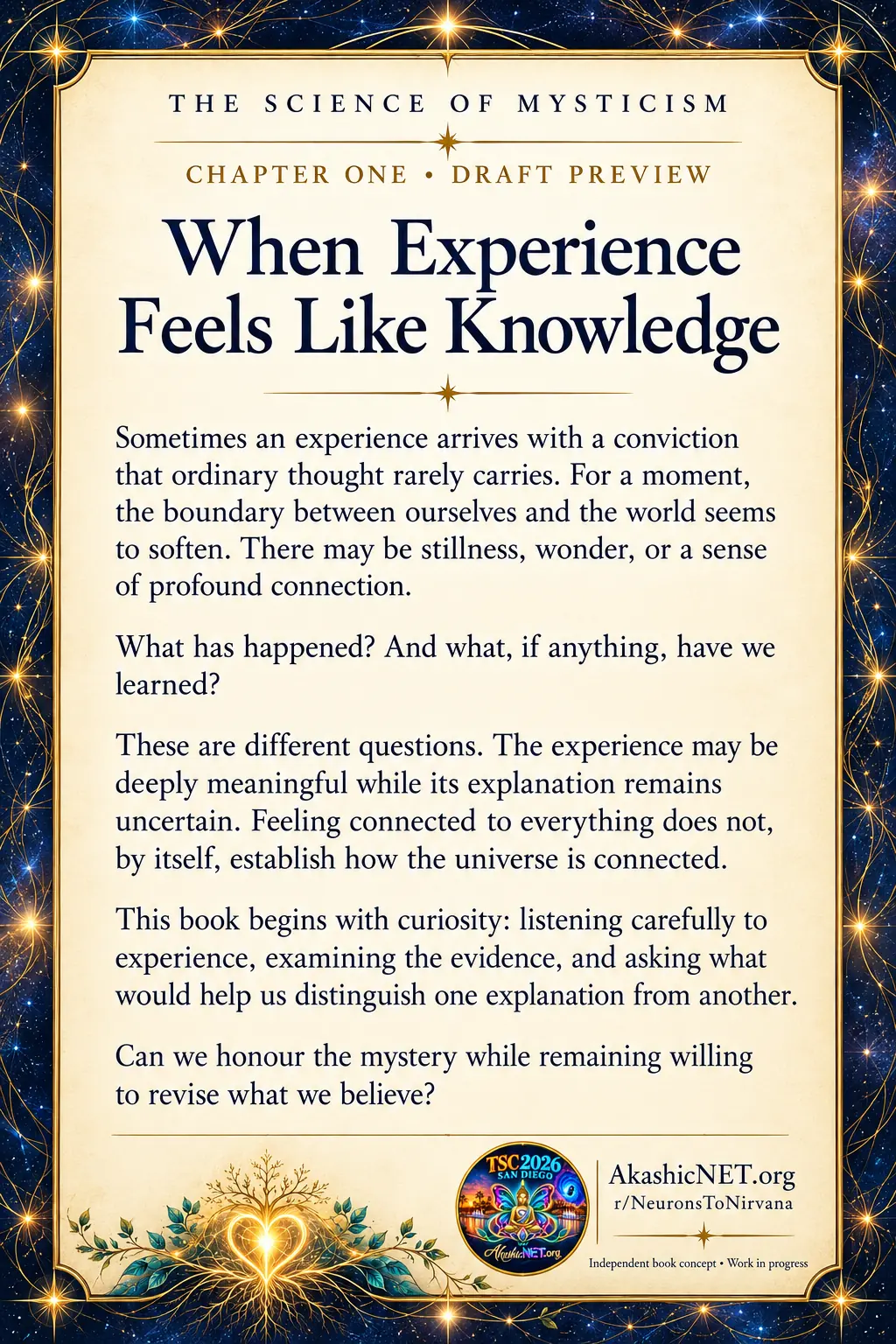
When Experience Feels Like Knowledge
Sometimes an experience arrives with a conviction that ordinary thought rarely carries. For a moment, the boundary between ourselves and the world seems to soften. There may be stillness, wonder, or a sense of profound connection.
What has happened? And what, if anything, have we learned?
These are different questions. The experience may be deeply meaningful while its explanation remains uncertain. Feeling connected to everything does not, by itself, establish how the universe is connected.
This book begins with curiosity: listening carefully to experience, examining the evidence, and asking what would help us distinguish one explanation from another.
Can we honour the mystery while remaining willing to revise what we believe?
Examining Felt Certainty · Research-Informed Draft Addition
Some experiences arrive with an unusual feeling of certainty. Something seems known before we can explain how we know it.
That feeling is itself available for study. We can ask how intense it was, how long it lasted and whether it changed someone’s life. We can then examine any specific claim it produced. The conviction belongs to the experience; the claim still needs its own evidence.
The Feeling of Finding Out
Imagine leaving a concert with the conviction that you have understood something about your place in the world. What could you write down that evening? The scene, the bodily feeling and the thought that came with it are worth recording in their own words. A few days later, you might recognise an insight about how you had been living, or realise that you had filled in some of the details afterwards.
Those records give us two ways to follow the experience. We can ask what the conviction meant and how it changed a decision. If it included a specific claim about the world, we can also ask what would count as independent support or make us revise it. Each question gives the experience a different kind of attention.
Read the longer draft of Chapter I
Three Sentences in a Notebook
Consider three entries someone might make after a powerful evening. ‘For a minute the distinction between the room and me seemed to disappear.’ ‘I felt sure that everything was connected.’ ‘I decided to call a friend I had been avoiding.’ The first describes a change in experience. The second records a conviction and hints at a claim that would need to be made more precise. The third describes a decision we could follow. A good account has room for all three sentences.
At first these statements may feel inseparable. On a second reading we can ask what each one would require. The person can describe how the room appeared and how certain they felt. If the friend agrees to talk, the two can say what changed between them. A claim about the structure of reality needs a way to distinguish it from other explanations. The notebook gives those questions a common starting point without making them carry the same weight.
What a Measure Can Tell Us
A questionnaire brings some order to a difficult conversation. Two people who struggle to describe an event can answer the same questions about it. Barrett, Johnson and Griffiths examined how such responses could be grouped and interpreted in laboratory psilocybin studies. A score can summarise what someone reported and be compared with what they report later. That makes the experience available for research even where its meaning remains personal.
The circumstances in which an instrument has been studied matter. A question asked after a laboratory session may be understood differently after a vigil, an unexpected experience in nature or years of contemplative practice. A researcher who wants to use it in a new setting can first ask what people think each question means. An interview might reveal distinctions that a fixed response scale leaves out. The scale and the interview can then show where they converge and where they diverge.
What Would Let Us Revise the Story?
Keep the earliest account and add later reflections with their dates. On the first day, write the experience as concretely as possible. A week later, ask which parts stayed clear, which words have changed and what conversations took place in between. Revision can be informative. We may see the difference between what was felt at the time and the story through which it became understandable.
If a conviction leads to a small act of care, follow what happens. If it leads to a claim that can be checked, say what result would count against it and leave space to record that result. Some convictions will remain philosophical or spiritual commitments. Others become questions that evidence can help answer. The first discipline of this inquiry is to give each kind of statement the care it asks for.
Research behind this addition
Barrett, Johnson and Griffiths (2015) validated the MEQ30 using 184 participants across five laboratory psilocybin experiments. Scores were associated with later reports of meaningfulness and positive changes. The questionnaire measures reported experience, not the truth of apparent revelations. This validation does not automatically establish equal validity across all traditions or spontaneous experiences.
The Book Taking Shape
Further Doors into the Inquiry
Each working draft begins with a short opening. The longer sections develop that opening through examples, evidence questions and connections to the next chapter. The accompanying notes identify the sources and their limits.
Chapter II · Working Draft
When the Self Grows Quiet
What remains when the familiar sense of ‘me’ becomes less insistent? Some people describe spaciousness; others, a loss of boundaries or an unsettling absence. Similar words can conceal different experiences. Before turning a moment of unity into a theory of everything, we can ask what changed: attention, memory, bodily awareness, or the way the experience was later told. A careful description is already a beginning. It gives wonder a shape we can examine without deciding too quickly what it means.
Which Part of the Self Grew Quiet?
We use ‘self’ for several things. There is the body that seems to be here, the sense that I am the one choosing what to do and the story through which I recognise my life. During an absorbing piece of music, the story may recede while the body feels unusually present. Another person might use the same word, ‘selflessness’, to describe a loss of agency they found unsettling.
An interview could begin with concrete questions about position, movement, choice, memory and emotion before asking how the person makes sense of it. What did you still know about where you were? Did the change feel welcome? Preserving differences of this kind would give a comparison more to work with than a shared label.
Read the longer draft of Chapter II
The Person in the Room
Imagine a pianist absorbed in playing. There may be little inner commentary about how the performance is going, yet the player still knows where the hands are, hears the other musicians and can choose to slow down. Imagine someone else saying they felt absent during an unfamiliar experience and could barely tell where their body ended. Both might later describe a quiet self. Their accounts point to changes in different parts of what we ordinarily gather under that word.
For the purposes of a conversation, we can ask about bodily location, the sense of owning a sensation, the ability to initiate an action and the story that runs through thought. These are working distinctions. A person may experience them together and use entirely different language for them. The task is to find what their words refer to before deciding how an account fits a category.
Let the Interview Start With the Event
‘Were you still aware of the chair under you?’ gives an interviewee a particular event to recall. ‘Did your ego dissolve?’ gives them a theory to agree with or reject. A careful interview can ask what was happening just before the change, which sensations were vivid, what became difficult and whether the person welcomed it. Their own interpretation has a place once there is a description to interpret.
The naturalistic DMT interviews cited with this chapter show one way to work with detailed reports. A set of interviews can make variations visible and help researchers form better questions. Recruitment and setting determine whose experiences enter the record. A sample of people who chose to describe an unusual event can offer a rich vocabulary while leaving open how common each experience is among other people.
A Comparison That Could Surprise Us
Imagine comparing reports gathered after a piece of music, quiet rest and a meditation session. Ask the same open questions, keep the interviewer’s prompts consistent and record how familiar people were with each activity. A second reader could group anonymised descriptions before being told which activity produced them. Keep a record of disagreements between readers. The labels should be allowed to change when they fail to capture what people said.
Perhaps reports from different activities cluster around a quieter inner narrative. Perhaps they separate according to comfort or the strength of bodily sensation. Either outcome would tell us what this comparison captured. An unexpected answer may be a sign that the original question was too broad. When someone says their self grew quiet, our next question can be a generous one. What did you notice was still there?
Sources & questions behind this preview
Selected AkashicOMNI perspectives: AWAKEN · TRANSCEND · #METAD
N2N’s nondual brief supplies community interpretations, not universal categories. A naturalistic DMT interview study offers descriptions of altered self-experience; its selected sample does not represent everyone or independently establish an external reality.
Chapter III · Working Draft
When Wonder Moves the Body
A piece of music reaches its turning point. The skin tingles; the chest seems to open. For one listener this is pleasure, for another a glimpse of the sacred. The body belongs in our account of mysticism, but its signals do not arrive with an explanation attached. We can study the timing of a shiver, the setting, the expectation and the meaning given to it. What might those observations reveal—and what would remain beyond the measurement?
Listening for the Turning Point
Imagine a room hearing the same track. One person feels chills when the bass returns, another at an unexpected silence and a third notices little until they see the crowd move. Each could mark the moment, describe the sensation and say what it meant to them. The sound, the social setting and the listener’s expectation give us distinct questions.
A listening study could compare a familiar passage with an unfamiliar one and collect time-stamped reports. Its design would have to account for volume, preference and the possibility that looking for chills changes what people notice. A dance study would add exertion, other dancers and movement artefacts. We could learn how a bodily response arises while leaving room for the different meanings people give it.
Read the longer draft of Chapter III
Where the Music Turns
Picture two listeners at the same set. One knows the track well enough to anticipate the return of the bass. Another has never heard it and notices the people around them begin to move. One remembers a rush across the shoulders, the other a sudden sense of belonging. A third listener may be moved during a quiet passage when everyone else is waiting. The turning point might be in the recording, the room or the listener’s relationship with both.
A chapter about musical awe can start by giving each description a time and a place. Was there a chill, a feeling of warmth or a change in how the room appeared? Did it come as the music built or after a silence? Was the listener sitting, dancing or watching someone else? The names people give these moments matter, and the sequence can help a researcher ask why some moments stand out.
Following a Feeling With a Measurement
Salimpoor and colleagues used brain imaging to examine intensely pleasurable music. Their findings distinguished dopamine-related activity during anticipation from activity around peak emotion. This gives a reader something specific to consider. The moments leading up to a passage and the moments when it arrives can play different roles. It also gives an experiment a well-defined question about timing and a particular kind of pleasure.
A study in a different setting would have to say which part it was trying to reproduce. People dancing will move their muscles and change their breathing. Measurements can reflect those changes alongside anything related to attention. If the question is about a brief chill, a quiet listening task and a time marker might be a useful first step. If the question concerns shared movement and belonging, the room and the other dancers become part of the design.
The Meaning of a Shiver
In one version of a listening study, participants could hear unfamiliar music and a piece they chose themselves. Record their expectations before each track. Afterwards ask which moments they would describe as pleasurable, moving or sacred, leaving room for people to decline those words. The same clip might carry very different histories. A result that appears only in familiar music would give us a different question from one that appears during unfamiliar passages as well.
Outside a study, two people can listen together and ask each other which moment stayed with them. One may describe a musical detail and the other a memory. There is something to learn from the difference before trying to put both accounts under one name. The body can mark a moment with extraordinary clarity. What that moment becomes may depend on the life in which it lands.
Sources & questions behind this preview
Selected AkashicOMNI perspectives: HOMESENSE · UMASC · CUT Present
AkashicNET’s discussion of music, chills and contemplative joy motivates the question. Salimpoor and colleagues measured dopamine release during music-related pleasure. This does not make musical chills and contemplative pīti identical, or establish detection of a cosmic field.
Chapter IV · Working Draft
When Coincidence Becomes Meaning
A coincidence may become a turning point before we understand why it happened. A song, a message or an unexpected meeting can reorganise the story we tell about our lives. A diary gives that story a second perspective. Alongside the remarkable matches, we can record ordinary days, expectations that went unmet and changes in attention. Meaning remains part of the account, while memory gains something against which it can be checked.
A Diary With Room for the Misses
Suppose a friend calls minutes after you think of them. Start by recording the thought and the call in their actual sequence. Then record the quieter days too: how often you thought about that friend, how often a call came and which thoughts passed without a match. Regular conversations and shared routines can make a particular meeting of events less unexpected than it first seemed.
For a prospective test, decide what counts as a match and how long the window lasts before looking at the results. Keep those rules when the examples are less striking. A diary can help separate what made a coincidence personally important from what would let us assess whether events coincide more often than expected.
Read the longer draft of Chapter IV
How Many Chances Did the Match Have?
Suppose you think of a song while walking home and hear it in a shop a few minutes later. It feels as if two worlds touched. Before asking how unlikely the encounter was, ask how many songs you thought about that day and how many places could have played one. Perhaps the song was popular that week. Perhaps hearing it yesterday made it easier to recall today. Those details change the comparison we need to make.
This becomes harder when the match is loosely defined. A line from a song, a similar title or a word spoken by a stranger might all feel like an answer. Each possible match adds another way for a striking event to happen. A diary kept before the outcome helps preserve the starting point. It also gives us a record of similar thoughts that passed quietly without an event to make them memorable.
A Diary as a Research Design
Choose a narrow question before beginning. For example, if you record that you expect a particular friend to call today, state which kinds of contact count and when the day ends. Keep the original prediction, the outcome and any reason the friend might have been likely to contact you. If you later notice a broader pattern, record it as a new question for the next diary period.
Try the same rule on days when you made no prediction, or compare the recorded sequence with time windows shifted away from the original ones. Choose the comparison to preserve ordinary patterns where possible. A weekend and a weekday may give quite different chances of a call. The point is to ask whether the original matches stand out against a reasonable account of everyday activity.
What Meaning Can Do
The studies linked with this chapter asked about reported coincidences and creative activity. Those measures describe what people noticed and reported in a particular research setting. They can raise questions about attention, curiosity and what people do with a surprising connection. Whether some events occur together more often than an appropriate comparison predicts is a separate question, calling for a different kind of record.
A coincidence can mark the moment you decided to visit someone, finish a project or ask a better question. The decision and its consequences are worth describing in their own right. Sometimes a diary will make a striking match easier to explain and a personal turning point will remain. Sometimes an unusual record will justify a careful follow-up. Both possibilities give the experience a place in a larger story.
Sources & questions behind this preview
Selected AkashicOMNI perspectives: AWAKEN · #METAD · CUT Present / Future
The Ozora ‘sign’ and TSC2026 synchronicity reflections are personal narratives. The Ozora post was accessed through the site’s description, not its full Reddit text. These examples justify questions about interpretation; they do not establish an external sender. Rominger and colleagues (2024) report three studies with final samples of 69, 93 and 80. Study 1 found a correlation between reported coincidences and creative activity (r = .35), but not every creativity measure showed an association. This does not establish causation or an external organising force. Figures are reported from the paper, not independently recalculated.
Chapter V · Working Draft
Who Speaks When a Thought Arrives?
Some thoughts feel made; others seem received. An unexpected sentence can carry a calm authority, as though it came from somewhere beyond our ordinary deliberation. That feeling deserves a careful hearing. Yet the felt arrival, the accuracy of the message, its usefulness and its proposed source are four different questions. We can explore each without forcing the others to agree. What could we check independently? What alternatives remain? And how should uncertainty shape the next decision?
Keeping the Thought and Its History
A thought can arrive complete. Later we may recall a conversation that gave it shape, or remain unsure where it came from. If it feels like guidance, record the original words, the time and the circumstances before discussing what they might mean. A remembered phrase, an ordinary cue and a genuinely surprising match deserve separate entries when we can distinguish them.
A private prompt to call a friend can be useful even when its origin stays open. A claim to have acquired specific information invites a different approach. Set down the exact claim before checking it, account for what the person could already have known and retain the misses. A source attribution should depend on what the design can distinguish.
Read the longer draft of Chapter V
When the Source Is Part of the Experience
Imagine a phrase arriving during a quiet walk. Its wording is vivid and the person feels that they received it. In an interview we might ask whether it sounded like a voice, appeared as words or arrived as a thought with a particular tone. How it seemed to arrive belongs in the account. An explanation of where the words came from is another question, even when the sense of a source was central to the moment.
The proposed source can change as a person thinks it through. An image may at first seem entirely new. Later they remember seeing a similar image earlier in the week, or a friend suggests another way of understanding it. Keeping the earlier account alongside the later one makes the change visible. It also gives the person a way to say which parts they remember clearly and which they are trying to reconstruct.
Give Each Question Its Own Record
The AkashicOMNI review method used here asks about experience, accuracy, usefulness and source. Suppose a person feels prompted to check on a neighbour. The feeling of being prompted is part of the experience. Whether the neighbour needed help can be checked in conversation. A visit might be useful even if the impression was mistaken. Understanding where the prompt came from would require evidence that can distinguish different accounts of its origin.
This helps us avoid asking one result to do four jobs. Someone may be right about a detail and mistaken about why it came to mind. A message may be moving and hard to check. A gesture of care may have helped even when the thought that prompted it cannot be traced. Each outcome can be reported in the terms the evidence allows.
A Test That Gives the Reader a Fair Chance
If a person reports obtaining specific information, write down the target, prediction and scoring rules before checking the answer. Where possible, keep the person who records the response apart from the person who knows the target. A judge could compare the original response with several plausible targets without knowing which one was chosen. Record misses and ambiguous responses alongside hits and decide in advance when the series will end.
A striking result in one series would make a repeat with independent oversight valuable. A repeat under conditions that better rule out information leakage could change how we read the first series. Even an accuracy result would leave the question of mechanism open. This is an inquiry into particular claims, alongside the much broader work of hearing what unusual experiences mean to the people who describe them.
Sources & questions behind this preview
Selected AkashicOMNI perspectives: AWAKEN · ACTC · #METAD
This opening adapts the four-way distinction in AkashicOMNI’s public-review method. Its received-guidance comparison is a fictional worked example, not participant evidence. Luke’s overview identifies reported anomalous experiences without settling their proposed sources.
Chapter VI · Working Draft
Many Languages of the Sacred
Unity, presence, emptiness, encounter: the words we inherit help us recognise an experience and tell its story. They can also lead us past differences that matter. A scientist’s questionnaire, a contemplative teaching and a community account do not ask the same questions. Listening across them requires more than collecting similar phrases. Who is speaking, within which history, and to whom? Perhaps careful comparison begins by allowing each account to remain particular before asking what, if anything, it shares with another.
Ask What the Words Do Here
The same word can do different work. ‘Presence’ can be an invitation in a practice session, a description in an interview or a response option on a questionnaire. Before treating these uses as a shared finding, ask who chose the word, who was listening and what the speaker wanted it to convey.
One way to compare accounts is to begin with each tradition’s own texts and practitioners’ explanations, then describe the particular feature we want to compare. Translation choices, disagreements within a community and limits on what can be shared belong in that account. A resemblance can be a reason to listen more closely and leave open how far the comparison extends.
Read the longer draft of Chapter VI
A Word Has a Place to Live
A person says ‘presence’ at the end of a practice session. They may be naming a quality of attention that the group has spent months learning to recognise. On a questionnaire, ‘presence’ may be a word selected by a researcher who needs to ask everyone the same question. The sound of the word stays the same. Its place in a practice, an interview or a research instrument changes what it can tell us.
Start with the people and texts that give an expression its meaning. A translator’s decision can bring readers closer to a way of speaking, while leaving some of its associations behind. A tradition may contain several readings of a term. We can ask who uses it, on what occasion and whether others within the same community would describe its purpose differently. Those details belong beside any comparison we make.
What Counts as a Comparison?
Sanders and Zijlmans ask whether the term ‘mystical experience’ carries assumptions that can get in the way of scientific questions. Their critique invites us to state more clearly what a study is measuring. We might ask about a felt change in time or a change in the boundary between self and surroundings. A narrower description can make a comparison easier to assess, while a broader term may carry meanings that an instrument does not reach.
Suppose a researcher wants to compare reports from two settings. They can identify a particular question both groups can answer in their own terms, then ask each group how it understands the question. Look for cases that fit well and cases that resist the comparison. Readers should be able to see how the shared description was made and what each account adds beyond it.
Listen Before Gathering
HIERATIC019 offers a companion reflection on how ritual takes meaning from its setting. An inquiry into a living tradition would begin by finding out who can explain the practice and what can be shared. Ask how people want to be credited and whether an account can be reviewed before publication. A lesson given in one setting may be unsuitable to repeat elsewhere, even when a researcher could record it.
A chapter can honour several ways of describing an experience while keeping each account attached to its history and purpose. Let the original words travel with their context. If a bridge between two accounts makes sense, show exactly what it connects. If a comparison breaks down, the point at which it breaks may tell us more about each tradition than a list of apparent similarities.
Sources & questions behind this preview
Selected AkashicOMNI perspectives: HIERATIC · CUT Past · UMASC
The N2N-reproduced ‘Secular Mysticism’ abstract provides an ethnographic lead; the full underlying article was not reviewed. Sanders and Zijlmans supply a methodological critique. Specific traditions still require primary cultural sources and informed review before a full chapter can make comparative claims.
Chapter VII · Working Draft
After the Extraordinary
The extraordinary moment ends. The ordinary day returns: a conversation, a promise, a task left unfinished. If an experience felt transformative, where should we look for the transformation? Perhaps in greater patience or a changed relationship; perhaps in confusion that needs time and support. Intensity alone cannot tell us what will follow. This chapter asks how meaning develops over time, how difficult experiences enter the account, and whether an insight becomes visible in the way we care for ourselves and others.
What Is Still There a Month Later?
A sense of care can feel immediate and still be hard to sustain when work, illness or conflict returns. Someone who wants to follow a change could choose a small action and notice what happens over time. Did they keep a promise, return to a difficult conversation or make space for another person to speak? Where appropriate, they could ask the people affected what those changes felt like from their side.
The same account should make room for uncertainty, disrupted routines or the need for support. A follow-up study could record what was happening before the experience and revisit the same questions at agreed intervals. It would give early enthusiasm, later action and experiences that became harder to live with their own places in the record.
Read the longer draft of Chapter VII
The Work of an Ordinary Tuesday
A week after a powerful experience, someone is standing in the kitchen and realises they are about to interrupt a person they love. They pause and listen. Another person has a harder week than they expected and asks a friend to stay on the phone. An inquiry into what follows an extraordinary event needs both stories. It can ask how people make use of an insight and what kinds of support they seek when an experience feels difficult to place.
A follow-up can begin with a change the person would recognise in ordinary life. Perhaps they want to listen longer before responding, show up for a promise or return to a conversation they have been avoiding. Choose an example small enough to notice. Ask what else happened that week. A conversation, an opportunity or a change in circumstances may be part of what made an action possible.
Leave Space for Difficult Changes
Lindahl and colleagues gathered detailed accounts of meditation-related difficulties from a sample chosen to learn about those experiences. The research helps us see the variety of situations people describe and the context in which a change can become challenging. Its design leaves open how often those experiences occur across practitioners. Riedel and colleagues add a different perspective through retrospective accounts of people experienced in both meditation and psychedelics.
A useful follow-up asks open questions before offering a story of transformation. How did sleep, work, relationships and ordinary responsibilities feel afterwards? Which changes were welcome and which were hard to live with? A person’s answers can change over time. Keep the first account, revisit the same questions later and give people a way to describe difficulties in their own words.
What Care Looks Like From the Other Side
If a change affects another person, ask what they would want you to notice and whether they wish to be part of the account. Someone may feel more patient while a friend experiences the same behaviour as distance. An act intended as helpful may need to be discussed and adjusted. Listening to the person affected can show what a description of our own intentions leaves out.
Research on longer-term change could record a baseline, use consistent follow-up intervals and report how many people were reached each time. Missing responses matter when the people who can be reached may differ from those who cannot. Everyday life gives us uneven, sometimes contradictory evidence. A chapter on integration can follow those details without making the extraordinary event the explanation for everything that came after.
Sources & questions behind this preview
Selected AkashicOMNI perspectives: ADAPT · REGENERATE · HOMESENSE · CUT Future
IONS offers a working transformation model. Lindahl and colleagues document varied meditation-related challenges in a purposively selected sample; their study cannot estimate prevalence. Neither source establishes a guaranteed path from extraordinary experience to flourishing.
Chapter VIII · Proposed Chapter · Working Draft
Different Doors, Similar Experiences
A person sitting quietly in meditation and another describing a psychedelic experience may reach for similar words: unity, timelessness, boundlessness. Shared language gives us somewhere to begin. Researchers can compare these reports using common questionnaires. Yet resemblance does not settle whether the experiences share a mechanism, a meaning or a source. Our task is to describe the similarities carefully enough that the differences remain visible.
Designing a Fair Comparison
Imagine two people giving the same rating for unity after different experiences. One describes a quiet widening of attention. The other describes a vivid loss of the boundary between body and world. A common rating gives the comparison an entry point. Short interviews, careful descriptions of the setting and comparable follow-up intervals would tell us more about what each response meant.
A study could define the feature it wants to compare in advance, ask about prior experience and record which parts of the setting were shared. It could then test whether any similarity holds across different measures and whether changes carry into ordinary life. Brain measurements would answer a further question about the conditions in which the reports occur. The proposed chapter begins with that distinction.
Read the longer draft of Chapter VIII
Start With the Feature You Want to Compare
Imagine two participants choosing the same number on a unity scale. One felt the room become vast and clear. The other recalls forgetting where their body ended. A shared measure lets us notice the similarity and ask more about it. A few sentences of description could show whether the rating refers to a change in attention, bodily boundaries, emotion or the way a person tells the story afterwards.
A fair comparison specifies one feature in advance and asks why the same measure makes sense in both settings. Give people a way to explain their answers, record prior practice and describe how the setting was arranged. When an item seems to mean something different across groups, that is a result to examine. It might lead to a narrower comparison or an improved question.
Match the Claims to the Study
The Altered States Database gives researchers a way to locate published studies using similar instruments. Its coverage varies across settings and methods. Before comparing groups, check how participants were recruited, when they completed the measures and what the underlying studies actually report. A summary from one paper may leave out the details needed for the comparison we want to make.
The psilocybin study discussed in the companion note offers an example of recording both context and brain activity while collecting accounts of experience. It provides a starting point for asking how those measures relate under particular conditions. A study comparing meditation and psychedelics would need a design that includes the relevant settings and measures for both. Similar experiences might appear under different conditions or diverge when we look more closely.
What Would Change the Comparison?
A proposal could name the main outcome, the smallest difference it would treat as important and which measures will be used to interpret the result. Ask what would happen if the results were similar on a questionnaire but different in an interview, or if a reported change was vivid on the day and absent at follow-up. A credible design can describe how it will handle those outcomes before any data arrive.
The proposed chapter returns to the question that opened the book. What happened, and what have we learned? Similar reports can help us choose a question. Differences in setting and meaning can show us where a comparison needs work. Follow-up can tell us which experiences people carry with them. Each step gets its meaning from the evidence it brings into view.
What a Combined Study Can Answer
A study by Griffiths and colleagues assigned 75 healthy participants to three groups. It compared very low-dose and higher-dose psilocybin with standard support for spiritual practice and included a higher-dose group with more intensive support. The groups all received some support. This design lets us ask about dose under the standard support conditions and about support intensity within the higher-dose conditions.
It leaves a different comparison open. A study designed to compare meditation on its own with a psychedelic session would need groups that make that question answerable. If we also want to know whether practice and a session interact, the relevant combinations need to be present. Recruitment, expectations and the willingness of participants to be assigned to different conditions would affect which conclusions the design could support.
When a Scale Travels Between Groups
Even when two studies use the same items, the answers may work differently. A phrase about losing ordinary boundaries can mean a welcome change to someone familiar with contemplative practice and an unsettling shift to someone experiencing it for the first time. Interviews can explore how people understand the items before a study compares group scores. A larger study could then test whether the scale behaves comparably across the groups.
Decide in advance which comparison matters and how close the results would need to be for a claim of similarity. An inconclusive result may simply leave room for both similarity and difference. A specific feature, such as the felt location of the body, may prove easier to compare than an overall score. We can preserve that limited comparison and leave broader questions about meaning or mechanism open.
Sources & questions behind this preview
Selected AkashicOMNI perspectives: HIERATIC · TRANSCEND · #METAD
Proposed chapter. The 2022 Altered States Database release describes 165 papers, 674 experimental datasets and 17,792 questionnaire applications, not necessarily unique participants. Its 145 pharmacological papers and 20 non-pharmacological papers reveal uneven coverage. These are published group-level summaries, not our own reanalysis; shared questionnaire scores do not establish a shared mechanism.
Proposed Chapters IX–XIII · 9 November 2026
New Chapters From the Recent Work
These five proposals grow out of AkashicNET essays and r/NeuronsToNirvana discussions. Each has a draft opening, longer sections and a note on what its sources can establish.
Chapter IX · Proposed Chapter
The Experience of Returning
A person survives a medical crisis and says that coming back changed what mattered to them. Someone listening may want to know whether the account reveals what happens after death. The person telling it may be trying to describe why their ordinary life now feels different. Both questions deserve attention. They ask for different kinds of evidence.
Read the longer draft of Chapter IX
Begin With the Person Who Returned
Imagine that a survivor describes an unexpected sense of peace and a wish to repair a difficult relationship. Start with what they want to tell. Ask which details they remember clearly and which they have understood differently since. The first interview can preserve the person’s own words, including uncertainty about sequence. A follow-up can ask whether the experience is becoming easier to speak about and how the change looks in ordinary life.
A person may also describe fear, confusion or nothing they can remember. A study that seeks only moving accounts will make the returns seem more alike than they are. Invite accounts of varied experiences, including silence and ambiguity. If the researcher wants to ask about spiritual meaning, allow participants to say which language makes sense to them and whether that language has changed since the event.
The Problem of Timing
AWARE II offers a prospective example from in-hospital cardiac arrest. The investigators interviewed 28 survivors and classified six accounts as transcendent recalled experiences of death. The study distinguished these from other descriptions, including dream-like accounts and experiences reported around resuscitation or recovery. The denominator belongs to those interviewed. The people available for interview were a subset of the original cohort.
A memory told after recovery does not carry a timestamp by itself. Different kinds of records can help. Clinical logs describe what staff were doing, monitoring describes parts of physiology and interviews describe what was remembered. An independently recorded detail may help locate part of an account if there is a convincing reason to rule out later exposure. Where the timing remains uncertain, the account should preserve that uncertainty.
What Would the Stronger Claim Require?
A claim about survival asks more than whether an experience was vivid. One approach would specify a target that could be verified independently and record when it was available. The protocol would also need to separate the interviewer from the target information, retain ambiguous and unsuccessful responses and report how often the equipment was in place. A successful observation could then be judged against the particular alternatives that design was able to address.
The question of what continues can also be asked in an ordinary sense. A person’s care can continue in habits, relationships and responsibilities taken up by others. HIERATIC017 puts those forms of continuity alongside more demanding claims about personal survival. A family can speak about what someone left with them while the scientific question remains open. Keeping both questions visible makes room for what people are actually trying to say.
Sources and Evidence Notes
AWARE II is a study of survivors, recall and awareness around resuscitation. HIERATIC017 is an editorial companion. The book’s survival question, BQ001, remains unresolved.
Chapter X · Proposed Chapter
What a Place Holds
In the published Joshua Tree reflection, sitting by a fire beneath the Moon came to feel like a pilgrimage. The record includes a photograph, footage and a later account of what the evening meant. Each preserves a different part of the event. This chapter asks how they can be read together without asking any one of them to tell the whole story.
Read the longer draft of Chapter X
What Each Record Can Carry
A photograph keeps what its framing, exposure and moment allowed. It may show the Moon and part of the sky. A sound heard while the photograph was being taken may survive only in the account unless it was separately recorded. A later reflection can explain why the place came to matter. Its value does not depend on becoming an instrument that recorded the setting.
HIERATIC019 distinguishes the Joshua Tree images from an illustrative scene and a reference image of the Pleiades. That is a useful editorial choice. A reader can follow the visual association with the Seven Sisters without assuming that the reference image is a photograph of what the author saw from that spot. To investigate a positional claim about the sky, a separate record would need time, location and the camera’s direction.
What Makes an Evening a Pilgrimage?
A gathering can become a ritual through the way people arrive, what they attend to and the actions they repeat. A fire might be shelter, a place to talk or part of a commitment someone makes to return to a practice. The same scene can mean different things to the people present. Ask which practices and relationships gave it meaning for the person telling the story.
Write the scene in layers. First give the setting, the order of events and the parts of the record you can locate. Then name the associations that mattered to you. Finally, say when you first made each connection. An interpretation that emerged afterwards belongs in the account with its own time and place. A reader can then follow the process by which an evening became a story worth returning to.
When a Story Enters an Archive
An archive can make accounts findable and help researchers ask what details people choose to report. The Institute of Noetic Sciences’ NEXA page describes one route for sharing remarkable experiences for possible future study. Submission is a decision about who receives a record and what it will be used for. A person can choose a different level of detail for their own journal, a public chapter and a research submission.
A useful archive entry identifies the observation, the interpretation and the material someone could inspect later. It can also indicate which parts of the original account should be kept private. Where a story involves other people, their consent and the context of the gathering matter. The aim is to make the account understandable while allowing it to remain a story told from somewhere and by someone.
Sources and Evidence Notes
HIERATIC019 supplies a published first-person reflection and labelled visual records. NEXA is an archive intake route. This chapter uses the public account and treats the author’s interpretation as testimony.
Chapter XI · Proposed Chapter
When a Number Travels
A result can travel in a single sentence. The people who repeat it may never see the table, the rule for including participants or the revision that came later. A number that looks precise can lose its history as it moves. Following that history is a way to make the claim clearer and easier to test.
Read the longer draft of Chapter XI
Read the Numerator and the Denominator
The telephone-guessing study offers a concrete example. The original abstract reported 50.0% for the pre-selected completer condition. The authors’ Table 3 and AkashicNET’s published correction give 101 correct responses out of 210, or 48.1%. The correction record explains that three groups in the deposited workbook had been labelled as completers when they had not finished the required trials. Those groups belong in a differently defined analysis.
This is a question about which observations belong to a particular result. The reported response count is not the number of people, and responses from the same group need not be independent. A difference between the corrected percentage and a nominal chance benchmark still needs an analysis that reflects the design. Start by making clear which rows the number describes, then ask what the study can infer from them.
A Proposed Mechanism Has Its Own Test
The November 2026 paper on wavelength alignment proposes an electromagnetic explanation for occasions when a remembered person soon calls or appears. That raises a different question from whether a telephone-guessing study counted its completers accurately. A proposed mechanism needs to say how a signal is produced, how it reaches a receiver, what detects it and how ordinary sources of signal and expectation would be separated.
A calculation based on assumed signal and detector properties can make the hypothesis more specific. A convincing test would also have to measure or constrain the relevant quantities. A laboratory detector observing a signal would address one part of the account. A receiver identifying a target under conditions designed to prevent ordinary information leakage would address another. Those parts could succeed or fail independently.
What a Repeat Could Decide
AkashicNET’s Intention–Awareness proposal asks a narrower question. It compares blinded target matching in sending trials with matched no-sending trials. The simulation work concerns how candidate statistical rules behave under stated assumptions. That can guide design choices. A trial with participants would still need an agreed stopping rule, a plan for missed responses and results that an independent group could repeat.
The practice for this chapter is to keep the source version, the count and the analysis beside one another. A later reader should be able to see what was originally published and why the number changed. When a new explanation cites a result, a correction to that result can be carried forward without deciding the fate of the explanation in advance. Each claim can then face the test it actually needs.
Sources and Evidence Notes
The correction is descriptive. The electromagnetic paper proposes a mechanism, and the Intention–Awareness page documents a protocol and design simulations. None of these is an independent replication.
Chapter XII · Proposed Chapter
A Memory of What?
A talk about memory brings back a conversation from months before. The words seem to return just when they are needed, although the thought they help to make is new. We can ask which parts were recalled, which were supplied by the present and how we would tell. Physics uses the word ‘memory’ too. Before joining the two inquiries, ask what each one means by recovery.
Read the longer draft of Chapter XII
What Returned With the Thought?
AkashicNET’s Memory Within a Thought begins with a festival conversation and a later talk that brought it back to mind. A remembered phrase can become an ingredient in an idea that had never occurred before. Even an accurate recollection can be used in a new way. The feeling of recognition and the contents available for checking give us two ways to describe the same moment.
Imagine that you kept a short note from the original conversation. Write down what you recall before reopening it. Compare the remembered words, the setting and the parts you cannot place. The note will leave some details open. The comparison can still show where recollection agrees with a record and where you have supplied an interpretation. A later thought can be valuable even if it revises the original conversation.
A Register Is Built for a Different Question
In a quantum circuit, memory can mean a register whose later state retains some dependence on an earlier input. The Quantum Memory Matrix paper reports computational-basis correlations in engineered circuits. Such a test asks how often specified measurement outcomes agree under the reported protocol. That is a well-defined result to appraise, alongside a much larger set of questions about what information was preserved.
Two quantum inputs can give the same probabilities in one measurement basis and different probabilities in another. An agreement score from the first basis cannot distinguish those inputs by itself. A stronger recovery claim would need an appropriate set of input preparations and output measurements, including cases that differ in relative phase. The question is which information can be recovered from the particular part of the circuit the observer is allowed to read.
From Qubits to the Akashic Hypothesis
Wheeler’s “it from bit” asks whether information underlies physical reality. “It from qubit” brings quantum information into that inquiry. AdS/CFT gives holography a more precise meaning in certain mathematical models. Gravity in a bulk and a quantum theory on its lower-dimensional boundary describe the same physics. Black-hole information calculations offer a concrete example. A holographic QMM extension would need to identify which bulk observables are encoded, where the encoding lives and how a decoder could recover them.
HOMESENSE888 pictures spacetime as lovingly self-aware cells. Its candidate physical idea is a relational information structure, with “substrate” reserved for the stronger claim that spacetime emerges from it. MultidimensionalCUT uses past, present and future to organise traces, observations and predictions. Three independent physical time coordinates would require a separate causal model and a way to recover ordinary one-time behaviour. A further question remains open. What would distinguish a network that retains traces from one that experiences them?
A First Test for the Encoding
In a small model, define the candidate cells, an encoding and a boundary decoder. Test whether it recovers pre-specified bulk observables after a controlled perturbation, including observables sensitive to phase. Compare it with a matched ordinary memory network. This would test the encoding rule in the model. Any connection to human remembering or theta–gamma coupling would need its own measured link and comparison.
Give the Bridge a Prediction
A connection between circuit information and human remembering would need a model of what encodes an experience, what changes over time and how the resulting information becomes accessible. The proposed model would need to predict a difference that a study could measure. For example, it would have to state when independently recorded details could be recovered under conditions where a specified competing account predicts a different result.
There is useful work at both ends of that bridge. In the laboratory, ask for the underlying circuit records and enough detail to reproduce the reported comparison. In a study of remembering, separate the felt return of an event from independently checkable details and control how the cues were given. Progress on one question can sharpen the language of the other. An analogy becomes a scientific proposal when it takes the risk of being wrong in a specific way.
Sources and Evidence Notes
The public BQ002 essay supplies a recollection and an interpretive model. The QMM paper concerns engineered circuits. AkashicNET’s review distinguishes basis agreement, phase-sensitive recovery and limits on independent recalculation.
- AkashicNET BQ002 · Memory Within a Thought
- AkashicNET · Quantum Memory Matrix research review
- Neukart, Marx & Vinokur (2026) · original circuit paper
- Quanta Magazine · It From Qubit
- Maldacena · AdS/CFT
- Quanta Magazine · Black-Hole Information
- Kletetschka · Three-Dimensional Time Proposal
- HOMESENSE888 · A Holographic QMM
Chapter XIII · Proposed Chapter
What We Make Room For
Under the ‘WE ARE ONE’ lanterns in the HOMESENSE887 illustration, different paths lead into one clearing. The people gathered there can listen, speak, sketch or simply be present. A shared space is something they make through the choices available to each of them. What would it take for a real gathering to offer that range of ways to belong?
Read the longer draft of Chapter XIII
Who Gets to Take Part?
Imagine a discussion at a festival or a community hall. Some people think best when they can speak while an idea is forming. Others need a pause, a written prompt or a quieter place to take part. A facilitator can ask which options would help, share the question in advance and leave room to pass. No one needs to explain their diagnosis or personal history in order to use an option.
The aim of the scene in HOMESENSE887 is to honour shared dignity across different ways of being. It invites questions that matter outside the illustration. Who could enter the space? Who understood how to join? Whose contributions were used afterwards? Asking those questions makes participation easier to observe than a broad claim that everyone felt included.
Practise Listening With Consequences
A person may listen attentively and still miss what the other person is asking for. Try returning the request in your own words and giving them a chance to amend it. If someone asks for a quieter route into a meeting, their advice may change the room layout or the way comments are collected. An offer becomes more useful when the person receiving it can shape the response.
The group can agree on one change and check what followed. An anonymous invitation to describe barriers, a short period of trying an option and an agreed point to review it give people ways to respond. Ask how the change affected others as well. Two people may need different things at the same time. A good record can show the trade-off and the next change the group is willing to try.
The Wisdom of a Revision
The HOMESENSE888 editorial preview asks how an insight might return to practice. At the scale of a group, the answer can involve rules, schedules, tools and people with authority to change them. A better draft of a page, a room with an alternative to speaking or a plan for who follows up on a suggestion can each give compassion a practical form.
A group can begin by noticing who bears the cost of participating. It can then revise a choice and listen to the people affected. Those actions remain possible while people disagree about the nature of consciousness or the source of a powerful experience. The book’s closing question is therefore open to anyone in the clearing. What would show that we had made it easier for someone else to be there?
Sources and Evidence Notes
HOMESENSE887 is a published editorial edition, and its gathering image is a symbolic illustration. HOMESENSE888 is an editorial preview. The meeting and follow-up are proposed examples.
Illustrated Chapter Companion
The Fractal Cosmic Mandala
What changes when a pattern we feel in the body resembles one we see in nature? Follow this question from the forest dance floor to Tibetan mandala art, brain signals, DNA and galaxy filaments.

Original music and an animated forest artwork inspired by Pachamama, the feeling of bass in the body and the motion of dancing outdoors.
Nature loves courage.
Terence McKenna, Unfolding the Stone
Education · Book Companion
AkashicCOURSES
Start with a Crash Course Religions lesson, then follow the question into The Science of Mysticism. Each route pairs an educational overview with a chapter where you can explore the underlying texts, scholarship or research.
Open the AkashicCOURSES Catalogue → · Browse All 24 Crash Course Religions Lessons ↗
Crash Course Religions · Episode 6
Buddhism
Read an early discourse alongside the book’s discussion of contemplative practice and the self.
Crash Course Religions · Episode 7
Indigenous Traditions
Explore what the Whanganui case teaches about place, kinship and who speaks for a community.
Crash Course Religions · Episode 17
Death and the Afterlife
Compare teachings about rebirth and resurrection with the separate question of what survivors report after resuscitation.
Crash Course Religions · Episode 18
Spirituality and the Supernatural
Ask how people recognise an experience as a sign and what interviews and surveys can tell us about it.
Crash Course Religions · Episode 19
Science and Religion
Examine how specific historical cases complicate a single story about science and religion.
Crash Course Religions · Episode 15
Ritual and Embodiment
Distinguish the meaning of a ritual from the bodily responses researchers can measure.
TSC2026 · Research idea · 15 October 2026
Music, Dance and Cross-Frequency Coupling
Following an attendee-reported conversation with ANT Neuro, AkashicNET proposes connecting this book’s questions with careful EEG measurement. One hypothesis concerns theta–gamma phase–amplitude coupling during absorbed psytrance listening or dancing. A separate hypothesis asks about delta–gamma coupling and altered self-experience under 5-MeO-DMT. These are questions to investigate, not established signatures of enlightenment or mystical experience.
The first practical step would be a substance-free educational demonstration comparing quiet rest and listening. Dancing introduces substantial movement and muscle artifacts; apparent coupling also needs checks for waveform harmonics and chance. Drug research would require a separate authorised protocol.
Human 5-MeO-DMT research reports complex slow waves; that finding alone does not establish delta–gamma coupling. A mouse study reported no clear-cut slow-wave/high-frequency coupling change. Human study · Mouse study.
Explore the ANT Neuro conference and festival proposal → · AkashicRHYTHM: music, movement and reflection →
A New Hope · An Unfolding Inquiry
The Books That Inspired This One
Two books by researchers at the Institute of Noetic Sciences (IONS) provide a starting point for a new, independent book concept. Their appearance here identifies the inspiration; it does not make this an official trilogy or an IONS-endorsed publication.
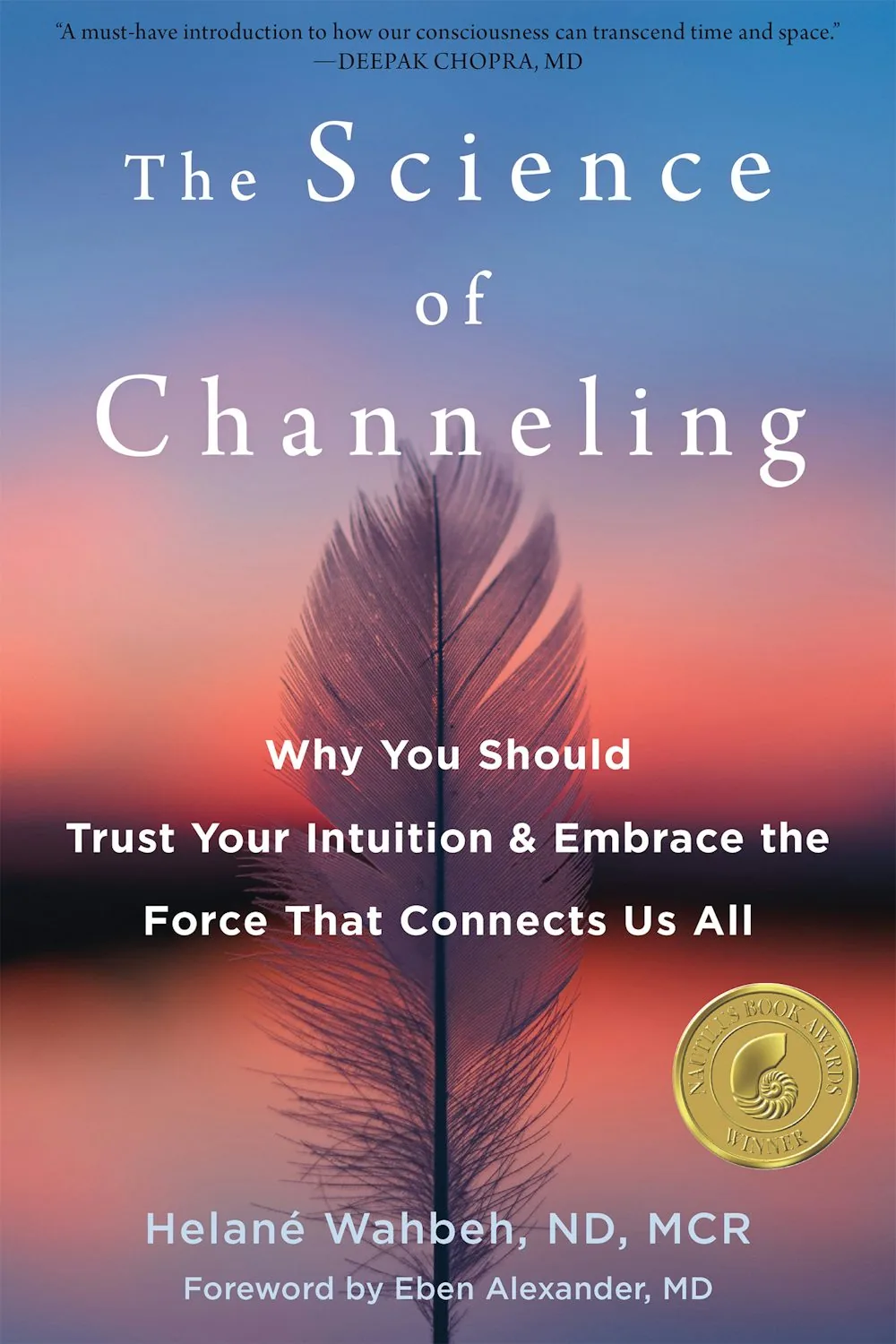
The Science of Channeling
Helané Wahbeh
A starting point for questions about intuition, experiences of receiving information and how their proposed sources are investigated.
Explore the book at IONS ↗
The Science of Magic
Dean Radin
A starting point for examining claims about mind and reality, and asking how evidence can distinguish competing explanations.
Explore the book at IONS ↗
Curiosity with Discernment
How the Chapters Are Being Developed
The editorial method draws on AkashicOMNI v0.5.0 Public Review Specification, published 1 October 2026 and clarified 2 October. Each preview uses selected public analytical perspectives, followed by AkashicNET synthesis. This is a focused editorial application, not a full execution or independent validation of all component frameworks.
Research update · 6 October 2026: Chapters I and IV now include research-informed additions, and Chapter VIII is proposed. Numerical findings are attributed to the published papers. The linked OSF repositories did not load during this review; their underlying datasets have not been independently downloaded or reanalysed. No cross-dataset comparison or new statistical analysis is presented.
For community accounts, record context, reported sensations, interpretation, corroboration and later outcomes separately. Do not assign MEQ30 scores retrospectively to Reddit posts: an omitted detail is not evidence that an experience was absent.
Experience
What was felt or reported?
Accuracy
What can be checked independently?
Usefulness
What changed in everyday life?
Proposed source
Which explanations remain possible?
DISCERN and DEEPEN inform the synthesis. Agreement among interpretive perspectives is not independent corroboration. An observation, a personal interpretation, a research finding and an unresolved hypothesis retain their different roles.
Scope, access and what could change these drafts
This was a targeted reading of selected N2N posts, AkashicNET pages and linked primary research—not a systematic analysis of the whole community. Some Reddit sources were available only as indexed excerpts or through the site’s account; live comment threads were not comprehensively reviewed. Access limits appear with the relevant previews.
The original component-framework bundles were not independently reanalysed. The public specification supplies the lens roles used here. Further source access, contradictory findings, cultural review and longitudinal accounts could change the chapter structure and claims. No universal mechanism or guaranteed beneficial outcome is established by this reading.
Join the Conversation
Which Chapter Would You Like to Explore?
Share your questions and reflections on the book concept and its working chapters and six proposals.