
N2N × AkashicNET · Research Synthesis · 2 November 2026
When the Boundary Softens
Psychedelics, Context & Connection
When the boundary softens, awareness can feel more expansive. Here, “boundary” means the felt distinction between self and surroundings: this describes an experience, not evidence of awareness extending beyond the body.
How do brain organisation, context and relationships shape connection?
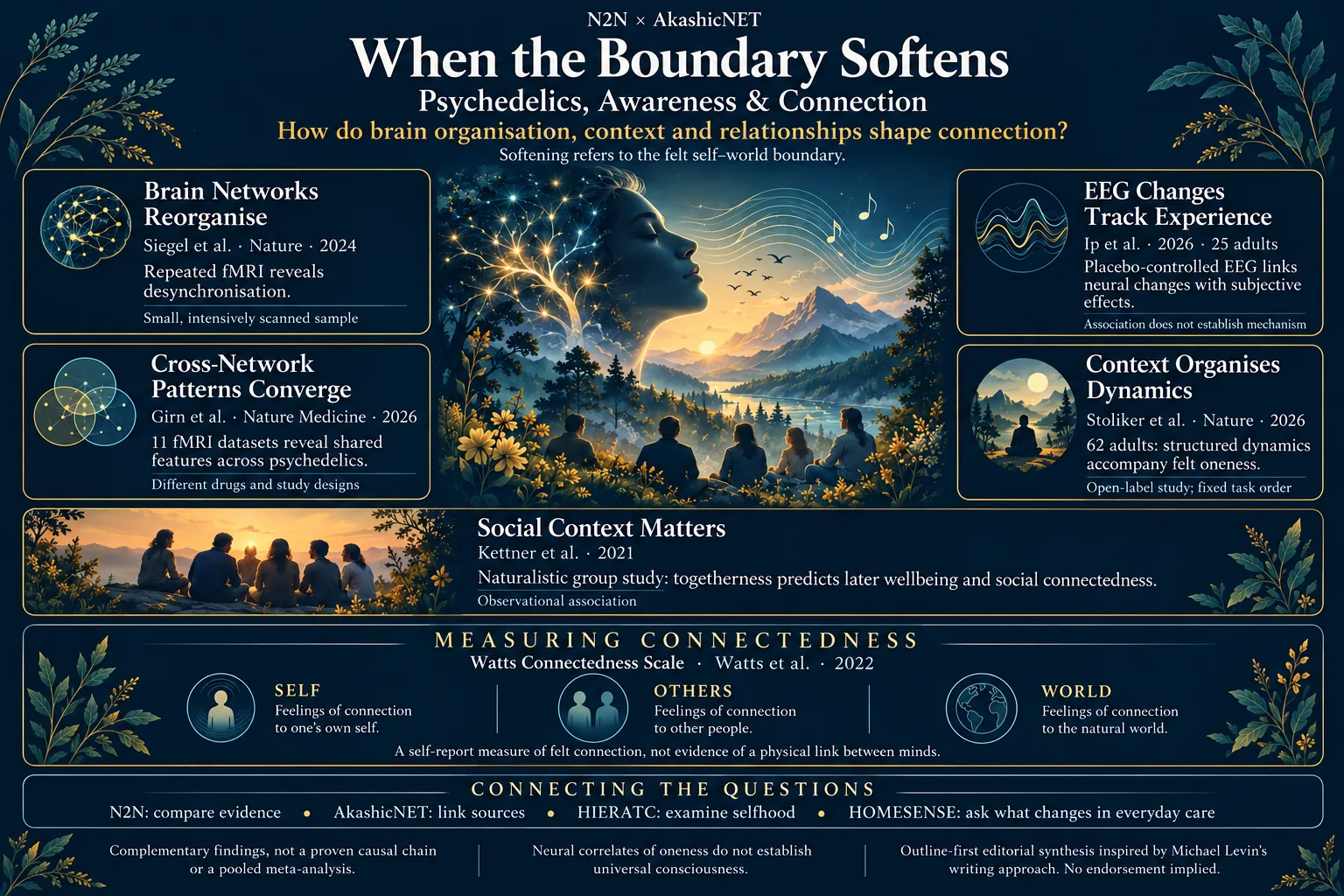
First the Overview, Then the Detail
Five Questions, Five Evidence Tracks
What changes in the organisation of brain activity?
Brain Networks Reorganise
Design: Repeated fMRI in a small, intensively scanned healthy-adult sample.
Psilocybin disrupted the usual synchronisation of brain networks. Changes in functional connectivity accompanied subjective effects; some hippocampal–default-mode connectivity changes persisted beyond the acute session.
Limit: Intensive repeated measurement adds detail within people but does not replace a large, diverse sample. Functional connectivity describes statistical relationships between signals.
How do measured dynamics relate to what people report?
EEG Changes Track Experience
Design: 25 healthy adults · randomised, double-blind, placebo-controlled crossover.
Psilocybin altered EEG power and connectivity, with changes associated with subjective psychedelic effects. This adds an electrical recording perspective alongside fMRI.
Limit: A small healthy-adult study does not establish clinical effectiveness. Correlations with experience do not by themselves identify its causal mechanism. Published online 27 January; issue date 20 March 2026.
Which findings recur across drugs and datasets?
Cross-Network Patterns Converge
Design: Mega-analysis of 11 resting-state fMRI datasets across classic psychedelics.
Uniform processing and Bayesian modelling identified shared features of altered communication between higher-order association and sensorimotor networks. Within-network effects varied and were less consistently supported.
Limit: Drugs, samples and scanning protocols differ. The paper is not a psilocybin-only study. Existing datasets in a pooled analysis must not be counted again as wholly independent replications.
What does context add to the experience of oneness?
Context Organises Dynamics
Design: 62 psychedelic-naïve adults · fMRI and EEG · open-label baseline comparison.
Across rest, meditation, music and a film, machine learning found structured, context-aligned brain dynamics associated with positive self- and boundary-dissolving experiences. The authors call the felt continuity with the environment “embeddedness”. Context alignment also correlated with next-day mindset change.
Limit: No placebo control and fixed condition order constrain interpretation. Next-day associations are not evidence of lasting clinical benefit. The imaging signatures are correlates, with the causal pathway unresolved.
How do relationships relate to subsequent change?
Social Context Matters
Design: Prospective naturalistic survey of psychedelic group settings.
Perceived togetherness, or communitas, was associated with subsequent self-reported wellbeing and social connectedness. It brings relationships and the wider setting into a discussion often centred on individual brains.
Limit: Self-selection, self-report and the absence of random assignment prevent attributing change to the substance alone. Communitas, connectedness and embeddedness are related concepts, not interchangeable measurements.
These findings can be compatible without being equivalent. Reduced time-averaged synchronisation and structured temporal dynamics are different measurements. EEG and fMRI also sample different aspects of brain activity. “More connected” is therefore too broad to serve as a single explanation.
Editorial Connections · Proposed Uses
From Research to Shared Inquiry
r/NeuronsToNirvana
Connect the latest discussion to earlier coverage rather than presenting every report as a fresh discovery. Compare the EEG study post, the April brain-network brief and the metaphysical-belief study.
AkashicNET
Extend From Wonder to Wisdom with explicit distinctions between brain organisation, experience and follow-up outcomes. AkashicPSI provides a wider inquiry pathway; claims about inaccessible information require separate tests.
HIERATIC
Use HIERATIC017 to examine meanings of selfhood and continuity. A change in the felt self–world boundary is relevant to that discussion but does not demonstrate survival after death.
HOMESENSE
Carry the question towards relationships and practical care: does reported connection become more attentive listening, sustained support or observable helping? That is an editorial research question, not an outcome already established by these studies.
Additional Curation · Initial Appraisal
Four Sources That Fill Gaps
The visual above covers the five core studies and the Watts Connectedness Scale. These additional sources extend measurement, interpretation and follow-up. Abstracts and relevant publisher text were inspected; independent replication and a complete risk-of-bias appraisal remain outside this review.
Connectedness & Sustained Wellbeing ↗
A naturalistic retreat study analysed 173 participants with follow-up extending to 12 months; connectedness analyses used 143. Connectedness was strongly associated with wellbeing change. No control group, selective attrition and simultaneous mediator/outcome measurement make causal mediation unestablished. These cohort figures are not the number completing the final follow-up.
Why curate it? Priority for follow-up appraisal: distinguish lasting self-report change from an acute unity experience.
The Watts Connectedness Scale ↗
Develops and tests a scale for reported connection to self, others and the world. It offers a way to define outcomes more carefully. It measures reported connectedness, not a physical connection between minds.
Why curate it? Measurement companion: specify which kind of connection is being discussed.
Psychedelics Alter Metaphysical Beliefs ↗
Prospective survey findings and a separate controlled dataset examine changes in beliefs about reality after psychedelic experiences. A shift towards a belief does not verify that belief. This source was already shared on N2N in November 2023.
Why curate it? Interpretation companion for HIERATIC: distinguish an experience, a subsequent belief and evidence for its truth.
Acute EEG Effects & the Following Day ↗
A placebo-controlled crossover study in 20 healthy participants examined EEG through 24 hours and self-reported outcomes at four weeks. It reported distinct acute and sub-acute associations. The small sample and correlational outcome links call for replication.
Why curate it? Time-course companion: the peak experience and the following day may carry different information.
Measure Connection Before Explaining It
The Watts Connectedness Scale distinguishes reported connection to self, others and the world. Those domains help us ask what changes after an experience.
Acute oneness, the authors’ embeddedness construct, social communitas and later connectedness scores are not interchangeable. Recording each separately would make future comparisons more useful.
What Would Strengthen the Connection?
- Measure acute oneness, later connectedness and observable behaviour separately.
- Compare settings prospectively, with appropriate controls and predefined analyses.
- Report follow-up denominators, missing data, adverse outcomes and absent changes.
- Test whether proposed neural signatures generalise to new participants.
- Check participant and dataset overlap before describing findings as independent replications.
Neural correlates do not settle metaphysics. A meaningful experience can motivate a hypothesis; a distinctive explanation needs evidence that separates it from alternatives.
How This Synthesis Was Built
We adapted Michael Levin’s outline-first writing approach: define the question and argument, organise claim-bearing panel titles, attach evidence and limits, then write the explanatory text. The brief overview precedes the detailed comparisons so each part can be understood in relation to the others.
This is an editorial adaptation, not a new research method validated by the cited studies. No collaboration or endorsement by Levin is implied. No new experiment or pooled statistical analysis was performed.
Source trail: the core cards link directly to the research. Scientific American’s report prompted this synthesis; its article and the Stoliker paper were published on 19 August 2026. This page’s publication and curation date is 2 November 2026.
AI-assisted research synthesis and conceptual artwork. Corrections and contrary evidence are welcome through Contact.