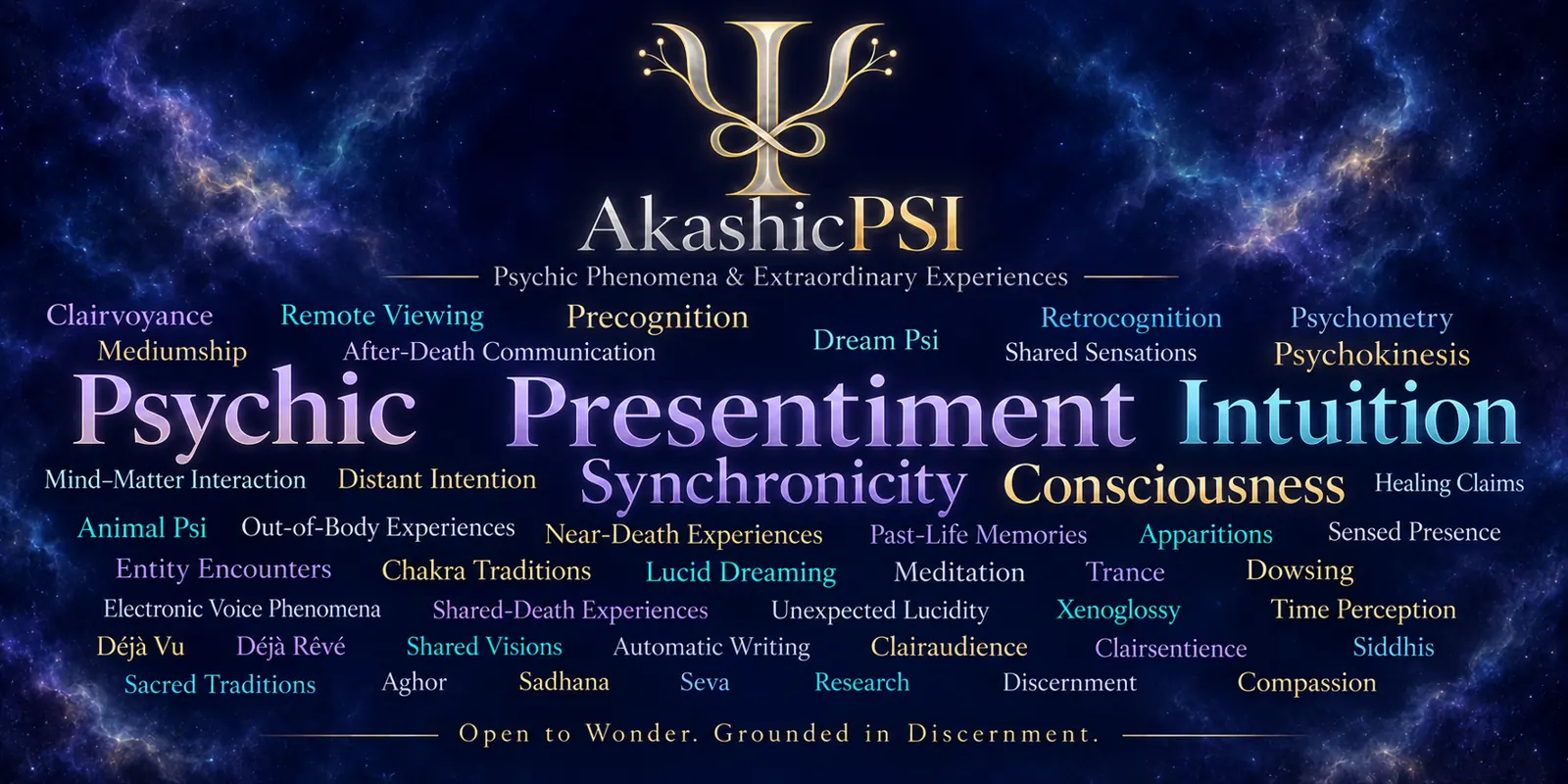
A place to explore unusual knowing, meaningful experiences and the questions they raise. Thirteen connected categories lead from an introduction to deeper descriptions, existing resources and the research still to be reviewed.
How to use this map
Follow the experience. Keep the question open.
This is a working editorial taxonomy, not an exhaustive or universally agreed scientific classification. Some entries describe a proposed effect, others a method or setting. A record can belong to more than one category.
Three levels of exploration: read the short description, expand its detailed introduction, then follow a resource link where one exists. “Research review pending” means a current literature assessment has not yet been completed for this category. It is a publication status, not a finding about whether an effect exists.
Thirteen doorways · Expand any introduction
Explore the whole category
CATEGORY 01
Telepathy
Claimed information transfer between minds without known sensory communication.
Read the detailed introduction
Reports may involve thoughts, images, emotions or apparent knowledge of another person’s situation. Research must distinguish an information-transfer claim from familiarity, inference, shared circumstances and unnoticed cues. Telepathy describes a proposed relation between a sender and receiver, not a particular sensory experience.
Research question: Can a receiver identify a concealed target under blinding, with independently generated targets and scoring rules fixed in advance?
Dedicated topic page · In preparationResearch reading list · Pending source reviewLatest literature assessment · Research review pendingWhat the research review will cover ↓
CATEGORY 02
Clairvoyance
Claimed access to information about hidden objects, distant places or events through non-ordinary perception.
Read the detailed introduction
Clairvoyance concerns information about a target without requiring another person to act as a sender. A vivid mental image alone does not establish access to that target. Reports need a documented account of what information was available, how targets were selected and how apparent matches were judged.
Research question: Does performance exceed a specified chance model after ordinary information access and flexible matching are controlled?
Dedicated topic page · In preparationResearch reading list · Pending source reviewLatest literature assessment · Research review pendingWhat the research review will cover ↓
CATEGORY 03
Remote Viewing
Structured attempts to describe a concealed or distant target, often investigated as a form of clairvoyance.
Read the detailed introduction
Remote viewing is also a procedure: a participant records impressions before target feedback. Session records, target pools and independent judging matter as much as memorable successes. Historical intelligence programmes provide an archive to investigate, not automatic confirmation of the claimed ability.
Research question: Can independently scored target descriptions be replicated across participants and laboratories, including unsuccessful sessions?
Claimed knowledge of a future event that could not reasonably be inferred beforehand.
Read the detailed introduction
Experiences can take the form of a dream, image, feeling or statement. Distinguishing a specific prediction from a broad expectation requires records created before an event, a defined time window and accounting for all predictions rather than only remembered matches.
Research question: Can specific prospective predictions identify genuinely unpredictable outcomes under preregistered scoring?
Dedicated topic page · In preparationResearch reading list · Pending source reviewLatest literature assessment · Research review pendingWhat the research review will cover ↓
CATEGORY 05
Presentiment
Claimed physiological anticipation of an unpredictable future stimulus without conscious foreknowledge.
Read the detailed introduction
The proposed effect concerns measurements such as skin conductance or other physiological signals before an event. It differs from a consciously reported prediction. Expectation, trial sequencing, timing, preprocessing and multiple analyses need particularly careful treatment.
Research question: Does a preregistered physiological effect survive independent replication and controls for expectation and analysis choices?
Dedicated topic page · In preparationResearch reading list · Pending source reviewLatest literature assessment · Research review pendingWhat the research review will cover ↓
CATEGORY 06
Retrocognition & Psychometry
Claimed knowledge of past events, sometimes associated with touching an object or visiting a place.
Read the detailed introduction
Retrocognition concerns apparently inaccessible past information. Psychometry describes an object- or touch-associated setting for such impressions. Provenance, prior exposure, public information and independent historical records are central to evaluating a report.
Research question: Can specific details be recorded before verification and distinguished from plausible guesses, prior knowledge and selective matching?
Dedicated topic page · In preparationResearch reading list · Pending source reviewLatest literature assessment · Research review pendingWhat the research review will cover ↓
CATEGORY 07
Channelling
Receiving or expressing information experienced as originating from another source, including conscious and trance forms.
Read the detailed introduction
Speech, writing, imagery or inner knowing may be attributed to a guide, deeper self or other presence. Definitions vary; Wahbeh uses channelling broadly. A reported state, the usefulness of its content, its factual accuracy and its claimed source are separate questions.
Research question: Which features of the experience can be documented, and can any specific information claims be independently tested?
Communication attributed to deceased people, through a medium or in a spontaneous personal experience.
Read the detailed introduction
Mediumship and spontaneous after-death experiences overlap but have different settings. A felt presence, an apparently accurate reading and evidence for survival of consciousness require different investigations. Bereavement context, information leakage, interpretation and source independence should remain visible.
Research question: Can specific information be identified under blinding, and what competing explanations remain even if accuracy is demonstrated?
Dreams interpreted as telepathic, clairvoyant or precognitive.
Read the detailed introduction
This is a cross-cutting category: dreaming describes when or how an experience occurs, while telepathy or precognition describes the proposed information relation. Ordinary dreaming, lucid dreaming and unusual vividness do not by themselves establish psi.
Research question: Do dream records created before target selection or disclosure match targets under blinded judging better than controls?
Emotions or bodily sensations interpreted as shared with another person beyond ordinary cues.
Read the detailed introduction
Some accounts are described as telesomatic experiences. Ordinary empathy, observation, expectation and shared environmental conditions offer important comparisons. The key distinction is between feeling something strongly and demonstrating accurate information about another person without an ordinary route.
Research question: Can independently timestamped reports correspond under blinded conditions while misses and ordinary cues are recorded?
Dedicated topic page · In preparationResearch reading list · Pending source reviewLatest literature assessment · Research review pendingWhat the research review will cover ↓
CATEGORY 11
Psychokinesis & Mind–Matter Interaction
Claims that intention influences physical systems or random processes beyond ordinary bodily action.
Read the detailed introduction
Reports range from visible movement to small statistical deviations in instruments. These require different controls. Physical isolation, calibration, complete data records, analysis decisions and independent replication are essential before a deviation can support a causal claim.
Research question: Does an effect persist under independent, preregistered tests that exclude physical interference and measurement artefacts?
Dedicated topic page · In preparationResearch reading list · Pending source reviewLatest literature assessment · Research review pendingWhat the research review will cover ↓
CATEGORY 12
Distant Intention & Healing Claims
Claims that directed intention affects another person or living system, particularly at a distance.
Read the detailed introduction
This category concerns the proposed distant influence rather than every benefit associated with care or a healing encounter. Changes in symptoms, biological measurements and clinical outcomes must be distinguished. Natural variation, treatment, expectation and selection can influence results.
Research question: Can a predefined outcome be reproduced with suitable comparison groups, blinding and complete outcome reporting?
Dedicated topic page · In preparationResearch reading list · Pending source reviewLatest literature assessment · Research review pendingWhat the research review will cover ↓
CATEGORY 13
Animal Psi
Claims that animals anticipate events, locate people or respond beyond known sensory explanations.
Read the detailed introduction
Reports may involve apparent anticipation of a person’s return or unusual navigation. Animals can detect cues unavailable or unnoticed by humans. Routine, smell, sound, environmental changes and observer expectations therefore require careful investigation.
Research question: Does a prospectively recorded response track an independently randomised event after species-appropriate sensory controls?
Dedicated topic page · In preparationResearch reading list · Pending source reviewLatest literature assessment · Research review pendingWhat the research review will cover ↓
Featured exploration · 10 illustrated chapters
Psychic Ability 101: a visual journey
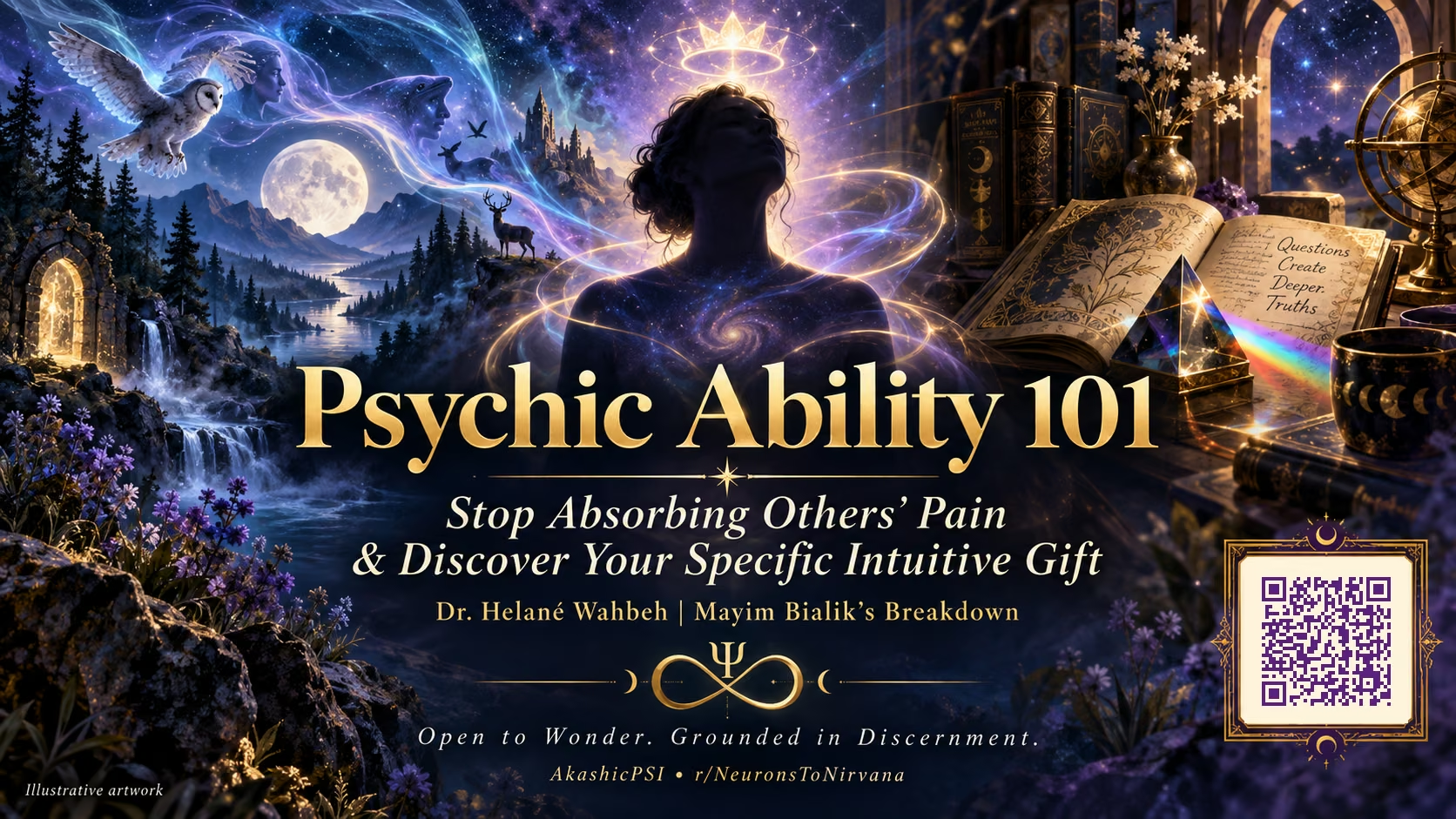
Explore twelve noetic signatures, personal boundaries, attention and dreams alongside Helané Wahbeh’s conversation on Mayim Bialik’s Breakdown. Read captions and accessible notes for every image.
A ten-visual companion to Dr. Helané Wahbeh on Mayim Bialik’s Breakdown. Explore the archive comparison, prospective interviews, mixed telephone-telepathy results and the questions that remain open.
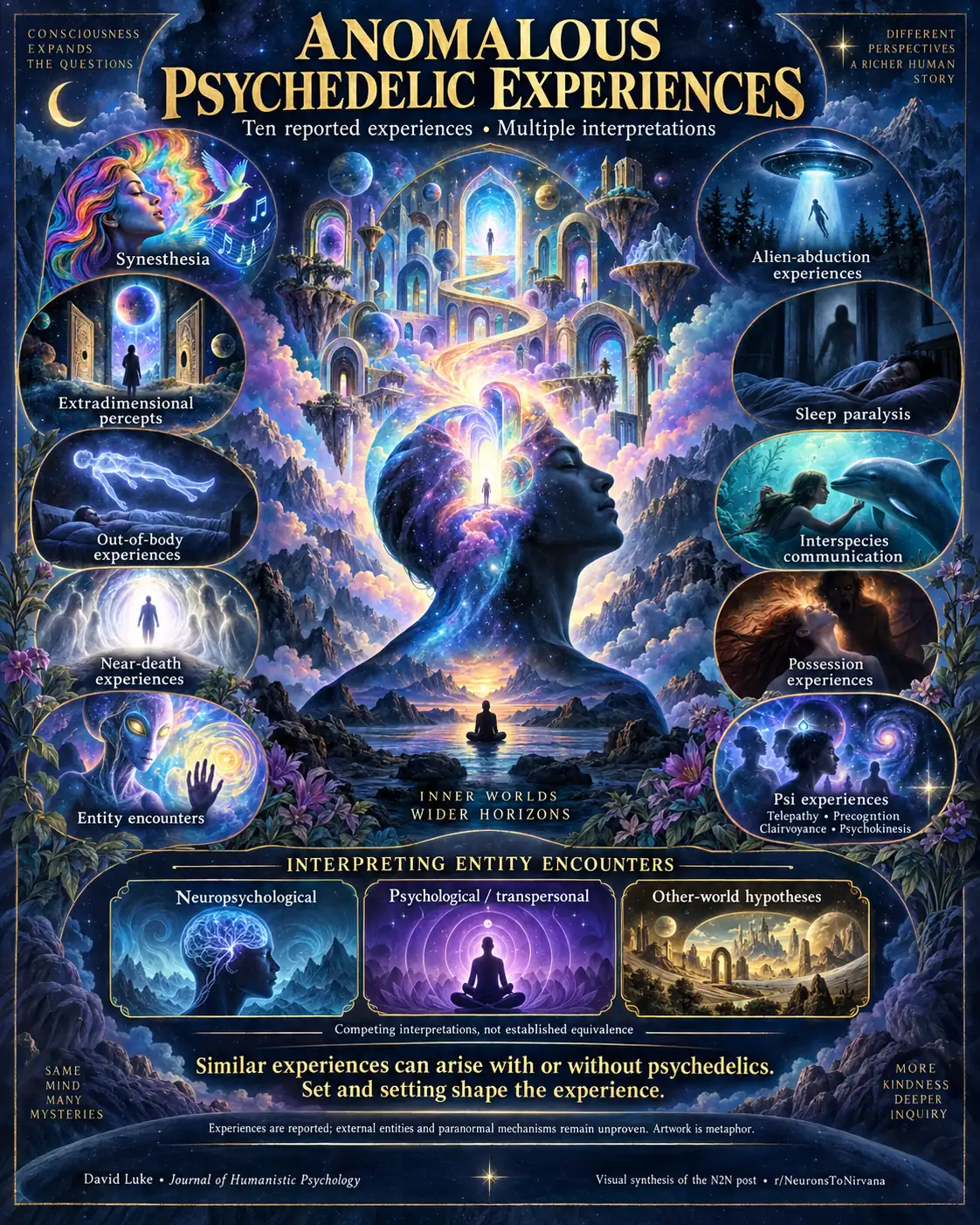
AI-generated visual synthesis of the linked N2N post. Symbolic artwork, not a depiction of verified entities, dimensions or paranormal mechanisms. Open the image to enlarge.
David Luke’s review essay surveys synesthesia, extradimensional percepts, out-of-body and near-death experiences, entity encounters, alien-abduction experiences, sleep paralysis, interspecies communication, possession experiences and psi reports. It discusses their occurrence with and without psychedelics and the influence of set and setting.
For entity encounters, the essay compares neuropsychological, psychological/transpersonal and other-world interpretations. These are competing explanations, not equally supported findings. The review maps a literature and its arguments; it is not a controlled demonstration of paranormal abilities.
Two maps, different purposes. These ten experience categories overlap with this page’s thirteen psi categories; they are not ten additional abilities or independent confirmations. Synesthesia and sleep paralysis should not be treated as evidence for telepathy or external entities.
Apply the framework to one claim at a time
Experience and context
Record what was perceived before deciding what caused it. Preserve timing, sleep or waking context, expectations, cultural language and the distinction between contemporaneous notes and later recollection.
Mechanism and interpretation
Compare neural, psychological and spiritual accounts against the same observation. A meaningful experience need not settle its source; a proposed mechanism needs predictions that could fail.
Information and verification
Where a report claims inaccessible information, define targets and scoring in advance, exclude ordinary cues, retain misses and seek independent replication.
Integration and care
Ask whether the experience supports lasting compassion, consent and useful action. Benefits and personal meaning are separate questions from metaphysical accuracy.
Research boundary: the four-paper editorial appraisal below is complete within its stated scope. It is not a systematic review, raw-data audit or independent peer review. BQ001 and BQ002 remain UNRESOLVED; no model-support or canonical-evidence promotion follows.
What the studies support. Where the conclusions stop.
Four core papers, three research settings: full-text methods, findings and limitations checked, with selected follow-up research and critical commentary. The assessments below are editorial judgements about particular claims, not a numerical quality ranking.
DMT and near-death experience scales
Timmermann et al. (2018): 13 healthy volunteers received saline first and DMT later in a single-blind, within-person study. All crossed the Greyson NDE-scale threshold after DMT. A separate comparison used 13 NDE reporters.
Strength: a controlled within-person contrast supports overlap in reported features. Limitations: small sample, fixed order, conspicuous drug effects and investigator knowledge leave expectation and order effects unresolved. The NDE group was selected for qualifying scores and recalled experiences from months to years earlier; setting and recall differed.
Assessment: useful exploratory evidence of phenomenological overlap. Failure to detect a difference is not an equivalence test. Shared questionnaire scores establish neither a shared mechanism nor survival after death; information accuracy was not tested.
Michael, Luke & Robinson (2021): 36 immediate interviews from 30 people, including repeat sessions, in a naturalistic DMT field study. Entity encounters appeared in 34 interviews.
Strength: detailed accounts recorded soon afterwards, with an inductively developed thematic analysis. Limitations: convenience and snowball recruitment selected experienced users; interview prompts, cultural expectations and uncontrolled settings may shape reports. Participants supplied substances without chemical verification. Frequencies count interviews, not independent people or population prevalence.
Assessment: a useful descriptive taxonomy of this selected corpus. It does not verify external entities, establish how common such experiences are generally, or test anomalous information transfer.
Michael, Luke & Robinson (2023) analyses the same 36 interviews from 30 people. Its five domains cover onset, bodily, sensory, psychological and emotional experiences, combining questionnaire-informed categories with themes developed from the interviews.
Strength: quotations and structured descriptions help compare changes in embodiment and selfhood. Limitations: this is a companion analysis, not an independent replication. Recruitment excluded people with lasting harmful psychedelic experiences, limiting safety inferences. The study did not measure long-term therapeutic outcomes.
Assessment: useful evidence about reported experiences in this group. Neural explanations and therapeutic possibilities remain hypotheses; descriptions alone cannot establish efficacy, safety or an external source of thoughts.
Salimpoor et al. (2011): extensive screening selected ten reliable musical-chill responders from 217 respondents; eight contributed usable PET data. Pleasant and neutral music were compared within listeners, alongside autonomic measures.
Strength: converging subjective, physiological and imaging measures; counterbalanced PET sessions and efforts to match musical controls. Limitations: a tiny, selected sample limits precision and generalisation. Reduced raclopride binding provides an indirect estimate of dopamine release. Separate fMRI sessions measured blood-oxygen responses, not moment-by-moment dopamine. The regional fMRI analysis used an uncorrected threshold within predefined striatal regions.
Assessment: evidence supports dopamine involvement in intense musical pleasure. The anticipation/peak distinction is an inference across modalities, not direct chemical timing. The experiment did not measure pīti, EEG states or spiritual attainment.
Michael et al. (2025) compares the same DMT interview corpus with 34 NDE narratives. It identifies meaningful content differences, including life reviews, deceased-person encounters and a boundary of return. This is additional comparative analysis, not a new independent DMT cohort. Differences in recruitment, language, interview format and recall constrain interpretation. It qualifies a simple equivalence claim without resolving the biological explanation.
Converging evidence for dopamine involvement
Ferreri et al. (2019) used a double-blind, within-person pharmacological comparison in 27 participants. Contrasts between dopamine-enhancing and dopamine-blocking conditions supported an effect on musical reward; the chills analysis involved 16 placebo-session responders. This adds causal leverage, but does not directly replicate the 2011 regional timing result. The studies share an author, and this does not establish dopamine as the sole mechanism of pleasure.
Pleasure is not every musical emotion
Goupil & Aucouturier (2019) distinguish musical pleasure from the wider range of musical emotions and question how reward, expectation and other emotional mechanisms fit together. This is conceptual commentary, not a failed replication. It supports keeping the claim specific rather than treating dopamine as a universal explanation for emotional or spiritual experience.
Larger, preregistered studies with better expectation controls could clarify DMT–NDE similarities and differences. Independently sampled qualitative work could test how transferable the reported themes are. Direct comparisons of musical frisson and carefully defined contemplative pīti would be needed before claiming a shared mechanism. Any claim of inaccessible information needs prospective targets, blinded scoring and independent replication.
Appraisal conclusion: the evidence supports studying these experiences and some of their physiological correlates. These papers do not establish consciousness surviving death, external entities, an Akashic information source, or a biological equivalence between musical frisson and pīti. BQ001 and BQ002 remain UNRESOLVED.
Scope and access: targeted appraisal completed 22 September 2026 for the four named core papers, the two follow-up studies and the commentary above. Full core texts were available, including the music paper’s supplement. This was a selected source search, not an exhaustive systematic review or an audit of raw data, interview coding, preregistrations or every correction. No independent peer review or new canonical-evidence acceptance is claimed. The Buddhist texts below support a comparison of vocabulary and practice contexts; they do not validate a neuroscience equivalence.
Spiritual science & contemplative inquiry · Ancient texts in context
Chills, pīti and meaning
“Chills” can name a brief shiver, visible goosebumps or a felt wave. Begin with the actual sensation and its setting. A musical peak, meditation and a devotional moment may invite comparison without having one established cause.
Empirical lens: measurable responses
Music research offers a way to investigate felt intensity alongside physiology. Record reported sensations separately from observable goosebumps, heart rate or skin conductance. None of these measures alone establishes a spiritual source.
Early Buddhist text: supporting conditions
In SN 12.23, the Upanisa Sutta, translated by Bhikkhu Bodhi, joy supports rapture, which supports tranquillity; happiness and concentration follow in the sequence. This is a Buddhist account of the path of practice. It does not equate a chill with awakening.
Later commentary: a vocabulary of rapture
Buddhaghosa’s Visuddhimagga IV.94–100, translated by Bhikkhu Ñāṇamoli, distinguishes five forms of pīti. Its descriptions include hair-raising, brief flashes, repeated waves and pervasive rapture. This later commentarial classification is distinct from the early discourse; the translation uses “happiness” for pīti.
The surrounding passage also contains levitation narratives. Those remain traditional accounts, not experimentally verified findings.
AkashicOMNI lens: compare without collapsing
Here “spiritual science” means disciplined contemplative observation and comparison with tradition-specific texts. Respectful attention does not require identical evidential status. Frisson and pīti can be compared as descriptions; a shared mechanism, EEG signature or metaphysical explanation needs its own evidence.
A reflection prompt: What happened, what preceded it, how long did it last, and what meaning did you give it? Keep observation and interpretation in separate notes. Do not treat sensations as a truth detector or rank spiritual progress by their intensity.
Boundary: these sources do not establish that chills detect an Akashic field, verify channelled information or indicate a particular theta/gamma state. The comparison is an editorial research proposal, not a diagnosis or a validated scale.
These areas connect to psi discussions but are not automatically psi phenomena. Links open existing broader resources; focused research pages may follow.
AI-generated conceptual artwork. An imagined contemplative scene, not a photograph of a named practitioner or a documented ritual.
Aghori traditions belong in this collection as living religious traditions with their own teachings, lineages and extraordinary-event accounts. They should not be reduced to a psychic ability or a sensational image.
Shiva, lineage and spiritual practice
The Baba Kinaram tradition at Kring Kund, Varanasi presents Aghor through Shiva devotion, spiritual discipline and service. Its accounts of masters include devotional claims and extraordinary events. These establish what the lineage teaches and remembers, rather than independently verifying a paranormal mechanism.
Sadhana and seva
Sonoma Ashram, in the Aghoreshwar Bhagwan Ram lineage, explicitly connects daily spiritual practice with selfless service. Its published projects include education, empowerment and eye care through its Indian partner. This gives the enquiry an observable dimension: how practice is expressed in care for others.
How to investigate extraordinary accounts
Keep the original account, its date, translation, witnesses and cultural meaning together. Separate visionary experience, healing testimony, historical biography and specific information claims. Ask what can be independently checked, what alternative explanations fit and what remains a matter of faith or interpretation.
A wider comparative collection
Future entries can examine Buddhist iddhi and abhiññā, Sikh accounts and teachings on ridh-sidh, Tibetan lama traditions, yogic siddhis and particular Indigenous traditions. Each needs its own sources and context. A religious title or lineage does not itself establish psi ability.
Research status: introductory lineage sources reviewed 20 September 2026. A dedicated historical and scholarly review, including case-specific extraordinary-ability claims, is pending. This section does not claim that an Aghori practitioner has demonstrated psi under controlled testing.
These candidate topics broaden the anomalous-experience collection. They are not additional confirmed psi abilities, and this list does not indicate that studies have begun. Each needs a scoped description and source review before a dedicated assessment.
Dowsing & Radiesthesia
Locating concealed water, objects or other targets using rods, pendulums or bodily impressions. A future review should compare blinded target performance with chance, environmental knowledge and involuntary movement.
Topic page and research review · Pending
Instrumental Communication Reports
Electronic voice phenomena and other signals interpreted as communication from an unseen source. Preserve original recordings and examine equipment, interference, processing, auditory pattern perception and independent blinded interpretation.
Topic page and research review · Pending
Shared-Death Experiences
Unusual perceptions reported by someone accompanying a dying person. Compare independently recorded accounts, timing, shared expectations, bereavement context and ordinary communication.
Episodes of apparently regained clarity or communication in people with severe impairment. These belong primarily to clinical and consciousness research. Definitions, baseline functioning and prospective observation matter; a lucid episode alone does not establish psi.
Reports of apparently unlearned language or knowledge. Independent proficiency testing, life-history records and prior-exposure checks help distinguish a robust claim from a few familiar phrases, forgotten learning or retrospective interpretation.
Dedicated topic page and research review · Pending
Time Distortion & Anomalous Familiarity
Experiences of time slowing, missing time, déjà vu or déjà rêvé: the feeling of having previously dreamed an event. Sleep, memory, attention and context should be investigated separately from claims about precognition or altered physical time.
Dedicated topic page and research review · Pending
Recurrent Unexplained Disturbances
Reports sometimes labelled poltergeist phenomena, including unexplained sounds or object movement. A future case review should document the environment, witnesses, recording continuity, ordinary physical causes and possible interference.
Topic page and research review · Pending
Shared Visions & Collective Altered States
People reporting similar imagery, presences or feelings during music, ritual or other shared settings. Collect accounts independently before discussion and examine shared cues, suggestion and cultural expectations.
Cross-tags rather than duplicate categories: automatic writing belongs with channelling; sensed presences with apparitions or entity encounters; clairaudience and clairsentience describe how something is experienced. Unusual experiences can be studied without assuming a common cause.
AkashicNET × r/NeuronsToNirvana
Insights already connecting the field
These connections draw on existing AkashicNET pages and community posts already referenced there. They are starting points for enquiry, not a comprehensive subreddit review or new evidence of psi.
How an experience arrives is a separate question from where it comes from
The twelve noetic signature factors describe reported styles such as dreams, touch, inner voice and bodily sensation. Use these as experience tags alongside a proposed phenomenon; a questionnaire score does not demonstrate its source.
An arriving thought can become a research question
BQ002 connects spontaneous thoughts with neural, embodied, social and transpersonal explanations. The community’s thought appearing in awareness post provides a reflection prompt: what preceded the thought, and what information was already available?
A synchronicity can be a guidepost
The Ozora Artisans’ Village post preserves the inspiration behind the channelling page. Personal meaning can guide attention and future questions without deciding what caused a coincidence.
Meaning and useful action deserve their own assessment
BQ011 asks whether interconnection leads to enduring compassionate action. A practice’s effect on care and behaviour can be investigated separately from a claim of anomalous information transfer.
Many perspectives do not count as many replications
AkashicOMNI helps compare culture, embodiment, interpretation and consequences. Its thirteen lenses organise an enquiry; they are not thirteen independent sources of experimental evidence.
Continue discovery in the community archive
These are live subreddit search links, not reviewed bibliographies. Primary papers, duplicates and evidence quality still need checking.
Research review pathway · Planned work
From a reading list to a considered assessment
Future topic reviews will distinguish the newest publication from the strongest relevant evidence. Existing guides remain useful starting points, but their presence does not mean a current systematic review has been completed.
Find and date the sources. Identify primary studies, reviews, preregistrations, replications, corrections and relevant criticism.
Separate the claims. Record what was experienced, what was measured and which explanation is proposed.
Read the methods. Examine blinding, information leakage, controls, sample size, statistical choices and missing outcomes.
Compare independent evidence. Distinguish reanalysis and repeated reporting from genuinely independent replication.
Publish a dated assessment. Include the search cut-off, access limits, findings, uncertainties and what would change the assessment.
Current status: the category introductions are available. Dedicated pages and current literature reviews are planned where marked. No automatic update schedule is claimed.