
 Featuring IONS research · Dr. Helané Wahbeh
The feature
Wonder, with room for better questions.
Mayim Bialik and Jonathan Cohen’s conversation with Dr. Helané Wahbeh opens a wide field: channeling, telepathy, energy healing and the possibility of consciousness beyond familiar boundaries. This feature follows those questions while separating testimony, measured outcomes and interpretations.
The episode was published on 17 September 2026. Wahbeh is introduced as Director of Research at the Institute of Noetic Sciences (IONS) and author of The Science of Channeling. Her research provides an opportunity to ask more precise questions about unusual experiences. [1]
An editorial companion to #HOMESENSE818 · The Living Network. Continue with the separate 49-slide IONS review preview.
01 / How channeling is studied
Begin with the right question.
A reported experience, a useful insight and verified information are different research targets.
The episode describes a program organized around prevalence, who reports channeling, how it might work and whether its content can be useful or checked. This is a valuable starting point: make a broad claim small enough to investigate.
Prevalence
Who reports the experience? How was the sample recruited?
Experience
What do people describe, and how does it affect their lives?
Performance
Can specific information be checked under controlled conditions?
Mechanism
Which explanation survives comparison with alternatives?
The prevalence claim needs its denominator
The supplied episode summary reports a figure near eight in ten under a broad definition that includes intuition. The exact survey, sampling frame and question wording remain unverified here. It should not become a claim that 80% of all people have demonstrated channeling ability.
Likewise, reports of generally non-clinical screening scores in sampled experiencers should stay tied to those samples. A self-report survey cannot establish either a paranormal mechanism or the mental-health profile of everyone who has an unusual experience.
02 / The archive comparison
What did “matched” actually mean?
Semantic overlap describes similarities in language and concepts. It is not a factual-accuracy percentage.
A retrospective study compared a curated channeling collection with UFODex, a large ufological archive containing books, periodicals and archival documents. Some materials concern military or disclosure topics; the archive as a whole is not verified military evidence. [2]
Existing narratives attributed by their channelers to extraterrestrial sources. Selection and prior cultural exposure matter.
comparison
A mixed documentary collection. Accuracy and independence require separate assessment.
The reported semantic-similarity range was 0.66-0.88 on selected questions. Topics including disclosure, psi and time showed overlap. The corpora also differed in emphasis: consciousness and ethics on one side; secrecy, technology and geopolitics on the other. [2]
The headline compresses all of this into “military files matched.” That wording encourages a stronger reading than the method supports. Matching ideas is not the same as identifying a previously unknown fact, documenting it before disclosure and then verifying it independently.
A stronger follow-up would report misses, include unrelated comparison texts, disclose selection rules and test whether specific predictions outperform shared cultural narratives.
03 / Prospective interviews
Shared themes. How specific are they?
Standardized collection improves comparability. The identity of a purported source remains a separate question.
- Across channelers, same purported ETI
- 0.65–0.79
- Within one channeler, across ETIsAfter residualization
- 0.75–0.88
The prospective work used three experienced channelers and standardized interviews. Its abstract reports measurable organization in the resulting text. High similarity also persisted when a single channeler described different purported ETI groups. [3]
That second finding deserves equal prominence. Repeated themes might reflect a channeler’s style, familiar narratives or the shared prompts. Group-specific information would require a more discriminating test: can independent judges identify the claimed group from a response when identifying labels and generic themes are removed?
Our interpretation: this is a useful feasibility and content-structure study. It does not establish a source outside the participants. Statistical claims about “non-randomness” would need the full model, baselines and analysis decisions.
04 / The external check
Where verification remains open.

IONS reports that requests for independently checkable details were consistently declined, with trust framed in terms of inner discernment. [4]
That does not prove fabrication. It does leave the decisive external check unmet. Confidence in the sincerity of an experience is different from evidence about its source.
Useful tests would specify a target in advance, conceal relevant information, record the response before feedback and score successes and failures under the same rules. Shared culture, expectation, common prompts and information leakage belong among the competing explanations.
Curiosity can remain open while the conclusion remains unresolved.
05 / Telepathy
Two studies. Keep them separate.
The numerical comparison comes from the published telephone experiment, not the episode’s Zoom report.
Telephone study: completer trials
Accuracy, with chance expectation at 33.3%
The study used triads and two selection timings. Pre-selected trials exceeded chance; post-selected trials did not. Emotional closeness was not significant at .05; communication frequency was associated with accuracy. Recruitment difficulties led to protocol changes, and conventional explanations were not fully excluded. [5]
A positive result in one design does not establish a general telepathic mechanism.
06 / Energy medicine
An experience. An outcome. A cause.
These are related questions, but they are not interchangeable.
The supplied episode summary describes Reiki and energy-medicine pilots with well-being changes and unexpected reports of guides or other beings. The exact trials, controls and outcome tables have not been independently matched in this edition.
- ExperienceWhat did the person report?
- OutcomeWhat changed, and over what time?
- ComparisonWhat happened in the control group?
- MeasurementWas it blinded, objective and prespecified?
- MechanismWhich explanation fits better than its rivals?
Attention, expectation, relaxation and natural fluctuation can contribute to a change after a session. A causal treatment claim requires an appropriate comparison. An objective measurement still needs sound controls; a guide report remains a report unless independently tested.
The episode’s parenting reflections, spirit-attachment discussion and intergenerational-trauma questions add personal and interpretive material. They do not, on this record, establish a clinical benefit or a verified explanation involving external beings.
07 / A reusable distinction
Four questions. No automatic leap.
Coherence
Does the account hang together? Consistent themes can arise from many sources.
Specificity
Does it distinguish this target? Generic similarity may fit many targets.
Accuracy
Does an independent check agree? Predictions must be testable, with misses counted.
Source
How was the information obtained? Accuracy alone does not identify a mechanism.
The channeling papers offer material about coherence and possible specificity. The high similarity across different claimed groups complicates specificity. Independently verified accuracy and source identity remain open. A compelling story, or a strong feeling of resonance, cannot supply a missing test.
08 / AkashicNET integration
A framework for inquiry, with uncertainty intact.
AkashicOMNI v0.4.3 · PRE-ALPHA · Release dated 19 September 2026
HOMESENSE818’s Living Network is an editorial bridge: relationships and interdependence invite investigation. Ecological networks are not, by analogy alone, evidence of a universal information field. AkashicPSI can explore that distinction explicitly.
EXPAND² v0.1 adds two moves: Discern the claim, sources and missing information; Deepen through alternatives, contradictions, consequences and time. Outcome signals express assessments, not truth scores.
This feature is an integration note, not a completed application of every perspective. BQ001 remains UNRESOLVED. No evidence promotion or canonical truth-status change follows. The proposed v0.5.0 capability remains unreleased. [8]
Separate companion / 49-slide review
A vision for humanity.
The completed AkashicNET review covers all 49 pages of the supplied IONS ConnectIONS Live presentation, dated 18 September 2026. It reviews the deck at presentation level; it does not audit the spoken webinar, audience Q&A, research transcripts or raw data. [7]
The deck describes 30 sessions involving three channelers, ten named purported ETI groups and a 28-question protocol. Thirty sessions are not thirty independent participants. Semantic and qualitative analyses of one dataset are complementary views, not independent replications.
Its social vision provides material for reflection: care, education, ecological repair, provision of basic needs and rehabilitation. The usefulness of these ideas can be discussed separately from whether the attributed cosmology is true. The deck’s own boundary between narrative content and source identity is central.
Two denominator corrections are especially useful: a cited 74% concerns societies in an older cross-cultural source, not all people; a 36% category concerns survey respondents’ claimed sources, not an ETI verification rate. Neither number belongs in a general-population prevalence chart.
Keep this companion distinct from the Mayim episode. The magazine does not reproduce IONS slides or imply an institutional endorsement.
The full companion is held privately for a proposed paid collection; the public link explains its scope and availability. The downloadable magazine remains the 21 September editorial snapshot.
09 / What would change the assessment?
Make the next test more informative.
- SpecifyWrite the prediction, target and scoring rule before data collection.
- SeparateBlind assessors; restrict leakage; include useful comparison material.
- DiscriminateTest whether group-specific answers outperform generic narratives.
- QuantifyReport effect sizes, uncertainty, dependencies and multiple testing.
- ExposePublish exclusions, misses, null findings and sensitivity analyses.
- ReplicateInvite independent teams to repeat a clearly documented protocol.
Priority leads: obtain the bonded-pairs methods; inspect the prospective channeling matrices and residualization; test archive matching against cultural baselines; replicate telephone protocols; identify the exact healing trials before drawing clinical conclusions.
Reading notes
Follow the episode. Keep the access limits.
How this edition was prepared
Times are approximate, carried from the supplied episode notes and chapter map. They have not been independently checked against every minute of the video. Exact watch duration was not verified.
This is an AI-assisted editorial adaptation of the full post and its corrections, informed by recent related chat records, official episode information, IONS abstracts and commentary, and the saved 49-slide analysis. It is not a full-transcript, full-paper or raw-data audit.
Source access is not uniform. The channeling and telephone numbers are linked to the inspected publication summaries. The Zoom protocol, broad prevalence and healing descriptions retain their episode-summary status. The non-physicalist framing is an interpretation; these findings do not settle whether consciousness extends beyond the brain. No quotation is reconstructed from missing captions.
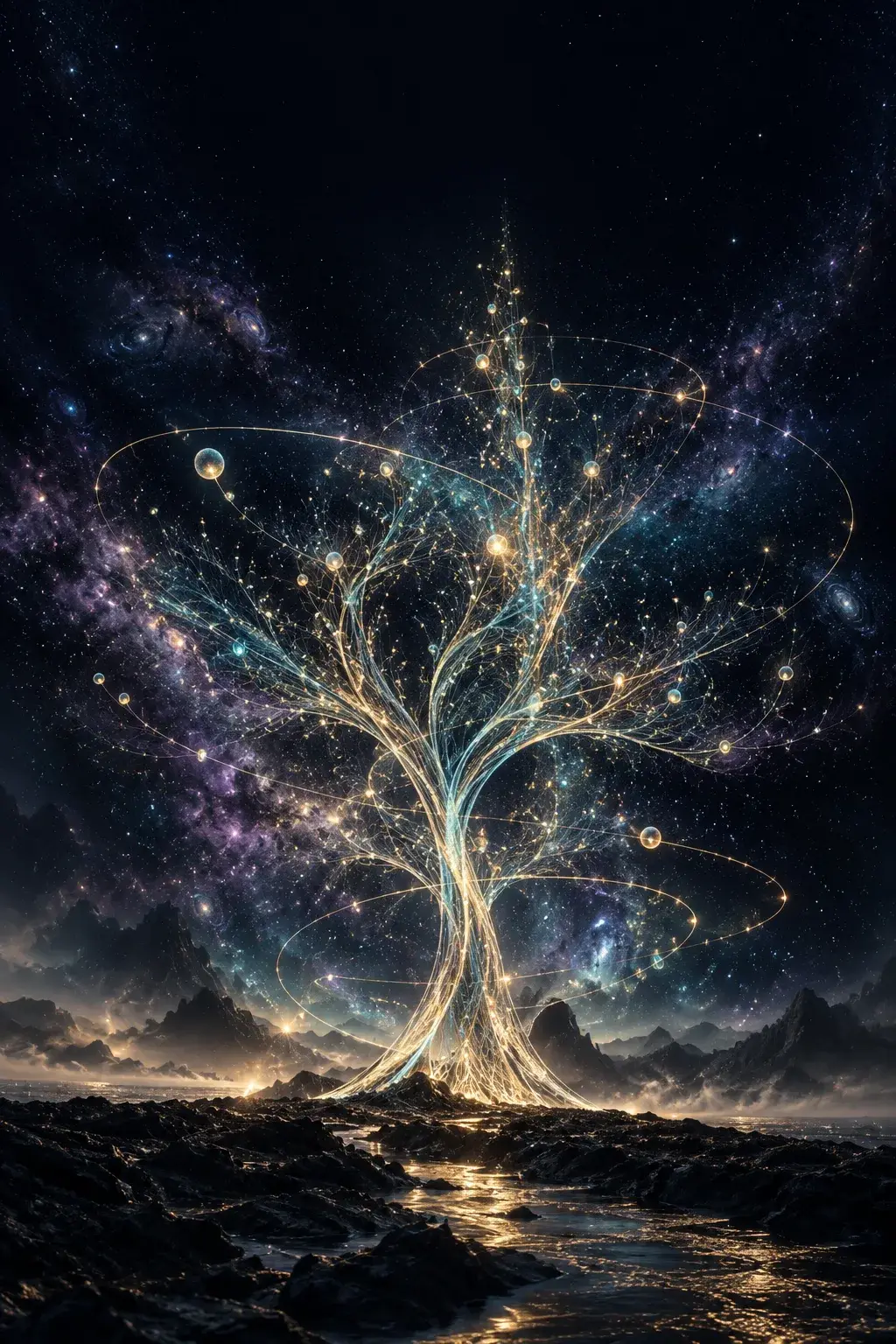
Original generated artwork is metaphorical. Charts and diagrams are editorial graphics. No artwork depicts verified entities, energy fields or mechanisms. The artwork direction is cosmic filaments and luminous ribbons, made with built-in image generation. This is not an IONS publication or endorsement.
Sources / Continue the conversation
The trail stays visible.
- Episode and publication date ↗
Mayim Bialik’s Breakdown, 17 September 2026. Official episode page; supplied partial notes inform detailed episode claims.
- Retrospective archive comparison ↗
Wahbeh et al. Semantic Correspondence Between Trance-Channeled ET Messages and Ufological Records. DOI: 10.31275/20263817.
- Prospective semantic analysis ↗
Wahbeh & Glick (2026). Semantic Structure and Correspondence. Abstract-level numerical reporting. DOI: 10.1080/02604027.2026.2656120.
- IONS explanatory article ↗
What Happens When Three Channelers Describe the Same Extraterrestrials? Includes the declined-verification discussion.
- Telephone experiment ↗
Wahbeh, Cannard, Radin & Delorme (2024). Who’s Calling? EXPLORE 20(2), 239–247. DOI: 10.1016/j.explore.2023.08.008.
- Companion qualitative paper ↗
Wahbeh & Glick (2026). Qualitative Structure and Meaning. Linked for follow-up; not an independent dataset.
- Presentation-level update ↗
A Vision for Humanity, ConnectIONS Live, 18 September 2026. The magazine uses the saved 49-slide review; no spoken-webinar audit.
- Framework baseline ↗
AkashicOMNI v0.4.3 PRE-ALPHA, release dated 19 September 2026. This feature is not a full execution of every framework perspective.
What result would change your interpretation?
With thanks to Dr. Helané Wahbeh, IONS, Mayim Bialik and Jonathan Cohen for opening the conversation. The next step is to keep the questions both imaginative and testable.