AKASHICNET · FLAGSHIP ARTICLE 02 · UPDATED 24 SEPTEMBER 2026
A Vision for Humanity
All 49 Slides Analysed Through Scientific, Spiritual and Cultural Lenses
An AkashicOMNI Review of Helané Wahbeh’s Institute of Noetic Sciences (IONS) Webinar [18 September 2026]
Original presentation:A Vision for Humanity: Convergent Themes Across Trance-Channeled ETI Communication, Helané Wahbeh, ND, MCR, Director of Research, Institute of Noetic Sciences. ConnectIONS Live, 18 September 2026.
Analysis: AkashicNET, developed with AI assistance. Expanded review, 24 September 2026. Approximately 35–45 minutes to explore in full; use the rooms below for a shorter visit.
Scope: All 49 PDF pages, including introductory material, section dividers, acknowledgments and the final questions slide. This is a presentation-level review with new comparative interpretation. It is not a new statistical analysis, a transcript of the webinar, or an independent audit of the underlying papers and data.
AkashicNET × AkashicOMNI · Rewatch Reflections
We Are All One: Love, Leadership & Enough for Everyone
An Institute of Noetic Sciences webinar, explored through spiritual meaning, scientific scrutiny and everyday care.
(6-Minute Read)Webinar: Reflections:
ET phone home? Homer answers: “D’oh!”
Rewatching Helané Wahbeh’s A Vision for Humanity: Convergent Themes Across Trance-Channeled ETI Communication, I expected to think about consciousness and extraterrestrial intelligence. Instead, I kept returning to leadership, love, attachment, housing—and who waters the tomatoes.
The slide about why she wanted to share this material was a tearjerker for me: a garden, a shared meal, generations together. Its reference to Charles Eisenstein’s The More Beautiful World Our Hearts Know Is Possible captured the emotional invitation. Whatever we conclude about the source of the communications, what would it mean to make care ordinary?
A shared table, a listening ear, someone watering the tomatoes. What could everyday care make possible? AI-generated conceptual artwork for AkashicNET × AkashicOMNI.
What Was Actually Studied?
Channelers
3
Sessions
30
Named ETI Groups
10
Questions
28
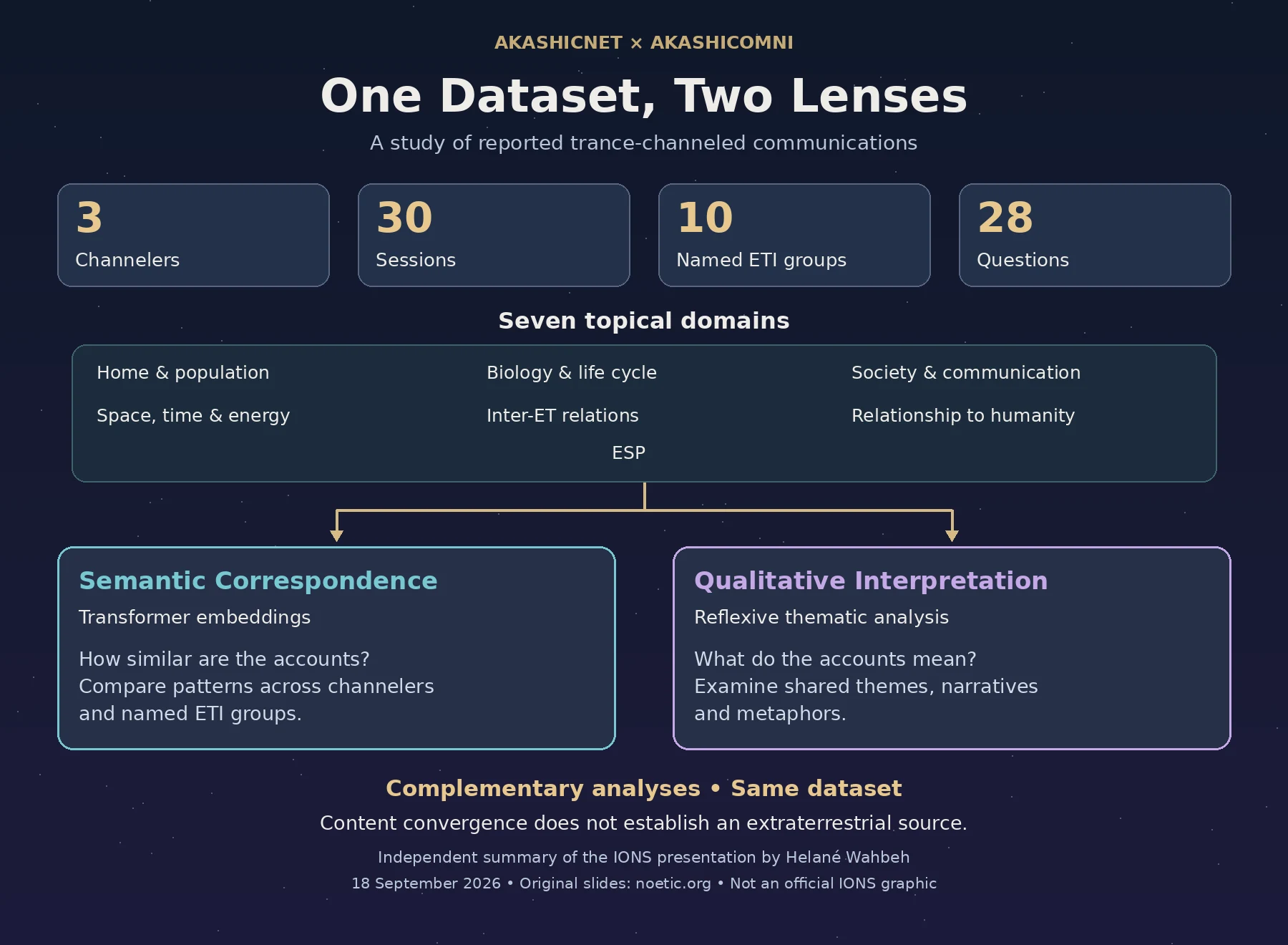
The presentation describes three experienced trance channelers taking part in thirty structured sessions addressing ten named purported ETI groups. The protocol covered seven domains:
Home and population
Biology and life cycle
Society and communication
Space, time and energy
Inter-ET relations
Relationship to humanity
ESP
Sessions were recorded, transcribed, de-identified and manually verified.
Two analyses examined the resulting dataset. Transformer embeddings compared semantic patterns; reflexive thematic analysis explored meaning, narratives and metaphors. These approaches can complement one another, but two analyses of the same material are not two independent replications.
Five themes reported in the accounts:
Consciousness as primary
Non-linear time
Abundant energy with ethical limits
Telepathy as foundational communication
Humanity in transition within a wider interspecies ecology
These are themes identified in accounts attributed to ETI. Their recurrence does not establish those accounts as descriptions of external reality.
Three channelers, thirty sessions, two complementary analyses. Exploring patterns and meaning leaves the source of the communications unresolved. Independent editorial diagram based on the presentation.
If We Are All One, What Would That Ask of Us?
The presentation’s “We Are All One” slide reports a non-harm and cooperation theme across all thirty sessions, with no external ruling deity in those accounts. The ethical invitation is powerful: extend concern beyond the familiar boundary of self.
My interpretation adds an essential question: does our idea of oneness leave room for individuality, consent and disagreement? Treating another person as connected to us should make us more curious about their needs. It should not let us presume we know what they want. Connection with freedom is a more demanding aspiration than everyone agreeing.
Enough for All, and Room to Disagree
Another slide proposes a sequence: consciousness acts on matter; nobody lacks anything; there is nothing to trade; there is nothing to fight over. Each step needs examination. The account of mentally creating a house is testimony within the dataset, not a demonstrated construction method.
Even if material needs were met, people could still exchange art, skills and experiences. Disagreements over autonomy, recognition or how to share a place might remain. Abundance would not automatically settle questions of power. The more practical invitation is to ask how communities could provide essentials, distribute responsibilities and respect ecological limits.
“Everyone’s Needs Are Met” introduces a further idea: caring for others can be joyful. Having enough resources and choosing to care are related but distinct. A workable human version would need both provision and institutions that hear people who are overlooked.
Even in the cosmic café, someone may want the music turned down. Abundance still needs listening.
Secure essentials, shared gardens and room to disagree. A flourishing community needs both provision and the wisdom to listen. AI-generated conceptual artwork; an imagined society.
Leadership, Love and Impermanent Attachments
While listening, I wondered why leaders make the decisions they do. Greed, popularity and inflated ego came to mind. Then another possibility: loyalty, passion and love for something impermanent—a person, party, nation, institution or ideal.
“I care about this” can become “this must survive at any cost.” A founder might sincerely serve a community while also needing to remain its indispensable protector. Reform could honour the original purpose while threatening the identity built around it. These are possibilities for reflection, not findings of the IONS study or diagnoses of particular leaders.
Can loyalty accommodate disagreement?
Can conviction survive correction?
Can love allow change?
Understanding a motive does not remove responsibility for consequences. Compassion needs accountability: who bears the costs, who can question decisions, and what happens when someone says no?
If everyone’s essentials were secure, would those with power welcome people’s greater freedom to disagree? A beautiful shared vision still needs protections for those who do not share it.
Spiritual Openness, Scientific Scrutiny
The Affirmative Reading. This takes experience, ethical imagination and the possibility of transformation seriously. These narratives may prompt care, restoration and responsibility without requiring certainty about their attributed source. Their coherence makes them worth examining.
The Critical Reading. This asks what else could produce that coherence. Three channelers are not thirty independent observers. Familiar cultural narratives, shared prompts and expectations remain possible contributors. Semantic similarity measures resemblance, not truth or extraterrestrial origin.
Stronger follow-up could preregister comparisons, examine prior familiarity, use suitable control accounts and seek independent replication. Contradictions deserve attention alongside convergence. For reflexive thematic analysis, transparent interpretive decisions and researcher assumptions are especially useful; requiring inter-rater agreement automatically would misunderstand that approach.
Our “50:50” approach gives comparable editorial attention to spiritual meaning and scientific scrutiny. It does not assign a fifty-percent probability to ETI contact.
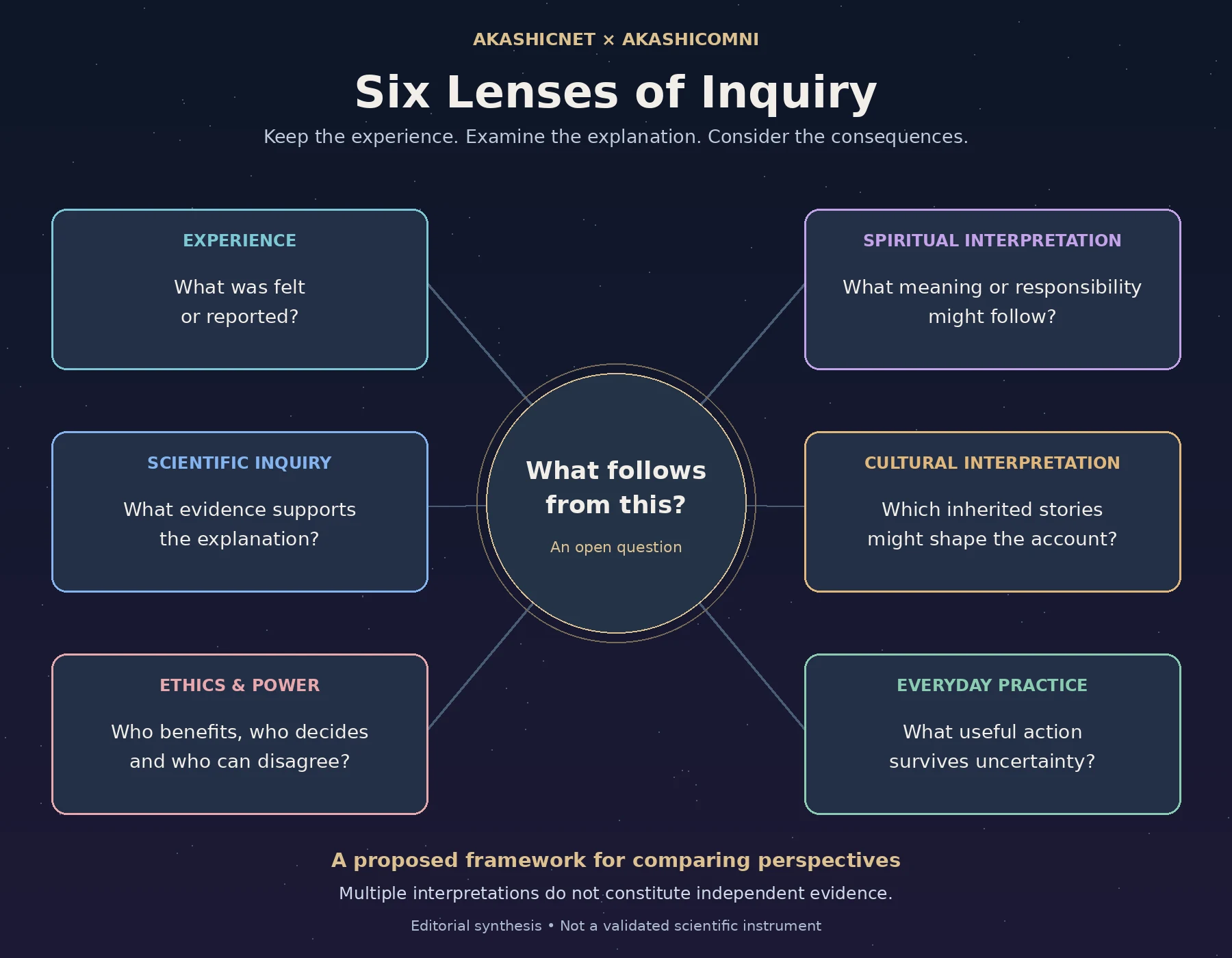
Honour the experience, examine the explanation and consider what follows. Six perspectives for open inquiry, with evidence and interpretation kept distinct. Proposed editorial framework, not a validated instrument.
A Place to Park the Question
AkashicOMNI offers perspectives to compare. Our AkashicPRISM exploration similarly invites reflection on how perception shapes interpretation. Neither supplies independent confirmation of the webinar’s claims.
The Memory Palace turns that invitation into an imagined reading space: ocean views, trees, coffee or green tea, a little 85% cacao, and room for an unanswered question. The Stargate 7:13 and cosmic pyramid are creative symbols. The Hyper-Meowing Toad has not submitted a paper.
Coffee, tea, ocean air and room for an unanswered question. Step into an imagined reading space where curiosity meets reflection. Even the toad is listening. AI-generated conceptual artwork.
For me, the useful next step is small enough to practise: share a meal, listen without taking over, correct an error, allow someone freedom, tend a shared place. A hopeful story earns practical value through what we do with it.
We are all one? Perhaps. Meanwhile, someone still needs to water the tomatoes.
What Kind of World Are These Accounts Asking Us to Imagine?
A civilization that treats care as ordinary, education as lifelong discovery, ecological repair as meaningful work and disagreement as something to resolve without violence is worth thinking about. We do not have to settle the existence of its purported inhabitants before examining the vision.
In this IONS presentation, Helané Wahbeh describes research into the content of accounts attributed by trance channelers to extraterrestrial intelligences, abbreviated ETI. The methodological distinction is crucial: studying what people report is different from demonstrating where the information originates.
The presentation reports three experienced channelers, 30 sessions, ten named purported ETI groups and a standardized 28-question protocol covering seven domains. Two approaches examine the resulting material: semantic comparison of language and qualitative interpretation of themes.
Five themes emerge in the researchers’ presentation: consciousness as primary, non-linear time, abundance bounded by ethics, telepathy as ordinary communication, and humanity undergoing a developmental transition. Those are reported themes within narratives. Their recurrence does not establish their physical or metaphysical truth.
Our question is therefore twofold: What can these accounts contribute to understanding human meaning and possible ways of living, and what would stronger evidence be needed to establish?
How the Lenses Work
Here, a spiritual lens explores meaning, contemplative possibilities and ethical development. It does not assume one spiritual tradition speaks for all others. A scientific lens examines methods, evidence and competing explanations. A psychological and cultural lens asks how expectations, shared stories and social context might shape the accounts. An ethical and systems lens explores consequences for actual institutions and relationships.
AkashicOMNI is the framework for comparing those perspectives. It identifies overlap, disagreement and unanswered questions; it is not an additional source of empirical confirmation.
“50:50” means comparable editorial attention to spiritual interpretation and scientific scrutiny. It does not assign a 50% probability to ETI contact or give every explanation equal evidential support.
Throughout this review, keep five categories distinct:
Documented presentation: what the deck contains.
Reported finding: what the researchers say their analysis found.
Testimony: what channelers describe or attribute to purported sources.
Interpretation: what we infer or explore from that material.
Thought experiment: a constructed scenario used to examine implications.
Five Themes, Several Readings
Reported theme
Spiritual interpretation
Scientific question
Cultural or systems question
Consciousness is primary
Interconnected awareness could support compassion and a less isolated sense of self.
What observation would distinguish this account from competing explanations? Narrative consistency alone cannot do so.
Does the language reflect familiar idealist or noetic traditions? How would the ethic change conduct?
Time is non-linear
The theme invites reflection on presence, memory and experienced time.
Subjective time, physical time and claims of access to future information require different tests.
Which metaphors recur, and do different speakers mean the same thing by them?
Energy and resources are abundant
Sufficiency and generosity offer an alternative to fear-driven accumulation.
What technology or physical process is being claimed, and is there independent measurement?
Even with plentiful goods, who allocates attention, land, status and decision-making power?
Telepathy is ordinary
It evokes intimacy, mutual understanding and connection.
Can information transfer exceed appropriate blinded controls? The deck does not present that test.
How would privacy, consent and the right to remain silent operate?
Humanity is in transition
Hope can sustain ethical development and repair.
What specific, time-bounded prediction could be evaluated?
Does the story encourage action, or excuse harm as an inevitable phase?
These readings can coexist without becoming interchangeable. A story may be ethically productive, culturally familiar and factually unverified at the same time.
THE PAPER ROOM · SOURCE CHECKED 24 SEPTEMBER 2026
Two Papers, One Dataset: A Deeper Reading
Access and scope: We could read the official IONS abstracts and the research team’s explanatory article. Publisher full-text access was blocked. This is a deeper appraisal of those accessible sources, not a completed full-paper audit. Questions about unexamined methods are questions, not findings of omission.
Visual 1 · What the two analyses share Study design as reported in the presentation; the two methods do not create two independent samples.
3 channelers · 30 sessionsStandardized questions across 7 domains
One transcript datasetThe common input to both analyses below
Language comparison
How similar are representations of the responses?
Semantic correspondence paper
Interpretation of meaning
What themes, narratives and metaphors recur?
Qualitative analysis paper
Shared boundary: neither route independently establishes the identity of a purported source.
Paper 1 · Semantic Structure and Correspondence
Helané Wahbeh and Beth Glick (2026). DOI: 10.1080/02604027.2026.2656120. The IONS abstract describes prospective structured interviews analysed with transformer sentence embeddings. It reports same-target correspondence across channelers of 0.65–0.79, and within-channeler correspondence across targets of 0.75–0.88 after residualization. It frames the result as internal organization of the material, without claims establishing external entities.
Visual 2 · Two reported ranges, two different comparisons Numbers transcribed from the official abstract. These are not accuracy percentages, confidence intervals or probabilities of ETI contact.
0.65–0.79
Across channelers
Same named ETI target
Reported semantic correspondence
0.75–0.88
Within a channeler
Across different ETI targets
Reported after residualization
The ranges are displayed separately because the abstract does not establish that they can be compared as equivalent measures. No significance test or ranking is inferred here.
Our interpretation: Similar descriptions of the same target may indicate a reproducible narrative pattern. Similarity across different targets within one speaker raises a separate question about recurring speaker characteristics or common themes. These possibilities can coexist. The two ranges alone do not isolate a target-specific signal from a speaker-specific contribution.
Why residualization matters: In general, residualization removes variation attributed to specified terms in a model. Its interpretation depends on what was removed and how. The accessible abstract does not give enough detail to reconstruct this procedure. We therefore cannot say that it removed cultural influence, question effects or every source of dependence.
What a stronger appraisal must inspect: the embedding model and version; the exact response unit; inclusion of question text; treatment of length and negation; the residualization model; baselines; uncertainty estimates; and whether the statistical analysis respects repeated observations within three people. A high-looking similarity value means little without the distribution expected under a relevant comparison condition.
The researchers’ explanatory article describes stronger-than-random correspondence. That claim needs the actual baseline and test to evaluate. Randomly assembled text would answer a different question from culturally informed participants responding to the same interview guide. The best control depends on which alternative explanation is being tested.
Spiritual and cultural reading: Recurrence may make the accounts meaningful material for comparison across experiences. Whether that recurrence reflects common traditions, ordinary cognition, an anomalous process or a mixture remains a separate explanatory question. A personally resonant passage does not determine which explanation generated it.
Paper 2 · Qualitative Structure and Meaning
Helané Wahbeh and Beth Glick (2026). DOI: 10.1080/02604027.2026.2656119. The IONS abstract reports reflexive thematic analysis of prospective interviews, identifying coherent descriptions, recurring themes across ETI accounts, and shared narrative forms and metaphors. It presents the material as organized meaning-making discourse without establishing external entities.
Our interpretation: This is a question about how accounts make sense and what patterns a situated analysis develops. It can add detail that a similarity measure misses: two passages might use related words but attach different moral meanings to them. Conversely, different vocabulary can express a similar relationship or ethical concern.
What depth requires: A full appraisal should examine how the researchers moved from extracts to themes, their assumptions and positioning, how exceptions changed the interpretation, and the breadth of material supporting each theme. Selected vivid quotations help readers understand an interpretation but cannot alone establish its prevalence throughout a corpus.
Frequency and importance: A theme’s significance is not automatically a count. If a later presentation says a proposition occurred in every session, that becomes a separately checkable coverage claim requiring a defined unit and denominator. This matters especially when silence about a practice is interpreted as evidence that the practice does not exist.
Two methods, possible tension: The qualitative analysis should not be treated merely as a stamp of approval on the numerical analysis. It may reveal contradictions, unstable meanings or speaker differences that qualify the similarity scores. A valuable joint reading makes those disagreements visible.
Visual 3 · From a meaningful account to a justified conclusion An editorial guide to inference, not a measured result or the paper’s original figure.
Account
A participant describes an experience or society.
Testimony
Pattern
Researchers identify recurring language or themes.
Reported analysis
Interpretation
Readers explore meaning, ethics and possible explanations.
Reasoned commentary
External verification
A separately testable claim requires independent observations.
Not supplied by coherence alone
The Most Important Unresolved Question: Verification
The IONS team’s article says requests for independently verifiable information were consistently declined in the accounts, with reasons emphasizing inner discernment. This is relevant narrative content. It is not a successful verification result.
A compassionate interpretation can respect a participant’s experience and the meaning they find in it. A scientific interpretation must still ask what could distinguish the account from alternatives. If both an accurate answer and a refusal are treated as confirmation, the proposed test can no longer discriminate between explanations.
Nor does refusal itself establish deception or disprove every anomalous possibility. It means this request did not supply the independent information needed for that verification. Sincerity, felt certainty, useful guidance and externally checked accuracy are different dimensions.
What Would Change This Assessment?
Complete methods and supplements could show which controls were implemented and resolve uncertainties currently left open.
Accessible, appropriately de-identified data and code could make numerical findings independently checkable.
A larger independent sample could test whether patterns generalize beyond these participants.
Matched culturally informed controls could test whether the named-group patterns are distinctive.
A separate preregistered information task could examine accuracy against independently verifiable targets. Establishing an ETI identity would require additional evidence beyond an anomalous result.
Current assessment: The accessible sources support a research program examining structured discourse. They do not settle the origin of the accounts. Our contribution here is to clarify the findings reported, the interpretations available and the evidence required for stronger conclusions.
All 49 Slides: Source Content and Comparative Analysis
The numbering below follows PDF pages. Descriptive labels are paraphrases, not guaranteed verbatim slide headings. Introductory and transition pages receive brief treatment; substantive claims receive fuller analysis.
The opening establishes the presentation’s identity and institutional provenance. That matters for attribution and locating the source. Neither a research affiliation nor an academic credential verifies the extraordinary claims discussed later. Our first task is to distinguish who presented the research from what the research can demonstrate.
Provenance and authority
Deeper interpretation: The presenter’s role helps locate responsibility for the work. It cannot replace examining the methods. Readers should be able to move from every claim to a source, rather than relying on institutional prestige.
Question for discernment: Which statements belong to the presenter, participants, researchers or this review?
The framing invites an interconnected view of existence. Spiritually, this can support care extending beyond the individual. Analytically, ecological dependence, interpersonal connection and universal consciousness are different propositions. Evidence for one should not silently become evidence for all three.
Two meanings of connection
Deeper interpretation: An ethical commitment to mutual dependence can guide conduct without settling whether all minds form one consciousness. Keeping those meanings separate allows philosophical openness without borrowing evidence from a different claim.
Question for discernment: Would the ethical invitation remain valuable under a different account of consciousness?
Slide 3 · Awareness Beyond Ordinary Space and Time
This page introduces an expansive noetic proposition. A spiritual reader may find it a useful invitation to explore experience. A scientific reader needs an operational definition: what would count as information acquired beyond ordinary access, under what safeguards, and compared with what baseline? The page itself supplies no such test.
Experience and acquisition
Deeper interpretation: Feeling unconstrained by time or space and acquiring accurate inaccessible information are different observations. A first-person description matters as experience; a claim about information requires checking its accuracy and ordinary routes of access.
Question for discernment: What would count as a miss, and would misses be recorded as carefully as apparent successes?
Slide 4 · Transformation, Innovation and Well-Being
The benefits are aspirational within this presentation. They suggest research questions about whether engagement with these ideas changes behavior or well-being. They are not measured outcomes here. A useful future study would separate inspiration, durable benefit and possible adverse effects rather than assuming they move together.
From inspiration to outcomes
Deeper interpretation: A moving presentation may produce immediate hope without durable changes. A future evaluation could examine concrete actions, duration and unintended effects alongside participants’ own accounts of meaning. Inspiration is an outcome worth describing accurately.
Question for discernment: What changed after a week or a month, and what else could explain it?
This repeats the framing of slide 3. Repetition can strengthen attention and thematic continuity, but it adds no independent evidence. In an evidence ledger, it belongs to the same underlying proposition rather than becoming another confirming observation.
Repetition as rhetoric
Deeper interpretation: Repeated framing can make a theme feel increasingly familiar. Our editorial task is to preserve the communication strategy while counting the underlying proposition once. Repeated illustrations and repeated sources likewise should not inflate apparent support.
Question for discernment: Are we responding to additional evidence or to growing familiarity?
The presentation places intuition, mediumship and trance channeling on a descriptive continuum. This may help audiences discuss experiences without immediate dismissal. However, proximity in a diagram does not establish a shared cause. Similar labels can also cover substantially different experiences. The qualified description of apparent ETI communication should be preserved.
Taxonomy before mechanism
Deeper interpretation: Grouping experiences is useful for asking questions, but categories should retain differences in agency, awareness and attributed source. A continuum can become misleading if it implies that a familiar intuition validates every more extraordinary category.
Question for discernment: What features distinguish each experience, and could different mechanisms produce similar descriptions?
The cited historical statistic concerns 74% of 488 societies, not 74% of people. Cross-cultural occurrence makes the subject relevant to anthropology and psychology; it does not authenticate a paranormal source. A cultural lens also asks whether older categories of possession or ritual experience map appropriately onto contemporary trance channeling. The underlying source requires its own review.
Cultural humility
Deeper interpretation: Studying practices across societies requires attention to local meanings rather than treating every tradition as an interchangeable example. Respect includes acknowledging differences in ritual, authority and interpretation. A broad survey label is only a starting point.
Question for discernment: Would practitioners recognise their experience in the category used by the researcher?
The chart concerns a reported source category in a cited survey. It is not a claim that 36% of humanity channels, nor a contact-verification rate. Respondents may report overlapping categories. Before drawing prevalence conclusions, we need the survey’s recruitment, denominator and question wording. Respect for respondents’ accounts does not require treating their source attribution as independently verified.
Labels and lived meaning
Deeper interpretation: The source categories invite investigation of how people interpret experience. A person may understand a communication through several labels. Adding those percentages would therefore be inappropriate without knowing whether responses were mutually exclusive.
Question for discernment: How did participants choose labels, and were their own descriptions preserved?
This is the deck’s methodological anchor. The current methods address the content and structure of reports; they do not resolve the identity of their source. That boundary should remain visible throughout the review. Spiritually meaningful interpretations remain possible, but later accounts of societies and technologies must still be read as attributed narratives.
A boundary worth maintaining
Deeper interpretation: Bracketing origin makes a tractable content study possible. It does not make origin irrelevant forever. Conclusions must remain matched to the research question actually investigated; meaningful language is a finding about language before it is a finding about another world.
Question for discernment: Where does a later statement move from reported narrative into an unsupported claim of external fact?
Slides 10–17: Design, Findings and Audience Preparation
Slide 10 · Earlier Channeling and UFODex Comparison
An earlier study compares material through ten questions. Overlap could be interesting, but two bodies of related narrative may share cultural influences or sources. Comparison does not automatically provide independent corroboration. This slide does not supply enough statistics or provenance analysis to distinguish those possibilities.
Comparison and source dependence
Deeper interpretation: Two archives can converge because their authors encountered overlapping stories. The important unit is not simply the document count but the degree of independence between sources. A provenance map would help identify quotation, borrowing and common background.
Question for discernment: What comparison material would be equally culturally familiar but unrelated to the claimed sources?
Prospective, standardized collection is a useful feature of the reported design. The deck describes recording, transcription, de-identification, manual checking and ethics approval. These are procedural claims to verify in the methods. Thirty sessions remain clustered within three individuals: repeated sessions expand the material, but they do not create thirty independent observers.
The participant is a recurring influence
Deeper interpretation: Thirty interviews offer detail, yet a speaker’s vocabulary, worldview and style can recur across sessions. Any analysis of apparent group signatures needs to consider this participant contribution. More text does not automatically compensate for few participants.
Question for discernment: Would the main pattern survive leaving out each channeler in turn?
The domains organize questions about habitat, biology, society, space and time and energy, intergroup relations, humanity and ESP. Shared questions enable comparisons. They can also generate shared vocabulary and topics. Analysis should distinguish agreement produced by the interview structure from convergence in the substance of answers.
The interview shapes the answer space
Deeper interpretation: Asking every speaker about the same seven domains creates useful structure. It also focuses attention on selected subjects. Unprompted recurrence, agreement after a prompt and agreement induced by a leading question should be distinguished.
Question for discernment: What important themes appeared outside the interview guide?
Semantic comparison and reflexive thematic analysis offer different views of the same dataset. They are complementary, not independent replications. An embedding model assesses relationships in language; it does not verify the external world described. Qualitative interpretation needs transparent decisions, researcher reflexivity and traceable examples, including tensions and exceptions.
Two lenses and one source
Deeper interpretation: Quantitative resemblance can motivate close reading, while close reading can explain why resemblance occurs. Neither method makes the other independent. A strong synthesis should also show instances where numeric similarity and interpreted meaning disagree.
Question for discernment: Were contradictions, negation and metaphor examined when similar wording concealed different meanings?
The presentation synthesizes consciousness, time, abundance, telepathy and human transition. A spiritual reading sees a coherent vision of connected life. A critical reading asks how the themes were developed, how broadly they occur and what contrary accounts were retained. The thematic pattern may be a research finding even while the propositions inside it remain unverified.
Themes are not frequencies
Deeper interpretation: A theme can be analytically important without being the most frequent phrase. Conversely, frequent wording can be structurally uninformative. We should not assign percentages to the five themes unless a separately defined coding procedure supplies denominators.
Question for discernment: What is the richest counterexample to each theme?
References make the work traceable and invite closer scrutiny. Publication is a route to examining methods and arguments, not a substitute for doing so. In particular, semantic and qualitative papers based on the same material should not be counted as independent confirmation from separate samples. This review has not audited their complete methods or datasets.
Publication as an invitation to inspect
Deeper interpretation: The DOI provides a stable way to locate a work. It is useful for checking revisions, methods and limitations, but publication status alone does not establish the truth of every sentence or an independent replication.
Question for discernment: What can we verify in accessible source text, and which questions require the complete paper?
The image communicates a social aspiration. It helps audiences imagine how cooperation might feel. Its evidential role is illustrative: it is not a photograph documenting an observed extraterrestrial community. Visual appeal should not quietly change the status of the accompanying claims.
The image as an imagined destination
Deeper interpretation: An attractive community image can help translate abstract values into a felt possibility. It can also make a proposed society seem more concrete than the evidence warrants. Labelling illustration protects the distinction between aspiration and observation.
Question for discernment: What institutions would make the pictured values possible in practice?
This is audience pacing, not a research result. A pause can offer space to notice reactions to unfamiliar material. That reflective use is compatible with keeping emotional receptivity separate from factual acceptance.
A pause for discernment
Deeper interpretation: The breathing pause can be used to notice enthusiasm, resistance or uncertainty before continuing. These reactions tell us something about our engagement. They do not by themselves adjudicate the truth of a claim.
Question for discernment: Can I notice my response without immediately turning it into a conclusion?
Slides 18–26: Consciousness, Provision and Abundance
The section introduces an ontological position about the basis of reality. It can be explored philosophically, but the section divider does not establish it. The useful distinction is between entertaining a worldview and treating that worldview as experimentally demonstrated.
Ontology and explanatory reach
Deeper interpretation: A consciousness-first interpretation raises questions about how individual minds relate to a shared world. Giving consciousness a foundational role does not by itself explain why events follow stable patterns or why people disagree.
Question for discernment: What does this worldview explain, and what assumptions does it still require?
The reported ethical convergence invites reflection on responsibility toward others. Claims extending across every session require transcript-level checking and explicit coding rules. A practical ethical lens asks how non-harm handles competing needs, self-defense and disagreement. A principle becomes more informative when its difficult cases are explored.
Non-harm under disagreement
Deeper interpretation: An ethic of oneness still faces cases where needs compete. Protecting one person may constrain another. Compassion becomes institutionally meaningful when paired with reasons, proportionality and opportunities to challenge an unfair decision.
Question for discernment: Who decides what counts as harm when affected people disagree?
The account describes provision through intention or mental activity. Spiritually, it can symbolize sufficiency and creative agency. Scientifically, no material manifestation is observed or measured here. The symbolic interpretation and the literal physical claim should remain separately labelled.
Agency without omnipotence
Deeper interpretation: The manifestation narrative can be explored as an image of creative agency. Translating it literally into claims that individuals cause every circumstance would exceed the evidence and can misplace responsibility for suffering.
Question for discernment: Which changes are within a person’s control, and which require collective support?
This continues the same attributed account rather than providing independent corroboration. Its imagery may prompt questions about identity and the relationship between mind and body. The accompanying building photograph is illustrative. Neither narrative continuity nor an evocative image supplies a physical test.
Continuity of a single account
Deeper interpretation: An extended narrative may be internally coherent because one speaker develops it consistently. That is a feature to describe, not independent corroboration. Tracking the speaker and transcript identifier across slides prevents double counting.
Question for discernment: Would a separately collected account supply the same specific details without shared prompts?
Slide 22 · From Manifestation to the End of Scarcity
The proposed chain links mind–matter influence, provision and reduced conflict. It contains several assumptions that need separate evaluation. Even a thought experiment granting abundant material goods leaves possible conflicts over recognition, belonging, location and authority. This is an especially useful point for systems analysis.
Scarcity has several forms
Deeper interpretation: Even if the thought experiment grants unlimited material production, attention, recognition and preferred locations may remain contested. Distinguish a reduction in deprivation from the elimination of every competing preference.
Question for discernment: What governance remains necessary after basic needs are met?
The accounts express unconditional provision and mutual care. Their ethical appeal can be discussed directly. Analytically, an explicit denial of wages or poverty differs from an interview that never mentions them. Absence, omission and researcher inference should be coded separately before making comprehensive claims.
Provision and choice
Deeper interpretation: A society can meet basic needs while still facing questions about autonomy, allocation and unusual requests. Benevolent provision is stronger when recipients have a voice and can question those deciding what they need.
Question for discernment: Who defines enough, and can someone reject the offered arrangement?
The material imagines creativity and contribution without a sharp division between work and pleasure. It offers a prompt for considering meaningful activity in human life. The harder institutional questions remain: who performs necessary tasks that few enjoy, how are skills developed, and how are people supported when participation is difficult?
Purpose and invisible labor
Deeper interpretation: A joyful account of work should also make room for maintenance, care and unpleasant tasks. A practical translation asks how such labor is recognised and shared without pressuring people to display constant enthusiasm.
Question for discernment: Can someone rest, decline work or struggle without losing dignity or support?
Descriptions of crystal-powered craft and plentiful energy are unverified technological claims. Engineering evaluation requires specifications, measurements and reproducible testing. A narrative may inspire a question, but it cannot serve as an energy budget. Environmental aspiration should remain grounded in the technologies and constraints we can actually assess.
A technology needs an account of operation
Deeper interpretation: A named material such as a crystal does not specify a usable energy mechanism. A technical proposal would need inputs, outputs, reproducibility and limits. The spiritual symbolism of abundance should not stand in for those details.
Question for discernment: What observation would demonstrate net usable energy and rule out ordinary sources?
The accounts emphasize stewardship and distribution. That invites a useful discussion about how ownership and institutions affect access. It does not establish that ecological or material limits disappear. Compassionate provision still needs practical decisions about infrastructure, maintenance and environmental costs.
Enough and fair are separate questions
Deeper interpretation: There may be enough of some resource in aggregate while access remains unequal or delivery difficult. Ethical commitment is relevant to distribution, but transport, infrastructure and ecological costs still need attention.
Question for discernment: Which obstacle is distributive, which is technical, and which is an ecological limit?
Slides 27–36: Living Together, Learning and Restoration
This organizational slide moves attention toward communal life. It introduces a new topic, not an additional result. A clear presentation should preserve that distinction rather than treating every page as a separate finding.
From worldview to arrangements
Deeper interpretation: The transition to social life lets us ask whether the ethical vision specifies workable relationships. Agreement on values can conceal disagreement on institutions. The following slides are most useful when read for that missing middle.
Question for discernment: How would a value become a procedure people could inspect and challenge?
Mediation and councils distinguish harmony from forced unanimity. Ethically, this is a productive theme. A systems lens asks who selects mediators, whether weaker parties can appeal and how coercion is prevented. The accounts describe arrangements; they do not supply observed evidence of their effectiveness.
Mediation and unequal power
Deeper interpretation: A council can support fair resolution or reproduce existing influence. Its name alone does not tell us which. Participation, independence, appeal and protection from retaliation are practical tests of the arrangement.
Question for discernment: Can the least powerful person safely challenge the mediator?
Individuality within a collective offers a counterpoint to the fear that unity means conformity. The ethical test is whether difference remains protected when it becomes inconvenient. Illustrations of beings are not evidence of observed species; their role is to communicate the narrative.
Belonging without sameness
Deeper interpretation: Unity is ethically attractive when membership does not require surrendering conscience. The difficult test comes when an individual’s view disrupts group harmony. Protecting difference requires more than celebrating it in principle.
Question for discernment: Is dissent welcomed only when it leaves authority unchallenged?
The attributed descriptions include early awareness and telepathic cultural transmission. These are not developmental research findings. They may raise philosophical questions about learning and identity, but claims of information transfer would require appropriately controlled investigation. They should not become advice about human infant development.
Learning and inherited meaning
Deeper interpretation: A narrative of being born aware may invite reflection on how much knowledge is learned versus assumed. Literal prenatal cultural transfer remains a distinct claim requiring independent evidence and clearly specified information.
Question for discernment: What knowledge is claimed, when is it demonstrated, and what ordinary access must be excluded?
Slide 31 · Communal Mentoring and Reproductive Technology
Two kinds of idea appear together: a social ideal of shared care and extraordinary biological descriptions. They need different evaluation. Shared mentoring can be discussed through consent, responsibility and safeguarding; unusual reproductive technology requires independent physical evidence. One idea’s plausibility does not validate the other.
Shared care and clear responsibility
Deeper interpretation: Communal mentoring can broaden support while also dispersing accountability. Practical evaluation would ask who is responsible for safety, how boundaries are respected and how a child’s preferences are heard.
Question for discernment: Who acts when a mentor is unsafe or a child needs another arrangement?
The accounts favor individual pathways and lifelong learning. This is fertile ground for reflection on curiosity and autonomy. A practical model must also address literacy, access, disabilities, guidance and how unmet needs are recognized. The deck does not compare educational outcomes or establish a universally effective system.
Autonomy with support
Deeper interpretation: Learner-directed education raises a productive tension between freedom and guidance. Some learners may need structure or assistance to access opportunities. A fair model would make flexibility available without leaving support to chance.
Question for discernment: How would the system recognise a learner whose unmet needs are not easily expressed?
Valuing elders is an ethical theme distinct from claims of extraordinary longevity or chosen life transitions. The first can guide reflection on dignity and inclusion; the latter need biomedical evidence. Neither should erase the reality of illness, dependency or the need for care.
Respect without idealisation
Deeper interpretation: Valuing elders should not make people earn dignity through wisdom, productivity or unusual health. An inclusive interpretation supports those with dependency and illness as fully as those who remain active.
Question for discernment: Does the social ideal still make room for vulnerability and uncertainty?
This transition suggests that participation extends beyond the beings usually recognized in human institutions. It changes the narrative’s emphasis, not the evidential status of its claims. An invitation to imagine a broader community is not evidence that such participation has been observed.
Rhetorical presence and observed presence
Deeper interpretation: A transition announcing wider participation can feel like a shift from possibility to fact. The review should identify that rhetorical move and keep the evidential status stable until new observations justify a change.
Question for discernment: What evidence, if any, has been added at this transition?
The material connects animals and planetary or stellar entities within a sentient ecology. A spiritual reading may encourage reverence and responsibility. Scientifically, animal cognition, Earth-system feedback and literal planetary or stellar consciousness are distinct subjects. Evidence about one should not be used to imply the others are established.
Ecology without category collapse
Deeper interpretation: Treating Earth with reverence can motivate care without settling whether a planet has subjective experience. Feedback and interdependence are not automatically equivalent to intention or awareness. Keeping categories distinct improves both ethical reflection and inquiry.
Question for discernment: What would planetary sentience mean operationally, beyond complex environmental feedback?
Repair is presented as meaningful, hopeful work. That may encourage commitment rather than resignation. However, recovery is not guaranteed by a narrative, and the slide supplies no measured ecological or therapeutic outcomes. The practical translation is to support specific restoration efforts and evaluate their results.
Hope with a measure of progress
Deeper interpretation: Restoration narratives can counter despair, but hope becomes actionable through specific goals and feedback. Some losses may remain even after improvement. A responsible account leaves room for grief as well as repair.
Question for discernment: What would count as recovery, for whom, and over what timescale?
This section divider prepares the audience for stories of change. It is a rhetorical and organizational element. Keeping such pages visible in the review explains the full 49-page count without inflating the number of substantive findings.
Transformation as a narrative form
Deeper interpretation: A section about change can make the preceding difficulties appear like necessary steps toward a happy outcome. That structure is meaningful, but it does not establish inevitability. Alternative paths and failures deserve consideration.
Question for discernment: Does the story leave room for change to stall or reverse?
The attributed histories portray cooperation emerging after destructive periods. As an analogy, they can support hope that institutions and behavior are changeable. They are not independently documented interplanetary histories or forecasts. Human progress requires choices and work; it should not be assumed to arrive automatically.
A hopeful analogy is not a forecast
Deeper interpretation: Stories of conflict giving way to cooperation can encourage work toward peace. They become misleading when used to excuse present harm as a required developmental stage. An analogy should not replace evidence about a particular conflict.
Question for discernment: Which concrete action follows from the hope, and who remains accountable now?
The typology contrasts service-oriented societies with hierarchical ones. It preserves variation within the material rather than presenting uniform agreement. Yet differences could also reflect pre-existing stereotypes attached to the named groups. A stronger analysis would compare those cultural expectations with the actual accounts.
Types and stereotypes
Deeper interpretation: A two-profile classification makes a complex narrative easier to grasp. It can also flatten variation within each named group. Analysts should look for mixed cases and avoid treating typologies as fixed biological or moral essences.
Question for discernment: Which account resists the service-versus-hierarchy split?
The recovery account offers a narrative of autonomy and relearning empathy. Its moral structure can be explored without accepting the described devices or brain changes as physical facts. These are attributed elements of one channeler’s account, not independently corroborated observations.
Recovery and agency
Deeper interpretation: An escape narrative invites attention to the conditions that make change possible: safety, choice and support. Its emotional logic can be discussed without converting its extraordinary elements into verified physical history.
Question for discernment: Where does the account show choice, and where is change imposed by others?
Support for formerly harmful groups raises a serious ethical question: how can communities offer rehabilitation while protecting those harmed? Compassion does not itself answer questions of accountability, boundaries or restitution. The narrative offers a starting point for that discussion, not evidence of an observed interspecies support network.
Reception with boundaries
Deeper interpretation: Welcoming people who seek change need not restore them immediately to positions of power. Care for those changing and protection for those harmed are simultaneous responsibilities. The narrative is most useful when both remain visible.
Question for discernment: What safeguards prevent renewed harm while allowing meaningful reintegration?
The selected account gives emotional texture to transformation. Emotional force can explain why a story resonates, but it does not authenticate its history. This material is attributed to the same channeler as slide 40; it should not be counted as agreement between independent witnesses.
Apology and evidence of change
Deeper interpretation: An apology can express recognition, yet its practical significance depends on later conduct and repair. Emotional specificity may deepen a narrative without verifying its origin. Readers should distinguish moving testimony from independently observed change.
Question for discernment: What actions would make an apology credible to those affected?
The deck synthesizes a sequence involving deprogramming, reception, renewed feeling, unlearning coercion, recovering losses and making amends. In the reviewed deck this draws on Draco and Gray material attributed to TCET103. It is a narrative interpretation from one channeler, not a validated treatment model or universal sequence. It may be used for reflection, with that boundary explicit.
A sequence is not a prescription
Deeper interpretation: The six stages describe an interpreted pattern in selected material. People and communities may change in different orders, revisit stages or need different support. Applying the sequence as a universal treatment protocol would go beyond this evidence.
Question for discernment: What cases would challenge the proposed order, and are they represented?
The analogies invite scrutiny of domination, instrumental treatment and our responsibilities toward possible future minds. They do not establish machine consciousness or a predicted technological future. An ethical lens can still ask what evidence would change our obligations, and how uncertainty should affect design choices.
Power over possible minds
Deeper interpretation: The AI analogy invites thought about creating agents for our convenience. Claims about consciousness require their own evidence, while questions about human accountability in design can be examined immediately. Uncertainty should be explicit rather than resolved by metaphor.
Question for discernment: Which obligations depend on sentience, and which already follow from effects on people?
The accounts describe psychic abilities as natural or dormant. That is testimony about capacities, not a demonstration of those capacities. A scientific test requires defined targets, blinding, leakage controls and reproducible outcomes. A contemplative interpretation about becoming more attentive to others should not be confused with verified mind-to-mind transfer.
Understanding and information transfer
Deeper interpretation: Feeling understood can arise through attention and communication without demonstrating telepathy. A test of anomalous transfer needs precise targets and independent scoring. A contemplative practice of listening should retain its own value without borrowing an unverified mechanism.
Question for discernment: Can the proposed ability produce repeatable information beyond what ordinary communication permits?
This can be read as an invitation to choose where effort goes. For practical reflection, intention can be connected to observable actions and reviewed outcomes. The presentation does not measure a paranormal causal mechanism. It also offers no basis for blaming people’s suffering on insufficiently positive thoughts.
Intention made accountable
Deeper interpretation: An intention becomes easier to assess when connected to an action and observable outcome. This permits learning without making every setback a moral failure. Structural conditions and other people’s agency remain part of the explanation.
Question for discernment: What action will express this intention, and how will I notice if it does not help?
The closing expresses a hopeful possibility within human life. Its role is rhetorical and motivational. Readers can ask what it invites them to do, while recognizing that emotional resolution is different from resolution of the research questions.
Inspiration after scrutiny
Deeper interpretation: A hopeful closing can gather the talk’s themes into an emotional invitation. Readers can welcome that invitation while retaining unanswered methodological questions. Closing the presentation does not close the inquiry.
Question for discernment: What modest, beneficial action remains justified even if the cosmology is unresolved?
Credits recognize the presenter, channelers, researchers, transcription support and wider institutional contributors identified by the deck. They provide provenance and acknowledge labor. A responsible review links readers back to the original presentation rather than implying these contributors endorse AkashicNET’s interpretation.
Credit and independence
Deeper interpretation: Acknowledging participants and support makes the work’s human infrastructure visible. Credits should not be mistaken for agreement with this review. Clear attribution also protects the distinction between source research and later editorial interpretation.
Question for discernment: Can a reader tell whose words, findings and judgments they are encountering?
The final page opens a Q&A; it contains no record of the discussion itself. We cannot reconstruct answers from this slide. Questions arising from our review should therefore be labelled our own, rather than attributed to the webinar audience or speaker.
The questions we cannot hear
Deeper interpretation: The final slide marks a missing part of a deck-only review: the spoken discussion. It may contain qualifications or answers, but we should not assume what they were. Further review should record actual timestamps rather than reconstructing conversation.
Question for discernment: Which unresolved question should be checked against the recording first?
New Comparative Analytics: What We Can and Cannot Calculate
The expanded analysis adds a claim map and comparisons between lenses. It does not create new effect sizes, semantic coefficients or participant-level findings.
Unit
What the presentation-level review supports
What it does not support
49 PDF pages
Complete page-by-page coverage, including transitions and repeated framing
49 independent findings
Three channelers
The reported number of participating individuals
Broad population representativeness
Thirty sessions
The reported volume of interview sessions
Thirty independent participants
Two analytical approaches
Complementary analyses of one dataset
Independent replication
Five themes
The researchers’ presented thematic synthesis
Five established laws of reality
Several interpretive lenses
Comparison of assumptions and implications
Additional independent observations
A future source ledger should link each substantive claim to its page, attributed speaker, paper reference and verification status. Recording timestamps should be added only after checking the recording. Shared quotation or transcript identifiers should make repeated use of one source visible.
For coverage claims, keep explicit agreement, explicit disagreement, unclear response, not asked and not mentioned distinct. Do not turn an unmentioned issue into an explicit denial. Do not calculate percentages until the denominator and coding rules are defined.
Stronger Data Collection and Analysis: A Research Agenda
The following are questions for paper-level review and future study, not assertions that every safeguard was absent from the original work.
Document participant context. Establish recruitment, familiarity with the named groups, previous publications, shared communities and possible contact between participants. Obtain consent for appropriate use of transcripts and protect identities and sensitive material.
Separate advance decisions from later interpretation. Record hypotheses, target selection, exclusions, primary outcomes and analysis choices before collecting confirmatory data. Choosing groups in advance is not equivalent to preregistering the full study.
Evaluate prompting and information access. Examine interviewer knowledge, question wording, order effects and possible cues. Record procedures in sufficient detail to assess whether shared structure explains part of the apparent convergence.
Use informative comparisons. Compare same-group accounts across channelers with different-group accounts from the same channeler. Where appropriate, add matched cultural texts and imaginative role-play accounts collected under comparable conditions. Such controls test whether convergence is distinctive; they do not assume participants are insincere.
Respect dependence in the data. Sessions from one participant share influences. Statistical analyses should accommodate that structure, and three participants limit what participant-level uncertainty can establish. A larger and independently recruited sample would be needed for stronger generalization.
Make semantic choices inspectable. Record embedding model and version, preprocessing, treatment of questions, text length, comparison baselines and sensitivity to reasonable analytical choices. Report effect sizes and uncertainty rather than relying on the adjective “high.”
Make qualitative interpretation traceable. Show how themes developed, the researchers’ positioning, full supporting context and contradictory cases. Reflexive thematic analysis should be assessed on its own methodological terms; a coder-agreement coefficient is not an automatic requirement or universal quality measure.
Test origin separately. If the question becomes anomalous information acquisition, use independently verifiable targets, safeguards against ordinary access, predefined outcomes and independent replication. Thematic resemblance cannot by itself establish ETI identity.
Three Thought Experiments, With Their Assumptions Visible
These are conceptual scenario explorations. No computational model has been run and no simulated results are claimed.
1. Abundance Without Automatic Harmony
Assumption: Everyone’s basic material needs are reliably met.
Question: Do conflict and hierarchy disappear?
Imagine a coastal community where housing and food are plentiful, but many people want the same quiet shoreline, recognition for their creative work or influence over communal decisions. Material provision removes some pressures while leaving competing preferences.
Insight: Abundance could change the conditions of conflict without eliminating the need for fair institutions. The slide 22 causal chain needs those intermediate assumptions made explicit.
2. Telepathy With a Right to Privacy
Assumption: Reliable mind-to-mind communication is possible.
Question: Does shared understanding automatically produce trust?
Imagine communication that requires consent and can be declined, then compare it with involuntary access to thoughts. The same hypothetical capacity has radically different ethical consequences depending on its boundaries.
Insight: Communication capacity and moral maturity are separate dimensions. A compassionate society would still need consent, privacy and ways to resolve misuse.
3. Rehabilitation With Accountability
Assumption: A formerly coercive group sincerely seeks reintegration.
Question: What would compassionate reception require?
Imagine a community offering care and opportunities to change while also protecting survivors, limiting access to coercive power and expecting concrete restitution. Compare this with unconditional restoration of authority based only on an apology.
Insight: Compassion becomes more practical when paired with safeguards and measurable changes in conduct. The recovery narratives raise questions; they do not settle them.
Checking Our Own Interpretive Lenses
Lens
What it helps us notice
What it can overlook
A corrective question
Open spiritual reading
Meaning, relationship, ethical invitation and lived resonance
Cultural familiarity or attraction to a hopeful story
Would I apply the same standard to an equally compelling account that contradicted my beliefs?
Methodological scepticism
Confounds, dependence and unsupported causal claims
The value of studying experience even when origins remain unresolved
Can I distinguish an unverified claim from an experience that is unworthy of study?
Psychological and cultural reading
Shared scripts, symbols, expectations and social context
Novel details that do not fit the proposed explanation
What evidence would show that cultural familiarity is insufficient?
Ethical and systems reading
Consent, institutions, distribution and unintended consequences
The difference between an attractive principle and a workable design
Who bears the costs, who can dissent, and how is failure detected?
AkashicOMNI synthesis
Agreement, tension and questions spanning perspectives
False consensus produced by interpreting the same material repeatedly
Am I adding evidence, or only another description of existing evidence?
Readers need not select one permanent lens. Moving between them is useful when the source and evidential status remain unchanged.
What This Review Concludes
The presentation offers a structured inquiry into channeling narratives and a substantial ethical vision. It is reasonable to study the language, experiences and meanings involved without first endorsing their attributed origin.
The strongest claims this review can support are about the presentation’s contents and the distinctions necessary to interpret them responsibly. The deck reports convergence; this review does not independently establish its statistical strength or exclude ordinary explanations.
The narratives may encourage care, curiosity, ecological responsibility and reflection on power. Those possibilities deserve examination on their own terms. Their value does not require converting narrative coherence into proof of extraterrestrial contact, consciousness-based manifestation or telepathy.
An open spiritual-scientific approach can welcome the experience, examine the method, compare explanations and remain willing to revise its interpretation. Hope and careful inquiry can share the same page.
Discussion question: Which idea would you find worth exploring in human society even if the source of these accounts remained unresolved?
Sources, Credits and Transparency
Original presenter: Helané Wahbeh, ND, MCR, Institute of Noetic Sciences (IONS), ConnectIONS Live, 18 September 2026.
Additional references named in the deck: Bourguignon (1973) and Wahbeh & Butzer (2020). Their underlying definitions, sampling and findings require direct source review before further quantitative claims are made.
This expanded article is based on the saved 49-page review, which records text extraction and visual inspection of the original deck. Official IONS publication abstracts and the research team’s explanatory article were consulted for the research companion. Publisher full texts were inaccessible during this update; the companion is an abstract-level appraisal with clearly labelled review questions. No full webinar transcript, Q&A record, research transcript corpus, raw data or analysis code was examined for this expansion. No new statistical experiment or computational simulation was performed.
The prose paraphrases and analyses the presentation. Original slide images and extended transcript quotations are not reproduced. Credit for the original presentation and research remains with IONS and the contributors identified in its acknowledgments. AkashicNET’s interpretations are independent and imply no endorsement by IONS.
AI assisted with organization and drafting. The rewatch reflection above develops the author’s observations shared while listening; it is separate from the researchers’ findings. Read the illustrated Reddit edition or share the X post.

 A Vision for Humanity