
AkashicNET × AkashicOMNI · Illustrated Inquiry
At the Edge
of Experience[Original: May 2020 · Synthesis: 22 September 2026]
Anomalous experiences, chills and contemplative science. What can we learn when first-person accounts, research and ancient texts meet?
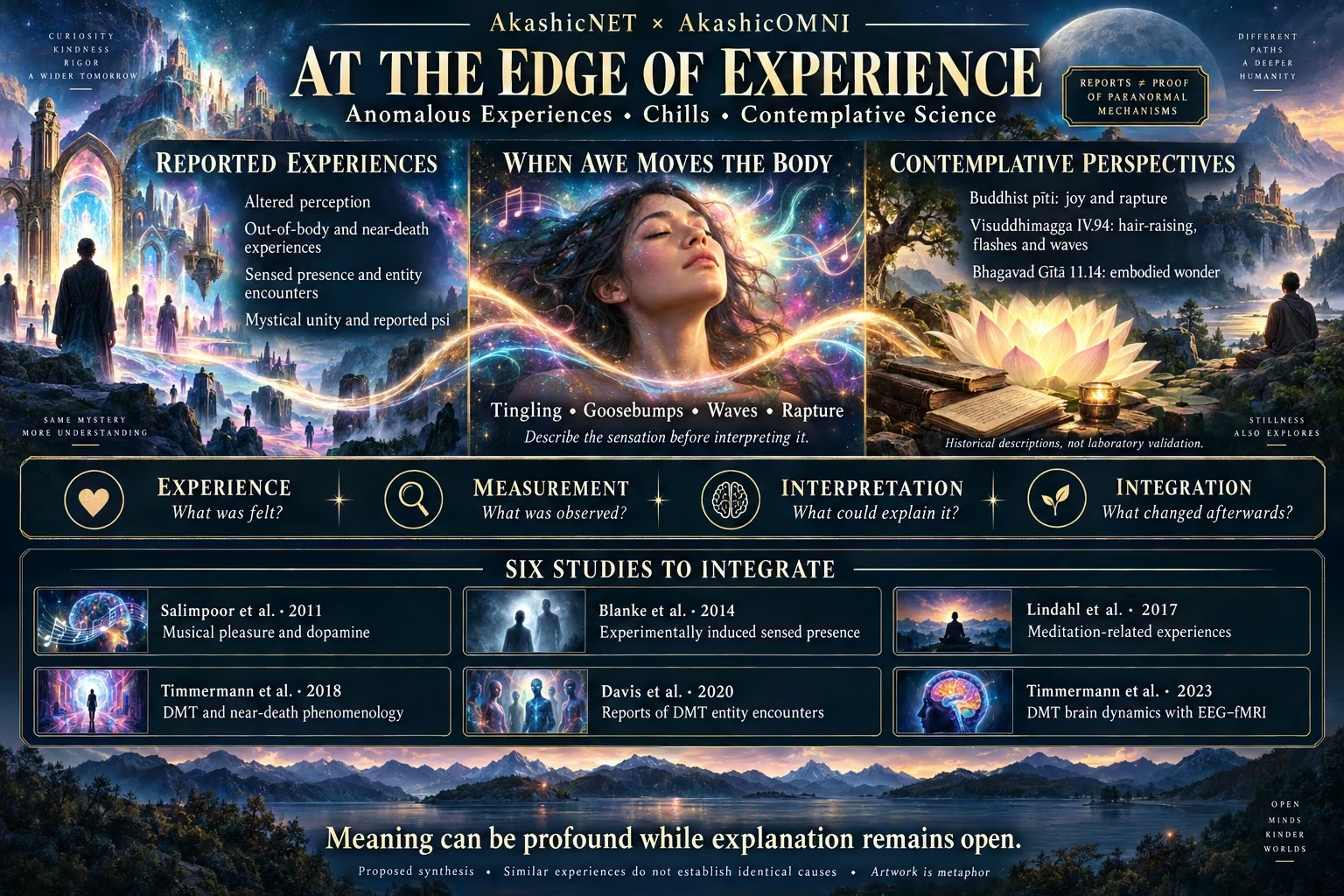
Lived Experience / Interpretation
A compelling experience raises several questions.
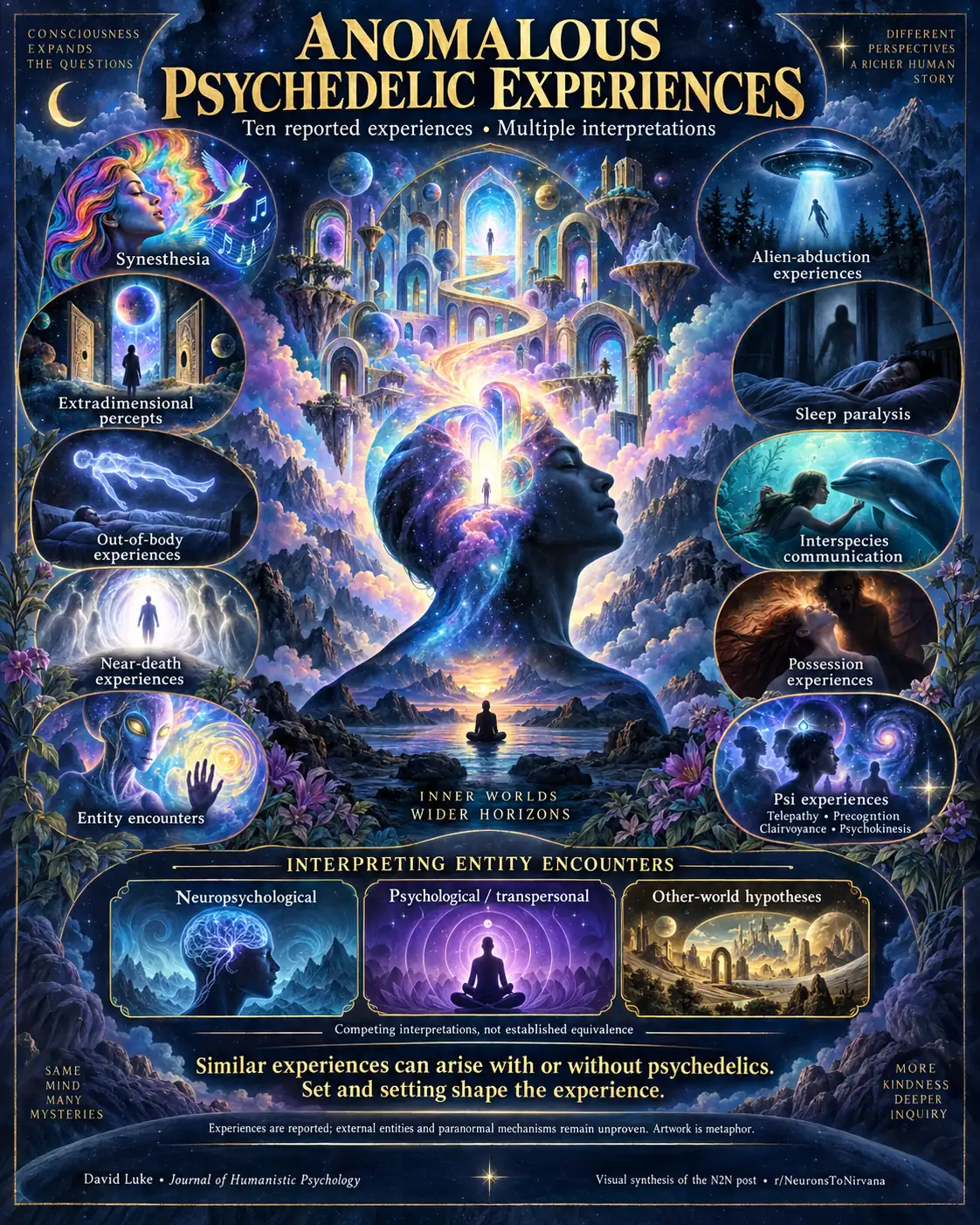
David Luke’s essay (May 2020) on anomalous psychedelic experiences provides the starting point: synesthesia, extradimensional percepts, out-of-body and near-death experiences, entity encounters, alien-abduction experiences, sleep paralysis, interspecies communication, possession and reported psi. The categories overlap, and the essay discusses experiences that can also arise without psychedelics.
Read the original N2N post (23 January 2025), quotations and source link, or explore the ten-experience visual guide.
The felt reality of an encounter, the accuracy of any information it contains and the proposed origin of that information are separable questions. A deeply meaningful event can remain open to several explanations.
Research / Traditional Interpretation
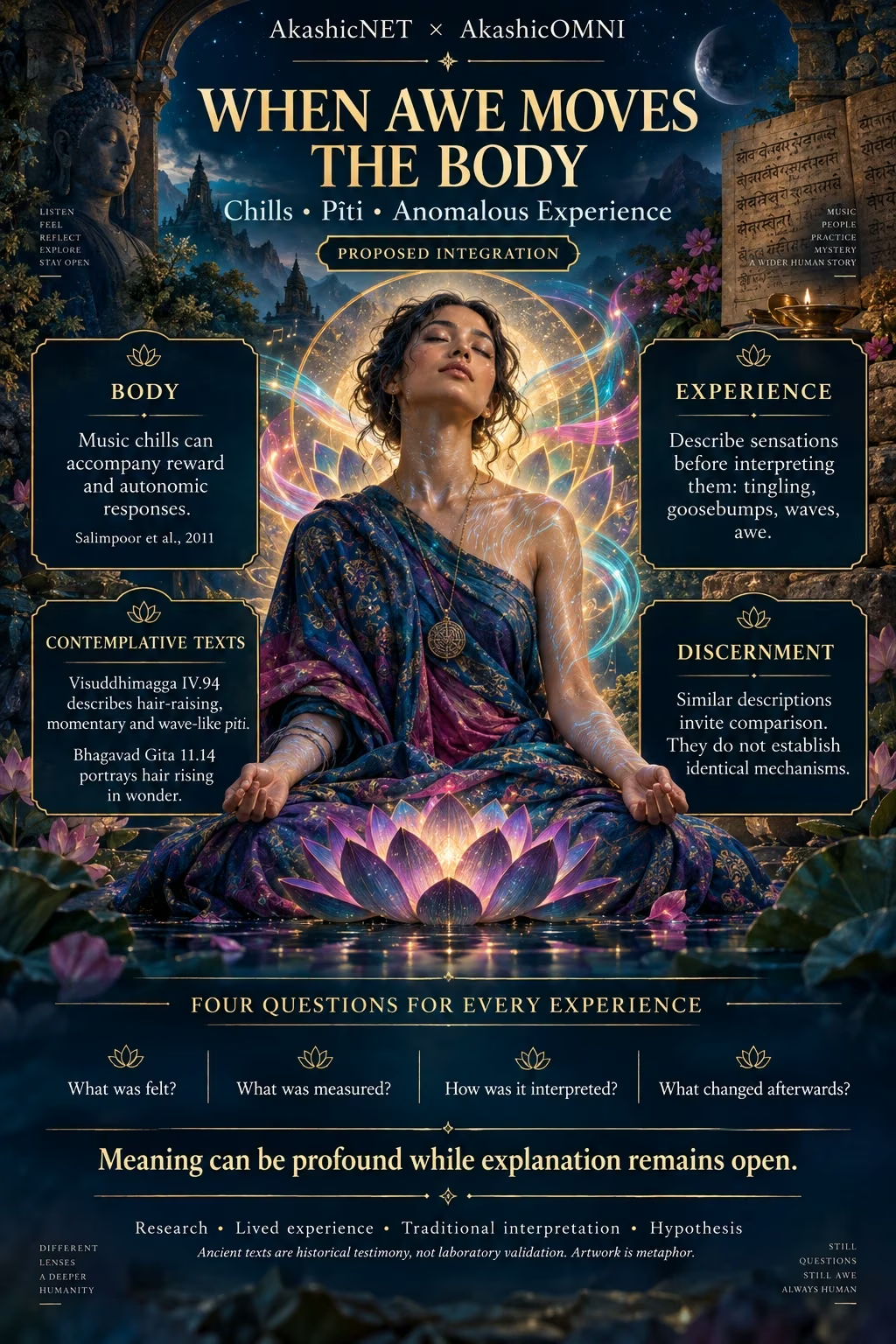
When awe moves the body.
Tingling, goosebumps, shivers and waves of rapture are related descriptions, but they are not interchangeable measurements. For this inquiry, “spiritual science” means bringing disciplined observation of experience into dialogue with testable research.
Salimpoor and colleagues’ music study connects peak pleasure to reward-system activity and dopamine release. It provides a research anchor for musical emotion, not a universal explanation of every spiritual sensation.
Buddhist sources: pīti is broader than goosebumps.
Dīgha Nikāya 2 describes rapture and pleasure pervading the body in jhāna. The later Visuddhimagga, IV.94–98, distinguishes mild hair-raising joy, momentary flashes, waves, uplifting rapture and whole-body pervasion. Translations render pīti as joy, happiness or rapture.
The commentary also includes levitation narratives. Those are traditional accounts, not experimental confirmation of levitation. Its descriptions can inform comparative phenomenology while its causal and supernatural claims remain separate questions.
An ancient portrayal of embodied wonder.
In Bhagavad Gītā 11.14, Arjuna’s hair rises in wonder during the vision of the universal form. This scriptural scene records a religious interpretation of bodily awe; it does not function as a physiological experiment.
Research Reading Guide
Six studies to integrate.
These peer-reviewed papers address different questions. They are a selected starting set, not a systematic review, and not all investigate chills or psi.
Salimpoor et al. · 2011
Musical pleasure and dopamine
Connects peak musical pleasure with dopamine release and distinguishes anticipation from peak emotion.
Limit: It does not establish that every devotional or contemplative chill has the same mechanism.
Anatomically distinct dopamine release during anticipation and experience of peak emotion to music ↗Blanke et al. · 2014
Experimentally induced sensed presence
Sensorimotor manipulation can induce the feeling that another person is nearby.
Limit: This demonstrates one route to sensed presence, not an explanation of every reported encounter.
Neurological and robot-controlled induction of an apparition ↗Lindahl et al. · 2017
Meditation-related experiences
Identifies 59 experiences across seven domains, including bodily, perceptual and sense-of-self changes.
Limit: The sample focused on challenging experiences; it does not estimate prevalence among all meditators.
The varieties of contemplative experience: A mixed-methods study of meditation-related challenges in Western Buddhists ↗Timmermann et al. · 2018
DMT and near-death phenomenology
Finds questionnaire overlap between DMT-induced experiences and features of near-death experiences.
Limit: Phenomenological overlap does not establish identical causes, an endogenous DMT explanation, or survival after death.
DMT Models the Near-Death Experience ↗Davis et al. · 2020
Reports of DMT entity encounters
Describes encounters, emotions, interpretations and changes respondents attribute to their experiences.
Limit: Self-selection and retrospective recall limit inference. Reports of telepathy do not independently demonstrate information transfer.
Survey of entity encounter experiences occasioned by inhaled N,N-dimethyltryptamine: Phenomenology, interpretation, and enduring effects ↗Timmermann et al. · 2023
DMT brain dynamics with EEG–fMRI
Reports altered functional connectivity, reduced alpha power and increased signal diversity in 20 healthy volunteers.
Limit: Different measurements can change in different directions. These findings do not verify access to an external consciousness field.
Human brain effects of DMT assessed via EEG-fMRI ↗The 2023 EEG–fMRI study also helps refine a claim in the older discussion: “less brain activity” is too simple. Reduced alpha power, increased signal diversity and altered connectivity describe different properties. None alone establishes that the brain filters an independently existing field of consciousness.
AkashicOMNI / Proposed Application
Thirteen perspectives, applied to one inquiry.
This is a proposed application of the existing AkashicOMNI perspectives, not a new validated scientific model or a framework-version change.
AWAKEN
Begin with curiosity about the experience.
HIERATIC
Read pīti and devotional imagery in their textual and cultural contexts.
HOMESENSE · Phase 8
Describe bodily sensations and the circumstances in which they arise.
ADAPT
Ask which responses support everyday functioning.
REGENERATE
Consider recovery, relationships and sustained wellbeing.
TRANSCEND
Explore altered perspectives without assuming a final explanation.
METAD
Separate the sensation, the interpretation and awareness of both.
ACTC
Translate insight into accountable and compassionate action.
MultidimensionalCUT · Past
Trace prior expectations, experience and cultural learning.
MultidimensionalCUT · Present
Record what is experienced and what can be measured now.
MultidimensionalCUT · Future
State prospective predictions and possible consequences.
UMASC
Compare bodily, personal and social scales without collapsing them.
AkashicNET Synthesis
Preserve sources, alternatives, uncertainty and practical consequences.
Inquiry In Practice
Observe first. Compare carefully.
A useful record separates four questions: What was felt? What was measured? How was it interpreted? What changed afterwards?
- Experience: note the sensation, location, duration and emotional tone before attaching a causal label.
- Context: record music, meditation, surroundings, sleep and other relevant circumstances. Keep private health details private.
- Comparison: include occasions when the expected sensation did not occur. Look for alternative explanations as well as apparent matches.
- Integration: revisit effects on daily functioning, relationships and wellbeing after the immediate intensity has passed.
A diary can help clarify patterns; it cannot by itself establish telepathy, external entities or a shared physiological mechanism. Any formal study would need suitable controls, consent and independent assessment.
For BQ001, overlap with NDE descriptions does not resolve consciousness survival. For BQ002, a feeling of receiving information does not identify its source. Both remain UNRESOLVED.