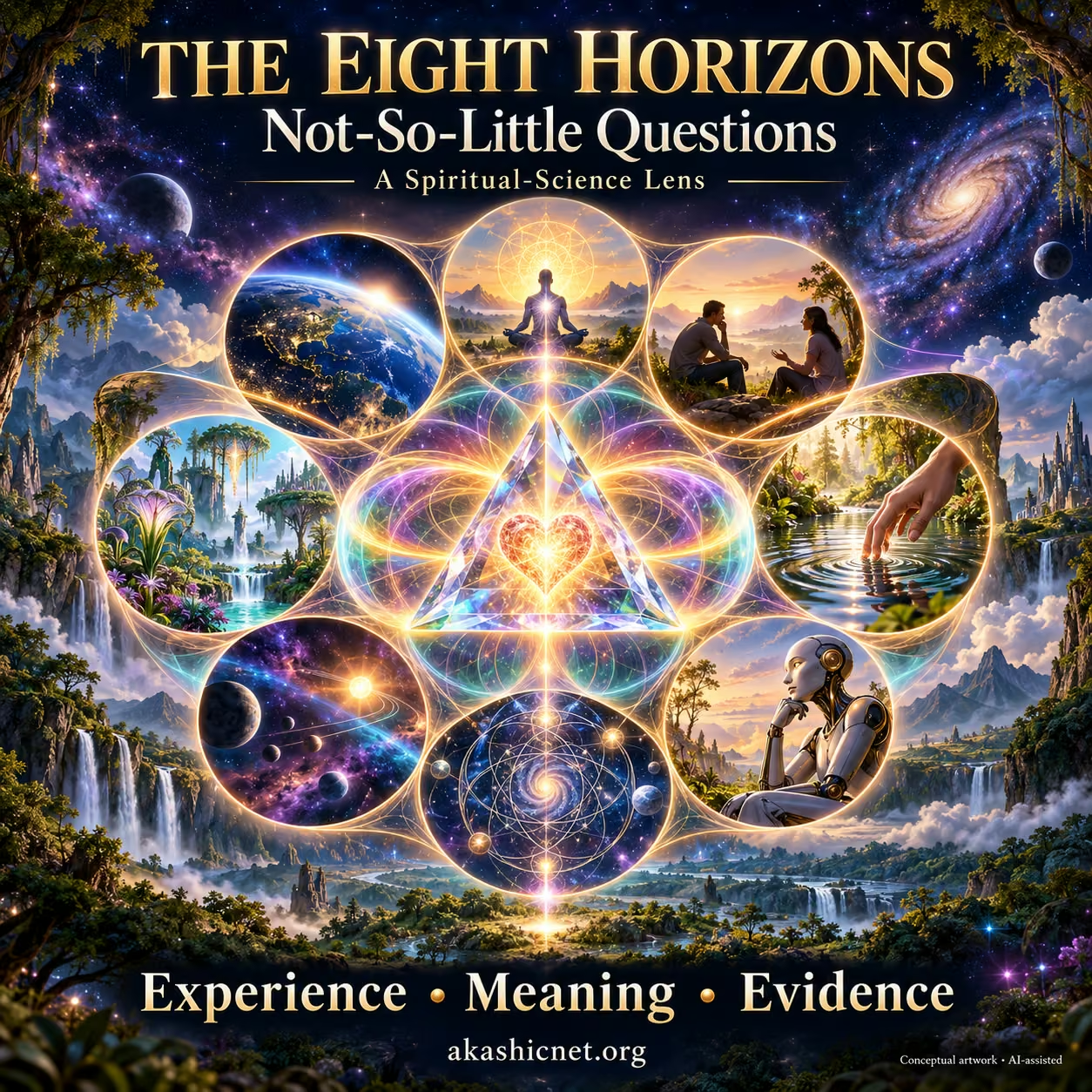
Some discoveries would improve a discipline. Others could reorganise humanity’s understanding of life, mind, responsibility and our place in the cosmos. This page maps the possible scale of that change—without pretending the answers are established.
?
Not-So-Little Questions · H01–H08
The eight Horizons
Eight proposed research horizons within the NSLQ series. These are open questions, not findings or adopted Big Questions.
Experience · Meaning · Evidence. Conceptual artwork · AI-assisted.
Editorial interpretation · 24 September 2026
A spiritual-science lens
Here, spiritual science describes an approach to inquiry: bringing spiritual experience and philosophical reflection into conversation with scientific investigation.
An experience can matter deeply while its explanation remains uncertain. Love can guide how we investigate; evidence helps us assess what we conclude.
Turn the PRISM
Experience
What did I notice, feel or perceive?
Interpretation
What meaning might this hold for me?
Alternatives
What else could explain it?
Evidence
What observation could distinguish those explanations?
Integration
Can this reflection help me live with greater kindness, humility and wisdom?
AI-assisted artistic metaphor · Not a scientific model
Series connection · 24 September 2026
Not-so-little questions. Open horizons.
The eight Horizons, H01–H08, belong to our Not-So-Little Questions editorial series: broad possibilities explored through smaller, clearly scoped questions. Horizons remains the name of this map.
The existing H identifiers, candidate status and BQ references remain intact. The series label does not turn a horizon into an adopted Big Question, a finding or a new framework version.
Horizons exists to turn consequential unknowns into clearer questions, and clearer questions into responsible inquiry. Its purpose is to help people understand life and mind while making better choices for one another and the living world.
Our mission is to connect scientific research, philosophy, contemplative inquiry and lived experience with traceable sources, explicit uncertainty and respect for the people and traditions involved. Each contributes in its own way; their different kinds of knowledge need careful interpretation.
“For the benefit of all beings” is an ethical aspiration. In practice, we ask who benefits, who bears risk, whose voice is missing and what effects extend to other animals, ecosystems and future generations. Benefit must be examined, not presumed.
Awaken within · Serve without. Success includes better questions, corrected mistakes, reduced harm and useful action, even when a profound question remains unanswered.
Long-term direction · Aspirations, not completed programmes
From open horizons to accountable service.
01Build a trustworthy knowledge commonsMaintain source histories, original publication dates, corrections and study-level duplicate checks. Judge progress by traceability and resolved evidence gaps, rather than the number of headlines collected.
02Make questions testableDevelop precise claims, competing explanations and prospective protocols. Seek independent criticism and replication, and publish null or disconfirming findings alongside positive results.
03Turn insight into sustained careThrough BQ011, investigate whether meaningful experiences lead to durable, observable changes in behaviour and collective wellbeing. Distinguish feeling connected from helping others, and helping others from measurable ecological benefit.
04Include people beyond familiar samplesInvite community-led questions and culturally appropriate measures. Seek consent, attribution and reciprocal benefit; cultural knowledge holders retain authority over restricted knowledge. Participation should not depend on adopting a shared metaphysics.
05Develop wisdom alongside capabilityConnect BQ005, BQ006, BQ007 and BQ009 through consent, restraint, equitable access and accountable decisions. Assess technologies by their effects on agency, suffering and relationships as well as performance.
06Keep the future revisableReview priorities as evidence, resources and community needs change. Preserve unresolved questions without promising breakthroughs. Any human or animal study would require appropriate expertise, independent ethics review and resources before recruitment.
Near term: improve sources and formulate bounded questions. Medium term: seek qualified collaborators and independently reviewed protocols. Long term: support reproducible understanding and demonstrated benefit. These are staged objectives, with no promised completion date or claim of an operating research institute.
News into inquiry · Editorial connections
What can this research help us ask next?
01Plant care → BQ011 / BQ007The 2024 plant-care study offers an immediate wellbeing signal. A next question is whether accessible, voluntary care activities sustain wellbeing and helpful behaviour over months, compared with equally engaging alternatives. It did not measure lasting compassion or ecosystem outcomes.
02Cultural inclusion → BQ005 / BQ006The 2026 cultural-sampling study strengthens the case for checking who our measures represent. Do definitions of wisdom and flourishing work across languages, educational backgrounds and communities? Its findings do not rank cultures or verify spiritual claims.
03Medication context → BQ007 / BQ011The 2025 antidepressant–psychedelic review adds newer evidence to the 2022 interaction review. A research implication is to record medication context, changes and adverse outcomes when interpreting experiences. The reviews have different scopes and do not establish that all combinations are safe.
04Expectancy → BQ011 / H03 / H04The 2026 trial-masking viewpoint prompts scrutiny of expectations, information leakage and blinded assessment. These are transferable methods questions; the article provides no evidence for non-sensory information transfer or anomalous mind–matter effects.
05Neural systems → BQ002 / H05Brain-interface research and biological organoid research help clarify the distinctions between decoding, neural activity and subjective experience. Neither demonstrates artificial consciousness. H05 still needs criteria that distinguish experience from convincing performance.
These connections propose questions and methods, not accepted evidential support for the BQs or Horizons. They do not change research-maturity ratings. This selection supplies no direct evidence for H01, H06, H07 or H08, and does not discriminate fundamental or nonlocal consciousness from competing explanations under H02.
Impact is not evidence. Distance is not impossibility.
Existing BQHorizon candidateNumbers show provisional global-impact rank
Interpretive analysis
Four reasons the top cluster matters.
01
Highest existential impact
BQ001 leads because independently verified continuity would change identity, death, grief, medicine and many religious and materialist worldviews at once.
02
Closest global competitor
Verified advanced nonhuman intelligence interacting with Earth would transform science, history, defence and humanity’s understanding of its place in the cosmos.
03
Karma needs layers
Ordinary behavioural and social consequences are not the same as a measurable trans-life causal law. Only the latter occupies the map’s highest-impact region.
04
Methods may move first
Non-sensory information transfer or mind–matter effects could reach laboratory replication before the larger metaphysical questions are resolved.
Largest compound shift
Continuity + reincarnation + measurable karma
If all three were independently established, the result would exceed any one finding. Personal identity could extend beyond one biological life; information might persist or transfer; and intention or action might have measurable consequences across lives. That would affect neuroscience, medicine, ethics, law, education and religious thought.
This is a compound hypothetical—not an AkashicNET conclusion. BQ001 and BQ004 remain unresolved, and no accepted edge currently joins survival, reincarnation and karma into one mechanism.
Admission gates for future BQs
A horizon becomes a question only after governance.
01Define the claimSeparate UAP from NHI, consequence from cosmic karma, and intelligence from consciousness.
02Name competing modelsInclude ordinary, psychological, technological and physical alternatives.
03Specify decisive observationsState what would strengthen, weaken or fail to distinguish each model.
04Build rights-safe provenanceTrace claims to primary sources without treating media repetition as independent evidence.
05Keep status unresolvedOpening a BQ records an inquiry; it does not promote an answer.
MAP: BQ001–BQ010 + EIGHT HORIZONS · BQ011 CONNECTS INQUIRY WITH CARE