

Research Addendum · 21 November 2026
Where the Phase Shows Up
Two qubits can agree every time you measure their bits even after a memory has lost their relative phase. How can the pilot tell? Measure the same pair in a second basis.
AkashicNEXUS² · From Circuit to Infographic
First Pass · Follow the State
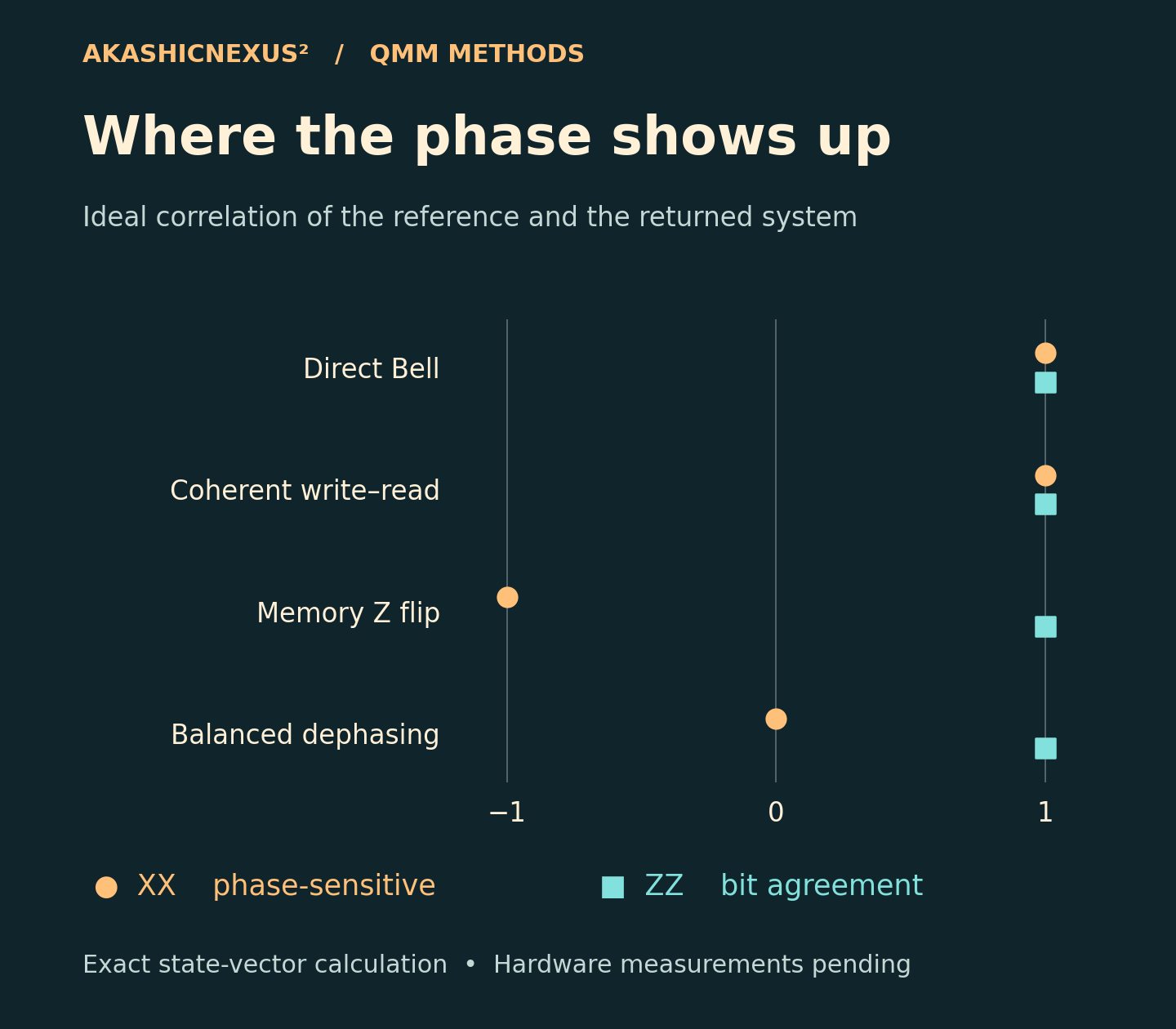
Prepare the reference and system in the Bell state (|00⟩ + |11⟩)/√2. A third qubit, the memory, starts at zero. Swap the system into memory, leave the reference untouched and swap back. In one branch apply Z to the memory between swaps. This changes the plus sign between the two terms to a minus sign. A direct Bell reference skips the memory cycle.
Second Pass · Reconstruct Each Mark
Measure both returned qubits along X in one setting and along Z in another. A correlation is the probability of agreement minus the probability of disagreement. A value of +1 means every pair agrees, −1 means every pair disagrees and zero means the two outcomes balance. The ideal calculation evaluates each observable on the three-qubit state with the memory left unmeasured.
As an algebraic cross-check, XX exchanges |00⟩ and |11⟩. The plus Bell state retains its sign and the minus Bell state reverses sign. ZZ gives +1 on both terms. Mixing the plus and minus states equally cancels XX. ZZ survives. Thus the bottom row is a derived condition from six measurement settings, with no additional shots. Each plotted mark uses the calculated expectation, with no sampling error bars.
Run python qmm-bell-baseline.py with NumPy installed. The script checks the four rows against the analytic values. Download the Calculation.
Why the System Boundary Matters
Between swaps, the original system is at zero and the reference is correlated with the memory. The joint state still predicts the readout under unitary evolution. Following the system alone hides the stored information, so its later behaviour can depend on its earlier preparation. A matched ordinary memory can produce this entire pattern.
AkashicENHANCE² · From Finding to Recheck
The Bronze Edition links each finding to a revision, a reason and a check. Here the first pass revised the pilot around a measurable coherent-transfer baseline. The second challenged the interpretation by asking which outcomes an engineered memory also predicts. The diagram records the status of each claim after those passes.

Further Recommendations
- Freeze the hardware analysis. Before taking shots, record the physical layout, realised interval and both compiled swaps. Interleave settings. For each basis calculate (equal counts − unequal counts) / total counts. Give each branch equal weight in the dephased estimate. Its coherent branch is shared with the intact estimate, so retain that dependence when reporting uncertainty on the contrast.
- Define what would count as successful transfer. Set a minimum XX contrast, a ZZ equivalence margin and a confidence-interval rule before inspecting counts. If calibration drifts or the compiler removes the interval, record the affected block and apply the prespecified repeat rule. Release all raw counts, including failed blocks.
- Make the physical claim falsifiable. Specify an additional coupling and its predicted phase or correlation shift as a function of a geometric variable. To proceed, the design must vary that quantity independently of timing, fields and temperature, quantify ordinary device effects and predict the dependence on a second hardware implementation. A numerical effect size awaits a physical model.
- Keep an independent review record. Give a reviewer masked branch labels and the frozen estimator. Ask them to reconstruct the contrasts before unmasking. Record discrepancies, corrections and the dated rerun in the ledger. Independent reconstruction and hardware results are pending.
Bronze Edition Review Record · AkashicENHANCE Scope and State · Published QMM Circuit Study